
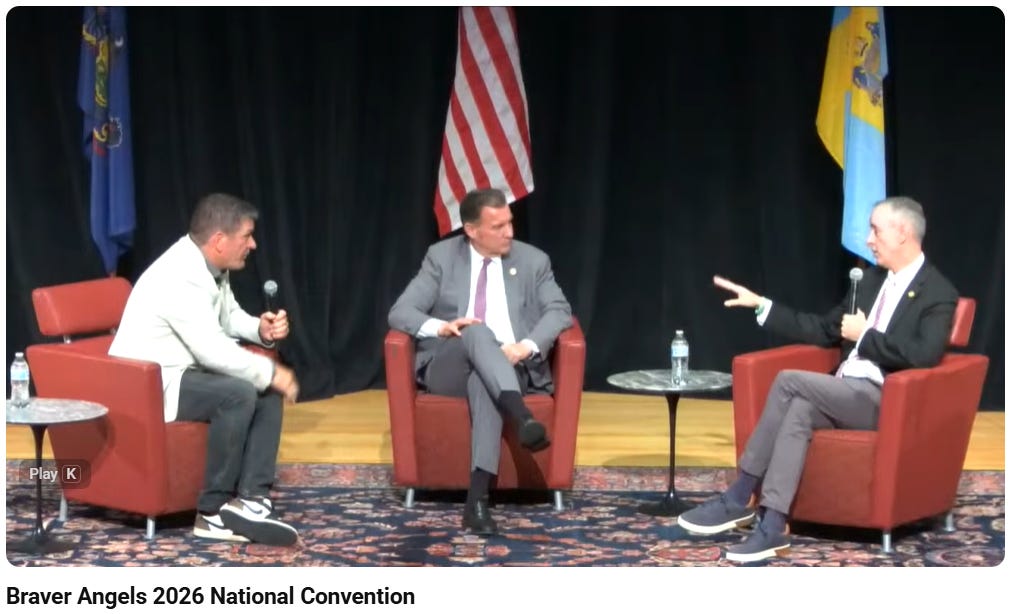
This past weekend (beginning Thursday June 25) Braver Angels held its biannual national convention. Among the highlights of the event was a discussion that the organization’s CEO Maury Giles conducted with the co-chairs of the Congressional Problem Solvers Caucus, Tom Suozzi (D-NY) and Brian Fitzpatrick (R-PA). This edition of Decency and Sense concludes with a full transcript of that conversation. At every participant’s utterance in that transcript is a time stamp hyperlinked to the spot in the Youtube video at which it occurs. By all means, give the discussion a full viewing and/or read. In advance of that, take in some noteworthy moments as I have described them below and then consider important context.
Although the conversation itself lasted about 25 minutes, the full Youtube video runs nearly 12 hours and spans nearly the entire day of convention activity. This conversation began shortly before the seven hour mark, and the first question that Giles posed to the guests was about their reason for joining and leading the Problem Solvers Caucus. Rep. Fitzpatrick suggested that one ought to “view diversity of thought as a strength to be harnessed, not a weakness to be criticized” and that government works best when those of different political orientations form relationships in which they are “seeing the world through the other’s eyes and meeting them in the middle.” Rep. Suozzi asserted that the only way to get anything worthwhile done in a tightly divided and highly polarized Congress is to engage in a bipartisan way. He referenced as an example the 21st Century ROAD to Housing Act (which the president had committed to sign on June 24 before he reneged shortly before the ceremony, as Reps. Fitzpatrick and Suozzi discussed in a joint NPR interview).
Rep. Suozzi next spoke of how gerrymandering and partisan sorting produce overwhelmingly “safe” Congressional districts for one party or the other, and that as a result most representatives give short shrift to the outlooks and concerns of colleagues and members of the electorate from the other party – a dynamic that is not true for him or for Rep. Fitzpatrick, both of whom represent competitive districts.
Rep. Fitzpatrick advocated for term limits and greater turnover among elected representatives, which would better incentivize representatives to make decisions with an eye toward legacy rather than reelection. Rep. Suozzi argued eloquently that “what we need in our country is people of good faith, of good will” to come together in pursuit of harmonious solutions rather than attack one another, and Rep. Fitzpatrick spoke similarly here.
Rep. Suozzi spoke of the Hidden Tribes study and shared that while the ideological extremes in the country are rather small, “the biggest group, which is killing us, is the 52 percent of Americans that is the politically disenchanted and the politically disengaged.” He went on to praise the efforts of the Braver Angels community for getting involved and getting educated and for “doing the essential work that the founders envisioned for our nation.” Rep. Fitzpatrick also invoked a founder. Much as I did in a June 14 post, Fitzpatrick spoke of the warning that President George Washington issued in his Farewell Address that “the greatest threat to this brand-new system would be internal division” arising from political parties, which Washington called factions.
I strongly support the work of Braver Angels. I find much truth in the observations that Reps. Fitzpatrick and Suozzi shared. It is urgent that we lessen partisan and ideological animus and promote a spirit of comity and collegiality, not only among our public servants but in society at large.
All of that said, I take this opportunity to again emphasize that the greatest danger to the survival and success of liberty in the United States lies not in the fact that the two major parties compete for control. As Rep. Suozzi noted, one can view them as both striving for that power because members of each tell themselves that their approach to promoting the general welfare is the right one and “so we want to get in power so we can do the right thing.” Suozzi averred that “arguably there’s a noble intent behind it.”
There is a far darker reality at play.
For the far foreseeable future, it will remain appropriate to speak of the October 2021 Open Letter in Defense of Democracy. Published simultaneously in the left-leaning The New Republic and the right-leaning The Bulwark, the letter shared that among its three authors and their 48 cosigners, “[s]ome identify with the left, some with the right, and some with neither,” and that they were united in their concern that “liberal democracy itself is in serious danger.” Here is how the letter explained it:
The primary source of this danger is one of our two major national parties, the Republican Party, which remains under the sway of Donald Trump and Trumpist authoritarianism. Unimpeded by Trump’s defeat in 2020 and unfazed by the January 6 insurrection, Trump and his supporters actively work to exploit anxieties and prejudices, to promote reckless hostility to the truth and to Americans who disagree with them, and to discredit the very practice of free and fair elections in which winners and losers respect the peaceful transfer of power.
Nine months after the January 6 attack, the letter writers voiced their concern over the dismal fact that the Republican party had welcomed back and was elevating the former president, who had schemed to overturn the rightful result of the 2020 election and had both encouraged and declined to put an end to a violent attack upon the Capitol, the purpose of which was to prevent Congress from officially certifying Joe Biden’s victory. Seventeen months into this same president’s current term, we witness an onslaught of actions to subvert the 2026 midterm elections. One of these is the SAVE America Act – the very legislation for which the president sought to hold the ROAD to Housing Act hostage.
Retired Judge J. Michael Luttig was a leading light of the conservative legal movement. He clerked for judge (later Justice) Antonin Scalia and for Justice Warren Burger, served as an associate in the Office of White House Counsel for President Ronald Reagan, served in the Justice Department of President George H.W. Bush and later received from President Bush appointment to a federal judgeship. He also was on President George W. Bush’s short list for nomination to the Supreme Court. In the runup to January 6, Judge Luttig answered Vice President Pence’s call for advice in the face of pressure from the White House that Pence agree to reject certification of Joe Biden’s victory in the 2020 election. Judge Luttig persuaded Vice President Pence that it would be unconstitutional and wrong for him to take that action.
This past February, Judge Luttig received honorary membership in the New York City Bar Association. He titled his acceptance speech “America’s Time of Testing Has Come.” It bears a full reading, including the endnotes. Below, in conclusion of this essay, are brief excerpts. Consider while reading them the role of a patriotic citizenry in rising above habitual partisan allegiances and as well the urgency of making common cause with all people, whatever their policy leanings, who truly adhere to the vision of ordered liberty that resides in the Declaration of Independence and the Constitution.
Since its very Founding, America has been the envy of the world and the beacon of freedom and liberty because of the shining light of its Democracy and its Rule of Law. But today, as we celebrate the 250th Anniversary of America’s birth, America is not that same envy to the world and not that same beacon of freedom and liberty to the world that it has been since its beginning.
We pray that tomorrow America will once again assume its deserved place as the envy of the world.
January 6, 2021, was a dark day in American history. On that day, the 45th President of the United States instigated a war on America’s Democracy and forced upon this nation an unpeaceful transfer of power for the first time in almost 250 years. From that day until this day, he has persisted in the prosecution of that war, presenting himself to America and to the world as a “clear and present danger to American Democracy.”
Four years later, on January 20, 2025, the same man, the 47th President of the United States and now wannabe king, declared war on the Constitution, the Rule of Law, and the nation’s Federal Judiciary.
[...]
The Founders believed that were such a demagogue ever to come into power in America, he would, having once been elected “and at a second or third election outvoted by one or two votes, pretend false votes, foul play, and hold possession of the reins of government.”5
The Founders of this, the greatest nation on earth and the greatest experiment in self-government in all of civilization, feared this man who has waged these wars on America’s Democracy and Rule of Law, and they feared these times. They believed these times would mark the end of the nation they had founded. Alexander Hamilton writing to George Washington in 1792:
Those then, who resist a confirmation of public order, are the true Artificers of monarchy . . . When a man unprincipled in private life desperate in his fortune, bold in his temper, possessed of considerable talents, having the advantage of military habits—despotic in his ordinary demeanour—known to have scoffed in private at the principles of liberty—when such a man is seen to mount the hobby horse of popularity—to join in the cry of danger to liberty—to take every opportunity of embarrassing the General Government & bringing it under suspicion—to flatter and fall in with all the non sense of the zealots of the day—It may justly be suspected that his object is to throw things into confusion that he may “ride the storm and direct the whirlwind.”
[...]
We must, finally, summon the courage that has eluded us in our all-consuming fear. Americans must summon from deep within the courage that was once our Founders’ courage when, “with a firm reliance on the protection of divine Providence, they mutually pledged to each other their Lives, their Fortunes and their sacred Honor.”9
[...]
If we but find the courage to speak truth to power now, today, as did the Founders and our ancestors when their time of testing came, the United States of America will endure forever as the beacon of freedom and liberty to the world. America will once again be the envy of the world.
TRANSCRIPT OF JUNE 26 GUIDED DISCUSSION AMONG BRAVER ANGELS CEO MAURY GILES, REP. TOM SUOZZI, AND REP. BRIAN FITZPATRICK
MAURY GILES [6:55:41]
In case you didn’t know already, we have a Republican and a Democrat who are talking together.
REP. SUOZZI [6:55:48]
You’re a Republican?
MAURY GILES [6:55:50]
But I think as, Brian, as you like to say, “What about we just be Congressmen?” Now tell me, you decided to take on leadership of something called the Problem Solvers Caucus. That’s such a counterculture play. Why do it and why does it matter?
REP. FITZPATRICK [6:56:10]
Me? Well thanks for having us. Good to see everybody. Why do it? I think there is a lot to that question. But I think the simplest way to answer it is if you truly believe that everybody comes to the table with different experiences, different perspectives based on the experiences they’ve had in life, based on their upbringing, the household they grew up in, where they were educated, life experiences, struggles with pain or whatever that have changed their perspective on things, that when you come to the table, you come there cognizantly knowing that you are the product of your own upbringing. And that people come to the table with different perspectives based on their life experiences. And if you want to learn from them, then you view diversity of thought as a strength to be harnessed, not a weakness to be criticized.
You realize that people check different boxes on the voter registration form when they’re 18 years old or thereafter, for a whole host of different reasons, if you believe that no one party has a monopoly on good ideas and that no one party has a monopoly on good people, if you truly believe that and you believe that diversity of thought is a strength, then you naturally want to gravitate towards a two-party group. And that’s what we are. We try to see the world through the other’s lives. Every successful relationship we have in our lives involves seeing the world through the other’s eyes and meeting them in the middle. Every single functional, healthy relationship in our lives. Government should be no different. That’s really what gravitated me towards this caucus.
MAURY GILES [6:57:51]
Thank you.
Tom, what about you?
We have something that sometimes is criticized coming to our convention – those watching might not know there are conservatives and progressives in the audience. And we have that same requirement in our leadership. You gotta have somebody who’s conservative and someone who’s progressive. For you, you have that same requirement for the Problem Solvers Caucus. But why do this, and why do it now? Why is it so important?
REP. SUOZZI [6:58:16]
First of all, let me just say how great you all are that you’re spending your time doing this. We need you in our country, so let’s just give yourselves a round of applause. Thank you for what you’re doing, we really appreciate it. Brian and I were talking about it before. We’re very grateful to you for what you’re doing. Maury, you’re okay too.
The reason to do this is because these jobs in Congress are really not worth it if you’re not getting something done. It’s not worth getting elected to be a member of the United States Congress if you’re not accomplishing anything. And the only real way to accomplish things is to – especially in this very tight majority environment, which is just separated by a couple of votes, and this very fractured media environment and people pandering to their political base and social media and cable news, and our foreign adversaries trying to blow us up and get us to hate each other – it’s not worth it do these jobs unless you’re working with other people to actually get things done. And to get things done, you have to be bipartisan in this environment. And Brian will be the first to tell you that the only time you get something really good done – like we just got this housing bill done in Congress that the president hopefully will sign soon was only because it was bipartisan and a bunch of bills that we worked on through the Problem Solvers are part of that bill. So, we’re doing it because you have to do it and because it is the only way to get stuff done.
MAURY GILES [6:59:53]
You know, but you have to get – the beauty of our system with the different branches of government is there is this one branch, the people’s branch, that’s gotta be every two years. So you gotta get elected. I don’t know if everybody knows this, but some people may assume, “Oh, they’re doing this because you are in a safe district. You don’t have any challenging race ahead.” That’s not true for either one of you. Talk about the courage and the line of compromise that you might be pushed on a regular basis. Because the incentives would tell you to do something otherwise. How do you do that and keep getting elected?
REP. SUOZZI [7:00:22]
People have to know that there’s 435 seats in Congress, and of the 435 seats in Congress, 400 seats are safe seats, you can’t lose. 200 Republican seats, 200 Democratic seats are gerrymandered – redistricting is one of our big focuses right now – are safe seats. 200 Republicans are gonna win the Republican seats, 200 Democrats are gonna win the Democratic seats. There’s only about 35 competitive seats and that number is going down as far as competitive seats because they’re playing all these games with redistricting all over the country trying to create more safe seats. When you’re in a safe seat, you have really no incentive of what you think is the right thing to do, to listen to the people, because the only way you’re going to lose a race is by losing a primary, and nobody votes in the primaries. Often it’s the base, far right of the Republicans, the base, far left of the Democrats. So the Democrats pander to the left, Republicans pander to the right, and the people are left out. And that’s what’s killing our country. Our seats are not safe seats. I’m a Democrat and Donald Trump won my seat by 19,000 votes. Brian’s a Republican, Kamala Harris won his seat. We have to talk to everybody. I’ve gotta get a large majority of the Democrats to vote for me, the majority of independents to vote for me. I’ve gotta get some Republicans to vote for me too, or I’m not gonna win.
MAURY GILES [7:01:37]
So the incentives in your districts themselves are creating that healthy dynamic.
REP. SUOZZI [7:01:42]
Yeah. And it’s better for America. We need more competitive seats. We need more politicians listening to the people.
MAURY GILES [7:01:50]
You know, Brian, you’ve done a good job not being in the news at all, not taking any hits recently. Those who know, know what I mean. How are you dealing with that with such consistency. In the face of…
REP. FITZPATRICK [7:02:07]
Well, let’s start: I’m a believer in term limits, and I think… number one, I believe in it because I think it’s a good thing for our country. I think it makes sense for the presidency. The 22nd amendment passed, which imposed term limits for the presidency. I think that should be the case throughout Congress, and the courts for that matter. I believe in turnover, it’s a good thing for our country. But if you start with that belief, if you start with the belief that service in elected office should be temporary public service, not a career, if that’s what you believe, then everything that follows, I think, is much more consistent with what you’re talking about. You can’t worry about elections, you cannot. Any job that any of you have, if your job…if you went to your work every day not feeling free to do what’s right because you were afraid of losing your job, you would be terrible at it. That’s no way to go about doing your job. So if you believe in term limits, if you believe that it’s temporary public service and that you care more about legacy than you do about reelection, which I would hope is the case for everybody because if you don’t, you’re going to regret it when you get older. You will. Everything flows from that.
So I don’t think it involves courage. I don’t think standing up for what you believe in, speaking your mind, representing your district, who are your bosses, because when this is all said and done, these are our neighbors. These are the people who are gonna live side by side with for the rest of our lives and you have to stick with them. Not stick with the speaker of the president or any leader of any party. Stick with your people back home. That’s the way our system of government works.
MAURY GILES [7:03:49]
You bring your point of view to the table and represent that. And we envision an America where that thing I was telling you that we call courageous citizenship becomes the norm. It doesn’t feel as if it’s that way now. Now, Tom, back in October, you participated in a constituent conversation with six reds, six blues from your district – I think you saw some of them again tonight – on our immigration work. And they don’t…their different parties, their voting different ways. Can you talk about what that experience was like to be able to sit down for that period of time and listen to them and have it not be a town hall situation with tomatoes being thrown and other things like this?
REP. SUOZZI [7:04:28]
Yeah, this is, I am so – I admire this group so much because it’s not about, you know, proving “I’m gonna get, you’re wrong, I’m right, I’m going to prove this!” It’s, “How can we find some common ground?” ‘Cause the only…every problem in America, every single problem, I don’t care what the issue is, is complicated. Anybody who says “Why don’t you just” doesn’t know what they’re talking about. There’s no “Why don’t you just.” So what we need in our country is people of good faith, of good will, who are willing to sit down and say, “Well, I think this.” And I say, “Well, I think that.” “Well how about this?” “How about that?” And you try to work together to find common ground. You cannot solve a complicated problem with everybody saying “You’re a bum!” “No, you’re no good!” “You’re one of those!” You never get to the topics because you just spend so much time in the fight that you never actually hear what anybody’s saying and you never actually work to find some reasonable, thoughtful way to move forward.
And the whole thing that is going on in our country right now with those safe seats I was talking about before, politicians pandering to their base, social media rewarding extremism – the crazier stuff you say, the more likes you get, the more followers you get, the more small dollar donations you get. Cable news, living these alternative universes, not to inform us but to inflame us so that they can sell advertising. And finally, our foreign adversaries –the Chinese Communist Party, the Russians, North Korea, Iran – filling our social media feeds with messages just to get us to say, “What’s wrong with them?” “What’s wrong with you?” “I don’t recognize my country anymore!” And they want us to divide ourselves from within, because they can’t beat us militarily, they can’t beat us economically, they want to divide us on what they think our biggest weakness is: our diversity, and our freedom.
MAURY GILES [7:06:21]
You know, Brian, your district’s Bucks County, just outside of where we’re at, right, and I know that we’re working to have a constituent conversation with your constituents as well. What advice would you give to volunteers in this work, trying to then come forward, find that common ground and bring it to their elected official? What advice would you give to them?
REP. FITZPATRICK [7:06:46]
Engagement, civility, diplomacy. You know, we have…all of us deal with protesters and certainly we celebrate that right. This is America. The most effective way to communicate is to do exactly what you’re doing. And I said this in the room in the back before, this organization, more than any other we deal with – it’s so striking to me and it warms my heart that you’re people of different backgrounds and perspectives, but you’re trying to see the world through the other’s eyes. You’re so respectful to each other. You want to find a way to get to yes and to figure out the best respectful path to get there. That’s the best advice I can give you is keep doing that. You know, don’t be a saber rattler, don’t engage in this red versus blue, Hatfield versus McCoy nonsense, where “I’m right and you’re wrong and, you know, if you don’t agree with me a hundred percent of the time, you’re stupid and a bad person.”
That’s how a lot of people engage in their dialogue, and it just doesn’t work. It doesn’t work in our marriages, it doesn’t work in our businesses, it doesn’t work anywhere, because it’s not normal. It’s not healthy. And it shouldn’t be the case in our government either. So the best advice I could give is take your perspective and spread it. Spread it to all corners of this country. Build organizations in all 435 congressional districts in this country. Get to know the members’ staff. Get to know the members themselves. Facilitate conversations. The best thing you can do. You know, Tom started, I want to reiterate: You people really give us hope, you really do. Because this kind of civil, healthy, respectful dialogue – if we could just clone and replicate you all and spread you throughout America, our country would be able to solve so many more problems.
REP. SUOZZI [7:08:27]
Can I say one thing?
MAURY GILES [7:08:32]
Please.
REP. SUOZZI [7:08:32]
There’s a study that’s in my head, it’s back from like 2017 but it’s been updated. I just haven’t read the report, but it was called Hidden Tribes. And it talks about how the far left of America – which is often younger, secular, unhappy with the history of our country – is like eight percent of the country. And the far, far right of the country – which is another six or eight percent, which is, you know, anti-this, anti-that, a little bit of hard edge, angry type of folks – it’s a very small piece of our country. Then you have traditional liberals, progressives. Then you have traditional conservatives. But the biggest group, which is killing us, is the 52 percent of Americans that is the politically disenchanted and the politically disengaged. “The whole thing stinks! It’s all rigged! It’s all broken!” And a lot of the populists are out there saying, “I know you’re unhappy with your country. I know your lot in life is no good. Let’s blow the whole thing up.”
And that’s working! It’s appealing to people. And to solve the problem requires this hard work. This democracy, the founders were concerned that the public would not be involved. That the public would not be educated. Would not do the work necessary to move our country forward. And you are doing the essential work that the founders envisioned for our nation. Because if we leave it just up to the parties, the parties are gonna fight for the parties. They’re gonna look out for the parties’ interests as opposed to the country’s interests. We need the people, and you are the people, that we need to make our country better.
MAURY GILES [7:10:08]
We’ll come back to the parties thing in a second. The issue we’re talking about tonight is our Citizens Commission on Immigration, because our body voted a few years ago that that was the issue we wanted to take on. And when people come into these common ground workshops, they come in oftentimes thinking, “Oh, wow – this person’s gonna think different from me.” And then they leave and they go, “Wow, we agreed on a lot!” What’s the practical reality in the body of Congress that you’re facing? How are you finding common ground on immigration?
REP. FITZPATRICK [7:10:41]
So it’s interesting, immigration, which divides so many people, really unites Tom and I. He comes to the table with incredible passion on this issue. He and I are both, you know, descendants of Irish immigrants through Ellis Island. We both believe in the same things. We believe that we’re a nation of rule of law and we’re a nation of immigrants. Not one, but both, Both are true. And it is that perspective that allowed us to become in a very short period of time the world’s military, economic superpower, the world’s currency standard is because of that perspective, that we were the place that everybody wanted to come to.
And we’re still the place that everybody wants to come to, despite all of our challenges. It’s actually the biggest advantage we have over our adversaries. You know, China, Russia, to name two, have massive demographic challenges on the horizon because they have an aging population, they have a low birthrate, and nobody wants to move there. We have a potentially endless labor supply to attract the best and brightest, invite the people in who are seeking a better way of life. That’s how so many of us got here. Unless you’re a native American, you are an immigrant to this country. The only question is how many generations back and what part of the world can you trace it to.
MAURY GILES [7:12:01]
So tell me then – because I totally get that, and you did a couple of things that our folks will recognize. You brought in the human story of knowing each other’s roots.
REP. SUOZZI [7:12:10]
He only brings up the Irish part about me. My father was born in Italy, I want to point out.
MAURY GILES [7:12:15]
Never would’ve guessed that. But how do you go to the member of Congress – because we ask our folks on a regular basis, go to the person you believe has a very different point of view. How can we have hope in your ability to go to that member of Congress that doesn’t have that, at least at the surface, that perceived same common ground?
REP. SUOZZI [7:12:39]
One of the great things about politics for me, and I’ve been doing it for longer than Brian – I was mayor in my hometown, I was the county executive, I was in Congress – I’ve had a lot of ups and downs along the way. But one great thing about politics is I’ve met every single type of person you can imagine and I don’t care what your ethnic background is, your religion or no religion, any factor about you. We all want the same stuff. Who loves me? Who doesn’t love me? What’s right? What’s wrong? How am I going to pay my bills? How am I going to raise my family? And the stuff that divides us is so minuscule. And there are people that are incentivized, whether they are foreign adversaries or people trying to make money or people trying to get political advantage, that are trying to exacerbate those differences whenever they can. And you guys have found, just by hanging out with each other, like, “Wow, I disagree with them on this, this and that, but they seem nice, reasonable people!” And that’s what everybody is. I mean, there is some jerks in the world.
MAURY GILES [7:13:44]
Are you able to do that with other members of Congress?
REP. SUOZZI [7:13:48]
Yes, we do that in the Problem Solvers, I do workout classes. I’m on the baseball team, I go to the prayer breakfast. Whenever I get an opportunity to spend time with other members on both my party or the other party, you gotta build relationships, very important part of the business. And it’s very hard in this current environment. It’s very hard, it’s so toxic, oppressive coming down from above.
MAURY GILES [7:14:10]
So, I know one thing you disagree on or have a different point of view on the solution is the role of parties. Brian, you’ve been pretty vocal about your perspective on that. And, one minute on your point of view on that, and then Tom, one minute on your point of view, and then I’m gonna ask a follow-up.
REP. FITZPATRICK [7:14:27]
So you’re in the city of independence, 1776. The signers of the Declaration, a very, very brave move. No political parties. 11 years later, the signing and the drafting of the Constitution occurred also in this city. There were no political parties. By the way, from the very, very beginning to the end, the Constitution, the document that created the greatest country the world has ever seen, beginning to the end of the Constitution, the document that created the greatest country the world has ever seen, beginning to end, four months. They had different interests. They had big states that had divergent interests with small states. You had agricultural states, and industrial states. But they were all Americans, and they came together and they said let’s figure this out.
When George Washington ran for president in 1788, he ran as an independent. There were no political parties. When he ran for reelection in 1792, there were no political parties. And it wasn’t until the end of his second term when Alexander Hamilton started the Federalist party, stronger federal…centralized government, closer ties to Britain. Thomas Jefferson started the Democratic-Republican party, that’s what it was called: states rights, closer ties to France. And General Washington, President Washington, dedicated a section of his Farewell Address, 1796, to say this is a problem. We did not envision this when we signed the Declaration, we did not envision it when we drafted the Constitution. He referred to it as factions, because he said that the key ingredient to the success of this brand-new country and this brand-new system of government that we formed was internal unity against a common external threat, and that the greatest threat to this brand-new system would be internal division that was fermented by our external enemies. And here we are, right?
MAURY GILES [7:16:14]
So I want to do something now, Tom. One minute to express your point of view. Brian, I want you to find one thing that you agree with what he says on common ground –
REP. FITZPATRICK [7:16:24]
I knew you were going to ask me that.
MAURY GILES [7:16:25]
One minute
REP. SUOZZI [7:16:30]
Listen, I don’t disagree with anything he’s saying as far as – that’s what Washington said. And it is a problem that the parties have gotten so powerful. I don’t think it is realistic to say we are going to get rid of the parties. But the parties have become too powerful and there’s too much – we have seen – I could tell you a long story but I’ll use up my minute – but the leadership of both sides is always trying to make sure they get the leadership. That’s their big goal. And if you want to put it in a noble perspective, it’s we think we’re right and they’re wrong, so we want to get in power so we can do the right thing. So arguably there’s a noble intent behind it. But when you’re just fighting to win and get the power, you’re leaving behind the people in the process. And you’re leaving behind getting things done that would be good for the country.
So my belief is that we have to reform the... Like, I don’t think the answer is term limits. I disagree with that idea. But I think that both these problems of the parties and term limits can be solved the same way. If the people were voting and involved and engaged, they’d throw the bums out. They would throw out the people that are no good and are not doing their job and hold them accountable. And that’s why this whole thing of everybody pandering to their base ‘cause they’re in these safe seats is the fundamental problem in our country of people just worried about pleasing their base – the base, the base, the base and not pleasing the people.
REP. FITZGERALD [7:17:57]
If I can interject, there is an area that Tom and I really agree on, which is key to this whole discussion, which is making sure that every American citizen has the right to vote in every taxpayer-funded election, whether you are – so there are a number of states in this country that are quote-unquote “closed primary” states. Meaning – both of our states – that if you dare to register independent, that you are told you are not welcome to vote in half of elections. Think about this for a second: you could be a 98-99-year-old World War II veteran who stormed the beaches of Normandy, saved civilization. Comes back home. Registers independent in the land of independence that we’re celebrating 250 years of, and in close to half the states in this country, you’re told you are not welcome to vote in one out of every two elections. Tom and I believe that is a grave injustice, that it’s wrong. We have legislation to fix it.
And by the way, not only – if I can just finish – Not only would it correct a grave injustice, but it would be a seachange effect on the floor of the House because the people from closed primary states that are in gerrymandered districts – we call them the vote no/hope yes crowd – they go to the floor knowing what the right thing to do is, but they’re afraid to do the right thing because they’re worried about not 100% of their district. They’re worried about 18% of their district. They’re worried about the 18% of Americans who vote in primaries in a closed primary system. If we can fix that, I’m telling you many good things would flow from that.
MAURY GILES [7:19:32]
Thank you so much. To all of you, thank you. They need our support, but in your own district. Your members need the support to find the people that will live this way. Thank you so much.
No posts
Comments
Nothing yet. Say the first thing.
Sign in to join the conversation.