

A parent told me her son’s teacher suggested she look into dysgraphia because he avoided handwriting. Additionally, she wrote this:
My son’s teacher has raised challenges with poor handwriting and creative writing (idea development and planning) so we are thinking of ways to provide positive support especially in light of him being younger [than current classmates due to a grade skip]. Possibly exploring dysgraphia.

It’s true there are ways to support children who struggle with writing. But let me say a little something about the idea of “dysgraphia.” It’s not that I don’t think it sometimes exists, and I’ve given you information at the end of this post about dyslexia, it is not a “2e issue” (twice exceptional with being gifted and having a disability). In fact, it’s quite common for almost any boy, even gifted boys. More boys than girls do not enjoy writing, especially when they are young. First, they do not, as a group, have the same early dexterity as girls have but that difference usually dissipates with physical maturing.
In many cases, boys do have enough dexterity and they prove it with their Legos, right? They may be stopped by not knowing what to write. Many reluctant writers eventually learn the power of the pen for persuasion and the necessity of “showing their work” as they grow older and in more advanced instructional environments.
If you’re worried about his writing at this young age, I suggest you have him copy one small sentence every day to make sure he’s training his eyes and hands to write. But do that for sure!
Keyboarding is a second option but don’t excuse him from the one handwritten sentence a day. It can be a different sentence every day, by the way, and keep it to 10 words or less for at least the next year. Allow him to work ahead if he asks about that, too. Make enough sentences for him to copy that he does ask to work ahead just to be done with it! It’s great fodder for showing him he really can do it. If he works ahead, he’ll gain more time for Legos and video games, right?
Or, if you give them the open-ended option of creating whatever they want, it is pure torture for you both! I was always at a loss when the assignment wasn’t specific in my younger years.
When I taught middle school students, I required a daily writing assignment and gave the students a pile of “story starters” to give them ideas. I rarely did “whole class” instruction. I’d assign a task to the entire group, explain it (when it was new to them), and then I remained available to work one-on-one with them.
It’s something tangible to look at, a photo or something cut from a magazine. Or you can print out a photo from the internet to use as the story starter. Some children will simply write a few sentences to describe what they see. If they can’t even do that, don’t worry. They’re looking for guidance. Ask them what they see in the story starter page and have them tell you about it. Here’s an example:
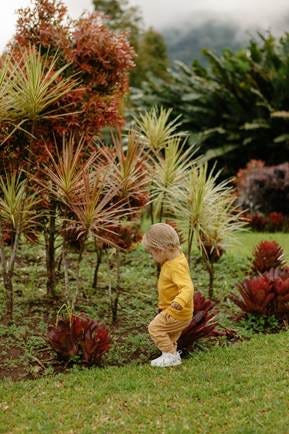
This is a young child outside.
You see that and the student or your child can see that. Before you give any hints, though, ask the child what he sees. He may simply start with the obvious: “There’s a kid walking around the yard.”
Tell him to write that down, as in “I see a kid walking around.”
Then ask something like this, “Do we know why the child is walking around?” or “Is there anyone else there?” This is when the typical struggling writer will say, “I don’t know!”
And this is what you can say in response, “So, you can make something up. That’s what a story is. Let’s make something up.” Each time the child gives any answer, have him write it down. Try to create about 5 sentences together. Short is fine. In this way, the child sees you’re not expecting a book! You are just trying to get them to write a little bit, and maybe, someday, write a little more.
My expectations varied with what I sensed or saw was appropriate for each child. My classrooms were full of a wide range of learners, so what I did was an example of diversifying instruction. Both parents and teachers can do this, too. I slowly, incrementally, ramped up the expectations as children progressed in their procedures and outcomes.
This is not mass dysgraphia. This is children who are trying to figure out what the parent or teacher wants. Many of us “turn off” our creative side when the adults around us have what seems like a hidden agenda for what the child’s product should look like.
In other words, I think it is simply a normal response for most boys, and some girls, too, to give us, and it’s simply not that hard to come up with ways to support a youngster with some writing issues. I’ve provided several good links here to get you started in making your own determinations about what to tell the teacher and what both you and the teacher can do. My bottom line is that the last thing you should do is let them off the hook. We all need to develop some writing skills and over time, keyboarding or typing our responses is fine.
Emily Finn, MS, OTR/L (August 18, 2020). Dysgraphia 101- Introduction And Strategies For Understanding Dysgraphia in Children. https://www.occupationaltherapy.com/articles/dysgraphia-101-introduction-and-strategies-5327#:~:text=The%20five%20different%20types%20are,phonological%20dysgraphia%2C%20and%20lexical%20dysgraphia.
This is a downloadable PDF: “The boys’ handwriting is never as good as the girls’, is it? https://warwick.ac.uk/fac/soc/ces/research/teachingandlearning/resactivities/subjects/literacy/handwriting/outputs/english_4-11_paper.doc
Men and women differ in the neural basis of handwriting. https://www.ncbi.nlm.nih.gov/pmc/articles/PMC7294055/
5 Levels of Gifted: School Issues and Educational Options in 2009. This is the original 5 Levels of Gifted book for parents and educators. Moderately Gifted, Highly Gifted, Exceptionally Gifted, and Profoundly Gifted children are the subjects of this book (78 of them) and their early milestones, behaviors, and parent journeys through how to raise and educate these children is a must-read. Parents who read this book can estimate their own children’s eventual IQs surprisingly accurately by the time they are age three to about six years old, before it is effective — or reliable — to have them professionally tested.
Here are links to the 5 Levels of Gifted book on Barnes & Noble: https://www.barnesandnoble.com/w/5-levels-of-gifted-deborah-ruf/1126358834 and Amazon: https://www.amazon.com/Levels-Gifted-School-Educational-Options/dp/0910707987 or directly from the publisher: https://www.giftedunlimitedllc.com/store/p12/5_Levels_of_Gifted.html
The 5 Levels of Gifted Children Grown Up: What They Tell Us (2023). This is a 20-year longitudinal study follow-up about the original gifted child subjects in 5 Levels of Gifted: School Issues and Educational Options (2005, 2009). In it, Dr. Ruf covers every conceivable topic to ask the 60 of the original study group of 78. She also shows readers how it is that people of the same original promise to succeed have vastly different outcomes. https://www.amazon.com/Levels-Gifted-Children-Grown-Up/dp/B0C9SHFRLH or https://www.barnesandnoble.com/w/the-5-levels-of-gifted-children-grown-up-phd-deborah-l-ruf/1143719859?ean=9798988323709.
Keys to Successfully Parenting the Gifted Child (2023). Need answers fast on what to do now? This is a short book — 80 pages including pictures — that is a great starter for parents just wanting some answers … fast! The content was originally from a PowerPoint I created for the parents of gifted children presentations around the country. The contents zero in on some of the most important things about raising gifted children that parents want to know. On Amazon, Keys to Successfully Parenting Gifted Children (2022, 2023) Print and ebook. The Nook version is also now on B&N.
Losing Our Minds: Too Many Gifted Children Left Behind (Oct. 2024). This is the first book in a Trilogy meant especially for educators, parents, adult gifted, and therapists. Questions for discussion are at the end of every chapter. The book provides a detailed analysis of the different levels of giftedness, the concept of “good fit” in educational settings, and the impact of various school environments on gifted children. It also includes personal stories and experiences of gifted children and adults, highlighting the challenges they face in finding appropriate educational and social environments. Available now on both Amazon and B&N. It is not the old purple book from 2005. Also, the Kindle and Nook versions are formatted so readers can click back and forth easily and find their place again. Follow this link: https://www.amazon.com/dp/B0DL3BSC9X or this link: https://www.barnesandnoble.com/w/losing-our-minds-deborah-ruf/1146410968?ean=2940185888872
Environmental, Familial, and Personal Factors That Affect the Self-Actualization of Highly Gifted Adults: Case Studies (D. Ruf, 1998) doctoral dissertation. Free PDF https://dabrowskicenter.org/ruf
Comments
Nothing yet. Say the first thing.
Sign in to join the conversation.