
December 23rd arrives quietly.
4:47 a.m.
I wake before the alarm. Before the noise. Before The Train asleep in the rooms of the wedding eve accommodation Ọrọ organised with the same colour-coded precision she brings to everything that matters.
I lie still.
Today.
Today is the day.
First of all, I pray. And study the Bible. My current devotional reads in YouVersion are all about being a fiancée, a wife. And then my Bible In One Year study.
When I am done, I do not reach for my phone immediately. I lie in the dark of a morning that has not yet decided to be morning and I let the weight of it settle. Not with anxiety — with the gravity of something enormous arriving exactly as expected. The way the real things always arrive. Not with fanfare. With presence.
I think about the Tuesday.
October 10th. A year and two months ago. A man walking a route he was not supposed to walk. A woman arguing into a phone about a brief with three factual errors while dealing with her GPS wahala.
I think about the study floor.
The PMOS and the silence and the Paris plan and the choosing anyway.
I think about Jos. The compound. The purple and gold. His agbada and the specific thing it did to the Jos afternoon.
I think about the rooftop.
The peonies. The reading chair from Wuse 2. The Tuesday Journal on the table. His voice saying Adesewa Coker, will you marry me like it was the most natural question in the world.
Because it was.
It had always been going to be.
“Soon”, he said on a dance floor in October.
Today is soon.
I pick up my phone.
6:02 a.m.
His voice note is already there.
Of course it is.
I press play.
His voice.
The 7 a.m. voice, arrived early today because today is not an ordinary morning. Quiet. The reading chair quality. The specific timbre of a man who has been awake for a while and has been sitting with something and is ready to give it.
“Good morning, Tesoro. Today you become my wife. I have been thinking about what to say and I have decided that the truest thing I can tell you this morning is what I told you fourteen months ago in a journal you had not yet read: I have never seen anyone more alive. That has not changed. It will not change.”
A pause.
“Zephaniah 3:17. The Lord your God is with you, the Mighty Warrior who saves. He will take great delight in you; in his love he will no longer rebuke you, but will rejoice over you with singing.”
Another pause.
“He rejoices over you with singing, Sewa. On this day and every day. Walk toward me.”
I lie in the dark and I receive it.
Completely.
Without managing it.
Then I get up.
Today there is a lot to become.
They do the civil wedding at 10 a.m.
The registry. The legal weight of it. The document that makes the rest of the day possible in the eyes of the state.
She wears ivory.
Not the wedding dress — that comes later.
This is the civil dress, which she has been keeping separate in her mind since August when the planning properly began: a column dress in silk mikado, structured at the bodice with the architecture of something that requires no adornment and receives adornment anyway.
Ivory so pure it almost reads as white in certain lights and reads as warm gold in others, depending on what the day is doing. The beadwork begins at the collarbone — hand-sewn, tiny, the specific oyster-white of Japanese seed pearls arranged in a pattern that her mother designed and Mrs. Taiwo executed over six weeks. The pearls trail down the bodice in two rivers converging at the waist, then disappear, then reappear at the hem in a final scatter, like light arriving at the end of something. The sleeves are sheer — barely there, the suggestion of coverage rather than coverage itself, the modesty of something that does not need to announce itself.
Her hair is up.
Simple. Deliberate. The simplicity of a woman who has done too much to her hair today to let it distract from her face.
The shoes are pearl-white kitten heels. Low enough to walk in with intention. High enough to mean it.
She carries nothing.
Just herself.
He wears black.
A three-piece suit in midnight wool — the specific black that is not costume but character, the suit that was cut for his body in the specific way of something that has been thought about rather than purchased. The lapels are satin — not wide, precisely wide, the width of a man who knows what he is doing. The waistcoat fits the way only bespoke fits, the watch chain his grandfather’s, the watch itself inherited, the cufflinks that belonged to his father on his own wedding day and which Mr. Adedamola pressed into Romeo’s palm on the Jos introduction evening and said nothing, because nothing was needed.
A white pocket square.
One.
Folded with precision.
They stand before the registrar with both families present — small, immediate, the inner circle — and they say I do in the legal sense of it and the document is signed and Chief Coker’s hand trembles slightly when he witnesses the signature and Mrs. Bimbo’s does not because she has always been the steadier one publicly.
They are legally husband and wife at 10:43 a.m.
Nobody screams about this yet.
The screaming is for later.
White.
They chose white for the traditional and the choice was deliberate — not the absence of colour but the presence of all colour simultaneously, the statement of two people who have decided that their union begins in light.
She is a goddess.
There is no other word.
The Aso-oke is Nigerian lace — the luxury version, the kind woven with the specific density of something that has substance beyond fabric, heavy enough to drape properly, light enough to move with her. White with gold thread running through it in patterns so fine they appear only when the light hits them directly, which means she spends the entire traditional ceremony appearing to shimmer whenever she moves.
The gele is twenty-one steps.
She counted them with the gele artist the night before. Twenty-one because it is a multiple of seven. Because Ọrọ chose October 21st for the same reason. Because some numbers are just theirs.
It is enormous and perfect and architectural — white lace shaped into a structure that could hold its form without a head underneath it and somehow makes the head beneath it more regal for its presence. The specific authority of a Yoruba woman in a properly tied gele is unlike anything else in the world and Sewa Coker in this gele, on this day, is the argument for why.
White elegant heels. The kind that require a woman to know how to walk in heels. She knows how to walk in heels.
His àgbàdá is white.
The fabric is an aso-oke of equal luxury — the same weavers, sourced by Mrs. Taiwo, the specific weight and sheen of cloth that understands itself. The monogram is embroidered on the left breast and on the hem of the outer garment in the specific gold that runs through her lace: RET-AO. Romeo Emmanuel Taiwo and Adesewa Oluwafemi. Their initials braided together in thread that will last as long as the garment does.
He looks like his father.
He looks like himself.
I AM READY TO GROW WITH MY GEES.
The venue is a ballroom in Abuja.
Not new-build — old. The old of a building that has been standing long enough to have developed character, that has high ceilings with the original plasterwork intact and antique architecture that does not require decoration because it is decoration. The chandeliers are not rented. They belong to the building. They have been there since before either of these families existed in Abuja and they are indifferent to weddings and present for all of them.
The pastels are everywhere.
The five hundred guests — they got to five hundred, Adaeze earned her fee — are in every shade of the pastel spectrum: dusty rose and sage and powder blue and the pale lavender that Lady Aurora chose because it coordinates with nothing and is somehow perfect with everything. The room looks, from the front where Romeo is standing, like a garden that has been brought indoors. Like something that grew rather than something that was arranged.
Five hundred people and every single one of them was chosen.
I have been standing here for eight minutes.
Pastor Kayode. The ballroom transformed into a sanctuary for the afternoon.
Pastor Dami is in the front row.
He looks at me.
I look at him.
He nods.
I nod back.
Nineteen years from the camp at nine years old where I made the pact. The Father and Son weekend. The decision that has held through university, through Aurora, through twenty-seven years of waiting for the person God had prepared.
She is about to walk through those doors.
Seun beside me. My best man. The only choice.
He puts his hand on my shoulder briefly.
I breathe.
The music changes.
Until I Found You by Sanchez.
Something happens in the room that cannot be manufactured: the collective intake of breath that a room produces when it understands that something is about to arrive that will be worth witnessing.
The doors open.
Chief Kunle Coker.
And Adesewa Evelyn Ariyike Coker on his arm.
The dress.
She told me nothing about the dress.
This was our agreement. She keeps the dress, I keep the reading chair’s final placement in the house. We negotiated this in September and I have not regretted it and I do not regret it now.
But nothing prepared me for this.
White. Of course white. But the white that does not arrive quietly. The white of something that has been designed by someone who understood exactly who was wearing it: a woman who fills rooms before her body arrives in them, who dresses with intention, who has been communicating through fabric since she was old enough to understand that fabric is a language.
The silhouette is a column. Clean. Deliberate. The line of it uninterrupted from collarbone to floor except where the skirt opens into a cathedral-length train that trails behind her like something the room itself is extending. The fabric is mikado silk with hand-applied French lace overlay. The lace is covering the bodice and upper arms in the modesty of something that covers everything and reveals the woman underneath it completely.
The back is the detail: lace cutwork from the shoulder blades to the base of the spine, an architectural window into her, the specific geometry of something designed to be witnessed from every angle.
Her headpiece is not a veil.
It is a crown.
Pearl and crystal. The collaboration of her mother’s taste and her own, sitting at the front of her hairline like something that was always supposed to be there and simply took twenty-five years to arrive.
She looks like herself.
The full version.
Maximally, entirely, unmanagedly herself.
She looks at me from the doors.
Across the ballroom.
Across five hundred people.
Across everything.
And something happens to my face that I have not given permission to happen and cannot stop and do not want to stop.
I cry.
Not the collapsing kind. Not the managing-it kind. The kind that arrives because something is too large for the chest that is holding it and finds the face as the nearest available exit.
Two tears.
Three.
The tears of a man who has been patient for twenty-eight years because he trusted God and is now watching the reason for the patience walk toward him through a ballroom full of pastels with her father’s hand under hers and a crown that was always supposed to be there.
Seun’s hand is on my shoulder again.
I do not move my eyes from her.
She is walking.
She sees my face.
Something crosses hers. Not the composed face but the open one. The one that is not performing anything for anyone and she holds my gaze across the ballroom and the distance between the doors and the altar and the five hundred people ceases to be distance and becomes simply the space she is crossing to arrive at me.
Chief Kunle Coker walks his daughter to me.
He stops.
He looks at me.
The same look as the Jos garden. The same look as the Introduction. The look that contains everything the two of them said to each other on a Sunday morning phone call about forgiveness and what it costs to put down what you have been carrying.
He places her hand in mine.
His hand is steady.
His eyes are not.
He takes his seat.
She is beside me now.
I look at her.
She looks at me.
Inside: here she is.
Inside: she walked toward me.
Inside: she stayed.
“You are crying”, she says.
Very quietly. For me alone.
“No”, I say.
“Reo.”
“I am not crying”, I say. “My face is simply expressing its opinions.”
She laughs.
It rearranges the front row.
Pastor Kayode smiles.
Pastor Dami, in the front row, looks at the ceiling briefly.
We face the altar.
Pastor Kayode speaks first.
About covenant. About the triangle. God at the apex, husband and wife at the base. The geometry of a marriage that works because all three points are load-bearing.
He quotes Ecclesiastes: a cord of three strands is not quickly broken. He speaks about what it means to love like Christ loved the church — not the feeling of it, the decision of it, the daily dying-to-self of it. He speaks about submission as the posture of trust, not the surrender of self — a woman choosing to align herself under the mission of a man who has aligned himself under God. Under the mission. Sub-mission. The deliberate, eyes-open, dignified choice of a woman who knows exactly who she is and is choosing, from that fullness, to receive and support his leadership.
Then Romeo turns to Sewa.
He does not take out a card.
Of course he does not.
He looks at her.
“Adesewa”, he says.
His voice is steady. The specific steadiness of a man who has been this quiet for twenty-eight years and is about to say the most important thing he has ever said and is not going to perform it.
“I am not going to tell you how we got here”, he says.
“You know how we got here. God knows how we got here. I am going to tell you where we are going.”
A pause.
“Ephesians 5:25 says: Husbands, love your wives as Christ loved the church and gave Himself up for her. I have read that verse many times. I have studied it. I have sat with the weight of it.”
He holds my gaze.
“Today I am making it my covenant. Every morning when I wake up beside you I am choosing again — to love you with the love that lays itself down. That does not keep a record. That is patient and kind and does not dishonour you. The love that endures all things because it is rooted not in who you are on your best day but in who God says you are on every day.”
The ballroom is completely still.
“I vow to be your covering Not your ceiling. ”, he says.
“Your protection, not your restriction. To lead with my face toward God so that when you look at me you see a man who knows where we are going because he is following The One who does.”
A pause.
“I vow to listen to you — actually listen, not prepare my response while you are speaking. I vow to hold the space when you need to be heard and offer the truth when you need to be helped and know the difference between the two.”
The smallest smile.
“I am still learning the difference. I will keep learning.”
The ballroom receives a soft sound.
“I vow to build with you. Imani. The house. The library — both libraries. Our family. Whatever path God ordains. I vow to walk every path with you. No contingency. No conditions. Both hands. Ten toes.”
He takes my hands.
“And I vow”, he says, “that every day for the rest of my life — I will walk toward you. Whatever the route. However long it takes. I will always walk toward you.”
“Mo nifẹ rẹ gidi gaan, Iyawo Mi. Ololufe mi ọwọn. I love you so much, My Wife.”
I look at him.
The man who cried when I walked through the doors and said my face is expressing its opinions.
The man who sends the verse every morning and means every word.
I take a breath.
“Romeo”, I say.
“I spent a long time running. You know this. God knows this. These people know this. Okay not all but some.”
I gesture slightly at the room. Scattered laughter fills the room.
“I ran from love because I did not believe I was worth being stayed for. And then you — you did not chase me. You just — were there. Consistently. With the verse and the rooibos and the truth when I needed it and the silence when I needed that.”
A pause.
“Proverbs 31:11 says: the heart of her husband trusts in her.”
I hold his gaze.
“Romeo, I am going to spend the rest of my life being worthy of that trust. Not performing worthiness — being it. In the ordinary Tuesdays and the hard Thursdays and the seasons we cannot see from here.”
“I vow to submit to your leadership. Not because I am less — because I know who you follow and I trust the direction. Submission means to be under the mission. And I know the mission. I have watched you live it.”
A pause.
“I vow to bring you the full version of me. Not the performing version. The real one — the one who stress-cooks and cries on study floors and carries things longer than she should.”
I squeeze his hands.
“I vow to bring her to you. Early. Before she becomes a plan.”
The ballroom is very still.
“I vow to pray for you”, I say. “By name. Every morning. For what you are carrying that you have not told me yet and for what I can see and for what only God can see. I vow to pray with you. I vow to be your safe place — the room where you do not have to have the fully formed position before you speak.”
A pause.
The last one.
“And Romeo.”
My voice does something. I let it.
“I vow to stay. Not to perform staying. To actually, daily, deliberately stay. To choose you on the Tuesdays that are easy and the Tuesdays that are not. To choose us — this triangle, God at the apex, both of us at the base, the cord of three strands that is not quickly broken.”
I look at him.
“I am not running. I am not going to Paris. I am here. Both hands. Ten toes. All in.”
“This is my covenant”, I say. “Before God, before these people, before you.”
“Ti amo, mi amor. I love you, My Husband.”
The rings.
His hands.
The specific hands I have been watching since the first time he drove me somewhere.
The ring slides on.
Then mine on his.
Pastor Kayode: What God has joined together, let no man separate.
I now pronounce you husband and wife.
Romeo. You may kiss your bride.
He looks at me.
I look at him.
He takes my face in both hands — the hands, those hands, the ones I photographed for the world on January 4th — and he kisses me with the specific quality of something that has been waiting to arrive and is now arriving.
The ballroom.
Five hundred people in pastels.
They do not contain themselves.
They should not be expected to.
The room transforms.
The same ballroom, the same chandeliers, but the ceremony has given way to the celebration and the two are different in temperature — the ceremony was sacred, the reception is joyful, and both are right.
Kottrell takes the stage at 7 p.m.
“Romeeooooo”, I says.
“Yes, wifey”, he says.
He looks at me when he says it.
The word.
Wifey.
Something moves through his face.
“You planned this”, I say.
“Well, there's more coming”, he says.
Johnny Drille follows. Then Bidemi Olaoba — whose voice in this room, in this ballroom, with these chandeliers and these pastels and these five hundred chosen people, does something to the air that cannot be explained only received.
Our first dance is to Kottrell’s performance.
Live.
We stand on the floor as husband and wife, six feet three and five feet five, the purple and gold of the traditional behind us and the white of the wedding present and the whole of the year and the two years and the Tuesday present in the music.
He puts his hand on my back.
I put my hand on his shoulder.
We dance.
Not for the room.
For ourselves.
The way we danced at Ọrọ’s wedding — on the edges, in the softer light, with the city somewhere beyond the walls — except this time we are not on the edges. We are in the centre. We are the reason the room is here.
Kottrell’s voice wraps around us.
Romeo leans down.
“Wifey”, he says. Into my ear. For me only.
“Yes, my husband.”
“The Tuesday Journal”, he says. “There is one more entry.”
I pull back slightly to look at him.
“When did you write it?” I say.
“This morning”, he says. “5:15 a.m.”
“What does it say?” I say.
He looks at me.
“December 23rd”, he says. “She walked toward me. She stayed. It was always going to be this.”
I look at him.
The chandeliers above us.
The five hundred people around us.
Kottrell singing.
“Reo”, I say.
“Yes, wifey.”
The word.
The specific word.
I feel it in my chest.
“You are the cheesiest man I have ever met”, I say.
“I am accurate”, he says.
“Accurately the cheesiest.”
“Consistently the cheesiest.”
We keep dancing.
It happens during the mother-daughter dance.
Not planned as a reception highlight — planned as a private moment, the specific private moment of a daughter and her mother who have found their way back to each other and want to mark it in front of the people who have witnessed the finding.
The song is something Mrs. Bimbo chose.
She told me the name three weeks ago and I had not heard it before and I sat with it and understood immediately why she chose it.
A love song. Old. The kind that has been carried through families for decades. The kind that does not announce itself.
We dance.
My mother and I.
And somewhere in the second verse she says something.
Into my ear.
Quietly. For me alone.
“You are who I was trying to be when I did not know how.”
The ballroom does not hear this.
Nobody photographs this moment. I have asked the photographer to give us this one without the lens.
I hold my mother.
The woman who stayed for twenty-eight years for the wrong reasons and is now staying for the right ones.
The woman who passed me a plate to dry in a Jos kitchen and said three sentences that undid eight years of distance.
The woman who sat in the front row of this ballroom today and wept in the specific way of a woman who does not weep publicly and who wept anyway because her daughter was walking toward something real and she had lived long enough to know what real looks like.
You are who I was trying to be.
I hold her.
I do not manage it.
Inside: this is what healing looks like.
Not the absence of the wound.
The present of the person on the other side of it.
The family and friends after party is in the garden of the Maitama house.
Thirty people.
The inner circle.
Fairy lights that Juliet organised and which turned the garden into something that looks like a dream someone had and then walked into.
Fewa and Amara in a corner, his hand in hers, the specific ease of two people who have done the work and are living in what the work produced.
Ọrọ and Mautin on the makeshift dance floor. They have not stopped dancing since the reception. One year and two months of marriage and they dance together like it is still the first time and also like it is entirely ordinary, which is the specific miracle of two people who have made the choosing into a rhythm.
Romeo’s parents. Mine.
At the same table.
Talking.
My dad and my dad-in-love. I catch a fragment as I pass: something about publishing, about a book my father has been thinking about writing, about whether Aurora Ltd. might be interested. Mr. Adedamola’s face is the face of a man who is genuinely interested.
Lady Aurora and my mother.
This one I stop to witness.
Two women. One Italian old money, one Nigerian composed silence. Both of them mothers of people who found each other on a Tuesday. Both of them here, at the end of December 23rd, in a garden full of fairy lights, talking.
I do not know what they are saying.
I know they are not performing it.
Juliet finds me.
She is still in her wedding outfit. She refused to change, she said she was wearing it until it fell off her. And Jacqueline is asleep on Tony’s chest three chairs away.
“Sewa Olusiji”, she says.
The name.
My name.
Olusiji.
“Juliet”, I say.
She hugs me.
The real hug. Both arms.
“Welcome home”, she says.
The same words she said in October at the rooftop proposal.
They land differently now.
Now they are true in the legal sense and the covenant sense and the forever sense.
“Thank you”, I say.
“Do not thank me”, she says. “Just be happy.”
“I can do that”, I say.
We leave at 1 a.m.
The after party still going. Ọrọ and Mautin will not leave until the lights go off, which is a fact about them but we have said the goodbyes and received the blessings and Adaeze has confirmed that everything is handled and Romeo has looked at me and I have looked at him and we have simply — left.
The car.
The drive.
Abuja at 1 a.m. on December 24, the harmattan quiet, the city doing its night version of itself.
She is beside me.
My wife.
The word lives in my chest differently now that it is real.
We do not speak much in the car.
We do not need to.
We pull into the driveway.
The house is lit. Juliet organised this too, the lights set to come on at midnight, the welcome of a house that has been waiting.
I get out.
I open her door.
She gets out.
She stands in the driveway and she looks at the house.
Our house.
The one my father built.
The rooms we filled together.
She takes my hand.
We walk to the door.
I unlock it.
She looks at me.
I look at her.
“Welcome home, Mrs. Olusiji”, I say.
She shakes her head.
But she is smiling.
“Thank you, Mr. Olusiji”, she says.
I open the door.
We go in.
The house.
The warmth of a space that has been prepared for this moment. Juliet’s fairy lights strung through the living room, flowers on every surface.
The dining table.
My wife’s dining table. Now ours.
The one that came from the Maitama apartment. The one that has held our most important conversations of the last two years.
She looks at it.
“Reo”, she says.
“Evie.”
“The flowers”, she says.
“Juliet”, I say.
“Of course it was Juliet”, she says.
She sets her crown down on the table.
The pearl and crystal headpiece that was always supposed to be there.
She looks at me.
The dress.
The lace overlay.
The cathedral train gathered at her wrist.
The ring on her finger.
“We are home”, she says.
“We are home”, I confirm.
She comes to me.
I hold her.
The night outside. December 23rd becoming December 24th, the year moving toward its end, the beginning that is also the beginning of everything beginning.
We have been waiting.
Both of us.
He for twenty-eight years of the decision made at nine years old and upheld through every season.
She for the two years of becoming the woman who could stay.
The wait is over.
This is the night.
The covenant complete.
The Tuesday made forever.
Two whole people.
God math.
One.
Narrator's Nook
The wedding is not the destination. The wedding is the door. Everything before it — the becoming, the therapy, the forgiveness, the PMOS, the study floor, the Paris plan, the Introduction in Jos, the bridal shower and the twelve women and the boxes — all of it was the preparation for the life that begins on the other side of this door.
The vows are the series’ central argument made covenant. He vows to love like Christ loved the church — the self-giving love, the daily decision, the covering without ceiling. She vows to submit under the mission — not the surrender of self but the choice of trust, the deliberate alignment of a woman who knows exactly who she is and who he follows. The triangle is the foundation. The cord of three strands. This is the only mathematics that holds.
Mrs. Bimbo’s whispered words during the mother-daughter dance — you are what I was trying to be when I did not know how — is the chapter’s most important moment and it belongs only to them. A mother giving her daughter the thing she needed to hear. Not at thirteen. Not at twenty. At twenty-five, on the day she becomes a wife, in the middle of a ballroom. Late and exactly on time, the way God’s provision always is.
And the Maitama house at 1 a.m. — the peonies, the fairy lights, the dining table that no longer seats one, the east-facing window, the room with the possibility built in — is the series landing on its final image not with drama but with the specific ordinary sacredness of two people walking through their own front door.
The Tuesday made forever.
She burned for everything.
She let him burn for her.
She stayed.
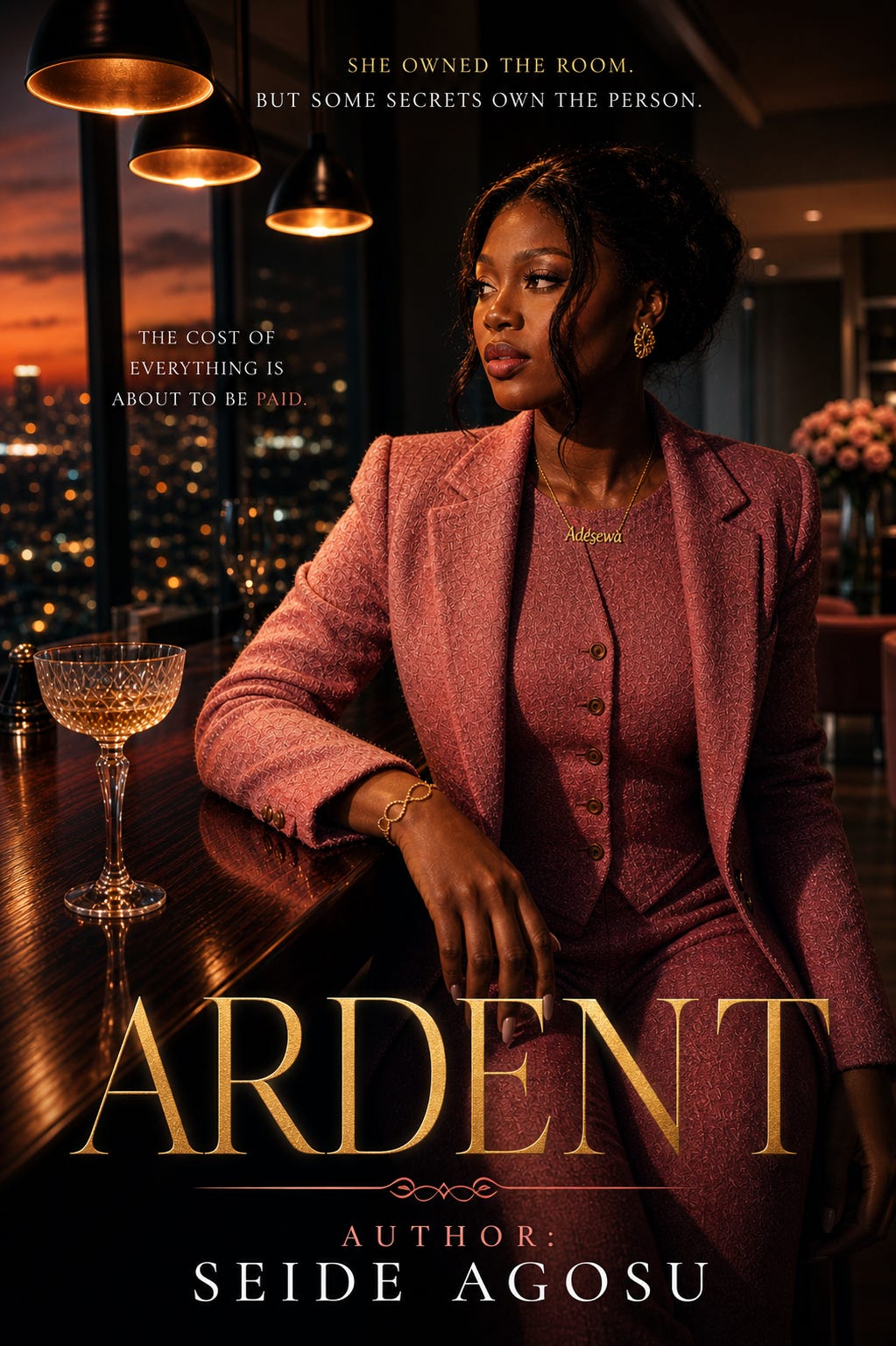
ARDENT will continue.
The marriage. The Imani doors opening. The path to the possibility. The life that is just beginning.
But this chapter is complete.
The door is open.
They are home.
Comments
Nothing yet. Say the first thing.
Sign in to join the conversation.