
“Shall we do the Charleston?” Meredith asked. It was the first time our five-some was playing Mahjong without our sweet-natured (and rather chic) elderly British teacher, Charlotte. My eyes darted around the card table to my friends—I couldn’t remember how to begin and based on their jittery looks, neither could they. Did we distribute the stacks of tiles to the right or the left? Which player was supposed to push out their row of tiles first?
“Sure,” I said with a nervous chuckle, probably downing a chocolate chip cookie, which I tended to do whether I was anxious or not. Why was the game of Mahjong so stressful? “But what do we do again?”
“We roll the dice,” said Ranjana, who somehow picked up the game quickly; she’s a numbers gal. “The highest roll goes first.”
Oh right. Thank goodness for friends, right? I wouldn’t have learned anything about how to play this game without them, and I’ve also learned to lean on them in other ways too. That’s what I began to think about as the weeks of play marched on from those earliest Wednesdays in winter. Mahjong isn’t just a game of luck and strategy. It’s a game of friendship. It’s also a metaphor for life.
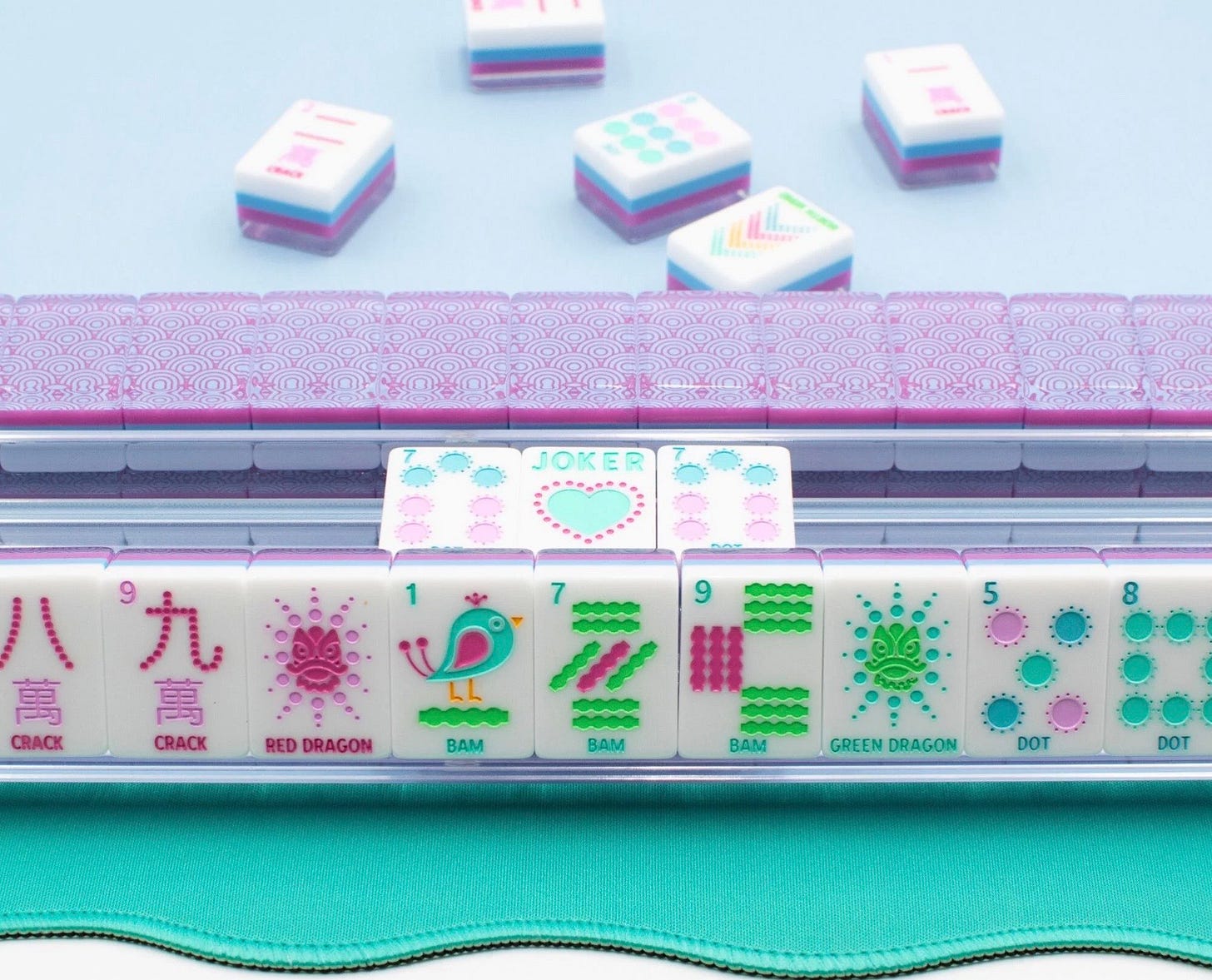
Let me rewind. When my friend Tovah asked me if I wanted to learn Mahjong, I hesitated. Wasn’t this something old ladies did after retirement? My close friend, Sara, had been playing for years and it made her happier than a summer’s day, but still: Was this going to be like some kind of coffee clutch at the nursing home? Then again, I adored the friend group that was inviting me to learn with them; they included women I’d been close with for years and friends I’d always wanted to be closer to. Besides, I love learning new things, always and forever like a chef’s kiss, so I said, sure, I’ll try it.
In our early lessons, my brain felt like it had been put through a dryer cycle afterward, like all these little compartments that were typically dormant were suddenly shaken awake. I write all day everyday—I don’t typically look for patterns, and I certainly don’t stare at numbers or little Chinese characters. What was this foreign language? Over several weeks and a very long losing streak, though, the Mahjong card began to make a little more sense. I didn’t win, but I could sometimes say, “I was one away!” from victory, which Sara said is a joke in the Mahjong world.
Everyone is always one away. You can buy t-shirts that say this.
Our five-some only played together, two of us teaming up if all of us could make it on Wednesday nights. This always made the round more fun because you could talk over your strategy with a friend and grovel with them when the tiles didn’t go your way. Tiles often didn’t go your way, and that was the first lesson for me of why I adore this game: When does life ever go the way you want it to? But just like in Mahjong, you decide how to respond: You can pivot and change your path, or you can accept defeat and start over. Either way, it’s your choice how to respond to whatever the game deals you.
My friend, Nancy, often groans with disgust or indecision when we play, and she’s capturing my own internal frustration. When I asked her if she thought Mahjong is a metaphor for life, she texted right away. “I’m the type of person who likes to plan out everything in advance and then follow that plan to the letter. Mahjong is a good reminder for me that sometimes you need to go with the flow and make new plans when necessary to get where you want! And sometimes (oftentimes) things don’t work out, but that just means it’s worked out for one of my friends, and there’s always another chance for me next time.”
We were supportive Mahjong players. If someone missed the chance to pick up a tile and saw it later, we’d encourage them to take it. When Ranjana and Tovah began to win game after game, clearly excelling in ways the rest of us weren’t, they cheered us on the way good friends do. At one point, when it was clear that some of us were advanced enough to recognize another’s strategy and work against them, Meredith kindly said, “Don’t hold back to be nice. We need to play for real.” Meaning, let’s not sugarcoat our moves. If you could hold on to a tile to keep someone else from winning, go for it.
We all agreed, each of us longing to get a victory under our belt. Still, even after weeks and weeks of play, I still hadn’t won a game on my own.
Our Wednesday meetups had been going on for months, and we found ourselves talking about our lives more and more as we divvied up tiles during the Charleston since the game was becoming clearer. We also began to grow faster at our play. One excruciating slow game over two hours early on transformed into three swift matches. We’d talk about our kids who were attending prom, parenting struggles, how our husbands can drive us crazy when they’re sick, what we could do to help a friend who needed us. We all began to look forward to these nights—hump day was now fun day—and not just because of the game but because it gave us an excuse to be together. To connect and laugh and complain and catch up.
There have been books written about the key to happiness, but what I’ve realized is that it’s not complicated. Happiness comes with connection, and Mahjong gives people a fresh way to connect. You are doing something new with the people you care about—or using it as a way to find new people to care about. Over time, it became even more apparent, at least to me, that our get togethers weren’t just about playing an old game. It was about building a Mahjong friendship circle.
Maybe this essay is a cheesy ode to our game play, but it’s true. The game of Mahjong is only as good as the people you play it with.
Our lives are only as good as the people we play it with.
Two weeks ago, I thought I had a win and hollered out, “Mahjong.” Everyone clapped and cheered, but then when we examined my tiles, I realized I had mixed up two lines. I didn’t win after all. My cheeks grew hot. These were my friends, but I felt kind of stupid. Why was I always messing up in this game? I just needed one more tile! Again!
Each of us went around the circle, taking a turn. Ranjana picked up a bird bam and discarded it. Then it was my turn. There was one tile left. One tile left in the entire game! When I reached for it, turning it over in my palm, my heart swelled.
Four dot. It was what I needed to win.
“Mahjong!” I called out, and my friends erupted into cheers and laughter and visible relief since I’d recovered from my earlier error. It was like hitting a home run after being struck out. My friends kept cheering, “Four dot!”
“That was the best win ever,” Nancy laughed, and we all cheered again. We couldn’t stop texting about it the next morning.
And maybe that’s the thing about Mahjong that’s even better than connection. Being together isn’t just about catching up and game play. It’s about sharing in each other’s victories, and then starting together again.
No posts
Comments
Nothing yet. Say the first thing.
Sign in to join the conversation.