
I’m endlessly fascinated by editors turned writers. In journalism, editors tend to stay in their lane, but more and more we’re seeing great book editors become great book writers. Take Jenny Jackson, Chris Pavone and Christine Pride. I first read Christine’s novel co-written with Jo Piazza, We Are Not Like Them, in my book club, and it was an honest and searing look at the impact of race in friendship. I loved it!
Recently, Christine and I shared a chatty drive back to the Back Bay Amtrak station after we both presented at the Newburyport Literary Festival. We got talking about writing, travel and publishing, and I eagerly took home her debut novel, All the Men I’ve Loved Again (out in paperback 6/12).
What a tender, heart-felt read! The story begins in 1999, and our heroine, Cora, is trying to reinvent herself in college when she meets and falls in love with sweet and adorable Lincoln. When family tragedy pulls her back home, Cora finds herself spending time with a young photographer—and she falls in love for a second time. The relationships fizzle out and life shifts in different directions, and the story picks up again in her thirties when she finds herself dating the same two men. Will she find true love, even after closing herself off to the possibility? You need to read the book to find out!
I’m so excited that Christine Pride is here with us today. Christine, let’s begin our second gab fest, only this time we’re not in a car. xoxoxo
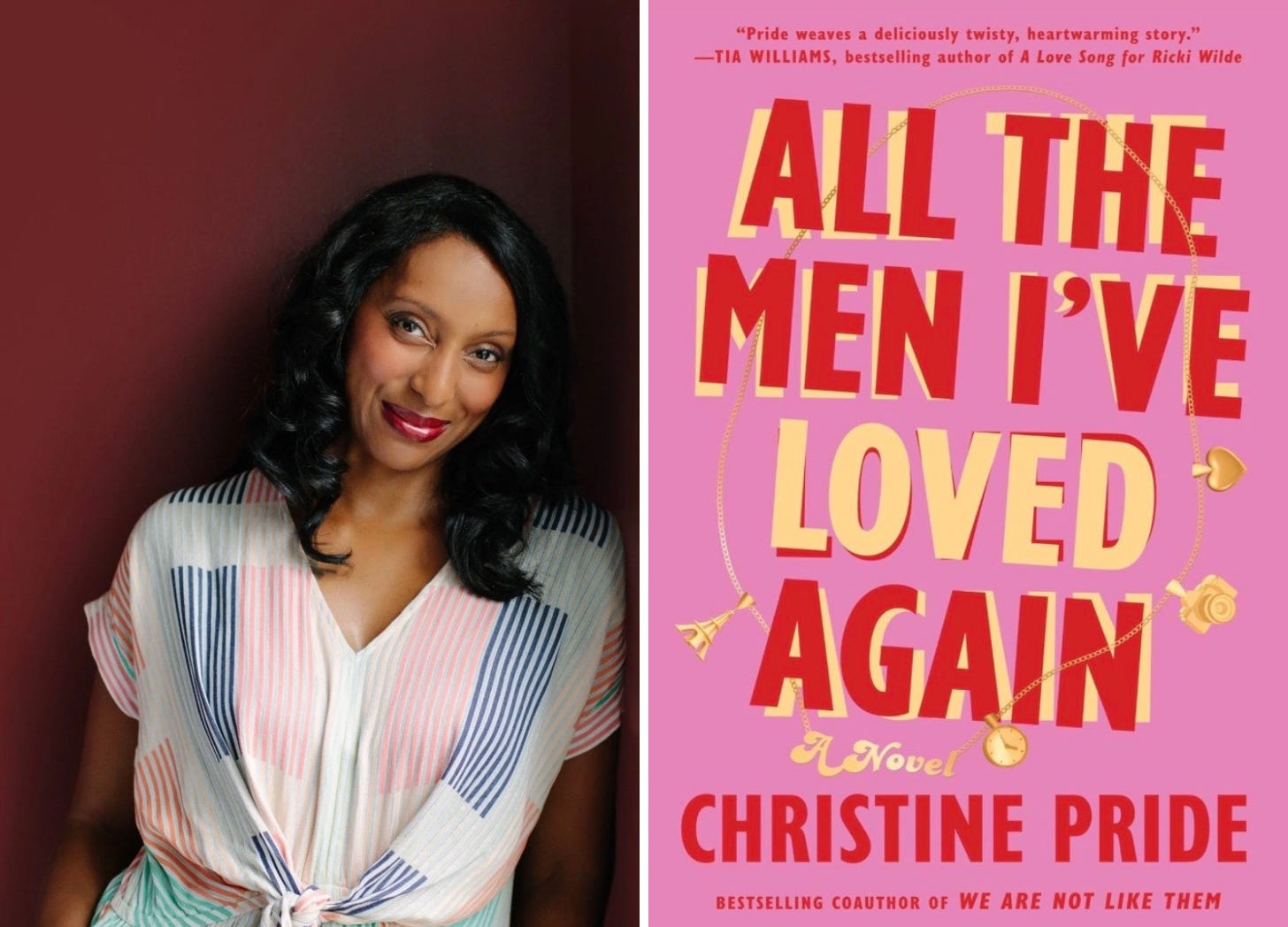
This is your first solo novel. Why did you decide to pivot a bit from your book written with Jo Piazza?
Yes, my debut novel is a departure from my earlier writing experiences in that the subject matter is very different and it was my first time writing solo! I’ve always thought about trying new ventures, creatively and otherwise. I did want to try my hand at an individual project after many years of collaborating with other writers as an editor and as a writing partner. It was a way to stretch! And yes, I also wanted to venture into somewhat “lighter” terrain after writing about heavy hitting and complex subjects like race, police violence and foster care. It was fun (in a different way) to write about first love and second chances. The novel still has plenty of emotional depth, but it’s also fun and juicy.
People often mistake a book character for its writer. Are there any parts of you or any parts of your life story reflected in Cora in All the Men I’ve Loved Again?
I did, wildly and improbably enough, date two men in my twenties back to back and then the same two men in my forties back to back. When your life is a novel plot, you almost have no choice but to use it as inspiration!
Ha! I love that. How has your career as an editor impacted your career as a writer? Is your editor hat always on when you’re writing? How do you turn it off?
One thing that’s really helped me as an author—and I wouldn’t even say writer, but author—is that I know how the publishing industry works after being a Big 5 editor for twenty plus years: the players, the timing, the vernacular, etc. It was a leg up to understand how the whole machine operates and thus what I could expect and push for.
As far as the writing itself goes, editing other people’s work for so many years has given me an intuitive understanding of the mechanics of plot, structure, character development, etc, and also, crucially, reader’s expectations. I know that helped me in the overall development of my novels, even though it’s still hard to string words together into lovely sentences no matter what! And everyone needs an editor (It’s impossible to wear both hats at once)—I certainly had struggles and blind spots from being too close to the material that I needed feedback and fresh eyes. Which is to say being an editor had already convinced me how important having one is!
I’m also much more sensitive to the emotional dimension of writing, after becoming a novelist. As an editor, I didn’t realize how much crying, and proverbial head slamming and wails of “this is impossible!!!” are an unavoidable (just me?) but often invisible (to the reader) part of the process.
What has been the pinnacle moment of your publishing career? Try to be specific. Can you describe what happened, where you were, why it was so great?
Getting the call that We Are Not Like Them was going to be a Good Morning America book club pick was very specific and very exciting! That call came about six months before publication so there was a lot of anticipation around what it would mean for the book and a lot of fun (but hard!!!) secrecy! It was a delight to be interviewed by Deborah Roberts and be on national TV for the first time! How can national TV NOT be a career pinnacle.
But even more than that, I’m proud of the way so many readers and book clubs responded to the book from there—from that launching point—it inspired so many heartfelt conversations about race that were timely and important and meaningful and when a book can do that, it’s special.
What has been the hardest moment of your publishing career?
Recently, I tried to sell a project I was very passionate about—an anthology about grief with “big name” writers sharing deeply personal and inspiring stories of loss and resilience. It was lining up an amazing roster of beloved writers and I know it’s the book I would have wanted to have when my dad died almost two years ago, or that I would want to give people in my life when they’re impacted by loss. And yet, my agents couldn’t get any editors on board. Which I think (wearing my editor hat) is a real miss, but it was also for me personally, who saw so much potential and meaning in this project, a disappointment!
If you could have one do-over in your personal life, what would it be?
I don’t believe in do-overs, actually. I think we only get one life and we make the best choices we can and then live with the accumulated consequences and course correct as we go. I recently got a tattoo to remind me of this—Amor Fati— which means love/embrace your fate. I don’t want to miss out on what could be by spending time and energy ruminating on what could have been.
I love that. See, there’s a reason we hit it off, Christine. :)
Speed round: If you could live in any one novel for one day, what would it be and why? Who am I kidding? That’s not a speed round question but I’m curious since you’re such a book lover like me.
I love this question, but my god, there are so. many. novels. How to possibly choose? I think, at the moment, I’d love to be a heroine in any one of Kennedy Ryan’s novels—they’re strong yet vulnerable Black women at the top of their game, meeting hot men, having the steamiest sex, overcoming any obstacle in their way, alongside their ride or die friends. (Also the clothes and parties and backdrops.) Sign me up.
No posts
Comments
Nothing yet. Say the first thing.
Sign in to join the conversation.