
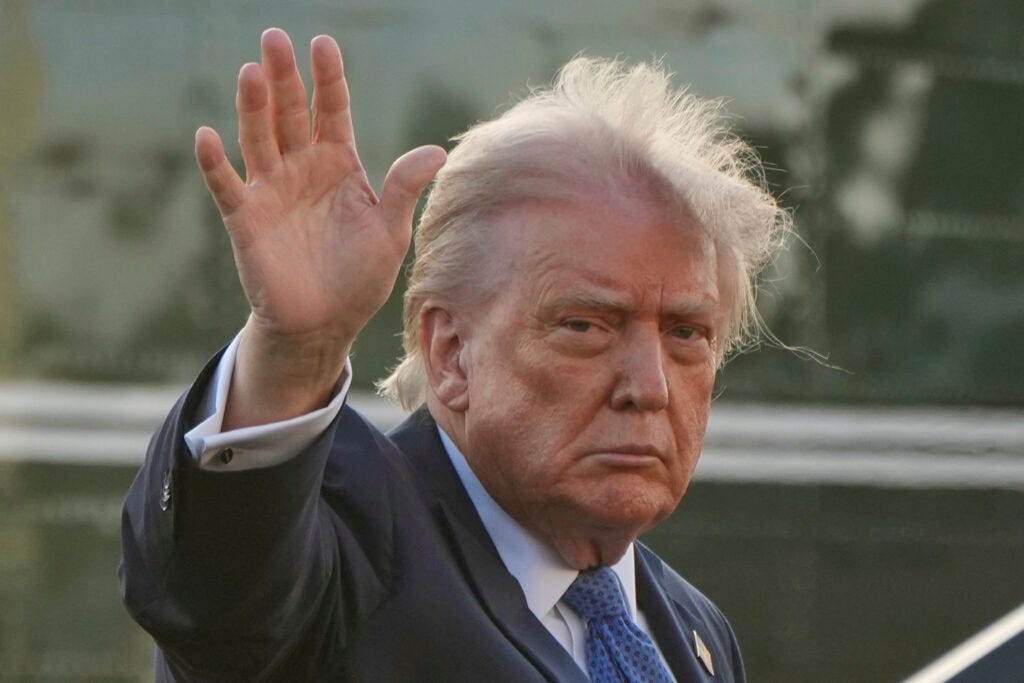
Imagine if news broke when President Obama was in office that a well-known bank had closed 385 of his bank accounts because of red flags he was involved in money laundering? Add to that, the info was based on court filings by that large bank where they certified under oath that the red flags were observed by people with “decades of law enforcement experience” in the area of money laundering.
That would of course have been a huge news story. Corporate media would be asking President Obama and the bank for comment. Plus every Democratic and Obama official going in the media would be pressed to respond to it and more. Yet when those identical facts became known about Donald Trump earlier this week, the media choose to barely cover it.
Instead, as former federal prosecutor Glenn Kirschner put it in our conversation on this issue, “the corporate media just shrugs and then they chase the next crazy meme he posts with him being next to General Patton and General MacArthur.” And in fact, corporate media covered that AI generated Trump meme arguably more than they did Trump’s money laundering!
But this issue demands far more attention. And ironically it only came to light because of lawsuit by Trump where he was trying to shake down money from Capitol One bank over their closing of his bank accounts in mid-2021. Trump’s lawsuit against Capitol One-- filed only after he was back in the White House in 2025 so he could have the weight of the government behind him—claims that 385 Trump related accounts were closed for partisan reasons. (Who has 385 accounts at one bank?!)
In response, Capitol One filed a motion to dismiss the lawsuit that revealed for the first time the details of why they closed Trump’s account—and that was the money laundering red flags. As the brief filed by Capitol One explains, “The closures were the result of months of analysis and a careful review by Capital One’s AML [anti-money laundering] team in accordance with bank policies and regulatory guidance.”
The legal filing continues that Trump’s claim this was all a pretense is absolutely incorrect. Instead, they wrote to the court that the plaintiff [Trump] “cannot meaningfully criticize the robust process undertaken by Capital One’s AML professionals with decades of law enforcement experience in deciding to close the accounts.” Yep, the decision to close the accounts was based on an investigation with “decades of law enforcement experience” in this specialized area. To bolster this, Capitol One specifically notes
Yep, they focused on bank rules dealing with “money laundering and terrorist financing.” While Capitol One did not detail exactly what was concerning about the Trump accounts, Appendix F they cited provides a long list of “examples of red flags to inform and assist banks in reporting instances of suspected money laundering, terrorist financing, and fraud.”
These red flags include the following:
-Funds transfer activity occurs to or from a financial secrecy haven, or to or from a higher-risk geographic location without an apparent business reason.
-Large, incoming funds transfers are received on behalf of a foreign client, with little or no explicit reason.
-Funds transfer activity is unexplained, repetitive, or shows unusual patterns.
-Payments or receipts with no apparent links to legitimate contracts, goods, or services are received.
- Items shipped that are inconsistent with the nature of the customer’s business (e.g., a steel company that starts dealing in paper products, or an information technology company that starts dealing in bulk pharmaceuticals).
- Multiple high-value payments or transfers between shell companies with no apparent legitimate business purpose.
Again, Capitol One did not reveal which of the above red flags caused the former law enforcement officials to recommend closing Trump’s 385 bank accounts. But as law professor Jen Taub—author of a book on white collar crimes—explained to me, a bank would not close these many accounts and lose the income associated with it unless something was truly alarming. She shared that it was likely Capitol One became wary of what Trump was doing before 2021 but didn’t want to close his accounts while he was President—so they waited until he left office.
As noted in their pleadings, Capitol One kept the reason for the closure of Trump’s account a secret from the public. They simply followed the rules of their institution—that all account holders agree to—and informed Trump the accounts were being closed. From there they gave the Trump companies months — together with several extensions — to move their money elsewhere. That is what Trump did so there were not even any damages.
But with Trump back in the White House, he has used lawsuits to shakedown media outlets, banks and more. That is what we are seeing play out here.
After Trump leaves office, we need the new Attorney General to investigative if Trump has been engaged in racketeering with this scheme. That would empower a prosecution under the RICO statute.
When you look at the details of this case, you must agree it demands far more coverage. Yet I have not seen one Republican member of Congress asked about on cable news. Nor have I seen reporters pressing Trump or Capitol One for more details on the red flags they found of Trump’s money laundering.
Once again, corporate media either is on board with Trump’s agenda or fears losing access to him. In either case, it’s up to independent media and citizen journalists to fill that role to inform the electorate of what is really happening!
Hope you check out my conversation with Glenn Kirschner. You will hear details corporate media refuses to cover:
Comments
Nothing yet. Say the first thing.
Sign in to join the conversation.