
Welcome to Dealmakers with Alex Segal ✍️, a Substack on the realities of being a talent agent, packed with weekly insights to keep you ahead of the game 🚀.
Having negotiated £40m+ in talent deals 💼 and grown company turnover 5x in 5 years 📈, I am sharing my experiences and knowledge of 17 years representing some of the biggest stars in the UK.
Dealmakers is read by key individuals at the BBC, ITV, Netflix, UKTV, Sky, Sony Music, and other major entertainment companies, as well as all of the UK’s leading talent agencies.
If you want to negotiate better deals, sign better clients, and build a standout career in talent management, and you’re not already subscribing, please do, and join everyone who gets Dealmakers straight to their inbox 📩.
You can also follow us on Instagram & join our WhatsApp Channel 🙌.
Free subscribers receive The Dealmakers Playbook 🚀 & Weekly Industry News 🗞️.
A paid subscription gets you:
✓ LOTS more agent intel with Ask The Agent 🧠
✓ My Q&A with VIPs 💡 series with industry stars
✓ 50% off all of the Dealmakers Deal Sheets ✨
✓ PLUS the actual Secret Toolkits 🔥 I use daily to stay one step ahead
The Summer Subscriber Discount is now on. Grab 50% off and pay ONLY £2 per month or £17.50 for the year.
Get Your Summer Subscriber Sale Here
What should I be asking for in this deal? It’s the question I get asked more than any other.
Acting agents negotiating their first podcast deal. Creator agents doing their first TV contract. Performers representing themselves with no idea where to start.
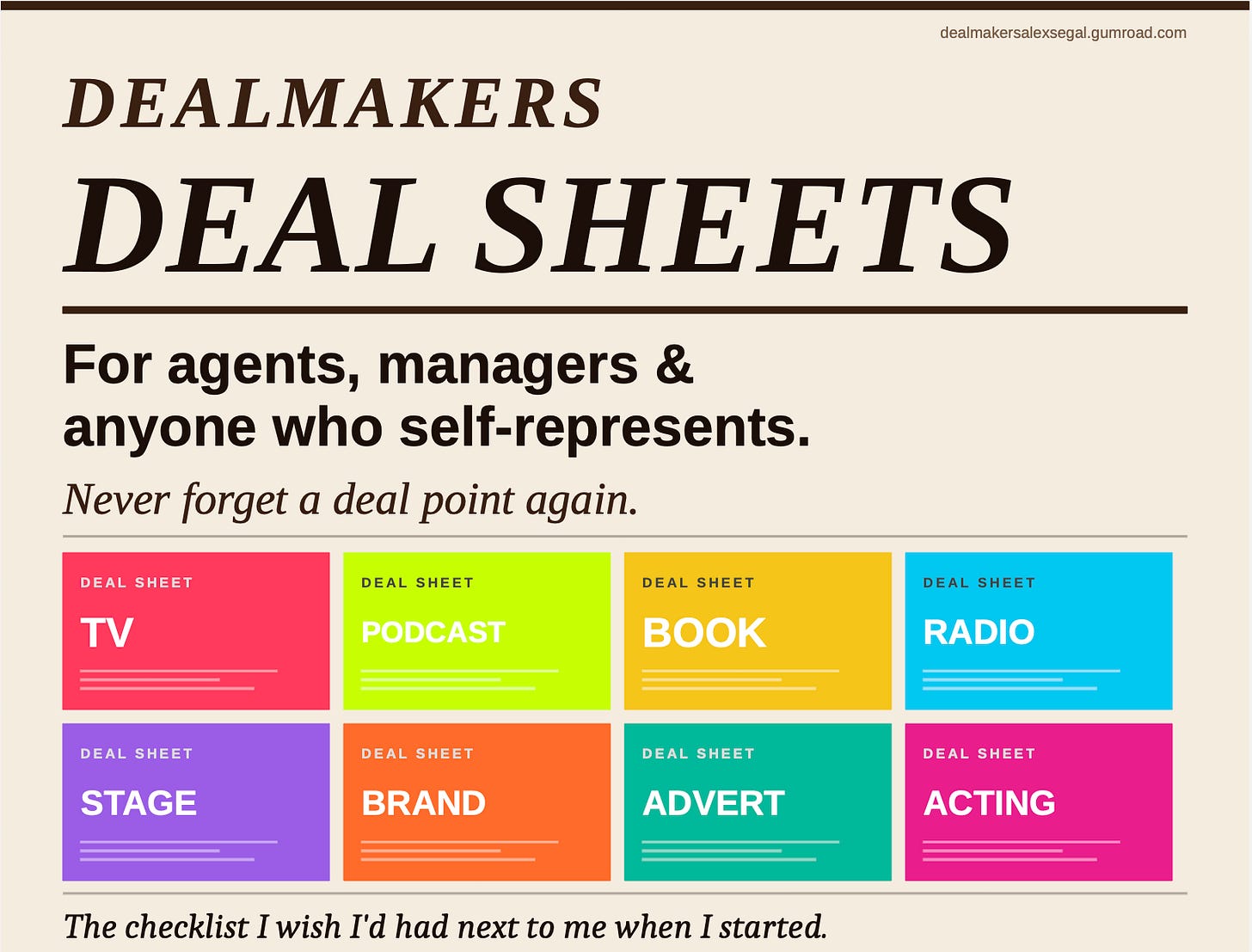
If you want to make sure you never miss an important deal point again, then grab my 👉 Dealmakers Deal Sheets ✨ and use code DEALMAKERS20 for 20% off 🎟️.
I’ve just got back from my Summer holiday in Spain. It was absolute bliss, and I spent my time alternating between the pool and the beach. After a relentless first half of 2026, it came at just the perfect time to recharge my batteries.
I was lying on a sun lounger scrolling through my emails, and my eyes locked in on one about a potential show I had been waiting on for a client. I had been waiting forever. No news for ages. Typically, the week I go away, it pings into my inbox. I open it up, and my eyes scan and clock onto the news: ‘Sorry, but we’re not going to be moving forward.’ Gutted. Straight away, I said out loud to myself, ‘He needs a job!’ It made me laugh. Without ever realising it, that one phrase had been etched into my brain forever more since it was used daily, repeatedly, by my old boss over a decade ago… and here I am years later still saying it.
My mind suddenly drifted back to those assistant days.
I’d had a short intern stint at Curtis Brown in 2007 just before I went to study at the Royal Central School of Speech & Drama to do a MA in Theatre Producing. I fell in love with agent life at Curtis Brown but went to Central (an extremely prestigious drama school) and came out to try my hand at theatre production. I didn’t like it all that much.
I wanted to go back to a talent agency.
I interviewed for what felt like forever before landing a job at one of my top picks: Artists Rights Group (ARG for short). An agency founded by the incredibly successful Sue Latimer, who represented major stars including Daniel Radcliffe, Liam Neeson, James Nesbitt, Lesley Manville, Lesley Sharp, John Hannah, Toby Jones, Adrian Lester, Alison Steadman, Imelda Staunton, and many more, including her son Freddie Highmore. She had represented them all for years before I turned up in 2009 and, guess what, she still represents ALL of them today. That kind of loyalty and longevity is extremely rare in this business. That is the sign of a phenomenal agent.
I started at the company with a different agent who had her own excellent client list. A few months in, that agent was let go. Sue then decided to let many of those clients go too, as there wasn’t an agent available for them anymore. I had no boss and no clients, so I assumed there would be no need for me. I was toast. I thought my amazing new job was going to be over before it had barely started.
To my absolute surprise, Sue told me she wanted me to stay and work for her. I didn’t see it coming. I was both scared and excited at the level of work and the calibre of actors I would be dealing with daily.
I never wanted to let her down. I wanted to prove myself to her every day and show that I had a future in this. She was demanding, as she should be (often scared the life out of me); ARG represents some of the best actors in the world, and you need to be on your A game every single moment of every single day. I actually created my first-ever Deal Sheet back then to ensure I never missed an important negotiation point that she taught me. I couldn’t afford to miss anything. I still use my own Deal Sheets to this day, hence why I have released them for you all to have. Sue was also very kind to me. She took the time to train me and explain why we do things the way we do. We had a great bond, except when we were discussing our Spurs & Arsenal rivalry.
I got to assist Sue and all of these incredible clients who I got to work with on a daily basis for over 3 years. It was one of the greatest times of my life. It was full of long hours, endless weekend script reading and a very high level of work, and it never left any room for error. It was a level of intensity I hadn’t experienced before… BUT it was the greatest talent agent education of all time. You can’t pay to get the education of being taught by Sue Latimer every day of the week.
Without that education, I wouldn’t be the boss of a major talent agency today.
I also wouldn’t be writing this Substack, as I wouldn’t have even half of the knowledge, skills or experiences to pass on.
It took me a long time to decide to leave ARG. I felt inner conflict for months. It’s hard to leave somewhere like that. In the end, it felt like the right time to take everything I’ve learned and become an Agent at another top company to see if I could make a name for myself. My time at ARG gave me the most amazing start. I’m a lucky boy. I really appreciated every opportunity Sue gave me. It ended a little funky, like these things sometimes can, and I’ve only seen her once since I left (at the BAFTA’s two years ago). It was great to reconnect briefly and catch up. I hope she’s proud of me.
Those three years left me with a lifetime of wisdom.
Little rules, phrases and principles that were drilled into me while I assisted on everything from Daniel Radcliffe’s life on Harry Potter to Adrian Lester on Hustle, one of my favourite TV series.
I still use them today. In fact, I’ve probably passed many of them on to every assistant I’ve had since.
So now I’m passing them on to you.
Let’s go. ↓
Oh, and just to really set the scene, here I am in the kitchen at the old ARG offices in Oxford Circus just before a film premiere. 17th April 2012. Where has the time gone? WHERE HAS MY HAIR GONE?

Cut to last month on the beach at Cannes Lions…

Have I changed much?!
So, here are some lessons that one of the most powerful agents in the world passed onto me:
💼 Needs a job. I may as well start with the one that set this post off. Needs a job! Sue loved to have everyone’s schedules printed on paper and updated weekly. We would sit down in her office and go through them client by client. Every time we moved onto the next client, she would either say ‘Needs a job!’ or she would say ‘Will soon need a job!’ It was never ‘in a job’. She was never content. Sue always knew that no matter what the diary said, those projects would end and what’s next? I still do this now. I go through clients with my assistant and just repeat ‘needs a job’, ‘needs a job’, ‘needs a job’, no matter what they’re even doing. It’s built into me that the end date will arrive whether it’s tomorrow or in 2027, and that the client NEEDS A JOB! It keeps your feet on the ground and never resting on your laurels.
🗒️ No post-it notes. Post-it notes were banned. I never used them then and still don’t use them now. I remember being told to never write anything important on a Post-it note because they lose their stick and get lost so quickly. They’re now banned with me too. Someone who used to be my assistant 8 years ago always tells me that he still doesn’t use them after I drilled it into him. Never write anything important on something that can easily get lost. Yesterday, I asked an old colleague who worked with me at ARG back then and is now an outstanding literary agent, and she said, ‘Haha, I definitely stick by no Post-it notes!’
🔎 The little things matter. We’ve all been there. An annoying and small task that you can’t be bothered to do. Sue would not mention it for weeks. I’d assume it wasn’t important, then BAM. She asks… and I hadn’t done it. I looked silly. A small thing she asked weeks ago, and I hadn’t done it. She always used to tell me that everything is important. Small stuff as well as big stuff… and even if I don’t realise its importance or it doesn’t seem important, there is a reason she is asking me to do it and that clients often will leave you when you mess up the small stuff, not just the big things, as that’s how they lose trust. Clients like to know that you’re busy but also want to feel like they’re your only client. The small jobs are important. The typo on their website bio or not forwarding on an event invite in time are as big as mucking up a contract.
⚡ Fast and thorough. My to-do list was a mile long, always. I had to get through everything in one day. If I rushed, I’d make a stupid mistake. If I took my time, triple-checked everything, or asked a colleague to check it over, I barely got through anything and that looked really bad. So I had to hone the art of being speedy but efficient. Never rushing, never taking shortcuts, but I was taught that in this job you have to move through your to-do list fast (as it grows as the same speed) without dropping the ball. Being thorough was paramount, but being fast was also important.
🕵️ Get to the truth. It was always important to really find out what the situation was before talking to the client. What does ‘interest’ actually mean? Who is interested? What happens next? Will it be an offer? Anyone else in the mix? We never wanted to be in a situation where a client said ‘what does this mean?’ or ‘ what happens if I like it?’ and we didn’t know the answer. We always had to second-guess what the client would say and be one step ahead of them at all times. Albeit, responding honestly by saying ‘I actually don’t know, I will find out and come straight back’ was always a better move than guessing. We all know what happens when you guess… or just make it up!
🚫 The need for a no. Always get the no. I go back to the beginning of this post, still fighting for an answer on a job, even if it’s a no. A project being left unresolved is a failure from an agent’s point of view. The client will always remember. Don’t leave anything unresolved. Bad news is still news, and that’s important for your clients who are waiting for answers.
☎️ Pick up the phone. The art of calling someone seems to be dying. Not when I worked at ARG. Emails were only used to really confirm things. All conversations, negotiations, creative chats and client discussions were on the phone. Your fear of someone listening to you on the phone disappeared after one day in the job. To speak to the calibre of clients the company had every day was an absolute honour. Email would never have been as fun. I also had to speak to some of the biggest casting directors, producers and agents in the world. It’s only when I look back years later that I realise how lucky I was.
⚖️ It’s an important responsibility. I always remember being told that signing a client is a huge responsibility. Their work, income, family, rent, mortgage, car etc isn’t entirely on you, but it’s a huge responsibility, and you have to work hard for them every day. I never forgot that. I always came into work ready to give my all for these people. I still do. I tell my team, if you ever don’t feel like you can achieve for a client, the worst thing you can do is to keep representing them. To manage someone is a big thing to say and do. You have to fight for them all day every day, through the highs and lows.
Free subscribers receive The Dealmakers Playbook 🚀 & Weekly Industry News 🗞️.
A paid subscription gets you:
✓ LOTS more talent agent insight with Ask The Agent 🧠
✓ My Q&A with VIPs 💡 series with industry stars
✓ 50% off all of the Dealmakers Deal Sheets ✨
✓ PLUS the actual Secret Toolkits 🔥 I use daily to stay one step ahead
📥 Get in touch with me alex@intertalentgroup.com
Comments
Nothing yet. Say the first thing.
Sign in to join the conversation.