
I’m sure you’ve heard it all before…
“Study and copy out (preferably by hand) great writing.”
“Learn the rules (so you can break them).”
“Write every day.”
It’s all good advice.
But here’s what most teachers of writing leave out…
When we read great writing, we simply nod along, affirming its greatness and believing we understand it.
It’s passive. There’s no engagement.
Instead, after you’ve read the headline, or the opening, or even the entire ad, sales page, or script, try coming up with it yourself. See where you struggle, even hit a dead end.
Then, when you go back and see again how the master did it, it’s a revelation. You’ll see not just rhetorical brilliance, you’ll see how skillfully the writer put the pieces of the puzzle together — because you yourself struggled to assemble them.
Even a less-than-impressive attempt will teach you something copying can’t: You’ll see clearly where your skill and the master’s part ways, and what you need to do to bridge that gap. Your “failed” effort will shine a light on the master’s moves. And make them unforgettable. (Learning scientists call this “productive failure.”)
In short, you can’t fully appreciate a solution to a problem that you’ve never felt as a problem.
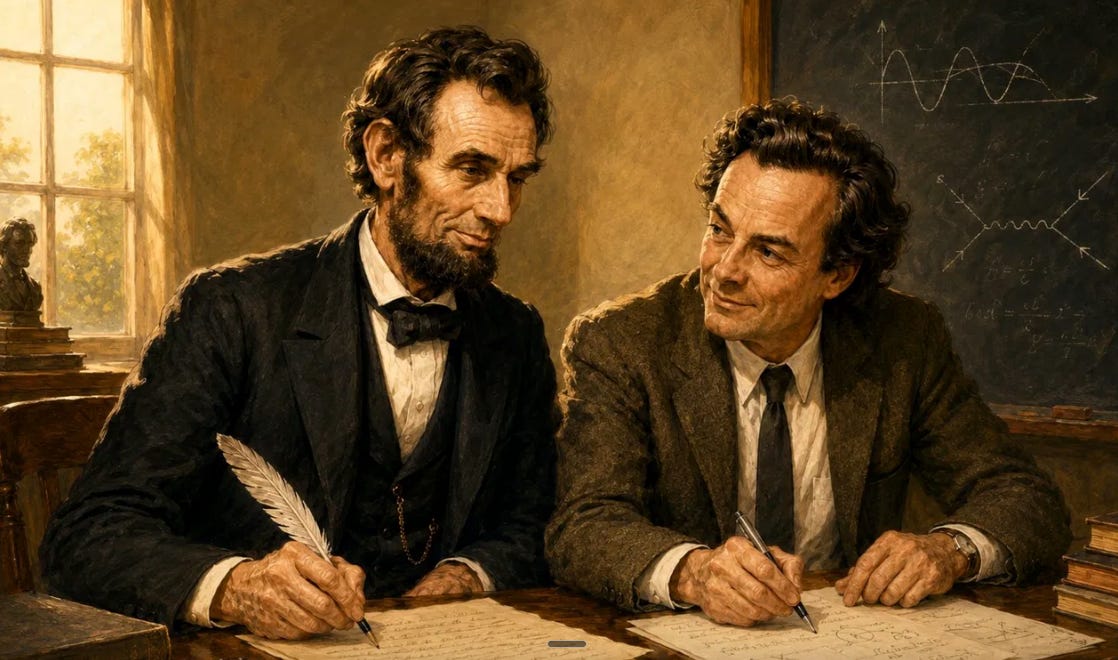
This is why Richard Feynman, the great physicist, admonished his students to “Learn how to solve every problem that has ever been solved.”
And it’s why, when Lincoln wanted to sharpen the logic of his rhetoric, he didn't just read Euclid's Elements — he painstakingly worked through the 173 proofs in the first six books himself until he could prove them all. (Study his speeches and see for yourself the mathematical precision of his logic.)
Want to write with the clarity and power of Hemingway? Don’t just read him — try to be him and get into his brain. For example, read over the deceptively simple opening to his novel A Farewell to Arms a few times:
In the late summer of that year we lived in a house in a village that looked across the river and the plain to the mountains. In the bed of the river there were pebbles and boulders, dry and white in the sun, and the water was clear and swiftly moving and blue in the channels.
Now put it away and try to write it out without looking. Not so easy, is it? What did you leave out and why? Was your version more labored, more awkward? What did Hemingway do that made his stripped-down prose so simple, smooth and unpretentious, yet ring so emotionally true?
Want to write copy like Gary Halbert? Sure, hand-copy some of his great ads. But then put them away and try to reproduce one without looking. What was that headline and lead that seemed so obvious when you first read them? Why is it so difficult to find? How exactly did he grab our attention, ignite our interest, fan our desire, and have us reaching for our wallets?
After you go back and see how Halbert did it, you learn not just what he did — you see his solutions to dozens of problems along the way.
Some writers read and study great writing for years, yet never grow to their full potential. Now you know why.
They’re like someone who goes to the gym and just studies other people exercising. They never put on muscle because they never do the reps themselves.
No posts
Comments
Nothing yet. Say the first thing.
Sign in to join the conversation.