

Stop the madness.
Some people believe AI is the way to go when it comes to copywriting. It’s fast. It’s good enough. And have you heard? It’s getting better every day.
Others swear by human copy. Heart to heart. Real empathy and emotion. Hand-crafted the old-fashioned way.
Businesses are firing copywriters. Re-hiring copywriters. Some are going all-in on AI copy. Others are banning it.
So who’s right?
Neither, it turns out.
Let’s stop speculating and see what the numbers have to say.
Spoiler alert: To some extent, for human versus AI, the results depend on the context and on what’s being tested.
For example, tests show that we humans do somewhat better on Google and Meta campaigns when you look at click-through rate and conversions. And in a Search Engine Journal ad study, when ads require a bit of nuance, emotion, or differentiation, we trounce AI by almost 50%.
And it probably won’t come as a surprise that studies find AI copy tends to be clear and on topic, but generic and not as emotionally compelling.
In short, if an ad has to change a mind or ring up a sale, a human is your safer bet.
Got lots of low-stakes product descriptions that need to be written? Then AI is your guy. Give it the low-stakes, high-volume tasks.
Tests on ecommerce/product pages show that AI product descriptions lifted conversion compared to human-written descriptions. In fact, in one case reported by Ritner Digital, AI descriptions produced a conversion lift of more than 20%.
However, these same sources are quick to note that it’s a completely different story when you move from product descriptions to sales pages and emails that require persuasion and selling.
Fortunately, some of the testers included a third option. And here’s where it gets interesting.
“Hybrid” copy is where AI drafts, a human edits/rewrites, AI has another go, and a human does a final pass.
AI brought structure, clarity, and speed. Humans: emotional hooks, specificity, and real differentiation.
No wonder the hybrid model consistently outperformed, resulting in the best combination of engagement and conversion.
And it took only 30 minutes to create (versus 15 minutes for pure AI), while pure human copy took a whopping four times as long (2 hours).
To use AI most effectively, it’s important to know how people perceive AI copy.
Yes, they’re increasingly sensitive to it. Especially pure AI copy in large batches.
But when it’s served up in short blurbs on specific topics, people sometimes rate it as clearer and more polished. (Especially when they are not told it’s AI copy.)
Where AI was found to come up short is in critical thinking and logic, originality, and contextual judgment, with perception studies showing human‑written content scoring dramatically higher on trust and brand resonance than AI‑generated pieces.
Negative reactions to AI copy are more about feelings than em dashes: without a human in the loop, people feel the lack of depth, the lack of point of view, and the lack of real insight.
The more your copy has to think, feel, and sell, the more it needs a human brain.
The more it must describe, summarize, or scale, the more a machine can help.
And the best results show up when you deliberately mix the two instead of declaring one side the winner.
Just be sure to use the right model for the right job. Simply put, the more money, trust, or reputation is on the line, the more you want a human at the wheel and the machine in the passenger seat.
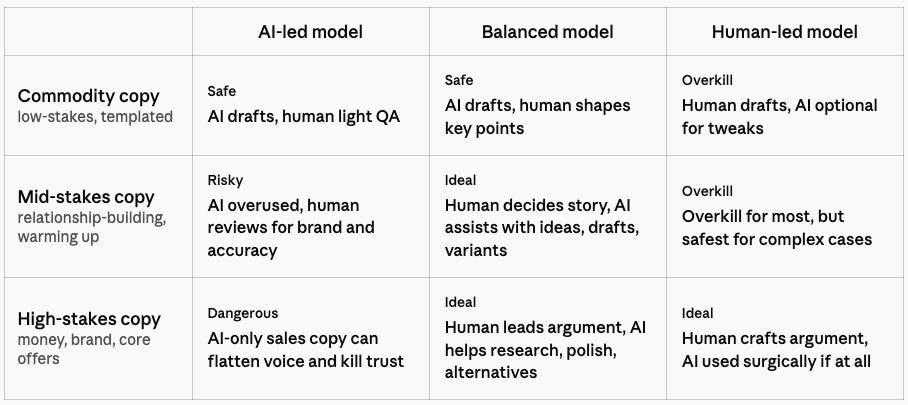
Let’s say you sell coaching, courses, or services.
Your commodity copy may be show notes for a podcast, video descriptions, social captions, or simple announcement emails. It’s probably safe to let AI handle some or all of this.
Mid-stakes work is evergreen nurture sequences, authority-building articles, or webinar opt-in pages. This needs more human participation.
And for high-stakes work such as a core sales page, launch email sequence, or webinar pitch script, human-led is the way to go.
Above all, you don’t want to look at AI as just a copy generator.
Think of it as a fast junior assistant, happy to brainstorm headlines, summarize research, draft up a rough product description, or turn one email into three.
You do what you’re best at: deciding what the argument is, where the emotional turns go, what has to be said, and what has to be cut.
Be AI’s creative director. Don’t let it become yours. Because when you swap roles with it like that, the number gods are often unforgiving.
When I work with coaching and consulting clients these days, a good part of my job is not just to instruct on how to use AI, but to show when to stop listening to it…
Before it flattens your voice into something your audience has already seen a hundred times this week…
And before you waste your time on copy that AI could do more effectively. Or misuse AI on parts that still need human involvement.
If you’re curious what the most effective model might be for your business, send me a DM and let’s talk.
No posts
Comments
Nothing yet. Say the first thing.
Sign in to join the conversation.