
Over the last three seasons, the Dallas Stars have been possibly the most well-rounded team when it comes to the other 20 percent; that 20 percent of the game that is played with a man advantage on one side, shorthanded on the other. Since 2023, Dallas is functionally top five in both categories. In terms of what makes a true contender, at least in a statistical sense, being top 10 on special teams is part of the checklist.
Yesterday we looked at the other 80 percent: analyzing Glen Gulutzan’s unique season in the context of a systems change, roster construction, strengths, flaws, etc. For now, it’s worth giving Gulutzan his flowers on this front. While he is on record as giving his assistants the reigns — just as he was given them in Edmonton — I have to suspect there is some level of collaboration, however minor. Whether it relates to tactics, deployment, analytics, I doubt Neil Graham and Alaine Nasreddine exist in a bubble. But even if they do, that won’t change the analysis for today.
I’ve long since begged for some genuine special teams analysis as it relates to winners. What kind of special teams traits do champions have in common, beyond just their PP/PK ranking? Which side can be overcome; or rather; which side can have imperfections? We won’t go down that rabbit hole, but the only team to really buck the trend in recent years is Vegas. They fell well outside of the top 10 on the PP/PK in 2023. But here’s the kicker, and why you can’t be fooled by outcomes: they were top 10 when looking at their shot quality generated per 60 on the PP, and shot quality allowed per 60 on the PK.
Which brings us back to Dallas. On the surface, they were great. Their power play was 2nd in the NHL (1st in shooting percentage, it should be said). The penalty kill was a different, more complicated story. They were 13th in the NHL, converted on at an 80.3 percent clip. However, they were top 10 in expected goals against per 60 per NaturalStatTrick. Micah Blake McCurdy’s model rated them a little higher, with the two groups being equally elite.
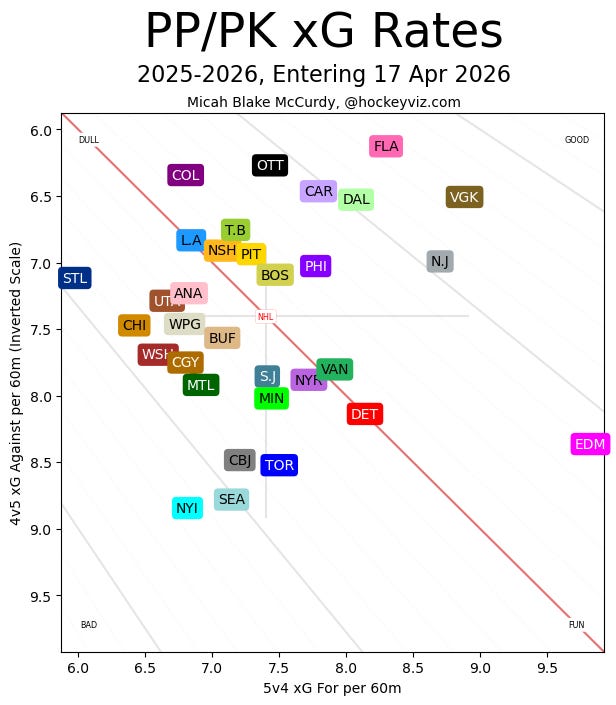
This pattern largely held true for Dallas even in the playoffs, where they were the top team on the power play, converting at a ridiculous 40 percent clip. The PK, like in the regular season, lagged behind, ranking 7th. But let’s dig deeper and grade them accordingly.
With a nicely done 69 goals scored, Dallas ended up 21st out of 584 rosters since 2007. That’s how good they were. When adjusted for minutes, they made it into the top 10 at 10.61 PP goals per hour of man advantage play. The Stars were a wagon and a half. But we know that already. How did they do it?
McCurdy has a handy, unique little shot pattern chart that shows us the average time between shots, and the average shot quality embedded within them, revealing the broad philosophy of each team. Are they patient, striking with intention and precision (the needle) rather than intention and percussion (the sword), or are they impatient yet impotent (feather) versus impatient and sloppy (the club)? The Stars were the needle through and through.
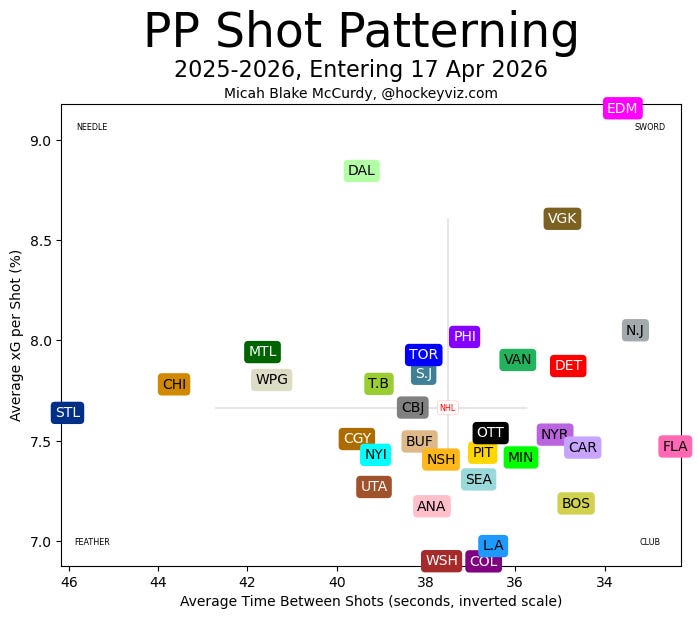
How they did it is simple: Neil Graham. As we saw with Steve Spott under Pete DeBoer, Dallas had a strong power play, but it was also predictable. And so it predictably struggled as teams were able to gameplan against the lazy point shots and inability to get inside more (to say nothing of the disaster that it was early on when Spott had Miro Heiskanen and Jamie Benn punting opportunities). Graham ditched the old schematics. Though controversial at the time, taking Thomas Harley off to give Miro Heiskanen his old role paid dividends, as his point presence became about pure facilitating, with a focus on getting Wyatt Johnston the puck in the homeplate area of the ice.
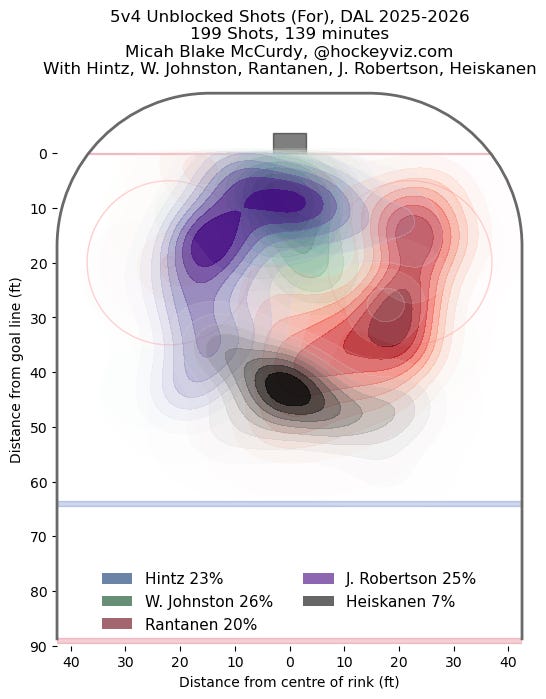
As you can see, it was a smashing success, and not just for Johnston to make Stars franchise history. And it was a success no matter who was out of the lineup. There were times when injuries forced Harley and Matt Duchene into the top unit, and none of it ever mattered. That’s the sign of a well-coached power play. The fact that they didn’t skip a beat versus Minnesota tells me that Dallas needs to protect Graham at all costs. If you missed the film room analysis, then don’t!
Funnily enough, I don’t think the PK was really that bad. Yes, ranking 13th is well below their previous standard, but if we just focus on the performance itself — their ability to prevent both shot quantity and shot quality — then we see that Dallas was in fact, one of the best; a title they’ve held for years under assistant coach Nasreddine.
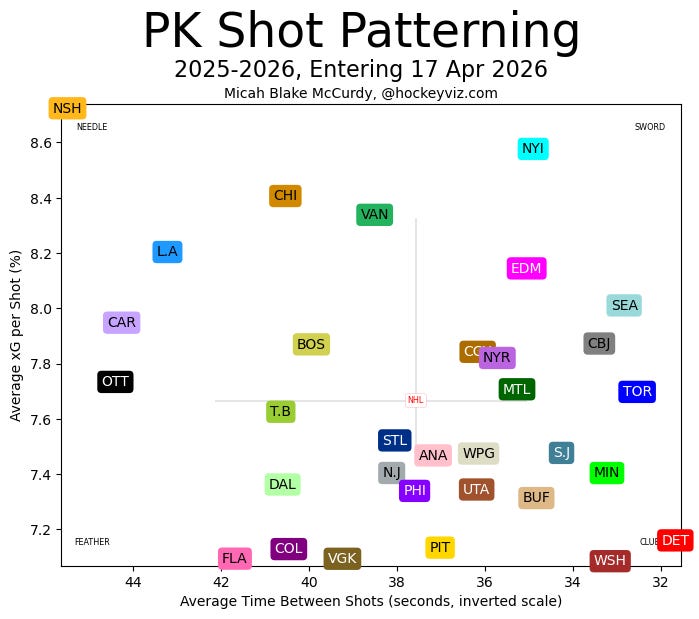
If they were so good, then what happened? Goaltending. At even-strength, Jake Oettinger and Casey DeSmith were solid, ranking 19th and 8th, respectively, among goalies with at least 500 minutes. However, shorthanded those ranks changed to 45th and 37th, respectively.
I don’t have a problem chalking this one up to volatility in net. After all, the personnel in Dallas has been more or less the same, and Nasreddine has been here for four years now. In all that time, the Stars were elite. Although it’s not without some asterisks. Not only did goaltending create some noise, but in the playoffs, Dallas’ top two forward penalty killers, Radek Faksa and Oskar Bäck, were duds in the faceoff circle. Faksa in particular got burned, and burned hard, with a -27 in faceoff differential. As good as the penalty kill was, it wasn’t perfect, and it’s okay to hold that against them when the bottom line is to avoid being scored on.
However, just because there’s valid criticism doesn’t mean there are broader takeaways here. A lot of this feels more like variance when you consider the history of these players and these units. We’re not looking at exposed cracks in the foundation here.
Don’t fret. Minnesota had a top three power play, so seeing Dallas’ numbers bend but not necessarily break in the postseason is a good sign, especially considering the season in net on the PK. The power play just looks and feels unstoppable. Really, it’s the hockey gods who may be the only ones with the power to stop Johnston in the slot.
All in all, special teams was and is an area of considerable strength for Dallas. Don’t expect that to change this upcoming season.
Comments
Nothing yet. Say the first thing.
Sign in to join the conversation.