
More Harley than Lundkvist.
Cap: $1.25M (Year 1 of 1)
GP: 52
Goals: 3
Assists: 8
Points: 11
Postseason: 2 assists, 2 points
xSPAR: 2.3 extra points in the standings
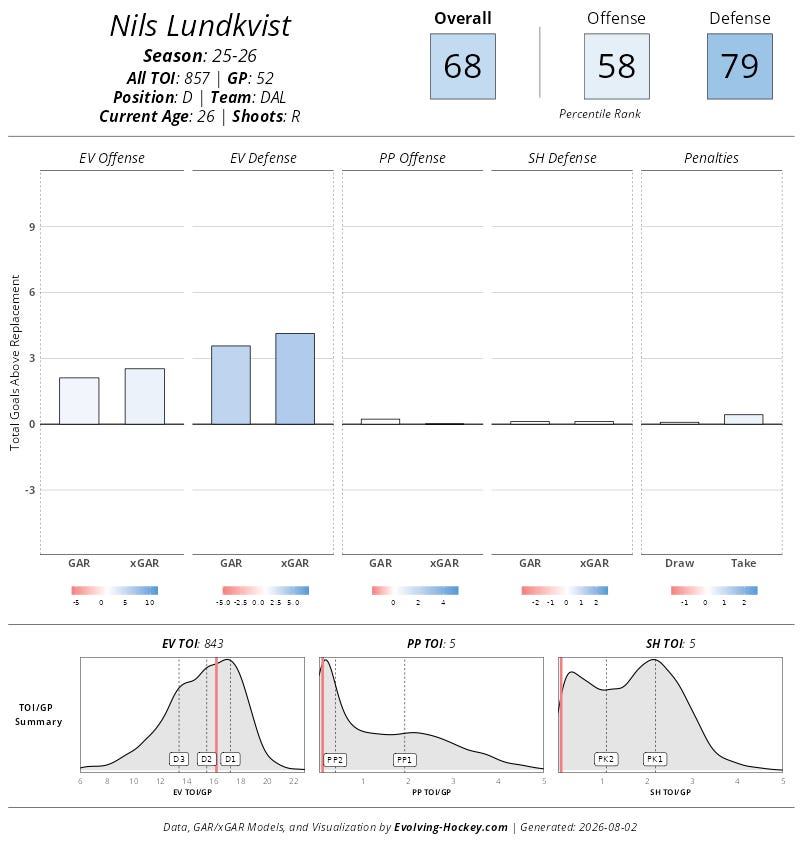
I don’t like using these for defensemen, but Corey Sznajder didn’t have enough tracking data for a player card (although we’ll get to some of the data that was there). In terms of goal, shot, and shot quality impacts, Lundkvist’s numbers looked like exactly what we saw: no weaknesses.
Even with just 50 games (50 seemed to be the magic number this season for the hockey gods; as in, no Dallas Star was allowed to play more than 50 games), Lundkvist showed some polish to his game, and perhaps we should have expected it in retrospect given that he scored in Dallas’ very first game.
Of all the players most likely to level up before this past season began, I doubt Lundkvist was topping the list for most fans. It wasn’t that Lundkvist was bad. It was that he didn’t have a ton of opportunities. Not only that, but it’s worth remembering that the Stars originally didn’t qualify him once he became an RFA. After literal years doing this song and dance where Lundkvist felt on the precipice, only to fall off rather than get roped in, a funny thing happened: not only did Lundkvist level up, but he became a model of consistency — the very consistency that neither his game nor his surroundings seemed to have. Little did we know that Lundkvist’s bet on himself was a sign of things to come.
What’s most amusing is that Lundkvist seemed to accomplish a level of consistency without much help. It was a tough year for Thomas Harley, albeit overblown in some areas, which makes Lundkvist a unique standout for the blue line outside of Miro Heiskanen.
The tracking data doesn’t make Lundkvist look great in terms of being able to transition, but he rates high for his in-zone defense.
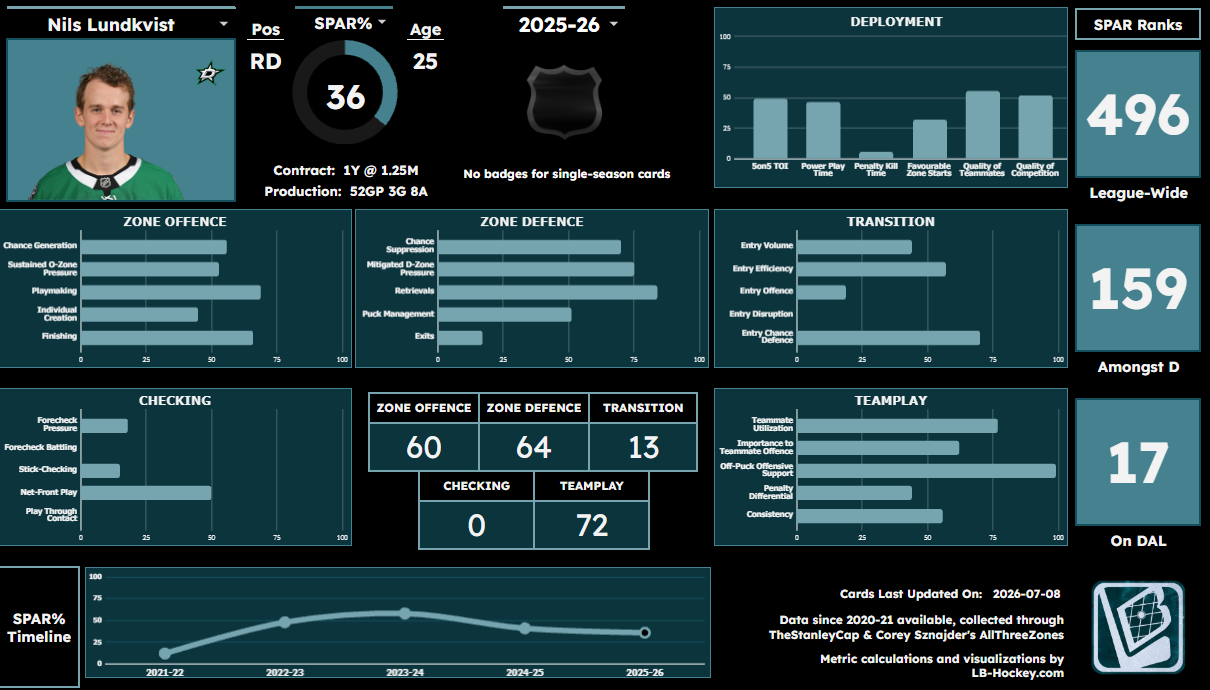
What’s amusing about the data (again keeping in mind that it was limited this season) is that he’s rated high in transition in the past. In fact, much higher last year.
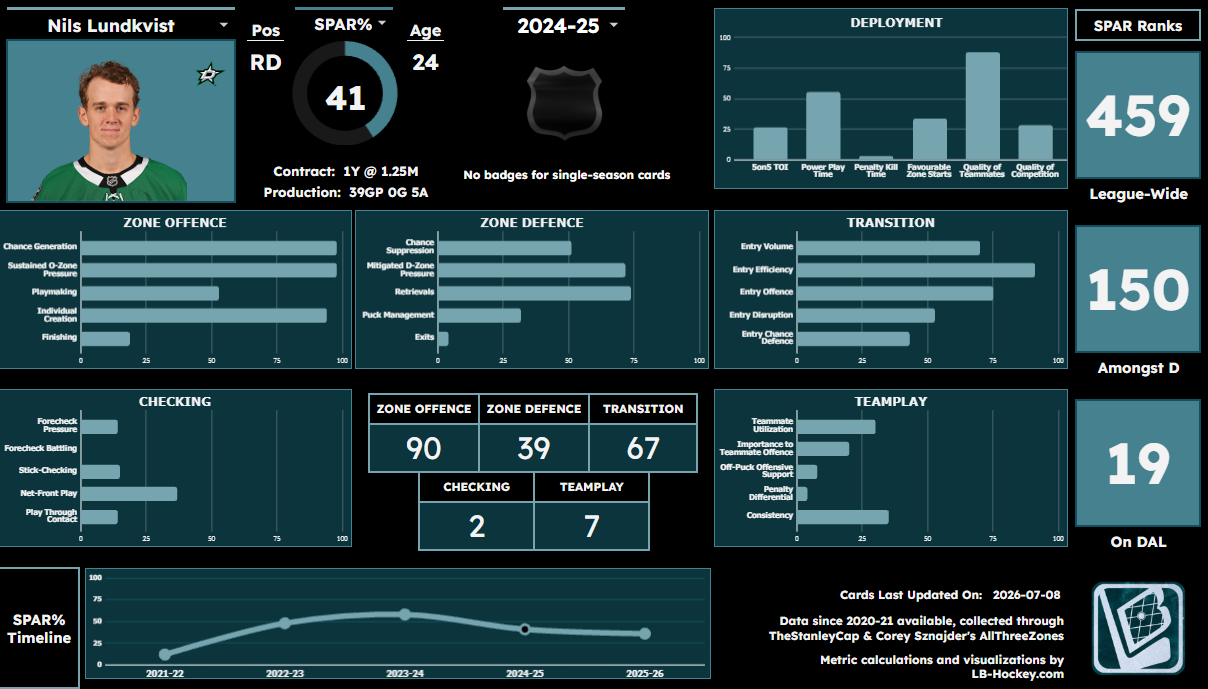
And then higher for in-zone offense the previous year.
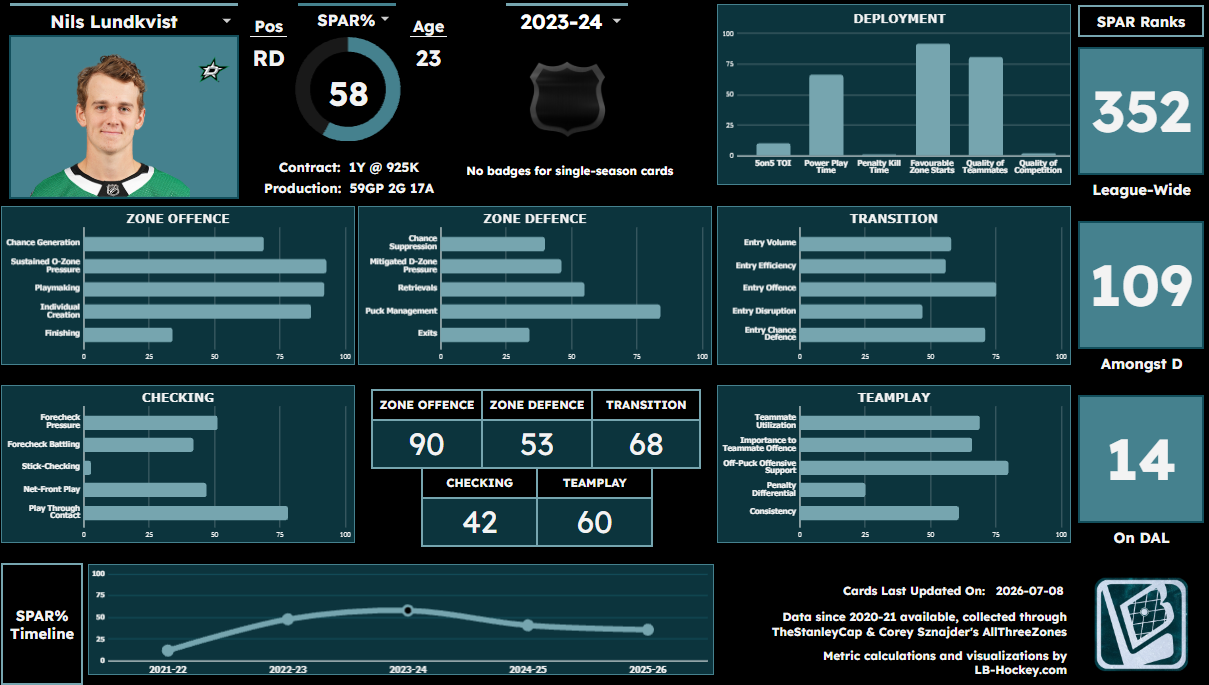
In other words, we’re slowly getting the full Lundkvist experience. There is some transition ability in his game, his offense is high level, and his in-zone defense has gotten better and better.
Despite the erratic season with Harley, the pair was pretty solid, all things considered. They were 52 percent in shot share, and 53 percent in expected goal share at 5v5. In the playoffs, they were even better at 62 and 66 percent in both categories, respectively. Harley and Lundkvist weren’t exactly sheltered either, as both saw a decent amount of defensive zone starts1.
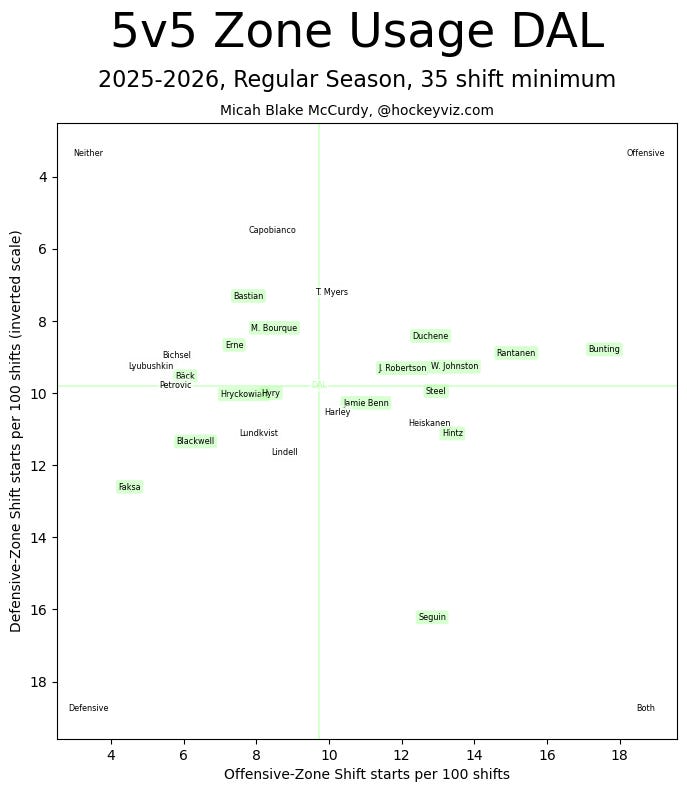
Granted, that in and of itself is open to interpretation. As we’ve discussed ad nauseum, Dallas was a terrible possession team2. This is largely a function of that. For the same reason that an elite possession team like Carolina didn’t have a ton of players starting in the defensive zone much even if they had clearly designated roles.
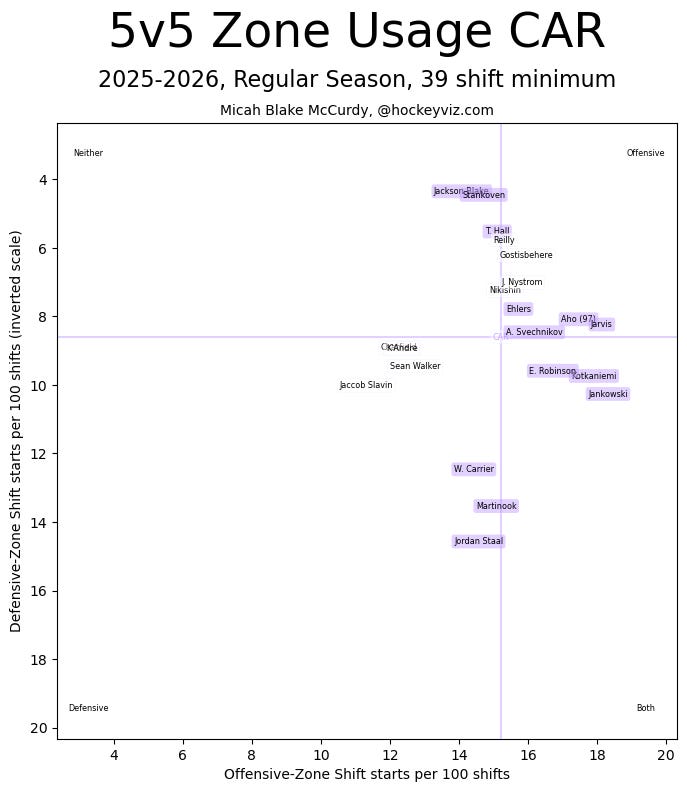
I mention this because it’s possible that Lundkvist and Harley level up next year. And possibly in a big way. The systems change was likely harder on the blue line than the forwards, who could still maintain an offensive rhythm away from even-strength, and on the power play, where they kept their offensive muscle memory warm even if it was ice cold at 5v5. If any of this changes for the positive, few players should benefit more. It’s not just about starting less in the defensive zone, but also being able to work the puck in the offensive zone, which both players do at a very high level.
I’m glad Glen Gulutzan stuck with them. It may seem obvious to some fans, but historically, teams love symmetry over chemistry: the offensive guy with the defensive guy. Harley and Lundkivst were proof — among many others — that two “offensive guys” could still make a solid defense pair. Granted, they still need to prove it beyond just one season. But Lundkvist continues to do his part; a part he’s been developing into for years.
It’ll be interesting to see if anything changes during the season, and how something like the trade deadline affects Lundkvist. The team will still need a right-shot defender down the stretch. If a blue liner like Rasmus Ristolainen becomes available (and he will3), then a team like Dallas seems like the most obvious destination. Regardless, Lundkvist will continue to be worth his contract and then some.
While common knowledge in the analytics community, layfans should still know that “defensive zone starts” is not a proxy for sheltered or unsheltered minutes. More than 60 percent of every player’s shift begins on-the-fly. So “starting in the offensive zone more” does not mean “sheltered all the time” just as ‘starting in the defensive zone more’ does not mean ‘always in the defensive zone’; which is how these stats tend to be interpreted.
By the way. I’m not using strong language to be aggro. They were 27th in possession share. Calling their possession numbers ‘terrible’ is not aggro. It’s just accurate. I see no reason to mince words on that front.
The Flyers are the most obvious regression candidate in the history of obvious regression candidates. No team with Christian Dvorak as one of their top two centers should ever comprise a top 10 shooting team at evens. Florida will be back in the playoff picture, and Washington will knock them out of the running with ease. Money in the bank.
Comments
Nothing yet. Say the first thing.
Sign in to join the conversation.