

Creative Intelligence is a free monthly newsletter about the art and business of color — from trend to strategy to design. Thanks for reading!
I mentioned a few issues ago that my family was going on a long summer bike trip. We did, and it was awesome.
We spent 17 days cycling through Austria, Slovenia, Italy, and Croatia. We swam in turquoise wild rivers, climbed mountain passes on grassy gravel, had gelato for recovery, and wandered corkscrewed streets in deliriously charming towns. We played. We laughed. We opened up. Everything we ate was delicious. Every day held new discoveries. There were challenges but zero type two fun. It was seriously fantastic.
We found that perfect mix of bike adventure and vacation-vacation – for who we are and what we want right now.
Toward the end of our travels, I found myself playing back memories of the trip while I pedaled. Tearing up (because that is what I do) at how good it all was. Marveling at our luck and the magic of it all. At how much I freaking love my little family and how much I love moving my body every day, traveling through a landscape on my own power.
And then, this little data-focused worm wove its way into my head.
Was it really a bike adventure if we only averaged 43 miles and 2600 feet of climbing a day? And we camped 0 times? Our friends were ticking off self-supported endurance bikepacking events with much larger stats. Shoot, we had done harder trips when our son was 4. We’ve lugged liters of water across the desert in our frame bags to dry camp for days. We’ve slept on the ground in 12 degrees, multiple times. We have endured miserable hike-a-bikes through endless blowdown. In the sand. And mosquitoes. We are used to forgoing showers and subsisting on jerky and bars and one-pot meals of pasta with tuna.
If this trip didn’t include any of those familiar bike adventure data points, did it still count? Was it still a bike adventure?
Could I love it as much as I do and still be considered someone who adventures by bike?
Talk about killing my joy.
Getting hung up on data and what has historically defined “bike adventure” for me erased in a millisecond the beauty of this experience.
It robbed my heart.
And then – because I had hours of time on the bike to think, but not too many hours because, as noted above, averaging 43 miles a day – it reminded me of how frequently this happens with color.
So often, brands let data rob their color of heart.
They let sales numbers and historical hits or misses dictate what colors they will adopt in the future. They acquiesce to retailers’ color requests that are based on what is working for their stores, for now. They send out surveys to consumer focus groups asking for validation on upcoming launches and interpret the responses as gold.
They use the same colors from the same areas of the color wheel again and again and again. They stay in their comfort zone.
This is not to say this data is not good information. It is. And, it should absolutely be considered in your color strategy. But it should not be the sole deciding factor.
Color strategy is a science and an art. It is a mix of data and gut, of history and future, of the trusted familiar and the thoughtful risk.
Data sets the framework. It provides the guardrails. But it is just one piece of the pie. Not the whole thing. And, I don’t know about you, but I don’t just want a slice of crust.
Data needs to be balanced with the spirit of your brand and the journey you are on. Data needs to be considered alongside the dynamic ways your brand – and your community – are changing.
Keep what’s true (your data will over and over again confirm this), and evolve what feels like it’s time to change (your data will not show you this or, by the time it does, it’s too late - your customers have moved on to something more exciting).
Think about the you of 5 or 10 or, heck, 20 years ago. What were your preferences for food, music, sport, play? Who were the people you spent the most time with? What was your work like? Your circadian rhythm? Your style?
How much of this has stayed the same, and how much has changed?
I bet a fair amount on either side.
This is what you need to let your brand’s color do. Let it grow.
Honor and preserve your brand’s core values, and give your color the freedom to shift and change. Give it the freedom to accurately reflect who your brand is now.
Don’t let what has worked in the past keep you in a rut that no longer serves you. Don’t let allegiance to data make you stale and unremarkable. Don’t let “playing it safe” play you out of the game altogether.
Don’t make rigid rules.
Instead, explore. Be curious. Consider things like:
Do color families that you have traditionally steered away from feel new and exciting now?
Do different color saturations or values than you typically use feel right for you now? Maybe your brand historically uses a palette of vivid brights, but now incorporating a few pastels or subdued, organic neutrals feels more attuned to who you are.
How can you apply or combine colors in new ways that better reflect your personality or the vibe you want to convey?
Trust yourself. Your brand is unique. Appreciate and love what makes your brand and community special, joyful; what makes you all come alive. Appreciate how this is changing, and embrace what you are moving towards.
This is the heart of what matters. Base your color decisions on this. Because when you do, your color will not only be relevant, but exceptional too. It will be rooted in what works and what’s loved. And, be perfectly timed.
Bottom line:
In color, just like in life, focusing too much on data in your decisions can result in a flat, uninspired, monotonous experience - one without heart or a connection to what is meaningful and memorable now.
Don’t let that happen.
When it comes to your brand’s color strategy: Weigh the facts, trust your gut, and dovetail data with art so the real magic can happen.
Make something truly unforgettable…and sellable.
Tell me how it goes.
Take care,
Dawn Rae
P.S. If you’re curious about our trip, here’s our route, and links to pictures from Austria, Slovenia, Italy, and Croatia. I’m always up for talking about the joy of cycling, especially bikepacking as a family. So, if you’re into that too, reach out!
P.P.S. Think someone else would like this? Share it. I’d love it, and maybe they would too.
This month’s Mini Palette from Daily Life:
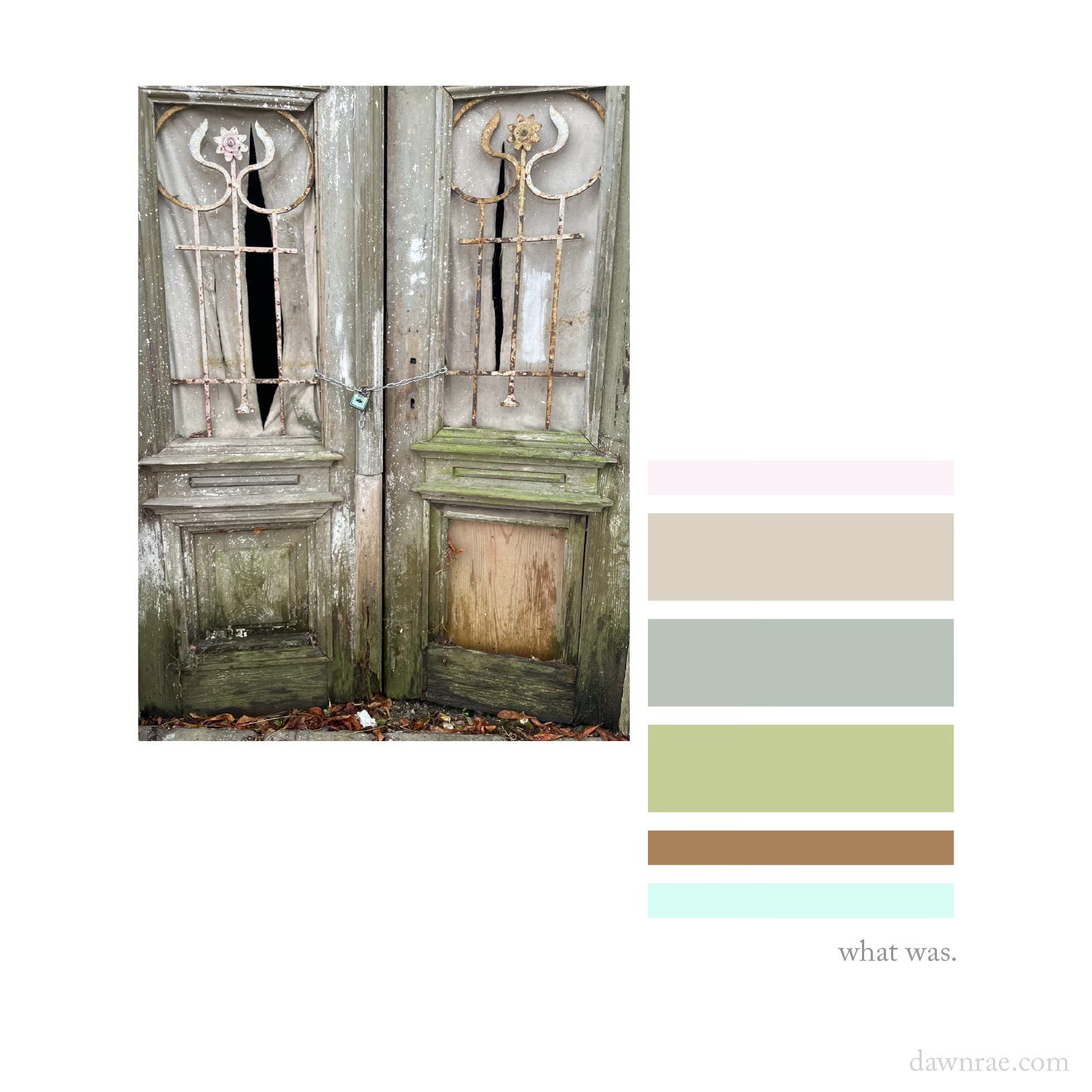
Surprising and lovely how something so old can inspire a palette that feels so fresh and promising. These colors remind me of the hopeful optimism of spring, and the lightness of spirit that rides in with that season.
I saw these doors on a quiet side street in Most na Soči, Slovenia, walking back to our place for the night after dinner. Earlier that day, we went swimming in a lake-like part of the Soča River that flows right through town. Its color is just slightly darker than the shade of the lock on these doors. It’s like swimming in pure cyan.
After swimming, my husband and son napped in the grass, and I, feeling a bit antsy, went on a solo ride to explore. At my furtherest point out, I got caught in a torrential thunderstorm. I could barely see 20 feet ahead. I am very much not a fan of being in a vulnerable position when lightning is involved. But I found a carport to shelter under, and eventually the storm passed.
I was treated to a spectacular golden-light view of Most na Soči as I dropped back down into town from the mountains. And, equally wonderful - a hot shower and a washing machine in our airbnb.
All the streets were wet and puddled that evening, as we wandered around. The air smelled so good. The colors were extra alive.
For breakfast the next day, I got the local cafe’s “Big Breakfast” and ate it all.
I help brands understand what their customers will love and value in the future, and I create the color design + trend strategy to get them there.
I design client-specific seasonal trend forecasts, color palettes, and color merchandising plans. Find a full outline of my services here.
If you are curious about working together, reach out: knoth@dawnrae.com.
website: dawnrae.com
socials: LinkedIn, Instagram, Substack
Creative Intelligence: all issues
Comments
Nothing yet. Say the first thing.
Sign in to join the conversation.