
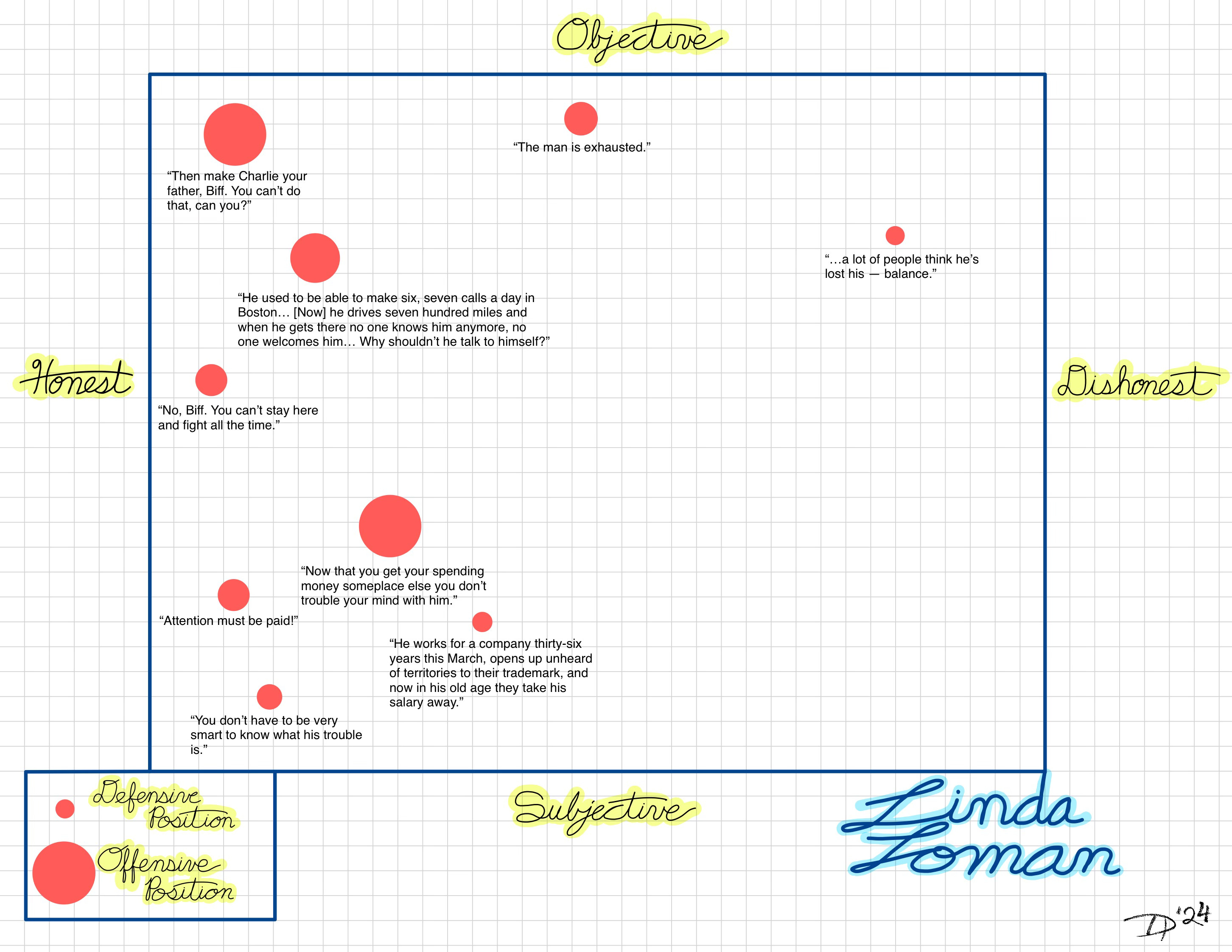
The Honesty Matrix is a three-dimensional chart that provides a unique method for exploring the nature of your character’s encounters based on honesty, whether what they say is correct, and the power dynamics at play. Using these criteria, you can place any line of dialogue on a point along three respective spectra: Honest/Dishonest, Objective/Subjective, and Defensive/Offensive Position. Before clarifying the meaning of each, let’s have a look at a sample Honesty Matrix exploring Linda Loman’s “Attention must be paid” speech from Miller’s Death of A Salesman:
When placing dialogue on your character’s Matrix, it’s best to approach it like you would an Ouija board. The idea is not to think too hard about where each line may fall but to trust your gut and allow your hand to move where it wants. The placements can be approximations at first; the more you practice, the more confident you will become. There are no laws in art, only suggestions. That means we’ve all got to get used to sailing in the wind of our own decisions, even when we’re not sure where it will take us. This exercise is as much about asking questions and developing decisiveness and judgment as it is about getting the “correct” answers. The Honesty Matrix will help you make the most educated decisions you can, and it will force you to develop the habit of making them.
The three dimensions of the Matrix:
HONEST TO DISHONEST: This spectrum evaluates whether the character speaks with the intention to deceive.
The most crucial thing to remember here is that honesty has nothing to do with the truth of the words but only the speaker's convictions. For example, you may be cast as a character who believes the earth is flat and spends the play's action making arguments to that effect. Your character could not reasonably be called dishonest because they believe in the truth of what they say. As you go through the play, remember that you may know what your character is saying is false but that this bears no relevance to your character’s honesty. Honesty is a matter of intention, not of fact.
Our sample Matrix teaches us that Linda Loman’s speech is almost entirely honest; we can be sure her intention is not to deceive. The only time in the speech when her words drift toward the dishonest end of the spectrum is when she discusses her husband’s health. Willy may well be “exhausted,” but Linda uses the word as a euphemism to minimize or conceal the whole truth from her children: that he has dementia and has become suicidal. So, while her words may be true, they are not entirely honest.
This allows us to gain a deeper understanding of her desires, which must include protecting her husband’s dignity.
OBJECTIVE TO SUBJECTIVE: This is the spectrum used to measure the truth of the words themselves.
Let’s take the same example: “The man is exhausted.” Willy tells Linda on the first page of the play that he is “tired to death.” From this, we can be sure that her words are objectively true. Therefore, we place the line at the objective end of the Matrix. The most potent lies use facts to conceal facts; that’s precisely what Linda does here, which is why the line is placed somewhere between honest and dishonest.
All this paints a picture of a mother whose thinking remains strategic and stable, even as her family's future hangs in the balance. Linda Loman is often viewed as a doormat or a wilting flower, but her Matrix shows us that this is not the story Miller is telling.
On the subjective end, we see Linda’s, “You don’t have to be very smart to see what his trouble is.” While she may believe that, it’s an opinion that signals mounting desperation to protect Willy from his sons’ callousness. Most dramatic arguments fall in the honest-subjective area of the spectrum, reflecting the speaker’s belief in the truth of what they say but representing their point of view as only one side of a conflict. In ideal dramatic conflicts, the writer ensures that neither character is objectively “wrong” to avoid biasing audience members as they choose which one to side with. I often remind actors, “Audiences go to the theater like gamblers go to the racetrack.” The fastest horses make for the most exciting races; good writers know that the stronger the argument, the faster the horse.
The more subjective or dishonest a character’s arguments are, the weaker and more insecure they become. From this, we learn that the obstacles before them are becoming overwhelming; they feel the gravity of the stakes and are beginning to want desperately.
DEFENSIVE TO OFFENSIVE: This spectrum reveals the power dynamics at play at a given moment. A character is more likely to be “on the defensive” when feeling overpowered or threatened and to “take the offensive” only once the leverage shifts in their favor. A defensive position is when our character speaks to prevent or hide something; an offensive position is when they use their words to create or change something.
This scale helps the actor discover what their character wants. The two umbrella categories, “to protect/defend” and “to influence/control,” are excellent places to start. These are the most satisfying terms I could think of (defilade and enfilade would be the most accurate, if not a bit esoteric), and I want to make doubly sure they are not taken to mean “offended” (defensive) and “rude” (offensive).
In one of her most indignant moments, Linda tells her son, “Now that you get your spending money someplace else you don’t trouble your mind with him.” She has no way of knowing what is going on in Happy’s head, making the line subjective; she believes in her heart it’s true, making it honest; and she speaks with the affirmative intention “to wake Happy up” to his selfishness, leveling it from an offensive position. This line of dialogue is honest-subjective-offensive.
The Matrix criteria help answer our relevant questions: Linda wants to wake Happy up in the face of the obstacle of his selfishness to avoid the stakes of her sons turning Willy into his grave with cruelty and ingratitude. The dramatic argument is, “Does or does not Happy value his father only for financial support?” It is self-evident what side of the argument she takes.
Now, a line spoken from a defensive position: "A lot of people say he’s lost his – balance.” Linda is preventing the full force of the gossip surrounding Willy’s condition from impacting her children’s view of him. Again, defensive dialogue will more often tend toward dishonesty as people are more likely to use deception to hide something (“I didn’t break the vase!”) than to create something. The exception would be any archetypical “villain” like Shakespeare’s Richard III, who actively uses deception to shape their circumstances.
To see how variable the Honesty Matrix can be, let’s look at a sample for Richard of Gloucester (soon to become King Richard III) in the first scene of Shakespeare’s Richard III. In this scene, he deceives his brother Clarence into believing that he hasn’t a clue why Clarence is being hauled off to the Tower of London when, in fact, Richard is the one who convinced the King to send him there:
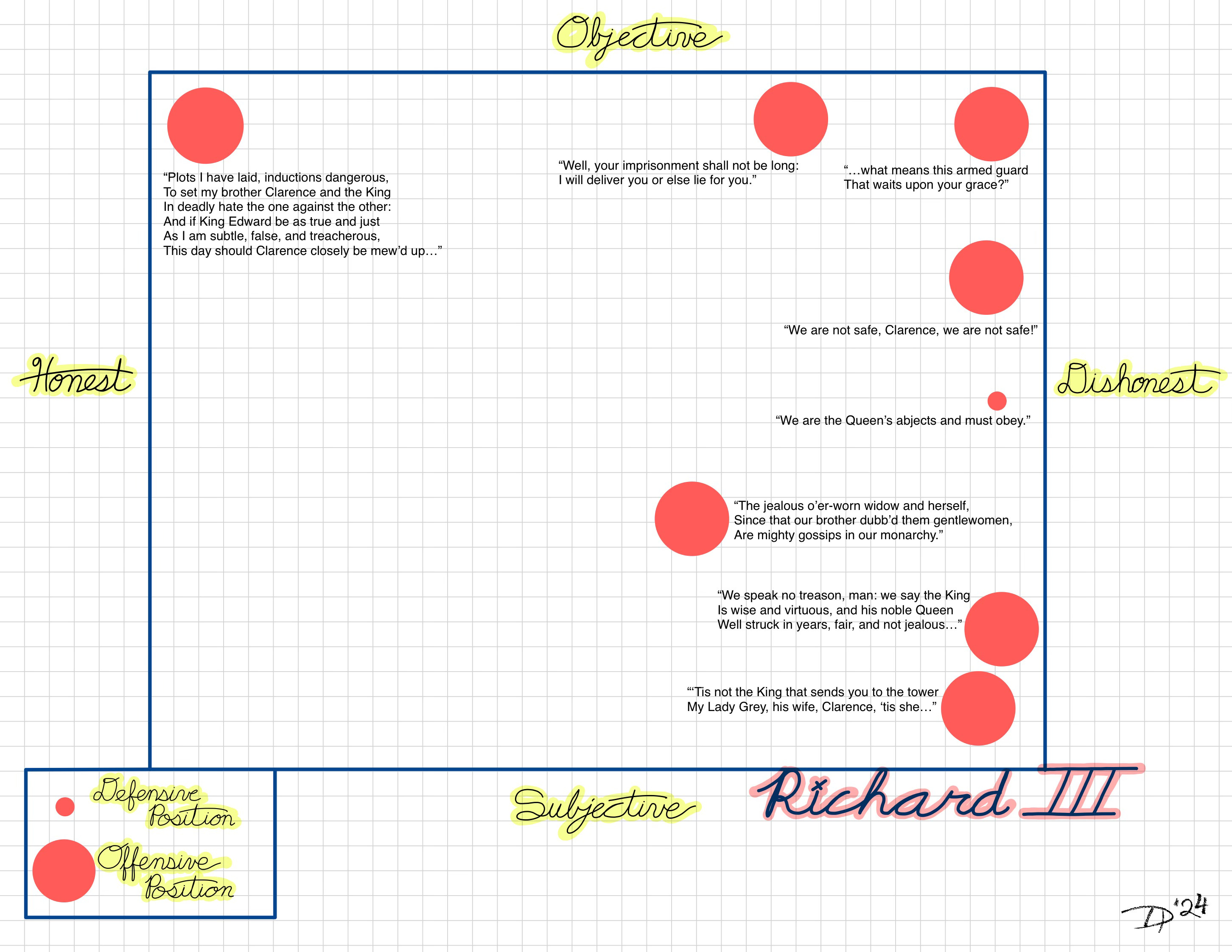
As you can see, the landscape of Richard’s Matrix is entirely different from Linda Loman’s; Linda is earnest and forthright, and Richard is scheming and manipulating. Nearly all of his dialogue falls as far toward the dishonest end of the spectrum as dialogue can get. For good measure, I’ve included one of the final honest-objective passages of his opening soliloquy to the audience to show that when Richard speaks to us, he always tells the truth; it’s much more fun to lie to everyone else in the play if he knows the audience is in on it.
You’ll notice that nearly all his dialogue is spoken from an offensive position because he always uses his words to bend and shape his world to his will. Even his defensive dialogue is calculated to manipulate and deceive, so his line, “We are the Queen’s abjects and must obey,” could easily be set next to a larger dot. I see it as coming from a defensive position because he uses the line to submit to Brakenbury’s request that they cut off their conversation and conceal his true feelings. However, this does not indicate a power dynamic in which Richard feels overpowered or threatened; Richard is entirely in control. If another actor or director saw this as an offensive volley, I would see their point.
It bears repeating that characters most often believe in the truth of what they say. While all characters use their arguments to persuade others to their points of view, dishonest-offensive dialogue is reserved for characters who use deception to do it.
If you are so inclined, add a fourth dimension to the Honesty Matrix, which I call Harmless/Harmful. You could use a color gradient with harmless dialogue indicated in light pink and more destructive intentions set in dark red or brown. All defensive dialogue may seem harmless, but it’s not necessarily so. If a character were to use facts to conceal information (dishonest-objective-defensive) that another character would suffer without knowing, we could learn even more about the mind and heart of the speaker at that moment. This would make it possible to identify a line of dialogue as dishonest-objective-defensive-harmful. I’ll leave the addition of that fourth dimension (and any others you think I have missed) up to you.
Use The Matrix; like “effective memory,” “personalization,” or any of our tools, it is there for you as needed. Whether you are an actor just beginning to acquaint yourself with the four pillars of character—argument, want, obstacle, and stakes—or a more experienced artist who needs clarity or wants to do some reps to sharpen up, use it.
The actor’s medium is, first and foremost, one of thought. To put it mildly, I have found that our theater colleges underperform in teaching our young actors how to read plays to discover information relevant to acting. The Honesty Matrix paves the way toward that discovery. It lays a foundation of true collaboration with the writer so that once the actor’s imagination does take flight, they can be sure it’s flying in the right direction. This sort of detective work may seem like drudgery at first. Still, it must be done, and I hope The Matrix helps you experience the fulfillment, freedom, and fun that come with deep inquiry, discovery, and collaboration.
No posts
Comments
Nothing yet. Say the first thing.
Sign in to join the conversation.