

It has been one month since Madonna released Confessions II, and I wanted to share some of my reflections.
My first night out was at a Madonnarama, in 2008, a week before my 18th birthday, at Houston’s South Beach megaclub. Hers was the face that greeted me, on every wall, as I entered the arena. Hers had been my very first CD (The Immaculate Collection) and her first Confessions had aligned my nascent queer consciousness to nightlife imagination.
In the Jewish numerical system, 18 spells out חי, life. That first Madonnarama, the arena of my unskillful first kiss, introduced me to the forces of life. 36 is 18 twice, so it’s known as double-חי, an even more auspicious year. This July, freshly 36, I turned up to an official Club Confessions release party, where many generations of revelers gathered to smile and sing to their favorite deep cuts. Drugs and the usual dissociation would not be necessary here. It’s Madonna, the sun goddess, who has brought happiness to each of us in our childhood bedrooms. She wants us to express ourselves, not hide behind post-modernism and posturing.
The DJ played classics before the stroke of midnight, then the bulk of Confessions II, and then all of the original Confessions tour: Forbidden Love, Music Inferno, Lucky Star, and that definitive version of Erotica. We danced and screamed, and a few things became clear:
Art is a gift to the world
…which saves us all. I saw gay men and women, trans younglings and hag elders, all touched by this woman’s music. It gave each of us a way out, a key to the door. “Burning Up” was mine, my very first night go-go dancing at Club Cumming. Don’t put me off, ‘cause I’m on fire. And I can’t quench my desire. So was “Into the Groove,” when I got into college and out of the suburbans. And “Back that Up to the Beat,” in Melissa’s apartment in 2023, and on and on.
Each song evoked smiles of recognition—each person had a story. The gift of life. Her tours, especially Confessions, have always had a messianic styling, as she emerges from the disco ball to spread the gospel. But it isn’t just about her; it’s in every creative person. Regardless of what the art does, whether it is “important” enough to address the heaviness of the present (as if it has to); regardless of if it endures; regardless of if I turn against what I’ve made and have it stricken from the annals of digital history. It’s a chance that must be taken. It’s the fire of Prometheus and the sun on your face. Of course it would be a Leo, the sign ruled by the sun, the king of the zodiac, Madonna, Ruby, Catherine, Kiko, who embody the pleasure of its delivery.
Labor is devotion
I now listen to Yasi Salek’s Bandsplain podcast on Madonna hours a day, and will not feel at peace until I’ve finished the saga. She and her guests break down every song, video, costume and controversy, and they’ve led me to watch videos I’d missed and revisit albums I’d taken for granted. What has stayed with me, and what has maybe always gone without saying: Madonna works. She has never stopped working.
At this point of the year, we’re nearing the end of the reading of the Old Testament. The Israelites stand at the threshold of the Promised Land. Moses, who has led them through their transition out of immiseration and into freedom, will not be joining them for the next chapter. His phase of consciousness, of setting forth and dreaming up the future, is closing. What comes next is the arrival, and the maintenance that comes with making it: what happens when you’ve found your place, your person, your thing? How do you not get lazy, or take it all for granted?
I have always believed that if fame would rescue me, then I could finally prove myself. If I was taken seriously, then I could really begin. But until then, I would await my arrival, embittered at my missed possibilities. The podcast has eroded at this delusion. Madonna made it young to the land of abundant success, and has since had to keep making it. She has learned new instruments and changed her sound, innovated and explored, so as not to stagnate into nostalgia.
Jupiter just entered Leo. More attention, visibility, and criticism. My rabbinical studies, a lark in the first year, are now becoming real, and I am being evaluated in the way I sing and interpret and speak and pray and lead. I write every morning, in a way I had once given up on. For the first time I feel like I really have to take my talents seriously, if I want to leave the realm of longing. In my twenties, I had a work ethic, but no grasp of how to take care of myself, and that longing for salvation sent me wandering in the desert, for years more than was necessary. I know that my ambitions always lead me to disease. But the doing itself feels pure, and I pray that if I commit and stop running, I’ll be able to handle real criticism, the sort that a working professional knows how to take. We’ll see.
We have no control
…of where it all goes. I once asked a friend of mine, after the release of her first book, how she copes with the feeling that nobody reads anymore. My own columns felt like dogfood for the anonymous. She told me: you have to think of it like a message in a bottle. Someone will find it, even if you don’t witness it.
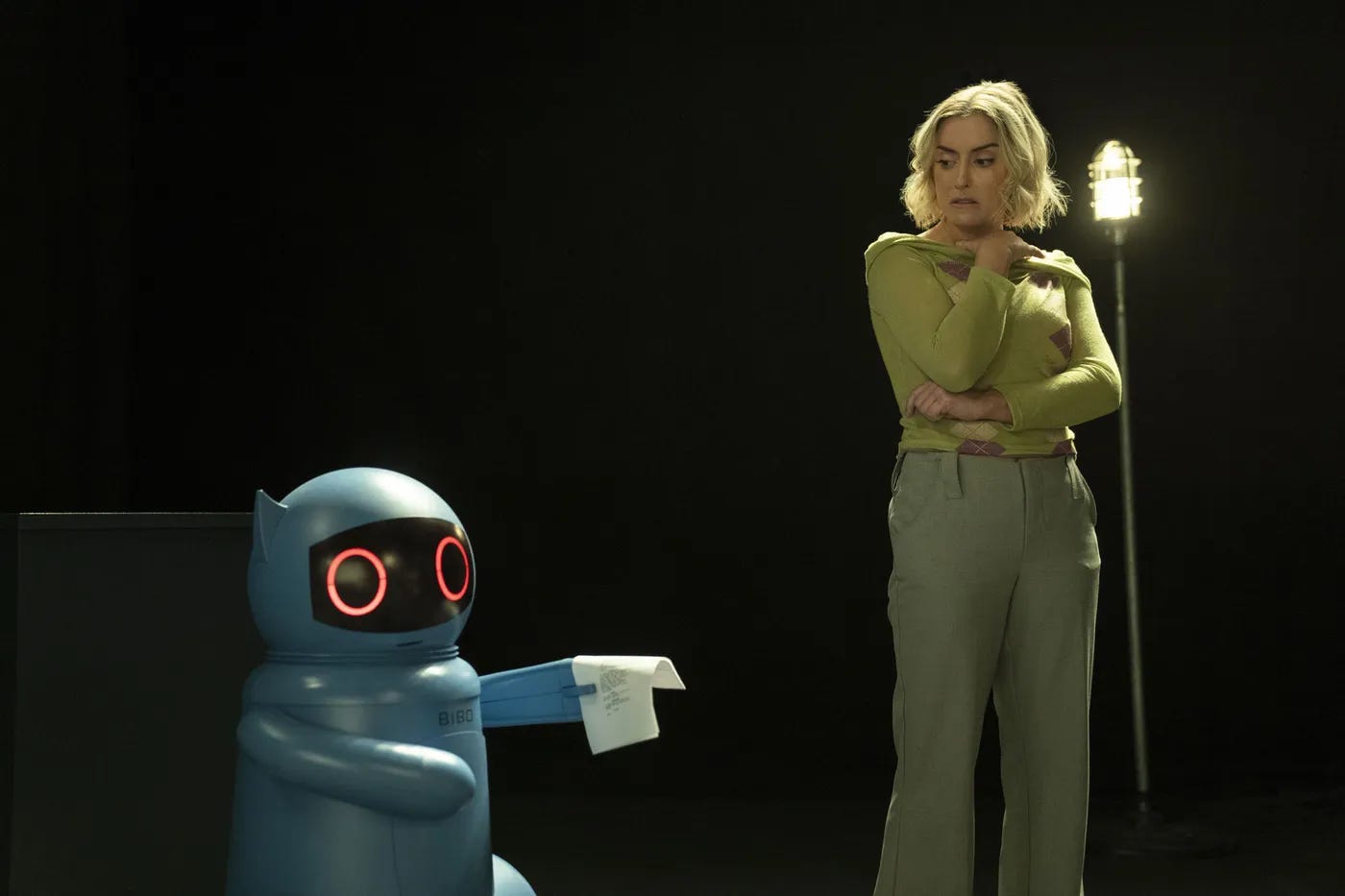
Fantasmas ends with a celebration in the school bleachers, a reading of work deemed too bizarre for a mass audience. Scripts thrown into the ditch find miraculous resonance. New players take up your lines and connect backstage. The DJ plays a song from twenty years ago, or forty years ago, and it rips open a tunnel through time.
In 2021, we took acid and went to see the 25th anniversary tour of Jagged Little Pill, at Jones Beach. The crowd was rough: rode-hard lesbians tailgating in the parking lot, and a lot of straight women who once found liberation in Alanis’ lyrics, and who have in the years since have had to face compromise and crushing relationships. There was pain in the crown, you could feel it palpably.
Alanis took to the stage, never looking or sound better, and whipped her hair into infinity. She herself, the Gemini high priestesss, hadn’t aged, and had the power to heal the crowd, to bend time and fold away the hard years like the lungs of an accordion. She opened a channel, and signaled to everyone a chance at t’shuva, a return to ourselves. Confessions II did the same, in my earphones and on the dancefloor.
Creation is contact with the fifth-dimensional, and dissemination is a ripple in the static of time. It doesn’t age, and it’s not going anywhere. It’s always worth it.
Comments
Nothing yet. Say the first thing.
Sign in to join the conversation.