
I’ve spent the last couple of weeks working on a new personal website that will be online soon, and as part of that effort, I’ve been reviewing all the essays I’ve written on Substack and Medium over the last few years.
Part of the reason for launching the website is to have my own place on the web, where my work is less susceptible to being blocked or removed according to the sensitivities of social-media algorithms or the whims of its high sheriffs. So, I’ve been reviewing those old articles to decide which ones might be worth preserving and which have served their usefulness (if they ever had any) or otherwise don’t need to be retained.
An article from June 2025 had a comment that gave me pause. In It Won’t Kill You to Be Pleasant, I wrote: “As for artificial intelligence, it can already do many things, but I’ve not seen any AI program that can convincingly imitate the warmth of a positive human interaction. It might do better in the future, but it’s not there yet.”
At that point I’d used AI only slightly and for limited tasks; more like a highly skillful search engine than anything else. Part of my reluctance to use it more was due to my discomfort with the idea of a machine or program attempting to mimic human interaction. It seemed way too much like HAL 9000 in 2001: A Space Odyssey. Not that I expected ChatGPT or Claude to become homicidally inclined like HAL; it just seemed like it would be a pale and perhaps sad imitation of interacting with real people.
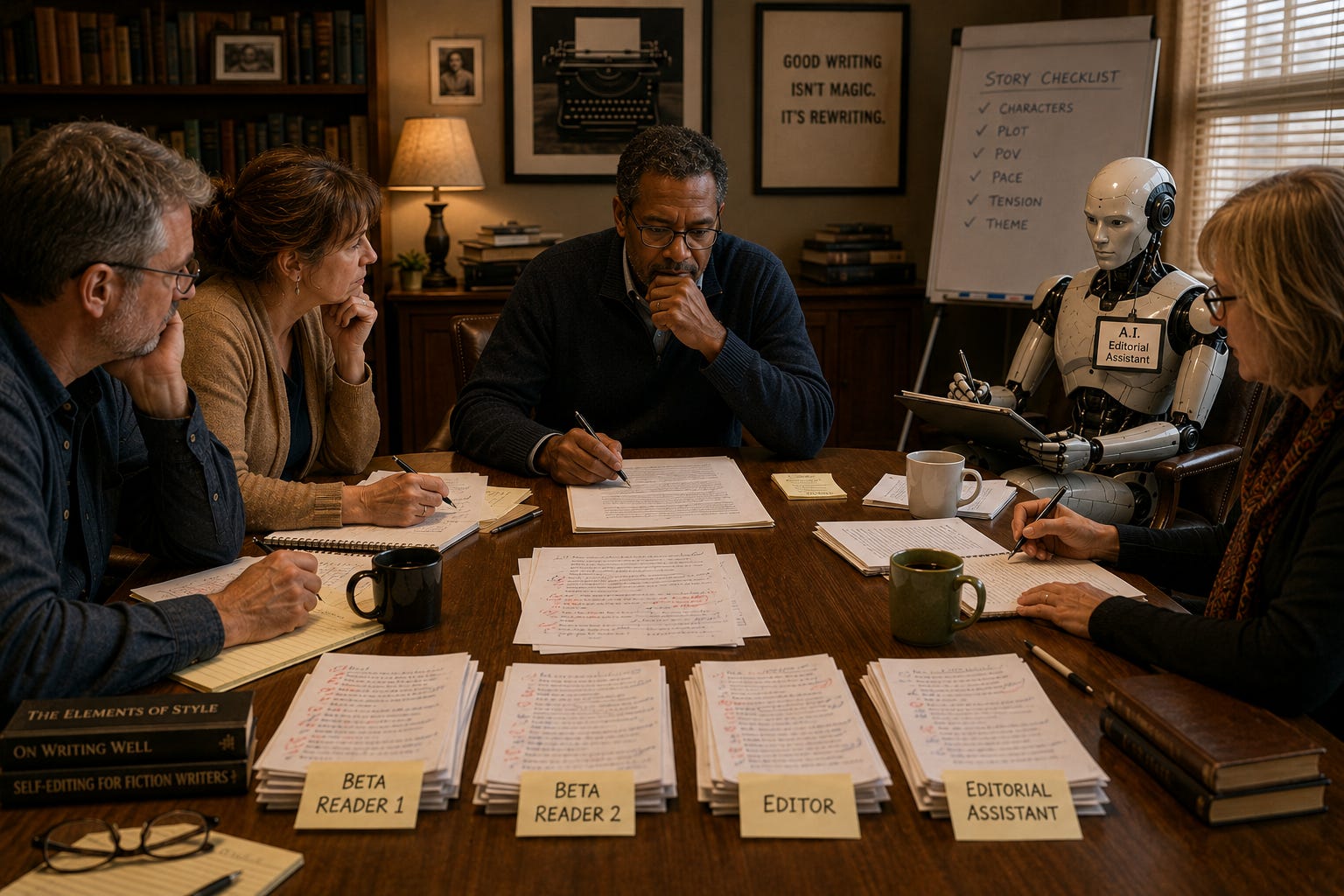
But as time has passed, I’ve started using AI programs for more – fact checking for articles I was writing, providing summaries of current opinions on political topics that I wanted to write about, and other tasks supporting my writing. During the past six months, I’ve been focused on writing short fiction instead of essays (which is the reason my essay output has been so low during that period). For my nonfiction writing, I’ve for many years used beta readers to review articles before I publish them, and I’m doing that now for my fiction. My most frequent beta reader is my wonderful wife, but I also call on other family members, friends and colleagues with knowledge of or an interest in the topic at hand, and sometimes a couple of other writers I know. And I started using AI in the same way – asking it to review articles and to assess their strengths and their weaknesses.
The results were interesting. Sometimes AI and the human beta readers identified the same strengths, sometimes not. AI and the human beta readers all usually differed on their ideas where articles could be strengthened, but when I got multiple comments like “the paragraph about X is redundant,” I would take a second look.
But I don’t always take the advice of either human or AI beta readers. For a recent short story, both AI and one of my human beta readers said that a character’s monologue in the closing section is too long. Two human beta readers didn’t comment on it. And I rejected the suggestion to shorten the monologue because the character speaking delivers important information that seemed difficult to communicate to the reader any other way. I’ve left it in…although if a publisher considering the story says “that last monologue is too long,” then it’s getting trimmed.
In that sense, I’m using AI just like my human beta readers: as editorial assistants whose role is to provide perspective on what I’ve written, but which I decide whether to follow or disregard.
An aside to other writers considering using AI as an editorial assistant: To experiment, I asked ChatGPT, Claude, and Grok all to assess and comment on the same article. ChatGPT and Claude both did, and although Claude has been touted as a better tool for writers, its comments were more generalized than ChatGPT’s. Grok wanted me to move to a paid tier.
When I started building my website, I realized that my limited experience with coding was going to be a problem. I took an HTML class in the late 1990s but aside from that, I was totally self-taught to the degree I knew anything about building websites. But if you read technology news, you’d think AI is replacing coders right and left, so I decided to see how much help it could provide me.
As it turned out, a lot. I asked ChatGPT if it had the capability to design a functioning website, and it responded “Yes, with some important distinctions.” It provided a list (AI is good at that) of what it could do – design the site’s structure, create the code, build mockups. It also listed things it couldn’t do – purchase the domains, upload files to a hosting provider, test the finished site, or maintain it after deployment. But I felt like all those tasks were within my skill range, so we went to work. It asked me questions, it asked about my preferences, it showed me samples and mockups, and in each case, I told it what I wanted. I expect to have the website ready for launch before much longer.
After using AI as an editorial assistant on essays and fiction, and working for a concentrated period on the website project, I’ve gradually realized something: Typing messages back and forth in the AI chat box wasn’t too dissimilar from communicating with a human via text messages or IM, though I never felt like I was communicating with a living person. The AI responses are as short and businesslike or as flowery and encouraging as you want them to be. You get to choose.
It’s fair to say that AI attempts to model its communication on human interaction, but it doesn’t seem to me like it’s trying to act like another person. At least that’s been my experience; other programs may behave differently, and perhaps if you ask it to try to be more human, it can. You can communicate by voice instead of keyboard. That’s not something that appeals to me. (Too much like HAL 9000 talking with Dave Bowman.) But as someone who started out with a healthy dose of skepticism, I was relieved to see that using AI in the way I did wasn’t uncomfortable or creepy. It was just another tool I was using. Just be sure that you use real human intelligence to manage the artificial intelligence.
This article may provoke some comment because the use of AI in writing either fiction or nonfiction is controversial. There are writers on both Substack and Medium praising AI as the tool that will unleash your full creativity in ways you never imagined, or condemning it as a crutch that will ruin your writing skills and damage your ability to think for yourself. Those most strongly opposed to use of AI tend to treat those who don’t share their view as heretics, so I may incur some wrath there.
There’s also an ethical dimension to using AI as I’ve described. Several fiction publishers I’ve been considering state flatly that they will not consider publishing anything done with the assistance of AI. None of them seem to specify exactly what type of assistance they mean. I’m sure if you tell Claude to write your story, that’s going to be unacceptable. But what if you use ChatGPT to summarize the US campaign in Guadalcanal as background reading for the WW2 action thriller you’re writing? And what if – I know someone who has done this – you use AI to write your pitch letters when you send something out to publishers for consideration?
I’m taking the easiest route and am not sending anything to publishers who state “no AI.” Even if I just used it to manage the mailing list for my newsletter, I’d be using AI. But I suspect publishers will find a total and unqualified ban untenable for much longer.
I’m not charging for subscriptions, so please consider supporting my work with a one-time or monthly donation at https://ko-fi.com/davidhroberson. Thank you.
No posts
Comments
Nothing yet. Say the first thing.
Sign in to join the conversation.