
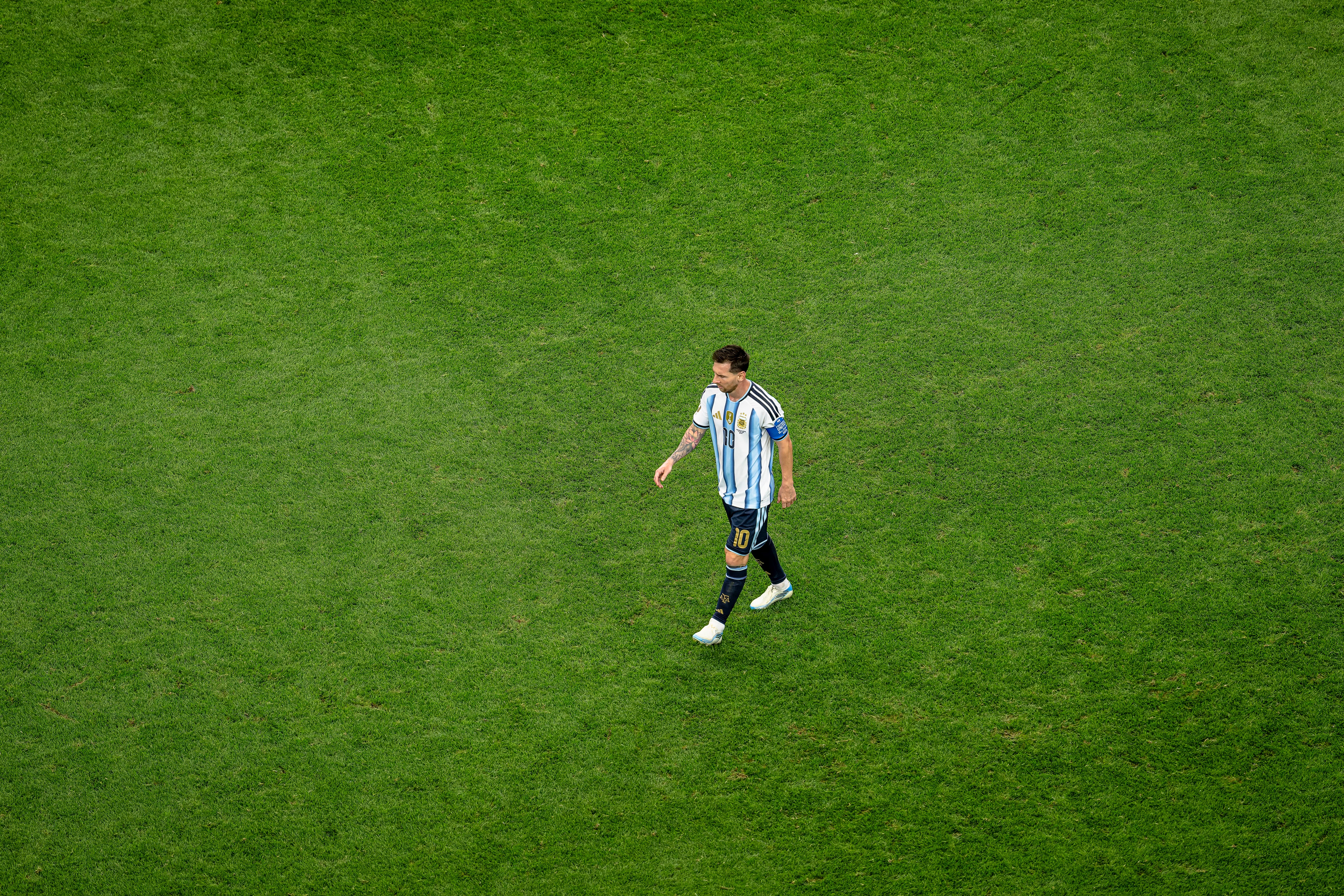
Lionel Messi has scored in every minute of a soccer match—except for the very first. At the beginning of a game, he’s usually just walking around. He’s looking.
As his former coach at FC Barcelona, Pep Guardiola, said:
“Right, left, left, right. He smells who is the weak point of the back four. After 5-10 minutes, he has the map.”
The “map” that Guardiola is referring to is a mental picture of the playing space that will essentially allow Messi to predict the future.
Many things that happen in elite sports unfold far too rapidly for athletes to simply be reacting, so they need to be unconsciously predicting. Take baseball as an example.
A Major League fastball takes about 400 milliseconds, or slightly less than half a second, to reach home plate. It takes half that time just for the retina at the back of the human eye to receive information and for that information to be conveyed across synapses (the gaps between neurons) to the primary visual cortex in the back of the brain, and for the brain to send a message to the spinal cord that puts the muscles in motion. That’s just to initiate muscular action, not to swing. It’s way too slow. Furthermore, because the angular position of the ball relative to the hitter’s eye changes so rapidly as it gets closer to the plate, the advice to “keep your eye on the ball” is literally impossible to follow. Humans don’t have a visual system fast enough to track the ball all the way in. So how does anyone ever hit a fastball?
The answer is anticipatory skill. Hitters are using cues from the pitcher—the angle of the arm; the rotation of the shoulder; the “flicker” of the pitch, which is the flashing pattern the red seams of the ball make as they rotate—to try to predict the future. They group that information into what psychologists call a “chunk”—a signal that tells them what’s going on and helps them decide where the ball is going almost the moment it’s released. They really are seeing the future, in a certain sense.
Some of the earliest work on chunking was done in chess in the 1940s. Chess players of different ability levels were shown chessboards for a few seconds, and then asked to recreate the arrangement of pieces. Grandmasters could reconstruct boards after seeing them for only three seconds, so they appeared to have miraculous memories. Decades later, that experiment was repeated, but this time the participants were also given boards with random arrangements of pieces. The grandmasters lost their advantage in that scenario. They didn’t have photographic memories; they had learned to chunk groups of pieces so they could understand a board instantly.
When Messi is “mapping” the field, he is a grandmaster (playing speed chess!) unconsciously picking up on familiar chunks that will help him decide what’s coming, and where to attack.
For the World Cup, I made a video that gets into all this in much more detail. You can watch that here. There are some pretty amazing video clips of athletes’ anticipatory abilities (as well as some miscues) in there, and there’s a quiz shortly after 11 minutes that will prove to you that you also chunk information into meaningful groups. There’s also an illustration of something I heard NFL Hall of Famer Drew Brees say recently, which I thought was the best description of playing quarterback I’ve ever come across.
If you take a look, let me know what you think. And enjoy the World Cup final!

Thank you for reading. If you enjoyed this post, please share it.
If a friend sent this to you, you can subscribe here:
Until next time…
David
Comments
Nothing yet. Say the first thing.
Sign in to join the conversation.