

I’ve been to three Olympics and a Super Bowl. I’ve been present for multiple world records. I once saw a cross-country skier win an Olympic medal with broken ribs and a collapsed lung.
But the most surprising thing I’ve ever seen in sports is playing out right now, and you probably haven’t heard about it.
Earlier this year, high school junior Cooper Lutkenhaus — while on spring break from Northwest High School in Justin, Texas — won the World Championships in the 800 meters indoors.
I ran the 800 in college, and I don’t even know what to say about this. Lutkenhaus is such an extreme outlier that there’s no historical comparison. Boys do not compete with elite men in this event; it simply does not happen. Last year, as a high school sophomore, Lutkenhaus finished second at U.S. nationals to qualify for World Championships. The other two qualifiers were 27 and 28. Lutkenhaus turned pro after that. This year, he was undefeated against pros until July. 🤷
I was wide-eyed enjoying all this as a track fan when I got a message from Cooper’s coach, Chris Capeau. He’d seen a clip of a talk I gave about the benefits of delaying specialization, a core topic in my book Range. Here’s what he sent:
“Great message! I coach Cooper and while it looks like he specialized super early, the same story you speak of is true. Just absolutely crushed it when he went all in.”
Coach Capeau then connected me to Cooper and his father, George, so I could learn more. Below is a lightly edited version of our conversation, in which Cooper offhandedly drops some points that I think are relevant to performance in any domain.
David Epstein: [Reads coach Capeau’s message]. I’d love to hear about that developmental story.
Cooper Lutkenhaus: Like he said, I did all sports when I was younger, just because my mom and dad wanted me and my two older brothers to get to try everything. Obviously, there are some people that go fully into one sport, and sometimes it can work, but I think when you’re younger, in middle school, even in high school, just enjoying everything. If you go off to college sports, you’re most likely just going to be doing one, so you might as well get to enjoy everything for as long as you can.
DE: What sports did you play growing up?
CL: I did football, basketball, track, cross-country, and wrestling. Those are my five.
DE: What ages did you start and stop each of those?
CL: I started football in fifth grade, and normally my parents wouldn’t allow that, but I begged them. Every single day I would ask, “please let me play, please let me play,” because we had a local team that all my best friends were on. They finally let me do it. And then I started everything else in seventh grade. I basically did everything for two years and then went to track.
DE: George, there’s so much pressure for kids to specialize early now, so I think it’s particularly influential when there’s a success story like this. There was just a big paper in the journal Science showing that early sampling is the typical path for elite athletes. But it’s hard to get that message across, so I’m curious if this was part of your parenting philosophy.
George Lutkenhaus: When all the boys were younger, they played one sport each year. Cooper’s two older brothers, they played baseball for a couple years. And then they moved over to basketball. Mom coached basketball, so that made life a lot easier for all of us. We kept it real simple because both of us were coaches. So that was kind of our philosophy. Doesn’t make it right, but it was a pretty sad day when Cooper went to one sport. We were all kind of looking forward to him getting to do as much as he could, because he was a good athlete, but it was one of those situations — we didn’t want to screw it up. You’ve got a kid who runs 1:53 [in the 800] in eighth grade, you don’t want to get him hurt somewhere else.
DE: And there aren’t really any best practices to rely on for this at all.
GL: Yeah, there’s no road map for that, let’s put it that way.
DE: Cooper, I saw you say in an interview that you still feel like you’re more in high school than in the pros in terms of training. Is that true even now, as a world champion?
CL: Yeah, I’m not really doing anything crazy. If you look at a lot of the top high school kids, they could do most of my workouts. A couple of my high school teammates can do 80 or 90 percent of my workouts. There’s always a little bit at the end where only certain people can do them, but it’s not like there’s a secret behind it. I’m still training like a high school kid.
GL: He said he’s training like a high school kid — the workouts may be very similar, but they’re way faster.
DE: Haha, yeah I figured. Cooper, what kind of mileage are you doing on a weekly basis?
CL: My standard mileage is about 30 miles per week during the fall. My dad, my coach, we like to build up over time. My freshman year, in the fall I was running 25 miles a week. It’s been just a slow increase over time. I think that’s how you should do it.
DE: You’re smarter than I was. I once jumped from like 20 to 80 miles a week in a few months, and it didn’t work out well. I also think about Jim Ryun in the 1960s, probably the closest experience to what you’re having, where he set an American record in the mile in 1965 as a senior in high school. And pretty quickly it came with all this pressure and intense training, and he famously stepped off the track in the middle of a race, and didn’t come back for about two years.
CL: Yeah, I think you definitely have to slow play it. On the pressure side, that doesn’t bother me much. I enjoy the pressure a little bit. Pressure can be either a good thing or it can be a bad thing, it just depends on how you look at it. I always like to be a little nervous on the starting line. I look at that as a good thing, because that shows you’re working toward something that you really want to do well. Something that so many people use as a negative, you can use it as a positive, and that can be such an advantage, even if that’s just because you just feel better on the line.
Something that so many people use as a negative, you can use it as a positive.
DE: Going back to your training, how much of your work are you still able to do with the guys on your high school team?
CL: All my easy runs and long runs I can do with my team. I love when we do a long workout together; my aerobic side still isn’t super strong, so it’s kind of funny — seeing a professional athlete struggling right alongside a bunch of high school guys. The speed stuff I mostly do on my own. But the endurance work is always fun to do with teammates. It’s gonna hurt, but when you have five other guys with you, it makes it a lot easier.
DE: Since you’re traveling to Europe to race against the best runners in the world, are you able to stay a high school kid?
CL: Having teammates around — like, I just said goodbye to them after practice today before we started talking. I gave one of them a hug because he’s my best friend. We kind of just mess with each other. But they obviously understand what I have going on, and they’re always there to support me. But also, like when we went to Europe, I always had my brother Andrew by my side, which made it a lot easier. In a way it almost doesn’t feel like you’re racing. It kind of just feels like a family vacation trip that you still have to take a little bit seriously for certain days. Whenever I have a lot of my family around, those have been my most successful trips. Last year, at [U.S. nationals], I had my whole family there — made the team and ran 1:42. In Poland, I had my mom and dad there — won a world indoor title. And then this past Europe trip, won two Diamond League [races] and had basically the whole family there again. So I guess I just have to keep bringing everyone everywhere — might have to get them off work a little bit.
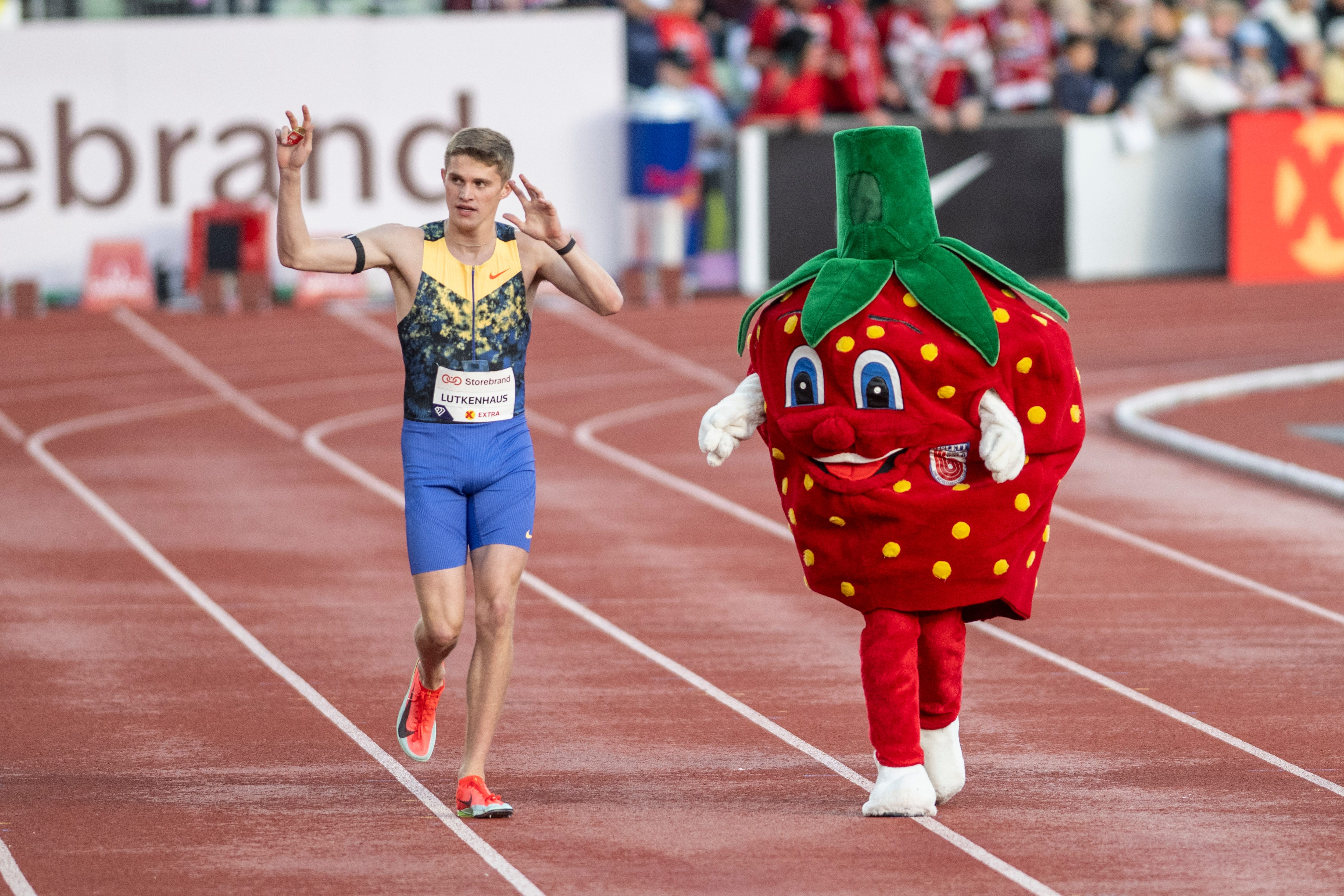
DE: That is fantastic, family vacation on the pro track circuit. You reminded me of the great Australian runner and Olympic silver medalist Jessica Hull, who made her breakthrough a few years ago, and I remember her saying that she attributed it to moving back home. At home she felt like when she had a bad day, she had a life off the track so she wouldn’t dwell on it all the time.
CL: Yeah, if I do have a bad workout, it’s pretty easy to forget about it, just because when I get home I really just don’t think about it. I mean, if you have a bad day, look at it, think about maybe what you could have done better throughout it, or leading into it, but things kind of wind down.
DE: Do you do anything in particular to wind down?
CL: I’ve been getting into a lot of shows recently. I’ve never been a movie or TV-shows kind of person before, but me and my dad have been watching Ted Lasso together.
DE: Good show.
CL: Great show. We have one more episode left, so I need him to get home before I leave today.
DE: On this general issue of having things outside track, did you find it hard to give up other sports, or was it just obvious?
CL: It was definitely hard to give up football, because that was my favorite sport. Giving up football, especially in the state of Texas, where that’s the most important thing in every high school, that was definitely a little tough. But I realized maybe I’m not fit for football. I’d probably play receiver and be 150 pounds when everyone else is 200-plus. So a hit might hurt a little bit. I had to give it up, but it’s been worth it so far.
DE: Did you take anything from those other sports you sampled?
CL: Definitely mental toughness from football. I mean, we’ve done 200 up-downs in full pads before, so we know what pain feels like. That’s way worse than a long run —
DE: I played high school football, smaller than you, and found the 800 far more painful! Just saying…
CL: …Also the kind of bond you gain with teammates in football. I mean, that’s the same throughout sports. In running, you’re all doing the same thing, trying to achieve the same goal, it’s just a little more solo, but you’re all using each other to be the best that you can.
DE: Part of the reason elite athletes tend to have had a sampling period is that it helps them just figure out what their best sport might be. How early did you start thinking that track was your best sport?
CL: Probably around seventh or eighth grade. I didn’t really look at it that way, though. I was just like, okay, I’m pretty good at track, but we’re going to keep going through the cycle. But when I ran 1:53 and 48 [in the 400] after eighth grade — okay, this is probably what I’m going to be the best at. But in middle school running just felt pretty natural. It was always fun. In basketball, there’d be a couple days like, man, I gotta go to basketball practice. But track, when we’d do workouts, those were always a blast with teammates. Not the long distance stuff, but the sprints were definitely fun.
DE: George, going back to the parenting conversation, it sounds like Cooper played a wider variety of sports than his brothers.
GL: Cooper was so into all of it, memorized everything. He was just into it a little bit more at a younger age than most kids, so that’s why we let him jump into football earlier. And sure enough, first practice the coach hands him a playbook and he’s gonna be the quarterback. And I go, “He hasn’t played football before.” And the coach said he’s going to be fine. He was just kind of a natural for a lot of that.
DE: Cooper, what positions did you play?
CL: Quarterback, receiver, cornerback, a little bit of linebacker — was never a fan of that. I always liked offense a lot more.
DE: Didn’t like stuffing holes in the line, huh?
CL: No. No. I also weighed like 140 pounds, so…
DE: What did you play in basketball?
CL: I was the center. Eighth grade I was the sixth man off the bench, and in the first game I was like, I’m gonna prove this guy [the coach] wrong. I think I dropped 15 or 20 points, and I never got taken out the rest of the year. I never liked being taken out of the game, not having a chance to try to help the team, even if I was super tired.
DE: And what about wrestling? … Your dad is laughing…
CL: Yeah, um, seventh grade — I didn’t like wrestling.
GL: He was actually pretty good, mainly because he was super aggressive. His first wrestling match ever he won in about 30 seconds. He runs up into the stands and he’s like, “That’s the funnest thing I’ve ever done in my life!” Remember, he’s the youngest of three boys, and I said, “Well, that’s because that’s the first fight you’ve ever actually won.”
CL: I enjoyed the matches, but I didn’t enjoy the practices.
DE: And your brothers cycled through sports somewhat too, it sounds like.
CL: You kind of had to where we’re from. That’s what you do in middle school. If you were one of the more athletic kids, you did everything.
DE: So George, this cycling through sports is a natural thing in your area, but is it also philosophical for you at all?
GL: It was a couple things. One, Mom and I were both coaching [multiple sports], so we had our own teams, so we didn’t have a lot of time for travel ball or anything like that. Everything we did was local, and we just kept it as simple as possible. Then when they got to seventh grade: “Okay, training wheels are off, let’s go have fun, play everything.” When we started getting involved with some sports, you saw kids flying all over the country; they’re 10 years old going to Denver to play tournaments. We can play that right here.
The one thing we did from an early age were performance courses that we do from the school districts, kindergarten all the way up through high school. That was always about making them a better athlete so when they do pick a sport, their motor movement is good. Basically you just train them to have fun, to go hard, to run right. They learned how to lift at an early age, all that kind of stuff, so when they did get up to that level, they had a bit of an advantage.
You just train them to have fun, to go hard, to run right.
DE: So this is a general athleticism thing from the school district that kids can do?
GL: Yes. When you’re in elementary school we do two sessions in the summer, one in fall, one in spring, about four weeks a piece. They’d be running around as little kids playing “duck, duck, goose,” but also learning how to tumble, do pushups, and run properly, things like that. You’ll see it just about everywhere in Texas, especially the DFW area. There are a lot of good athletes in this area, and a lot of them just start with basic stuff like that versus sports skills.
DE: George, I once talked to Serena Williams, and to my surprise she told me not only did she play a number of different sports, but her dad took her and Venus off the travel circuit at some point so they could focus on school. For Cooper, on the one hand, he has to do his homework and none of the guys he’s racing against have that hanging over them. On the other hand, maybe there’s a nice balance to his life. How do you think about that going forward?
GL: That’s something we thought about when we made the decision to go pro, and the biggest thing for him is that the only change from the last year and a half has been from wearing a Northwest Texan uniform to wearing a Nike uniform. And instead of going to a local meet, he’s going to Eugene [Oregon] or wherever. The only thing that’s changed in his life is the sport side. We talk all the time about what things are going to look like after he graduates high school. He’s going go to college — he didn’t always like to hear that. He’s going to go to class. Similar to … Coop, who’s the lady we talked about all the time who went to USC? … Allyson Felix. Similar to that, where school takes up the middle of his day. He’s free to workout morning and afternoon, but he’s still around kids his same age and going to class. And we’re fortunate; there are a bunch of colleges close to our house.
DE: Did I miss anything you want to make sure I know?
GL: I think the most important thing — and I tell Cooper all the time — none of this is normal. We didn’t anticipate it, we didn’t push for it, but at the same time here we are, just trying to work through all of it. He does a great job with it. He doesn’t like it when I brag on him to people, but I think if it was another kid, sometimes you wouldn’t have made the same decisions. But his attitude toward things, and his mental side of things are just light years ahead of anything I’ve ever seen. I’ve coached thousands of kids over the years, and I’ve never seen anything like it.

Thanks to Cooper and George for their time and insight, and to Chris Capeau for making the connection.
Cooper is competing at U.S. nationals, which start today, so cheer him on! You can follow him on Instagram.
If you enjoyed this post, please share it.
If a friend sent this to you, you can subscribe here.
Until next time…
David
Comments
Nothing yet. Say the first thing.
Sign in to join the conversation.