
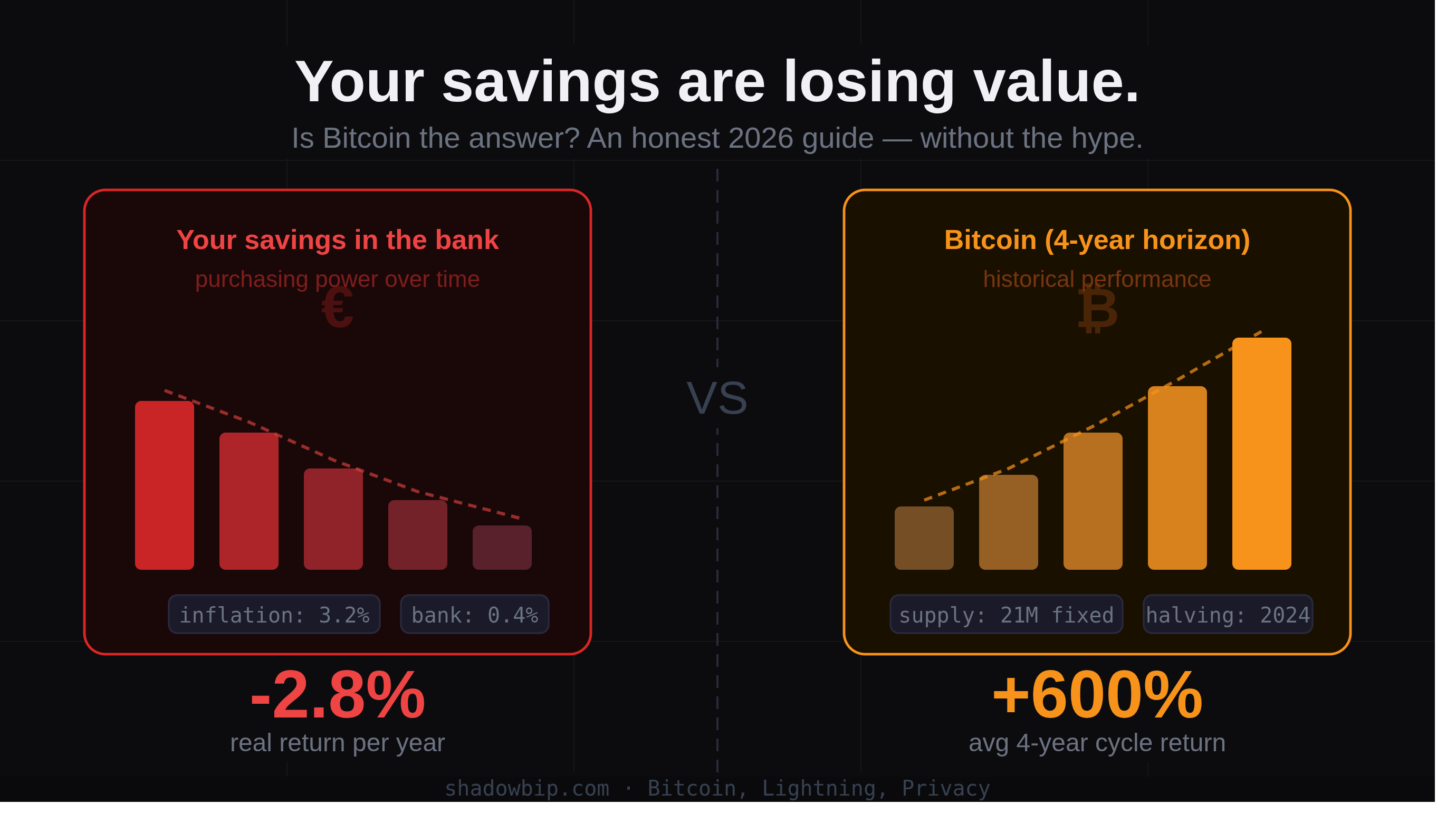
Let’s start with a number that should make you uncomfortable.
3.2%.
That’s the inflation rate in Italy in May 2026 — the highest since September 2023, driven by energy prices spiking from the Middle East conflict. In the broader Eurozone it’s the same story: 3.2%, well above the ECB’s 2% target. In the US, even worse: 3.8%.
What does 3.2% actually mean in practice?
It means that €10,000 sitting in a current account today will have the purchasing power of roughly €9,690 in twelve months. Not because the number on your screen changed — it didn’t. But because everything you can buy with it costs more.
Your money is evaporating. Silently. Continuously.
The question is: what do you do about it?
For decades, the standard advice was: put your savings in a bank account, buy government bonds, maybe invest in a diversified fund. The system worked reasonably well when inflation was low and rates were decent.
That world is gone.
Bank accounts: Italian current accounts pay on average 0.3-0.5% per year. Against 3.2% inflation, you’re losing roughly 2.7% of purchasing power annually. Every year.
BTP (Italian government bonds): 10-year BTPs currently yield around 3.8-4%. That looks competitive until you factor in taxation (12.5% on capital gains), inflation eroding real returns, and the fact that you’re locking up capital for a decade.
Real estate: Still a cultural default in Italy — “il mattone non tradisce.” But entry costs are enormous, liquidity is zero (you can’t sell half a flat in an emergency), and price growth in most Italian cities outside Milan and a handful of tourist destinations has been flat to negative in real terms for a decade.
Gold: The classic inflation hedge. It works — gold has maintained purchasing power over centuries. But it’s illiquid, expensive to store securely, and in the short to medium term can be volatile and frustrating to hold.
So where does Bitcoin fit?
Comments
Nothing yet. Say the first thing.
Sign in to join the conversation.