
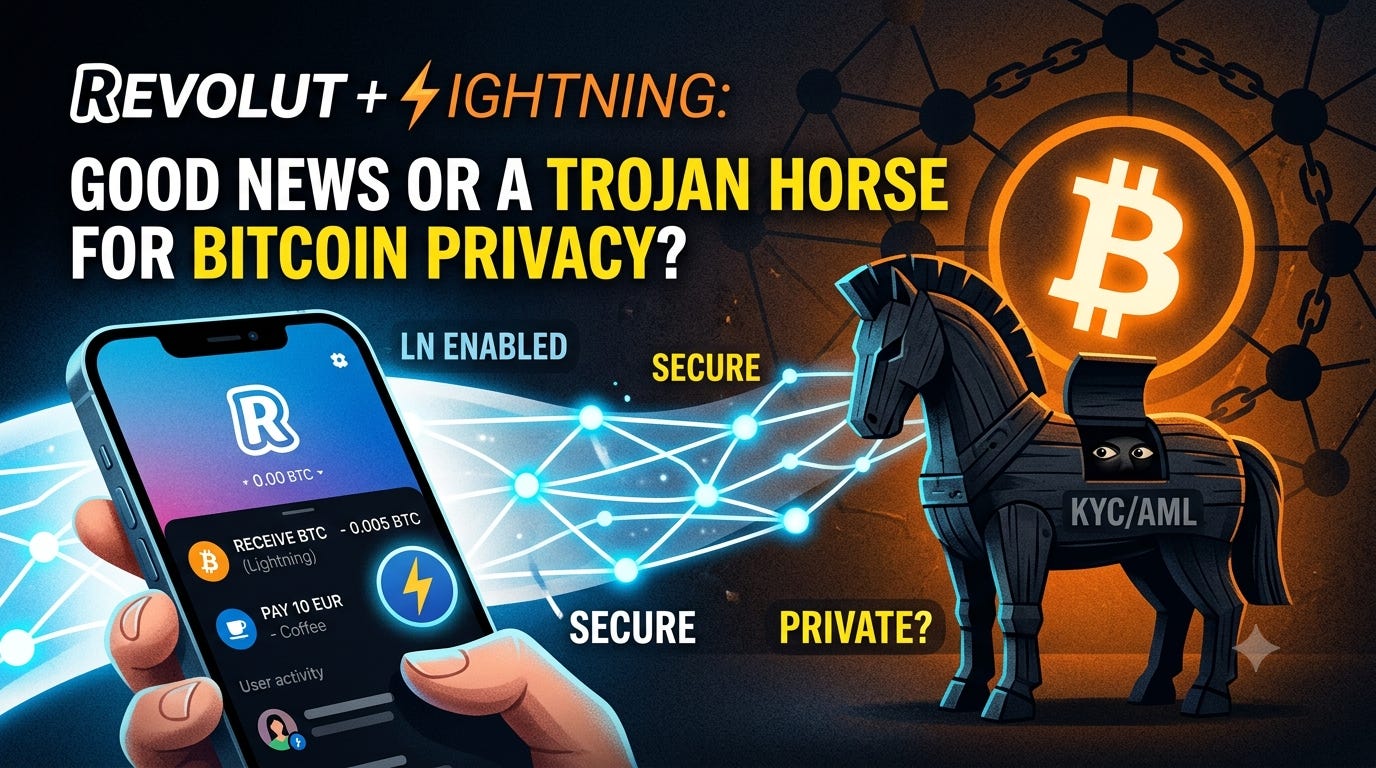
A few weeks ago, Revolut announced it was integrating the Lightning Network for users in the UK and European Economic Area, through a partnership with Lightspark — the payments infrastructure company founded by former PayPal President David Marcus.
The headline sounds great: one of Europe’s largest fintechs, with over 35 million users, is adopting Lightning. Bitcoin’s Layer 2 scaling solution is going mainstream. Mass adoption is happening.
But if you’ve been following this Substack — if you’ve read about how chain analysis watches your every transaction, or how Nostr Wallet Connect turns your node into a sovereign payment endpoint — you might want to slow down before celebrating.
Because Revolut + Lightning is not the same thing as Lightning. Not even close.
Let’s be precise about the technical reality of this integration.
Revolut is not running a Lightning node on your behalf. It is not giving you a channel. It is not giving you keys.
Revolut is connecting to Lightspark’s “open Money Grid” — a centralized Lightning infrastructure layer — and using it to process Bitcoin payments faster and cheaper than on-chain transactions. Users get a better UX for Bitcoin transfers. Revolut gets lower transaction costs. Lightspark gets a major enterprise client.
What users do not get: custody of their Lightning keys, control over their channels, or any of the sovereignty that Lightning was designed to enable.
This is custodial Lightning. Revolut holds the keys. Revolut manages the channels. Revolut can freeze your funds, comply with government requests, apply transaction limits, and report your activity to regulators — because that’s what regulated financial institutions are legally required to do.
The Lightning Network is a tool. Like any tool, what matters is who controls it and how it’s used.
Revolut is a fully KYC’d platform. To use it, you’ve verified your identity with a government-issued ID, linked a bank account, and agreed to terms of service that include full compliance with anti-money-laundering regulations across every jurisdiction it operates in.
This means every Lightning payment you make through Revolut is:
Linked to your real identity — name, address, date of birth, passport number
Logged and stored by Revolut
Reportable to financial intelligence units if triggered by automated compliance systems
Freezable at any moment if Revolut’s risk engine flags your account
The Lightning Network itself is pseudonymous. Payments route through onion-encrypted hops. Channel balances are private. But none of that matters when your entry and exit point is a fully KYC’d custodian that knows exactly who you are.
You’re adding Lightning’s speed to a surveillance layer. That’s not what Lightning was built for.
I don’t want to be entirely negative here, because the Revolut integration does matter — just not for the reasons most headlines suggest.
It proves Lightning works at scale. Revolut joining Coinbase (which routes ~15% of BTC payments through Lightning), Kraken, Bitfinex, Bitstamp, and Strike means Lightning is now tested infrastructure at enterprise level. The reliability and liquidity questions that plagued Lightning in 2021-2022 are largely answered.
It increases overall Lightning network liquidity. More nodes, more channels, more routing paths means better payment success rates for everyone — including sovereign node runners like us. A larger network is a more useful network, even if some of the new participants are custodial.
It onboards people to the concept of Lightning. Someone who uses Lightning for the first time on Revolut and experiences instant, near-free Bitcoin transfers is more likely to eventually ask “why do I need Revolut for this?” That curiosity is the on-ramp to self-custody.
It validates the Lightning Address standard. Revolut’s integration includes Universal Money Address (UMA) technology — email-like payment addresses that work similarly to Lightning Addresses like zap@shadowbip.com. When 35 million Revolut users start sending payments to human-readable addresses, the concept becomes normalized. That benefits the sovereign version of the same standard too.
Here’s a table that mainstream Bitcoin media consistently fails to publish:
Revolut Lightning Self-Custodial LND Node Key custody Revolut You KYC required Yes — mandatory No Fund freezing Possible at any time Impossible Privacy Zero — fully surveilled Strong (especially over Tor) Channel control None Full Routing fees earned None — Revolut keeps them You keep them Regulatory exposure Full Minimal Self-sovereignty None Complete
The difference is not a matter of degree. It’s a matter of kind. One is a bank account that uses Lightning rails. The other is a sovereign payment node.
If you’re running your own LND node — or thinking about it, as I covered in How to Set Up a Bitcoin and Lightning Node — the Revolut news is a reminder of exactly why self-custody matters.
Every user who sends Lightning payments through Revolut is using Lightning without owning it. Every payment that flows through Revolut’s Lightspark infrastructure is a payment that Revolut can see, log, and report.
The sovereign alternative already exists. It’s called running your own node. It’s called Nostr Wallet Connect — where Zaps go directly to your node with zero custodian in the middle. It’s called zap@shadowbip.com — a Lightning Address backed by my own LND node, not Revolut’s Lightspark account.
The tools for sovereign Lightning already exist and already work. The question is whether people will reach for them or settle for the convenient custodial version.
This is not the first time a powerful Bitcoin technology has been co-opted into a custodial product.
Bitcoin itself: designed to eliminate banks. Result: millions of people hold Bitcoin on Coinbase, Binance, and Revolut, trusting custodians with their keys.
Multi-signature wallets: designed for trustless shared custody. Result: mostly used by exchanges to manage their own cold storage, not by individuals.
Lightning Network: designed to enable sovereign, peer-to-peer micropayments. Result: increasingly dominated by custodial wallets and now major fintech platforms.
The pattern is consistent: powerful privacy and sovereignty tools get wrapped in convenient custodial interfaces, and most users choose the interface over the underlying capability.
This isn’t cynicism. It’s an observation about incentives. Convenience wins in the short term. Sovereignty requires education and effort.
Which is exactly why publications like this one exist.
If you’re a Revolut user: using Lightning through Revolut is better than on-chain Bitcoin for small payments. But understand what you’re trading: speed and convenience in exchange for full KYC exposure and custodial risk. It is not sovereign money. It is fast bank money.
If you’re curious about sovereign Lightning: start with setting up your own node. It’s more work. It’s worth it. The difference between your money and Revolut’s money in a Lightning wrapper is the difference between owning a house and renting one.
If you already run a node: the Revolut news is a validation, not a threat. More Lightning adoption means more liquidity, better routing, and more people who will eventually want what you already have. Your node is ahead of the curve.
Revolut + Lightning is good for Lightning adoption statistics. It’s bad for Lightning’s original promise of financial sovereignty.
35 million new “Lightning users” who can’t access their keys, can have their funds frozen, and are fully surveilled by a regulated fintech is not what Satoshi had in mind when he designed peer-to-peer electronic cash.
The sovereign version of Lightning — self-custodial, private, censorship-resistant — is still there. It’s just harder. And that difficulty is, increasingly, the only thing separating real sovereignty from the appearance of it.
Know the difference. Choose accordingly.
Want to go deeper on self-custodial Lightning? Here’s everything I’ve written on the topic:
Nostr and Lightning: The Protocol Stack That Could Replace Everything — How NWC connects your node to Nostr for sovereign Zaps (free)
How to Set Up a Bitcoin and Lightning Node: DIY vs. Ready-Made — Start here if you want to run your own node (free)
What Nobody Tells You About Running a Lightning Node — The real operational experience (paid)
Your Bitcoin Is Being Watched — How chain analysis works and how to defend yourself (free)
Tor and I2P: The Dark Web of Privacy in the Bitcoin World — Network privacy for your node (free)
⚡ Zap me directly — no Revolut, no Lightspark, no middleman: zap@shadowbip.com 🐙 GitHub: https://github.com/asyscom
Comments
Nothing yet. Say the first thing.
Sign in to join the conversation.