
by David Eagleman and Vidar Wendel-Hansen
In a Man City vs Arsenal game in 2024, referee Michael Oliver laid on his whistle to signal the play was over. But just afterward, as if in defiance, Leandro Trossard kicked the ball. From the sidelines, it looked like a deliberate act of insubordination.
The Premier League had just launched new rules to increase effective playing time, so referees could now yellow card players when they committed deliberate actions that delayed the restart of play, such as interfering with the ball. Trossard was carded.
But from a brain science perspective, something else entirely was at play.
To understand why a kick can happen after the whistle – and why it sometimes can’t be otherwise – we need to journey into the inner cosmos of the player’s brain.
We sometimes assume our brains are instantaneous decision-making machines, but in fact they crank out their operations over many hundreds of milliseconds. When the referee blows the whistle, the sound waves travel to the player’s ears and stimulate tiny hair cells in the inner ear; the transmission time takes about 25 milliseconds (depending on how far the referee is from the player). These vibrations are translated into electrical signals, which then travel along the auditory nerve to the brain’s auditory cortex, and this consumes another ~25 milliseconds.
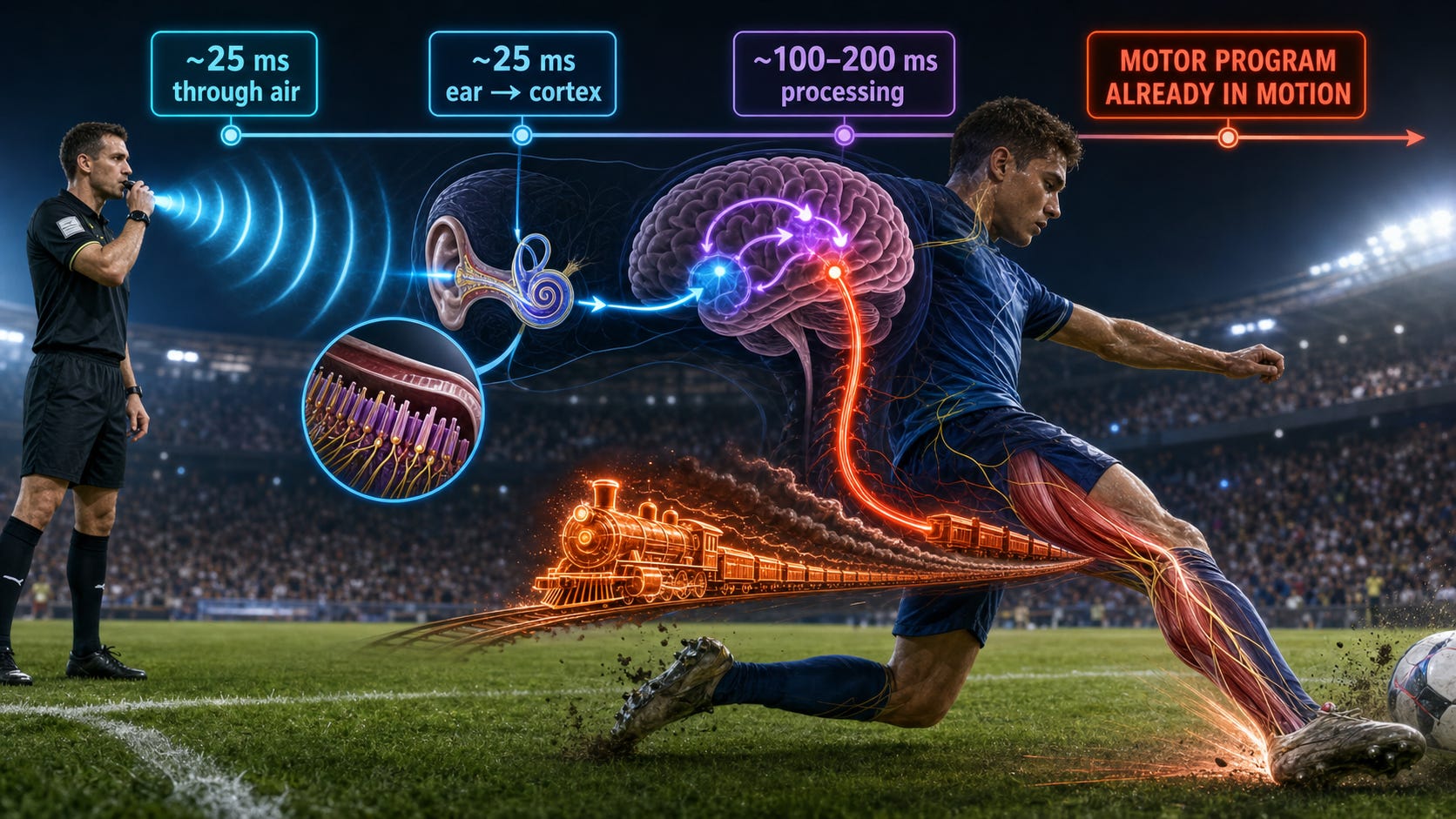
But registering the whistle is just the beginning. After the sound is detected by the auditory cortex, the brain has to decide what to do with that information. Different regions of the brain get involved in the analysis, and that takes time: typically about 100-200 milliseconds before the player’s brain registers that gameplay has stopped. That may sound like an imperceptibly short duration, but it’s enough to make a difference during fast-paced athletic competition.
But the problem has only begun, because the player’s brain might have already been going down the long neural road of activating a motor program (a kick) before the whistle blew. Well in advance of his foot swinging forward, the motor cortex has to compile its instructions and ship them down the spinal cord to the muscles. In other words, in many cases, the train has already left the station before the whistle demands that no more trains leave.
Although some of our actions involve conscious awareness, most don’t.1 Actions like kicking a ball require rapid, precise coordination of muscles, joints, and balance mechanisms, but all of this coordination lives deep in the circuitry of the nervous system: The motor programs are run automatically, and by the time we become aware of our intention to move, those neural instructions are already well on their way out to the muscles involved. As a result, a player’s motoric destiny is already set before he registers the whistle.
Interestingly, from the player’s perspective, they may feel like they’ve kicked just before the whistle, even though everyone can see the kick came afterward.2 This happens because consciousness is delayed, and our brains are constantly trying to interpret and reconstruct what just happened.3 So, to the player, their response seems well-timed, even if the camera’s evidence tells otherwise.
Thus, a kick after the whistle doesn’t necessitate that the player is ignoring the referee. The lag between hearing the whistle and kicking the ball is what happens as the brain works to catch up with the external reality.
This sort of timing hiccup isn’t just a quirk of soccer. In any sport where decisions and movements happen at high speed (sprinting in track, swinging a baseball bat, or vying for a basketball) players are constantly pushing the limits of their neural timing systems. These athletes train their brains and bodies to make complex decisions (often based on limited and potentially contradictory sensory information) and to execute precise movements in fractions of a second.
But all brains, even the best-trained, have inviolable processing delays, which can lead to moments when players appear to act too late.
Referees, fans, and players typically don’t always realize the extent to which the brain’s timing lag influences gameplay.4 But in the high-octane world of professional sports, understanding the brain’s inherent delays might lead us to be more forgiving of those extra kicks, swings, or movements. After all, what looks like defiance on the field may sometimes represent be the long journey of sluggardly signals in the brain.
David Eagleman is a neuroscientist whose research focuses on the intersection of brain science and behavior, including how humans perceive time and make decisions. Vidar Wendel-Hansen is a research physician with a keen interest in neuroscience and soccer.
No posts
Comments
Nothing yet. Say the first thing.
Sign in to join the conversation.