
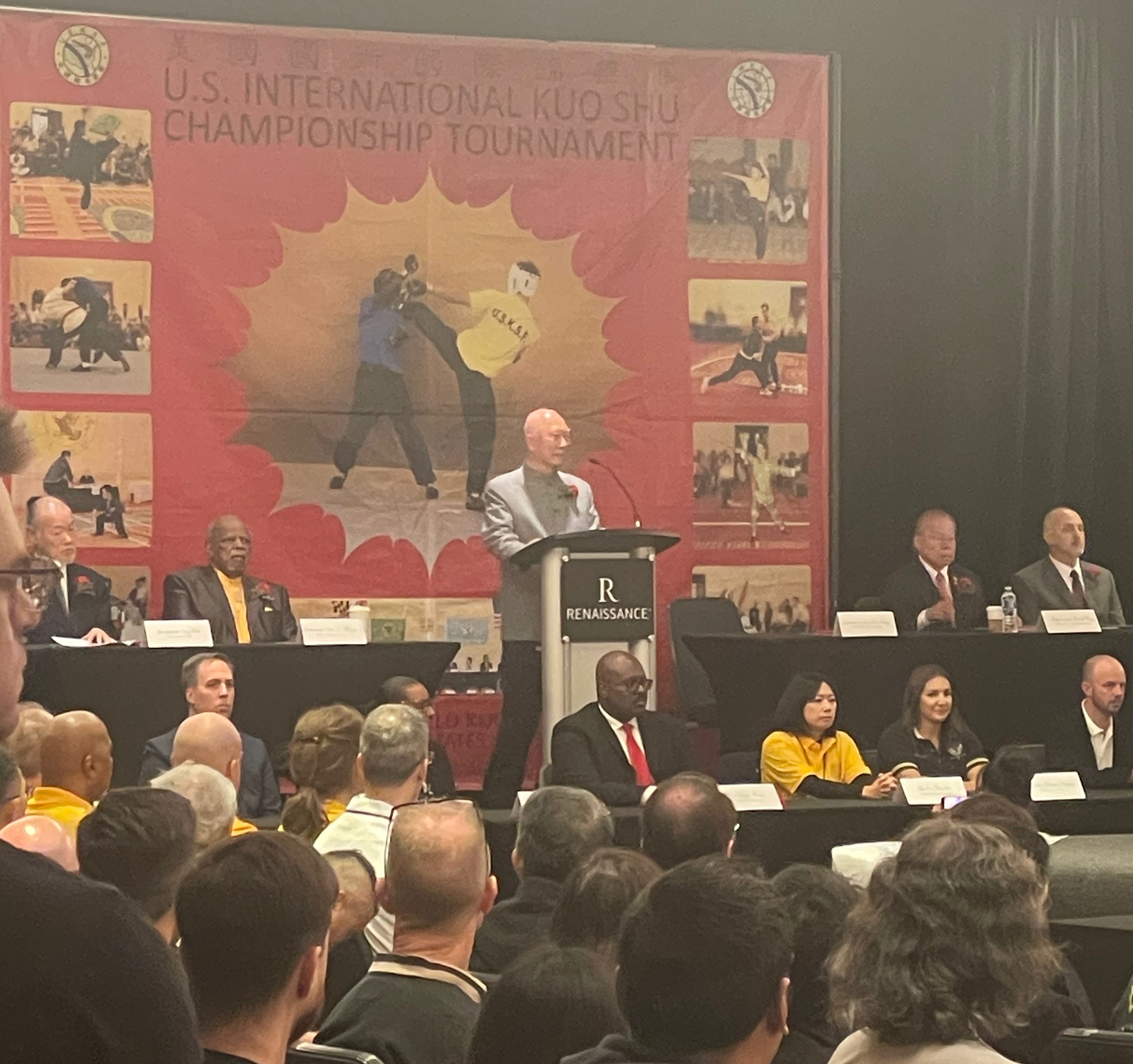
Baltimore. Sunday morning.
They call your name.
You bow to the head judge. You walk in — deliberately, that’s the protocol — and bow again at the place you start.
I had done the eighteen-point staff form some three hundred times over the past few months. I had a new six-foot bamboo staff, beautifully speckled, that replaced my old warped one. This was my next-to-last event, and I had asked a friend to film it.
I walked in like a man going to battle. First move, I punched the staff outward, staring into the head judge’s eyes. I hoped she saw my fierceness.
Then it started unscrewing.
Move two, I wobbled — staff between both bent arms, hands in prayer position, but the staff wasn’t level. Small. Recoverable. But something in me started watching.
Somewhere around move seven, I struck with my hands reversed at an imaginary attacker forty-five degrees to my left. When I went to make the next move, the sequence was off.
I stopped breathing. Something panged in my chest. My body went hot. The room swirled.
And then I was gone.
Not searching for the next move. Gone — standing on the fifth floor of a hotel with a staff in my hands and no idea where I was in my own body.
I froze for what felt like a century, searching inside for my map. The map was inverted.
I skipped five moves. Maybe six. I jumped to the closing, the only sequence I could still reach, and finished it as I’d learned it.
Then I sat in horse stance while four judges lifted small numeric cards with my score. They judged what they saw.
I bowed without breathing, avoiding the head judge’s eyes. I walked backwards out of the ring, because you never turn your back on the floor.
I had walked in like a warrior. I walked out like a man being taken to the gallows.
Mr. Lee, the head of my school, was watching from the next ring over. By the time I was out, he had moved on.
This was my first national tournament. They invited me the year before and I was too afraid to go.
The whole event was in our hotel, the entire fifth floor. One large room with six rings and the Lei Tai raised platform. Four more rooms down the hall.
Seven events in one day — two with the staff, two forms, a two-man simulated fight, sparring, and our school’s mass attack. Some ran at the same time, so I ran from one ring to the next, no breath, no arrival, just my name being called somewhere down a corridor.
The noise never stopped. Six rings going at once. Kids and parents cheering. You wait at the edge of your ring for your name inside all of that.
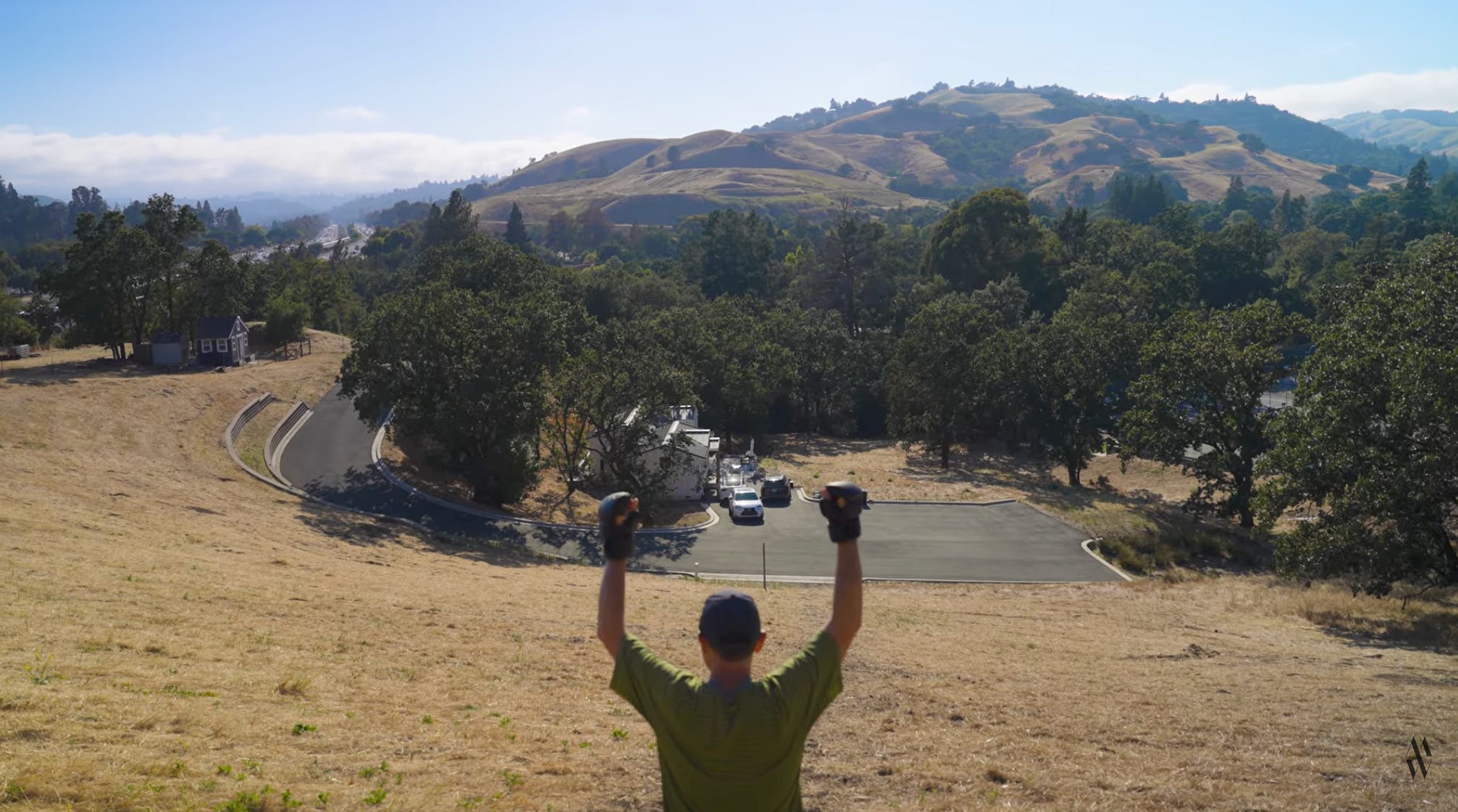
For two months I’d been getting ready. I installed a heavy bag on my back patio and had the gardener cut a path up the steep dirt hillside behind it. A few times a week I’d hit the bag, then jog the hill, five rounds. Juneau, my labradoodle, would hide under the table while I panted. I called it my personal bootcamp, copied from the Lei Tai fighters’ training.
A few weeks before Baltimore, in a Monday instructor trainee class, we competed in our groups. It was the night after my first three-hour intensive, and the instructor that day had shown us what fierce looks like. I decided that night that Mr. Lee and the other instructors were going to know I was fully here.
I had been stuck at three stripes on my purple belt for seventeen months.
Mr. Lee later said that I had carried my group, and that I’d moved better than he’d seen me move.
He gave me my fourth stripe that night, in front of everyone.
Here is what nobody in that room knew.
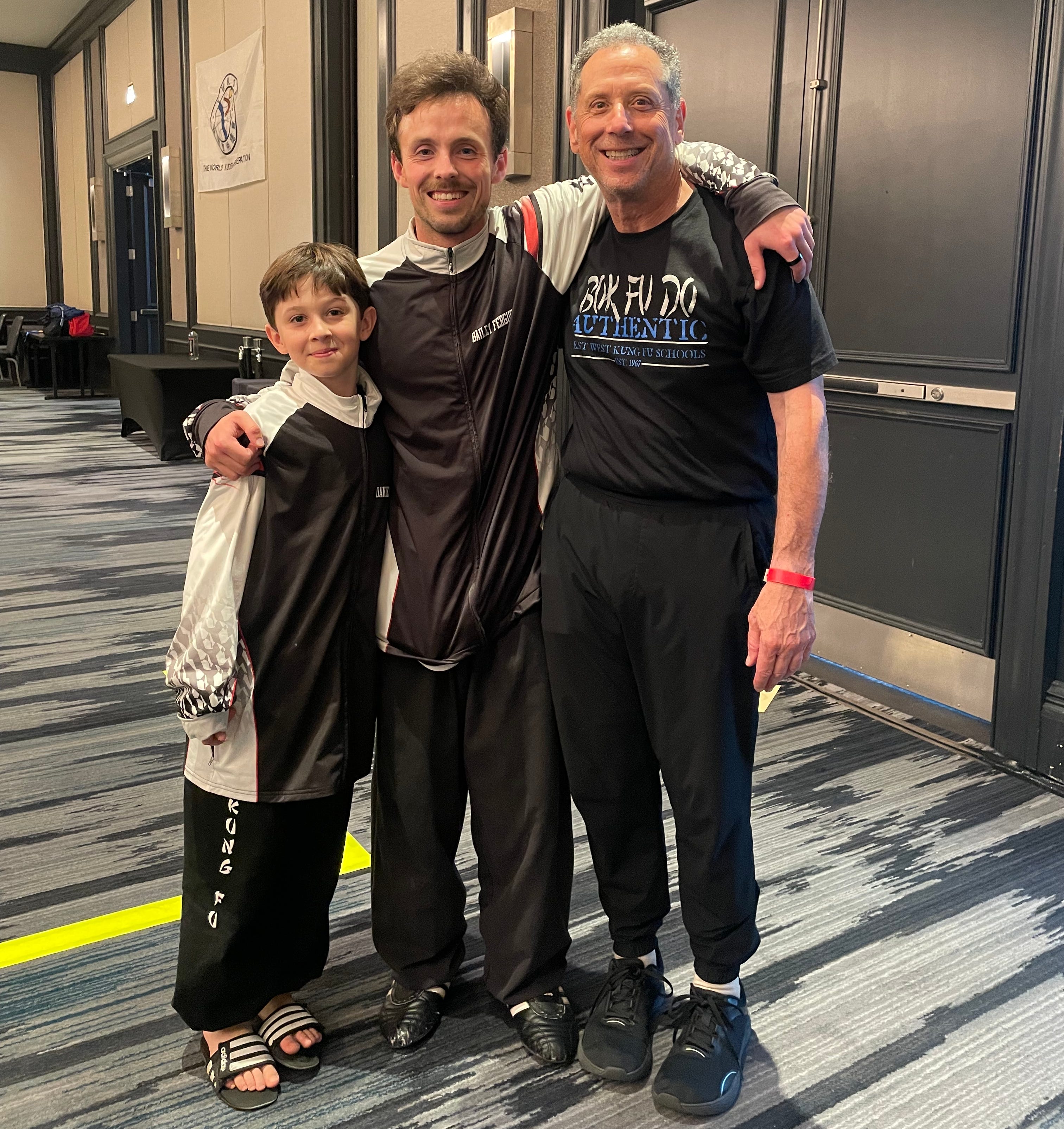
The night before, I watched our school dominate the Lei Tai. My instructor Mr. Ferguson took gold, and a few other brown belts did the same, as is our tradition. I left at nine to get a decent dinner and some rest. Room service came an hour late and cold. I sent it back. The second tray came thirty minutes after that. I ate at ten thirty.
Somewhere in there I learned that a family member had been admitted to the hospital.
The next morning, before my seven events, my mother’s assisted living called. She is ninety-two. Her leg was swollen again. They couldn’t reach anyone else.
So I did what I’d done every morning of that trip. I walked the Inner Harbor.
Friday. Saturday. Sunday morning before my events. Monday before the train. I took photographs each day.

Sunday morning I felt a rare calm. I came around the corner of the Ritz-Carlton frontage and found two trees in full bloom. I took out my phone, said a prayer of gratitude, and photographed them.
Then I went up to the room and put on the blue silk top and black silk pants. My uniform’s black sash was twisted, not laid flat like the black belts wear theirs.
I felt like an actor going into a play more than a warrior.
I walked to the elevator and hit five. My pulse climbed. My palms went wet.
The mass attack is our school’s event. We invented it. No other school ran it that weekend, and four of our own black belts sat as judges all day. The crowd around that ring was thick.
I screamed my kiais like my life depended on it.
I kicked the first attacker with a crossover thrust, turned, blocked the second one’s right hand, bent him over with a whipping arm bar to the abdomen. Chopped him to the kidney. Right and left punches through successive broken-bow stances.
Then I turned him, and as I went to chop his right pectoral, my shoe caught the carpet.
I stumbled. I didn’t stop. I kept the target and ran him down, dropping him with a second crossover thrust.
Then I turned to the first one, on the ground to my left. I knelt and went to work — punches to the chest, a simulated groin grab, a right hand that finished him.
At the end I let out a kiai a classmate told me he heard from the far side of that enormous hall. I let it fly like a primal beast.
Silver.
I think that second crossover is where I reinjured my right hip bursa. Third time this year. I didn’t feel it in the ring.
Afterward one of the black belts told me, “You tripped, you stayed on the target, you hunted him down. That’s exactly what mass attack is about. That’s why you got the silver.”
I hoped Mr. Lee had seen it.
Two nights later I was in lower Manhattan, in a corner suite above the Hudson, visiting my daughter on her summer law internship.
I woke at two thirty in the morning from a nightmare about the staff form.
Not about losing. About the freeze. Running the sequence, hitting move seven, stopping. Again. Again.
I lay there and interrogated it for an hour. What did I do wrong? What could I do better? Should I feel horrible? What did Mr. Lee think when he saw me? Would there be a penalty?
And here is what I finally understood, somewhere around three thirty.
Mr. Lee saw it. Mr. Lee never misses anything.
Four stripes is where you get tested for the next belt.
So the verdict I was dreading at two thirty wasn’t about a form. It was whether a man who had just decided I was ready had watched me on that floor and changed his mind.
I don’t know. He hasn’t said, and I’m afraid to ask.
He had given me no reason to believe it. The fear was mine.
Two things broke that day, and they broke differently.
In the staff form, the sequence went and my orientation went with it. I stopped performing and started searching. Where am I, what comes next, who is watching. The moment my attention left my body, I had nothing to come back to.
In the mass attack, my footing went and my orientation held. I knew where the target was. The plan was gone and the purpose wasn’t.
I’ve spent my life building sequences. Careers, organizations, standards, a marriage, plans for how the next thing would come into being. Forms. Each move initiates the next one, in time, without thought.
And then something breaks the chain — an illness, a phone call, a person leaving, a body aging — and the only question that matters is whether you can stay oriented when the sequence is gone.
I trained the form three hundred times. I trained the rupture like it was optional.
Before Baltimore I participated in a five-day intensive, three hours a day. They coached us on the freeze directly. If you go blank, don’t show it. Keep moving. Do the wrong moves with conviction. The judges don’t know our forms.
Mr. Lee taught it his own way: the form in pieces, from a standing start. I did that some. Not enough.
And in our last trainee class before the flight, he froze us midway through our forms. The instructors came running at us. They untied our belts and used them to bind our arms. They covered our eyes. They put sparring vests on our heads and helmets on our legs. I took a staff and ran around one student, pounding the floor while he tried to keep going.
We laughed. It was fun.
They taught me the rupture. I nodded and went back to running the form from the beginning.
Six days later I stood on the fifth floor of a hotel with a staff in my hands and no idea where I was in my own body.
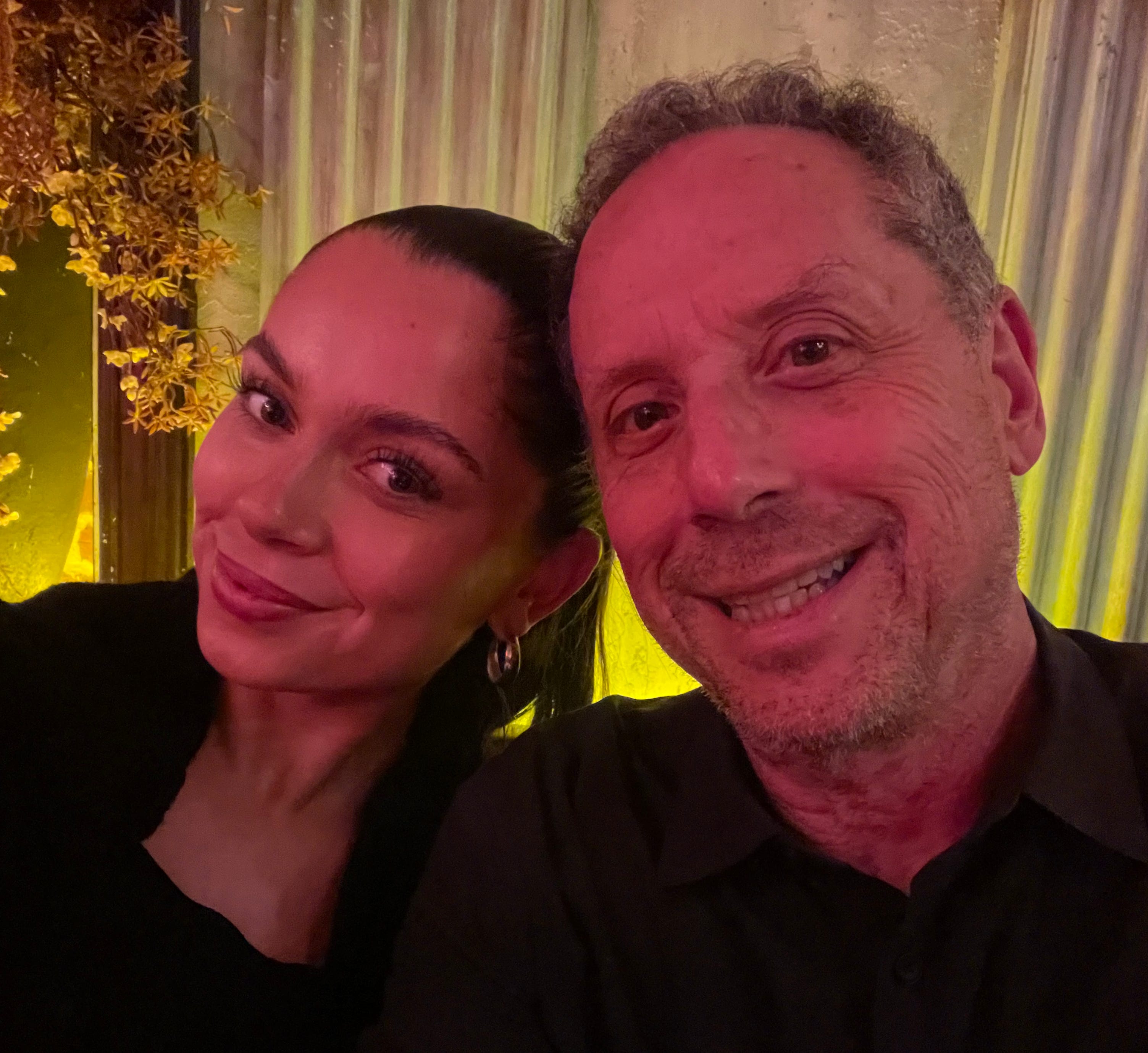
In New York that week, I told my daughter.
We had burgers the first night, then frozen yogurt with cookie dough mixed in. I told her I’d frozen in the middle of a form in front of the head of my school. I told her about waking at two thirty in the morning.
Later, on the plane home, she said, “You’re human. You care so much you got nervous. I’m proud of you.”
There were years I believed that keeping quiet was how you held something together. It isn’t. It only delays the accounting and makes it more expensive.
There’s a Hebrew word I carried into Baltimore. I understood it differently on the way home.
Hineni.
It doesn’t mean I will win. It doesn’t mean I am ready. It means: here I am.
Here is the man who did the training. Here is the man who came with a family in crisis behind him. Here is the man who walked the water instead of feeding the fear. Here is the man who forgot five moves in front of four judges, then held horse stance and waited for the card.
Not here I am when perfect.
Not here I am when young.
Here I am.
I bowed. I walked backwards out of the ring.
And the next morning I walked the harbor again.
My friend shot the video. Photographs too, on his Sony.
He never sent them. I never asked.
I told myself there wasn’t much to see.
I still haven’t seen it.
No posts
Comments
Nothing yet. Say the first thing.
Sign in to join the conversation.