
Please see relevant disclosures here.
Summary: There are genuine signs of stress in GPU infrastructure credit, especially around CoreWeave, but the market is not treating every GPU-backed loan alike. It is separating structures according to what really supports repayment. Customer credit is the senior risk, operational delivery is the gating risk, and compute prices govern renewal, residual value and recovery. A forward curve is therefore not a substitute for an investment-grade take-or-pay contract. Its value begins where the contract protection ends: in non-investment-grade offtake, mezzanine debt, merchant tails, refinancing and post-default re-leasing.
Over the past month, mainstream coverage of AI infrastructure finance has shifted noticeably from capital abundance to investor resistance. On July 10th, the Los Angeles Times reported that the five largest U.S. data center builders added roughly $350 billion of debt obligations over five years. Amazon’s $25 billion offering received an unusually cool reception, while S&P downgraded Oracle to the lowest investment-grade rating as its AI spending rose. Eleven days later, Bloomberg reported that nearly 80% of data center securities issued since early 2025 were trading at wider spreads than at issuance. Prime Data Centers paused a bond sale and Pure Data Centres abandoned a proposed €1 billion bond in favor of bank financing. Those are not GPU loan defaults, but they establish the backdrop: the marginal buyer of AI infrastructure credit is becoming more selective.
The most direct GPU finance evidence came from CoreWeave. Bloomberg reported the launch of a $2.6 billion delayed draw loan tied to deployments for Anthropic, Jane Street and other customers on July 16th. By July 29th, CoreWeave sweetened the economics materially. That sequence shows an observable price concession on contracted, first lien paper. It shows that the market remains open, but only at a price that recognizes execution, covenant, customer, and refinancing risk.
A second line of coverage has focused on how those risks may propagate. Axios highlighted the increasingly circular role of Nvidia and other vendors as supplier, investor and prospective guarantor, while broader reporting has emphasized the long-dated commitments and special purpose vehicles used to finance the buildout. ITPro identified the critical collateral assumption directly: there has never been a forced resale of aging accelerators at anything like the scale now being financed, so nobody knows how three year old GPUs will clear if many lenders sell at once. These concerns are relevant, but they are not interchangeable. A vendor guarantee, an off-balance-sheet capacity commitment, a widening bond spread, and a GPU-backed project loan expose different obligors to different losses.
That distinction is the point of the analysis that follows. The press wave is directionally right that AI infrastructure credit is repricing, but “GPU-backed debt” is too broad a category for underwriting. The relevant questions are whose payment promise supports the facility, whether the project can reach acceptance on time, how much legal and liquidity protection surrounds the collateral, and where the lender is exposed to merchant compute prices. A robust forward curve is valuable precisely because it can illuminate the final category. It cannot substitute for the first three.
The clearest signal is CoreWeave’s latest $2.6 billion first lien delayed draw term loan. Initial discussions in mid-July centered on 425-450 basis points over SOFR at 99 cents on the dollar. By July 29th, reported terms had widened to as much as 500 basis points at 97 cents on the dollar. The facility was marketed with a 1.35 times debt service coverage covenant, and it was intended to finance GPU deployments under take-or-pay arrangements involving Anthropic, Jane Street, Hudson River Trading and other customers. The market demanded roughly another 100-125 basis points of spread, plus two points of original issue discount, to hold the debt.
That is an expensive clearing level, not evidence that financing has disappeared. It also says more than the headline spread alone. The risk premium sits on a contracted, secured project vehicle rather than an obviously speculative merchant fleet. Investors are charging for the possibility that the contracts, delivery schedule, covenant package and parent credit will not remain as cleanly separable as the legal structure suggests.
CoreWeave’s credit default swaps tell a similarly cyclical story. Five year protection reached approximately 881 basis points in December 2025, fell as low as 452 in early June, and then returned to roughly 855 late in July. The latest move is therefore a round trip to a previous stress peak, not a whole new regime. Twice, the market has priced CoreWeave near 880 basis points; between those episodes, new customer contracts and cheaper project financings persuaded investors to mark the risk down sharply.
The balance sheet makes that volatility consequential. At March 31st, CoreWeave reported $25.1 billion of principal debt, including $7.5 billion classified as current, against $2.2 billion of cash. Quarterly net interest expense was $536 million, while equipment purchases reached $7.7 billion. Operating cash flow was a strong $3.0 billion but still fell roughly $4.7 billion short of those purchases and benefited from working capital and deferred revenue movements. CoreWeave also scheduled $6.1 billion of principal payments for the remainder of 2026 and $5.7 billion for 2027. These are not necessarily refinancing cliffs, but they make continuous access to debt markets essential.
The strongest counterexample to a generalized seizure is CoreWeave’s $8.5 DDTL 4.0 facility. It is non-recourse, priced at SOFR plus 225 basis points and rated A3 by Moody’s and A(low) by DBRS. The vehicle is secured by project assets, data center leases and an investment-grade customer contract. After customer acceptance, debt sizing shifts to a 1.2-times coverage test that CoreWeave says can support leverage above the equipment’s original cost.
That structure is not principally a bet on GPU liquidation value. It is project finance against the present value of high-quality customer payments. A compute curve would still inform renewal and recovery, but it is not the foundation of initial senior sizing. The contract has deliberately engineered most merchant price risk out of the senior tranche.
Move down one tier and the economics change. CoreWeave’s $3.1 billion DDTL 5.0 finances contracts with two large non-investment-grade customers. It closed at SOFR plus 450, carries BA2/BB+ ratings and requires a 1.35 times debt service coverage ratio. Its credit agreement also contains liquidity reserves and equity cure mechanics.
The covenant history matters because ring-fencing is not immutable. CoreWeave amended DDTL 3.0 to reduce certain liquidity requirements, postpone the initial testing of its debt service coverage covenant and permit unlimited equity cures through October 28th, 2026. Those changes may be sensible responses to delivery timing, but they show that legal isolation can weaken the construction and revenue recognition slip.
The wider neocloud market exhibits the same discrimination. Nebius raised $775 million at SOFR plus 250 against deployed GPUs and contracted cash flow from an investment-grade customer. IREN announced $3.65 billion of investment-grade financing at a 6% blended cost for infrastructure supporting a Microsoft contract. Lambda expanded a secured facility to $1 billion, although detailed public pricing remains limited. At the riskier end, AMD reportedly agreed to rent GPUs from Crusoe if other customers could not be found, helping support a roughly $300 million loan near 6%. The backstop improves that transaction while revealing what lenders would not accept without it: highly levered, unhedged merchant exposure.
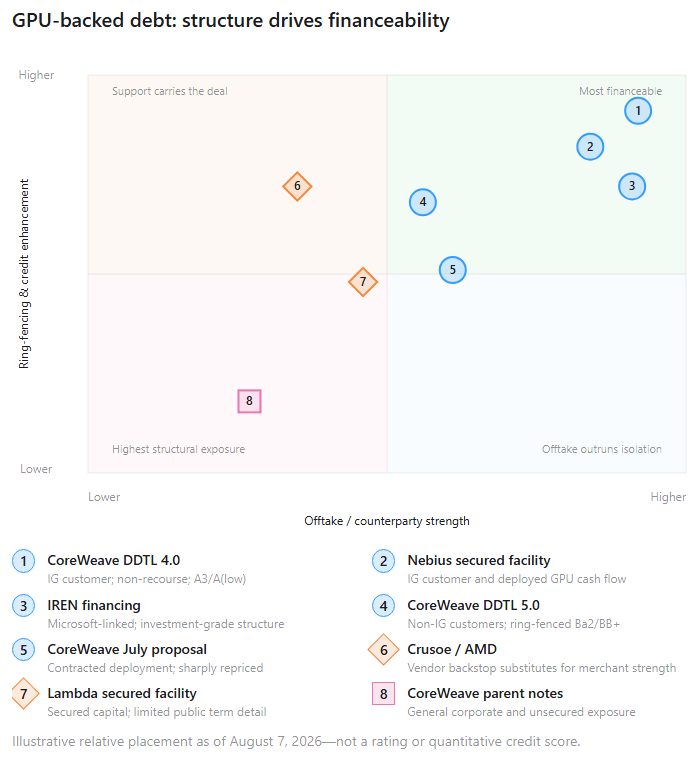
Figure 1. The matrix is a qualitative map, not a relative-value screen. Table 1 supplies the disclosed transaction terms behind the placements.
A robust compute curve would make three risks measurable. First is the merchant tail after a contract expires. Instead of amortizing against historical equipment cost or an accounting depreciation schedule, lenders could size residual debt to stressed forward rental cash flow for the relevant GPU generation, region, cluster size, network and service quality.
Second is contract moneyness. Suppose a customer pays $2.50 per GPU hour while the forward market for equivalent capacity falls to $1.60. The contract is 56% above market; a reset to the curve would erase 36% of gross contracted revenue. The apparent strength of the fixed contract is now paired with a stronger incentive to renegotiate, dispute performance or seek an exit. At the same time, the lender’s replacement revenue, collateral recovery and refinancing capacity are falling. Customer behavior and collateral value deteriorate together: classic wrong-way risk.
Third is capital stack allocation. Senior debt can be sized to high confidence customer payments and bank guarantees. Mezzanine debt can absorb renewal and residual price exposure. Equity can bear construction overruns and deep merchant risk. The curve does not make every tranche safe; it reveals which tranche is carrying the unpriced compute exposure.
The capacity premium identified by Bandi and Su strengthens this use case. A physical term rental includes not only future compute but the right to assured capacity. Financial futures may therefore price below physical term rentals. For a lender, that stripped down financial price can serve as a deliberately conservative residual value mark, provided the contract, location, and cluster basis are modeled separately.
Compute cannot be stored, so cash and carry arbitrage cannot mechanically anchor futures to spot. Public one- and three-year cloud commitments also bundle compute with minimum-use obligations, provider pricing policy, customer credit and a capacity access option. They are not clean forecasts of future merchant prices.
The deeper obstacle is the short side. Neoclouds are physically long compute, but voluntarily selling forward can crystallize the obsolescence curve they would rather leave implicit. Customers may buy protection or capacity, yet there is no naturally balanced population of sellers willing to quote multi-year prices across standardized GPU grades. An exchange can list a contract, but it cannot manufacture that risk appetite.
Credit covenants offer one route to bootstrapping the market. Lenders could require borrowers to hedge a portion of uncontracted capacity, renewal exposure or residual value as a condition of leverage. That requirement would create recurring short interest and observable forward marks. Options or floors may be more practical than mandatory short futures because they avoid margin calls when compute prices rise and the physical fleet becomes more valuable. The hedge should be sized to the debt’s exposed cash flows, not to the fleet’s headline GPU count.
CME, ICE, and Architect plan to launch compute futures later in 2026, subject to regulatory approval, while Kalshi has begun publishing an implied GPU curve from prediction market contracts. Those are useful experiments, but venue readiness is downstream of natural counterparties, standardized deliverable grades, basis risk controls, and multi-year liquidity.
The market is determining whose payment promise sits above GPUs-as-collateral, whether the capacity can be delivered on time, and who bears the loss when the contract ends or fails. Investment-grade project structures can route around most merchant price risk. Lower-tier neoclouds, mezzanine lenders and parent creditors cannot.
A compute forward curve will make the risks outside the senior contracted tranche visible, comparable, and transferable.
If you enjoy this newsletter, consider sharing it with a colleague.
Share Buy the Rumor; Sell the News
I’m always happy to receive comments, questions, and pushback. If you want to connect with me directly, you can:
Comments
Nothing yet. Say the first thing.
Sign in to join the conversation.