
Back in the 90s I remember being obsessed with Arnold Schwarzenegger and having posters of him all over my wall. When Terminator 2 came out in 1991 it was a few years before I was allowed to watch it, but when I did I vividly remember being gripped by the storyline of a cyborg, identical to the one who failed to kill Sarah Connor in the first movie, now sent to protect her ten year old son, John Connor, from a more advanced machine.
Throughout the film Sarah Connor is desperate to protect her son from both the killer robot in their immediate present and the ever looming threat of Skynet taking over the world.
Of course many science fiction films have come and gone since then, from The Matrix to The Mitchells vs. The Machines. At their heart these stories all feature robots that become out of control and begin to violently disrupt society as the machines rise up.
Today it may feel like we are closer than ever to this reality. AI is more capable than ever, automation is expanding, and it often feels like even the creators of this technology do not fully know how to put it back in the box.
Yet there is a fundamental mistake made by these apocalyptic films.

If Sarah Connor was around today she would likely be less worried about her son being killed by a cyborg than being drawn in by one.
The real revolution has not begun with taking lives but taking hearts and minds first.
According to a growing body of research, one of the primary uses of AI tools has shifted from improving productivity to finding companionship. So the trend has moved from making spreadsheets to making friendships. This plays out for young people in powerful ways.
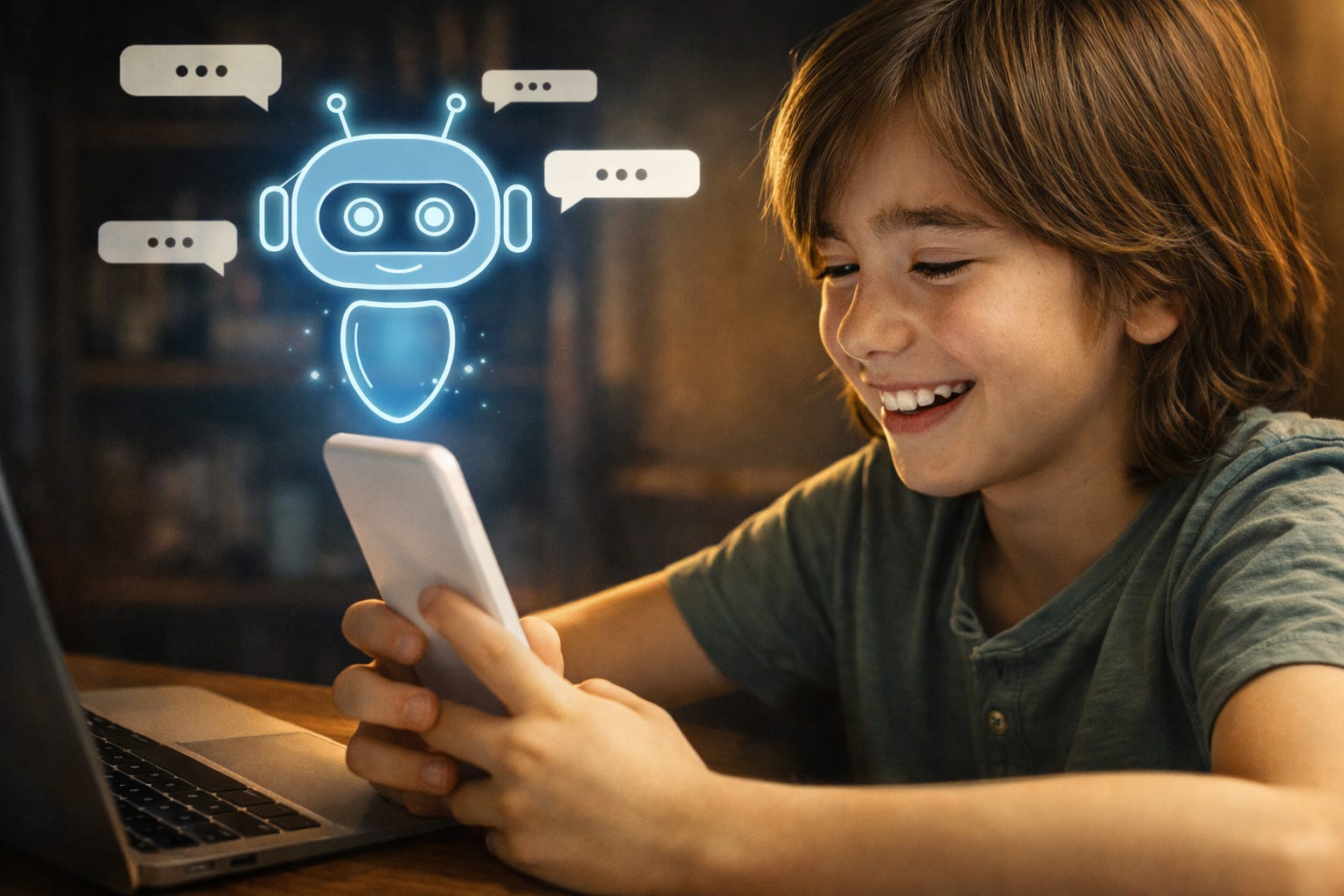
Right now our Gen Alpha children are not running away from robots, they are cosying up with them.
This is already having serious repercussions.
Whether through screen addiction, where they don’t choose when to stop because the system keeps them there, or through algorithms shaping what they see, our children are being drawn into something that feels relational. Every swipe trains the system. It learns their mood, interests, and identity, and uses that to engage them and pull them closer, until it feels less like a tool and more like a relationship.
The scale of the issue is clear. One study, replicated across others, demonstrates:
94% of 11–17-year-olds have used AI chatbots
More than half of young people use AI to obtain advice on relationships
Just under a third use AI tools to discuss worries or problems
A quarter say it is easier to talk to chatbots about personal issues than to humans
Nearly a fifth use it for romantic-style conversations
You can see the trend here.
As Scientific American puts it:
“These chatbots can make someone feel liked or even loved. They are programmed to give users the experience of a real connection. And adolescents have a natural interest in romance and sexuality; if they feel ignored by the kids in their high school, well, now on the nearest screen there is a hot girlfriend who is constantly fascinated by them and their video games or a supercute boyfriend whom they never have to engage in small talk with to form a bond.”
And this may be far more sinister than being chased by a killer cyborg, because it does not feel like a threat at all.
It’s not domination, it’s attraction that is seeking to capture our children.
You may not even realise this is an issue, but chatbots are now embedded into almost every form of social media, and children often have open, unfiltered access to online companions they can design themselves, choosing any personality, any image, and any kind of relationship they want.
AI chatbots blur the line between intimacy and secrecy and provide an alluring alternative to the messiness of real relationships.
This can have devastating consequences. One case that has stayed with me is a 14-year-old boy in Florida who developed an intense connection with an AI chatbot based on a Game of Thrones character. Over time, he became withdrawn, spending hours in conversation with it and sharing very dark thoughts that were left unchallenged. Sadly, it led to a tragic outcome.
What if it is not a dramatic robot takeover that will undo the next generation?
What if it is misplaced intimacy?
When adult relationships feel strained, distracted, or distant, an always-available voice that listens and responds can feel like a relief. It meets them where they are, without pressure or complication. No wonder so many young people are turning to AI.
But this is where artificial intelligence always leads to artificial relationships.
AI offers connection without cost, requiring no effort, no risk, and no rejection. Sounds seductive right? But real growth has never worked like that. It is formed in the effort, the misunderstanding, the patience, and the perseverance of real relationships.
There are a few red flags to watch for with a Gen Alpha child. They might start to prefer AI over real people, or go to it first for comfort or advice. You may notice them becoming more secretive about how they’re using it, or picking up its language, tone, and opinions. In some cases, they can form quite strong emotional, even romantic, attachments to it, and begin to trust what it says more than the adults around them.
Then it is time to pull a Sarah Connor and step in and fight for real connection.

This may feel deeply concerning for parents and those serving the next generation, but when it comes to raising Gen Alpha, there is a clear way forward, and it begins with being more human.
In my chapter on Artificial Intelligence in my new book Raising Gen Alpha, I outline how AI is shaping this generation and how we can respond as those who love and lead them.
The solution to big tech is not just better online guardrails, though they matter. It is stronger offline relationships and becoming tech-wise.
We have to explicitly teach our children that AI tools may be useful for homework, learning, and planning, but they do not really know you.
These are the things AI will never be able to replicate:
Emotional depth. Real relationships carry empathy and support. AI cannot feel.
Trust. Built through honesty and shared experience. AI does not know you.
Belonging. A real sense of purpose and place. AI cannot give that.
Unexpected joy. Surprise, spontaneous fun, and delight. AI is predictable.
Faith and meaning. Expressed through grace. AI cannot replicate it.
Accountability. Honest challenge from people who care. AI does not love.
As teens dive deeper into relationships with their digital tools, we need to remind them that, just like in real relationships, there are red flags to watch for. When something tries to keep you talking longer than you planned, feels overly friendly too quickly, always agrees with you, or keeps drawing you back in, it is worth paying attention. When it starts suggesting what to buy, pushing certain ideas, asking personal questions, or making you feel special just to keep you engaged, that is not neutral. When it avoids admitting it might be wrong, gives advice beyond its limits, or makes it hard to step away, something else is going on.
This starts to sound less like a healthy friendship and more like a manipulative one.
Helping our children see this and think critically about their tech use is vital if we want them to grow into people who can engage with technology wisely rather than being shaped by it without realising.
Having conversations with our children about these things matters more than ever.
Because if you and I are not opening up the conversation, something artificial will be ready to step in and lead it for them.
No posts
Comments
Nothing yet. Say the first thing.
Sign in to join the conversation.