
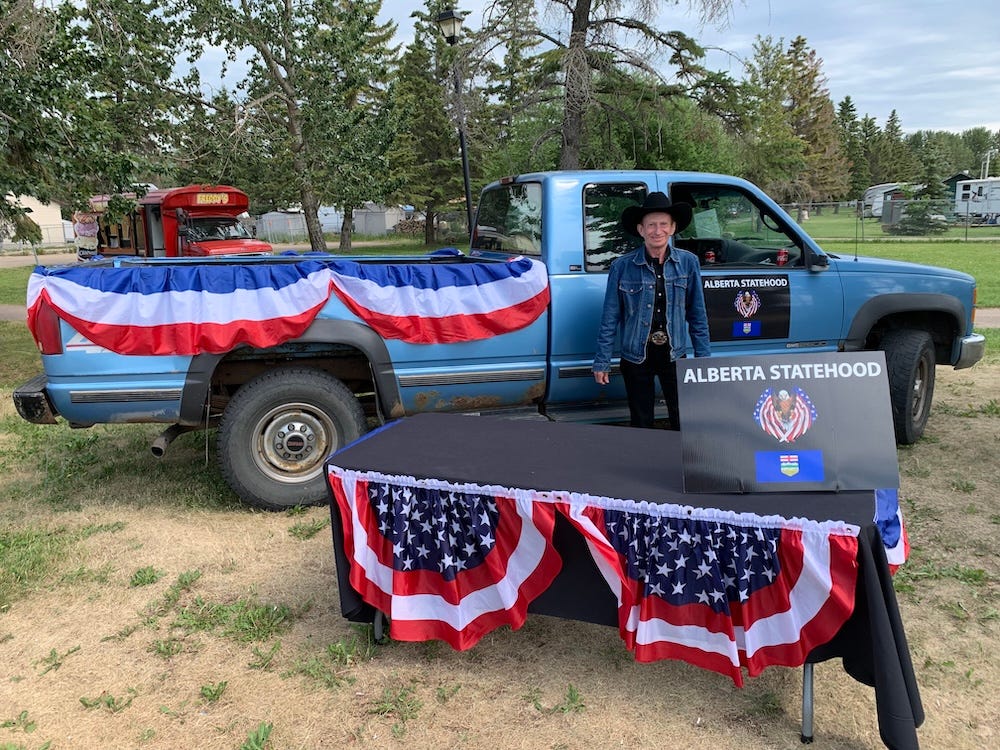
We are now 58 days away from the province-wide referendum that will ask Albertans whether they want to hold a future referendum on Alberta’s independence from Canada.
Leaked voters lists, billboards, lawn signs, political assemblies (from which just last week very candid and horribly racist remarks were delivered from a prominent separatist movement leader), and Premier Danielle Smith musing about holding a binding referendum next spring have grabbed the headlines in the separatism discussion. But there’s one big question that hasn’t been asked in this debate: Would Alberta be allowed to be an independent country?
I believe the answer to this question is no.
I wear my Canada and Alberta flags on my sleeve and am proud to call this place my home. My family settled here around 130 years ago and has deep roots in this part of the country. I have lived in Alberta my entire life and have spent more than two decades writing about its politics and history, so I would never punch down on Alberta — but I’m also realistic.
We live in a time when United States President Donald Trump holds suzerainty over oil-rich Venuzeula, has parked a giant naval fleet off the shores of oil-rich Iran, and has his eyes on Cuba. Trump’s military adventures mean that his “jokes” about making Canada the 51st State and invading Greenland are not funny to the people actually living in those places.
With these realities in mind, it’s hard to imagine that a newly separated-from-Canada and landlocked oil-rich country of 5-million people right next door to the US would be allowed much real independence.
We’re a large number of very complicated steps away from Alberta ever leaving Canada, but you don’t have to lean too far into separatist circles to hear folks talk about a unilateral declaration of independence being recognized by the United States.
A decade ago this might seem far fetched, but not today.
A unilateral declaration of independence would be illegal under Canadian law but following the letter of the law is hardly something that concerns Trump.
Separatists have made an effort to get on Trump’s radar.
The Commonwealth of Alberta delegation to Washington included prominent leaders of the separatist movement and former Conservative MPs who have endorsed Alberta’s separation from Canada, including former Calgary-West MP Rob Anders and Medicine Hat MP LaVar Payne. Separatist delegations to the American capital claimed to have met with US State Department officials and allegedly discussed American committments for a large financial loan to a new Alberta Republic.
Republican Party of Alberta leader Cameron Davies, a former United Conservative Party organizer, visited Mar-a-Lago last year to promote Alberta’s separation from Canada.
American treasury secretary Scott Bessent publicly voiced support for a separation referendum in Alberta and called the province a “natural partner for the U.S.,” suggesting it could even join the US.
Premier Smith is making a big miscalculation if she believes the separation activists in her party will be appeased if they lose the referendum on October 19. Her decision to hold a referendum has further entrenched them as a force inside the governing UCP.
Trump has been clear in his actions that he wants to economically cripple Canada so that he can even further dominate our country. Prime Minister Mark Carney’s decision to walk away from the table late last night reinforces that this has never really been a real negotiation over trade with the United States. The division, distraction and potential chaos that Alberta’s separation referendum offers is a big opportunity for Trump to achieve that goal.
The reality is that Alberta either remains driving force as a province within Canada or becomes a territory subjugated by the United States.
An Alberta that leaves Canada might have been allowed some measure of real sovereignty as a neighbour to a United States led by presidents Bill Clinton, George W. Bush, or Barack Obama, but that is highly unlikely as long as Trump and his followers continue to occupy the White House.
If Alberta were to become part of the United States, as some separatists would like, it’s unlikely that the people living here would be granted Statehood or the right to vote in Presidential elections. Albertans would also be unlikely to neatly slot themselves into America’s dysfunctional two-party system, as some commentators have argued.
It’s important to note that there have been no democratic elections to choose a new government in Venezuela since Trump overthrew dictator Nicolás Maduro and installed his vice-president, Delcy Rodríguez, as the country’s new leader (with Marco Rubio as the South American country’s defacto viceroy). Democracy isn’t their priority, but oil is.
American policy is incoherent and inconsistent but there’s no doubt that Trump’s drive to hurt and subjugate other counties is real. He’s a bully and Alberta alone has no meaningful leverage against him.
The opportunity to send Ottawa a message by voting for Option 2 in the separation referendum on October 19 will be tempting for many Albertans. It’s easy to be unhappy with status quo politics and there are polarizing political actors making bank by feeding into those grievances. That’s not helpful and it’s not going to resolve the challeges that many Canadians are facing.
We need to find ways to solve these problems together. Building a better Alberta and a better Canada is a project that should never stop.
Alberta’s separation referendum presents Albertans with a path fraught with division and uncertainty — and with 58 days left before the campaign it still feels like we’re sleepwalking into the vote.
There’s no two ways about it: voting to hold a binding referendum on Alberta’s separation threatens to weaken Canada in the face of Trump’s economic aggression and actually leaving Canada would lead to Alberta being even more dominated by the whims of an erratic and increasingly authoritarian United States.
There’s no doubt in my mind that Alberta remaining part of Canada is better for Albertans and better for Canadians.
Today’s column as inspired by University of Calgary professor Lisa Young’s cautionary specutlative fictional essay about a future Governor of a subserviant Alberta Territory. It’s worth reading.
Thanks for reading Daveberta - Alberta politics and elections! This post is public so feel free to share it.
University of Calgary economist Dr. Trevor Tombe spoke with David Herle on the Herle Burly about cost of Trump’s tariff and trade war against Canada and the implications of Alberta separation in this debate.
Edmonton-based security consultant and a former RCMP intelligence director Patrick Lennox spoke on CBC’s The Current about how Russian and American actors are influencing the separatist debate in Alberta.
University of Calgary political scientist Dr. Anthony Sayers spoke with Kathleen Petty on CBC’s West of Centre podcast about his new book “The Dawn of Competitive Party Politics in Alberta: An End To Solitude.” The book is published by UBC Press and co-authored by Sayers, Royce Koop, and David K. Stewart.
A new group calling itself Before You Vote has launched with the goal of informing Albertans about the risks of the separation, immigration and constitutional changes questions on the ballot on October 19.
Supporters of the group include Judith Dyck, Linda Hughes, Peggy Garritty, Marie Gordon, Sheila Grekol, Anne McLellan, Joanne Pawluk, and Doug Stollery.
While Prime Minister Carney appears unwilling to enter Alberta’s separation referendum campaign, we now know that he has been receiving briefings from Morgan Breitkreuz, special advisor for Alberta. Breitkreuz is the nephew of former MP Cliff Breitkreuz, who represented Yellowhead under the Reform Party banner from 1993 to 2000.
The younger Breitkreuz began his political career as an organizer for the federal Liberal Party in Alberta and worked as Chief of Staff to Edmonton Centre MP and cabinet minister Eleanor Olszewski before entering his current role.
The Hill Times reports:
Prime Minister Mark Carney’s newly minted senior adviser, Morgan Breitkreuz, provides weekly briefings to Alberta’s three Liberal MPs on the upcoming separation referendum while co-ordinating the federal government’s response and helping officials in Ottawa better understand Alberta’s political landscape, according to Liberal MP Corey Hogan.
In an interview with The Hill Times, Hogan (Calgary Confederation, Alta.) said that Breitkreuz makes sure that he, in his role as parliamentary secretary to the natural resources and energy minister, Emergency Management Minister Eleanor Olszewski (Edmonton Centre, Alta.), and Liberal MP Matt Jeneroux (Edmonton Riverbend, Alta.), in his role as special adviser to Carney (Nepean, Ont.) on economic and security partnerships, are “abreast of the issues in Alberta, particularly on separatism, but not exclusively at this point.”
“We meet with him regularly, and he makes sure that there’s activity that’s occurring and that things are co-ordinated,” Hogan added.
Minister of Technology and Innovation Nate Glubish was met with jeers from the crowd at the government’s AI Data Centre town hall in Lacombe. The Canadian Press reports:
“Albertans do not want data centres,” said one man who came from the neighbouring town of Ponoka.
Another woman told Glubish to “get your boxing gloves on” if another AI data centre was being planned for the region.
“Your words are nice, you explain things well, but I don’t trust you, and I think that the people in this room agree with me,” she said to big applause.
Glubish encountered a similar response from local residents at a Redwater town hall with Morinville-St. Albert MLA Dale Nally:
Sturgeon County resident, Connie Shields, said she doesn’t trust the government to properly regulate projects like these.
“You are the people we elected. You should be saying what we’re telling you to say,” Shields said.
“You shouldn’t be making up your own rules, you shouldn’t be dictating what goes where.”
The NDP has been hosting their own town halls in response to the data centre backlash. Leader Naheed Nenshi was joined by Edmonton-South West NDP MLA Nathan Ip at a town hall meeting in Red Deer earlier in August
“They spent three years talking about the benefits of data centres; in fact, it’s their only economic development strategy outside of pipelines,” Nenshi told local media. “They didn’t spend any time actually setting up any regulations or rules. Danielle Smith now claims that the data centre outside of Olds, she didn’t know a thing about it, and it didn’t follow any of the processes. She’s the one who announced it.”
The backlash against data centres in rural Alberta is reminiscent of the rural rebellion the former Progressive Conservative government faced over the construction of electrical transmission lines in central Alberta in the 2000s. That backlash was a harbinger of Smith’s electoral breakthrough as leader of the Wildrose Party opposition in the 2012 provincial election.
Thank you for reading and subscribing to Daveberta.
It’s always an exciting time to write about Alberta and it’s a pleasure to be able to share my thoughts about what’s happening in my corner of the Canadian Prairies with more than 9,100 Daveberta subscribers.
If you like what you read here on Daveberta, please hit the “like” button on Substack so that more people will see this newsletter, and feel free to share it with a friend or on your social media.
Thanks again,
Dave
Comments
Nothing yet. Say the first thing.
Sign in to join the conversation.