
We belong to two hives at once: the local one on our stone wall at Beit Neshika, and the greater national hive surrounding us. Both share a common geography, and both face a similar physical reality. We are forced to stand guard against adversaries that are larger, stronger, and bred with a far more lethal capacity for violence.
On paper, the weight class favors the intruder every single time. But whether it is a line of worker bees locked shoulder-to-shoulder against a predator three times their size, or a generation standing watch on the hills, mass isn’t the final vote. You stand your ground, absorb the impact, and drag the fight into the dirt so that inside the threshold, life and sweetness survive.
At our educational hive at Beit Neshika, the annual summer confrontation between honeybees and wasps has officially begun.
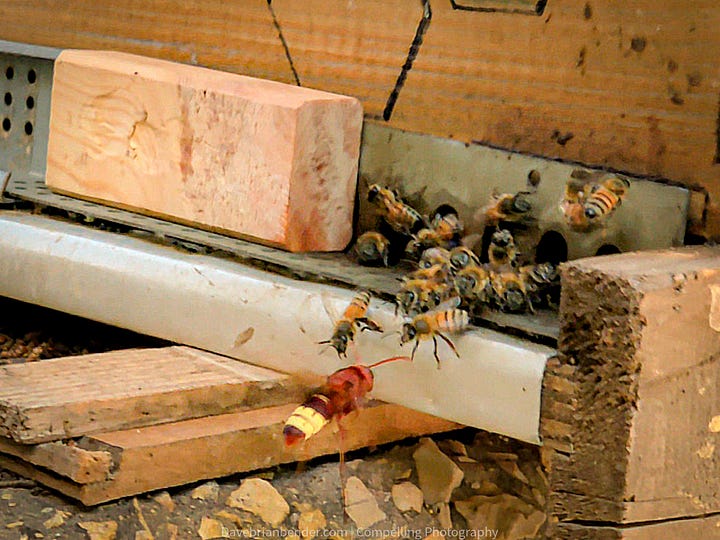
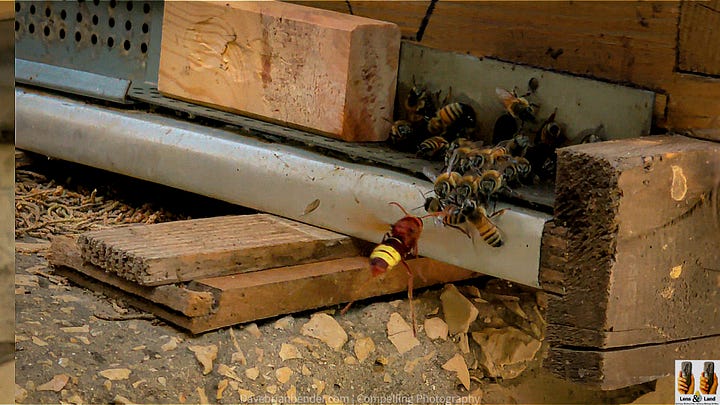
In this corner of the world, biological defense and regional survival happen to share very similar grammar. When Vespa Orientalis - oriental wasps - move on the entrance of our demonstration beehive at Beit Neshika with decoy sorties and brutal decapitations, they are testing a threshold. They are checking whether the hive still has the memory and muscle to hold. Maybe there’s a Tu B’Av parallel.
“In modern Israel, Tu B’Av is celebrated as a holiday of love – the Jewish Valentine’s Day. But its origins run far deeper: the end of the spies’ punishment, the lifting of the ban on Benjamin, the opening of the road to Jerusalem, and much more.”(Beit Avi Chai)
The primary aggressor is massive. Reddish, thick-waisted, and marked with a sharp yellow band across its abdomen, the wasps - commonly working in pairs - hover inches off the concrete. They don’t charge blindly. They troll, seemingly idly, lazily, closely assessing the honeybees - usually only scant inches away - as the latter leave and return from foraging for nectar, pollen, and water for their hive.
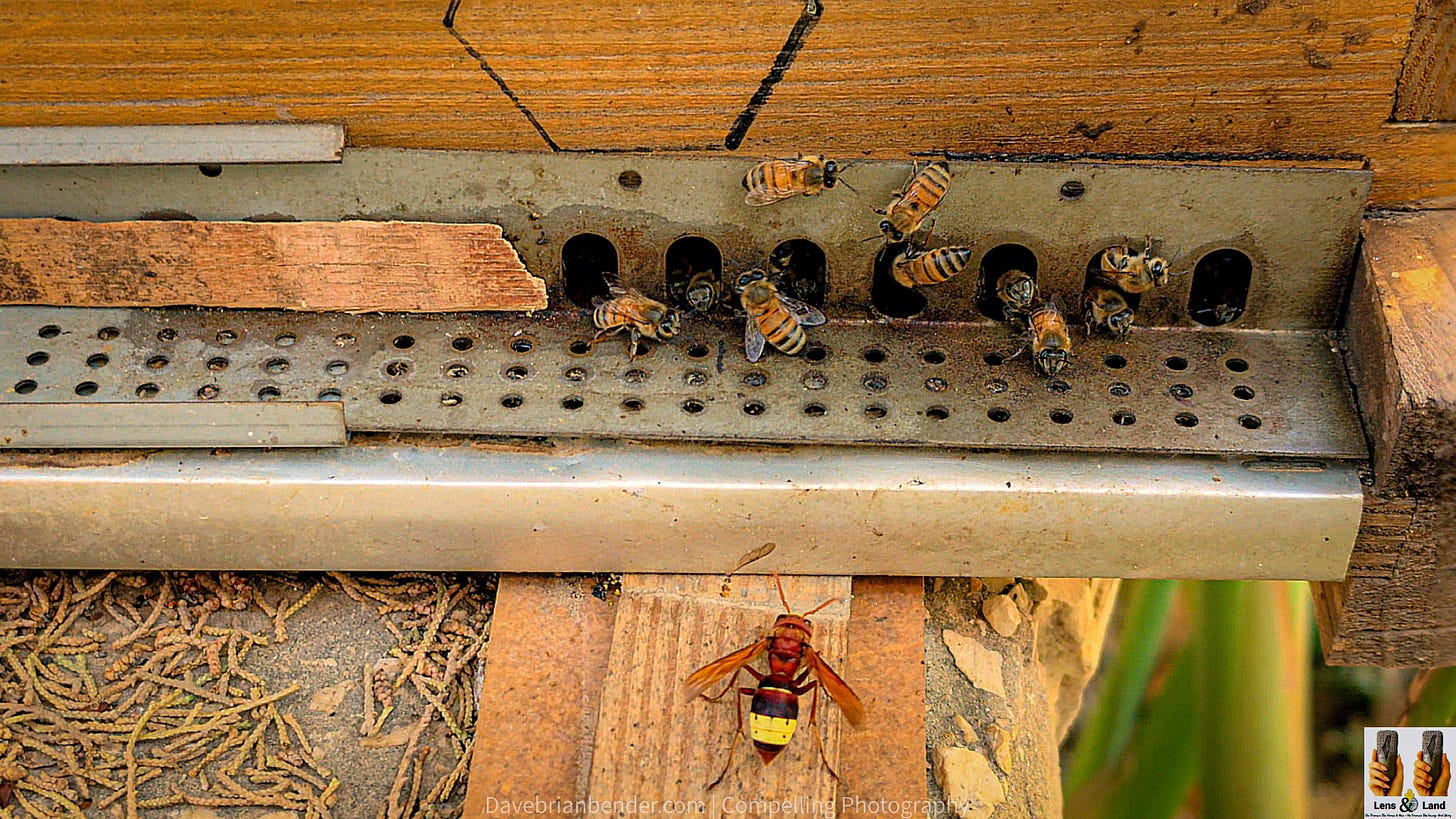
The wasps’ strategy is surprisingly coordinated:
The Decoy:
One wasp may linger high, drawing the gaze and energy of the perimeter.
The Strike:
Then a second wasp swoops in low, grabbing a worker off the landing board before flying off with the prize to feed its own larvae.
On paper, the weight class favors the invader entirely. And the stakes are absolute. Wasps can easily debilitate a colony through sheer attrition. In a weak, stressed, or small hive, the loss of field bees at the entrance triggers a downward spiral: fewer foragers return, the defensive line collapses, and the wasps move inside to finish the job.
This hive, however, is built for the fight. This colony possesses the cluster density, raw energy, and hard-earned genetic instincts needed to parry the threat. They don’t panic.
Across the bottom metal slot of the hive entrance, guard bees form a tight, outward-facing defensive line. Antennae twitching, legs anchored, they calculate the distance faster and better than Iron Dome-synched radar. When a wasp touches down or hovers within striking range, guard bees don’t retreat into the dark—they lunge outward, singly and in clustered salvos to meet the incoming weight.
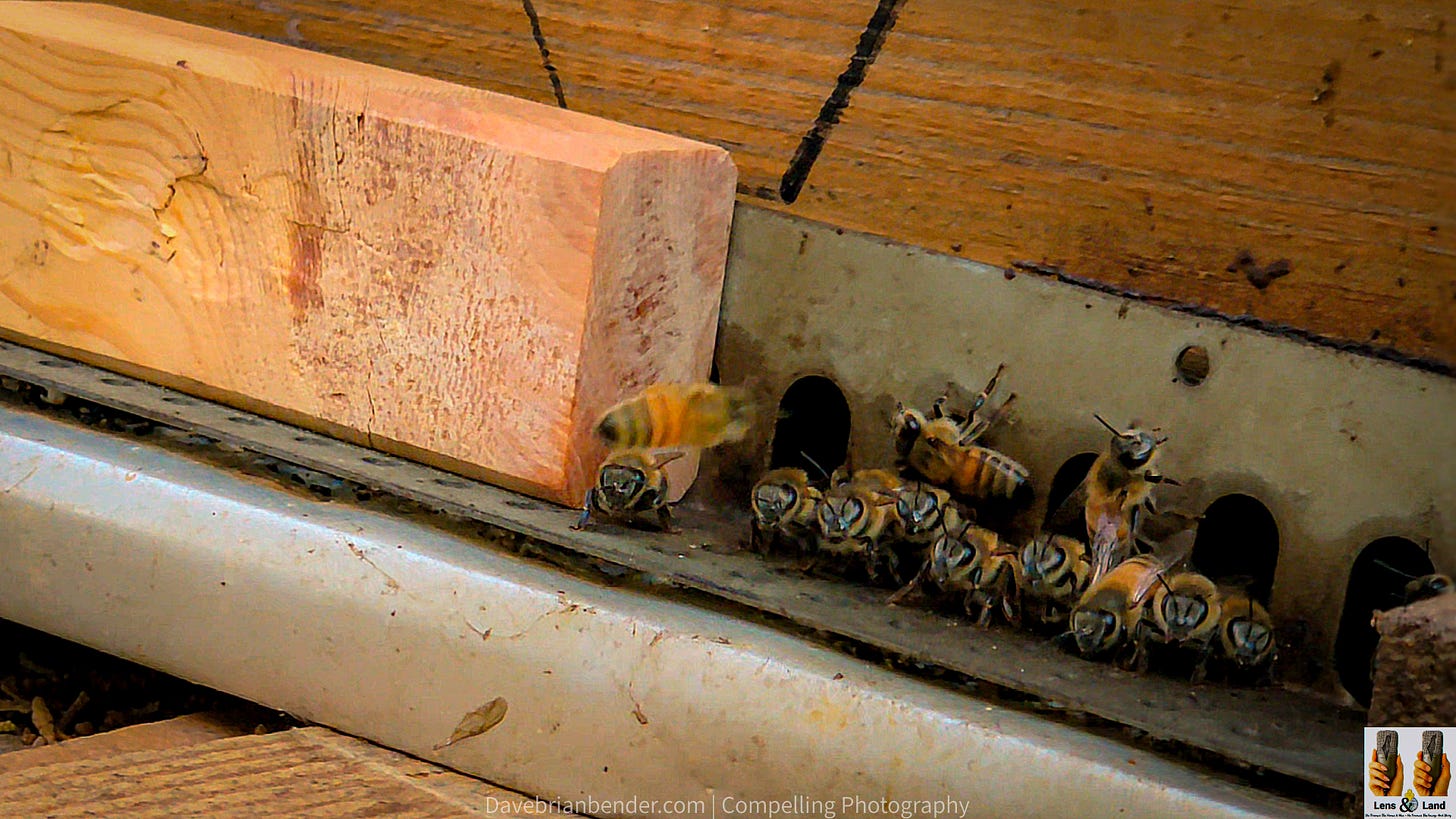
When contact happens, it isn’t clean. It is raw, chaotic wrestling. A guard bee locks onto the wasp’s legs or thorax, dragging both of them off the ledge onto the dirt below. On the ground, surrounded by fallen pine needles, they roll in a tight, violent knot, the bee struggling to insert its own stinger beneath the wasp’s fingernail-hard chitin armor.
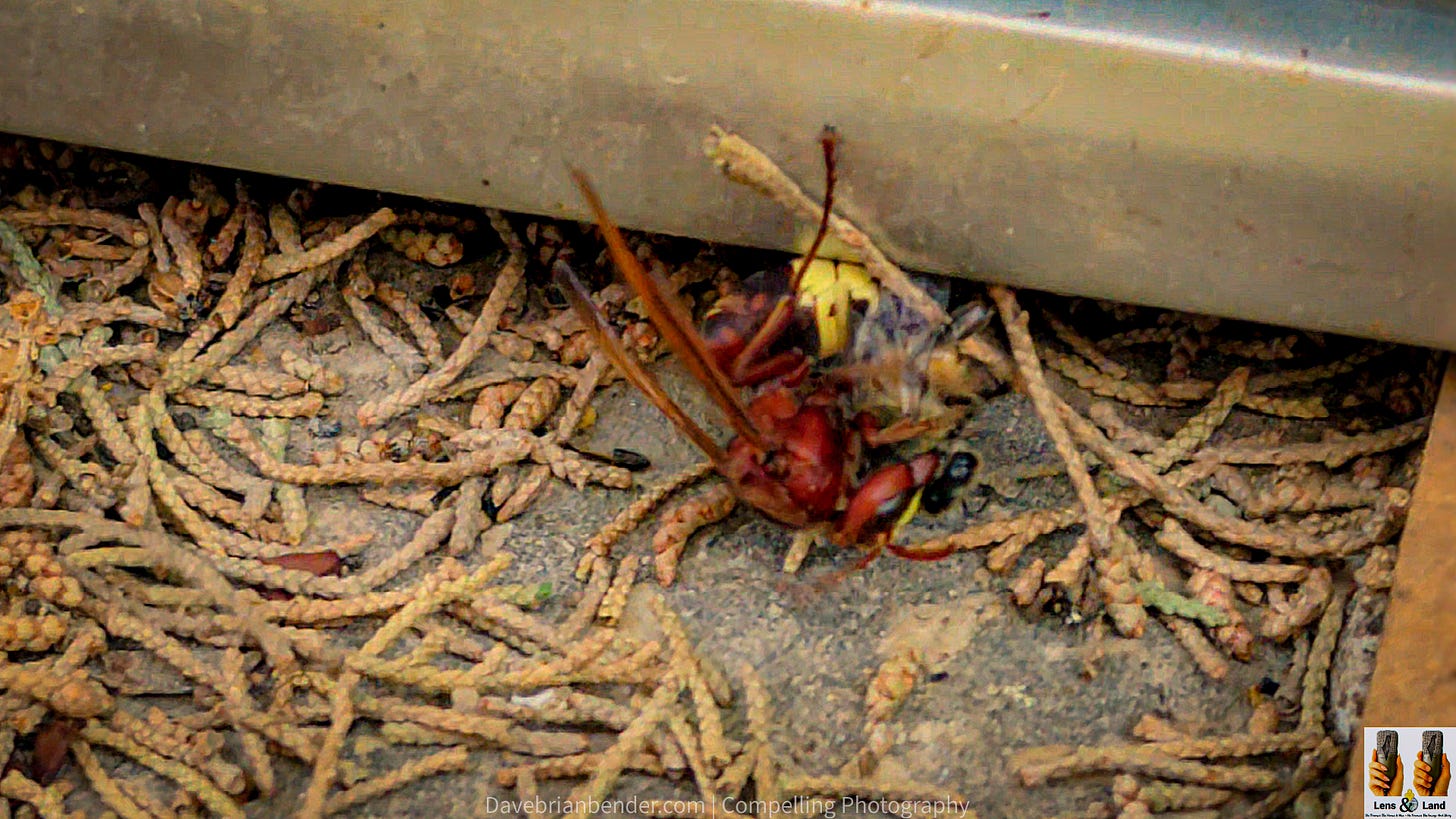
When the wasp does succeed in pinning a worker, its method of execution carries a grim, unmistakable irony. It doesn’t just sting. Using its heavy front pincers, the wasp clips the bee’s neck, severing the head entirely before flying off with the torso. Literal decapitation. In this corner of the Mediterranean, that specific, barbarous mechanics of murder isn’t a dark literary metaphor or a distant biological curiosity. It is a terrifyingly familiar tactic, written directly into the recent history and trauma of October 7th, and so many similar atrocities over the last century.
As a security-minded retired newsman, watching this daily siege on a wooden ledge makes the regional parallel unavoidable. We live in an unforgiving neighborhood. The wasps don’t want to build alongside the hive; they want to raid it, drain its resources, and slaughter its populace. Like the bees, Israel finds itself perpetually forced into a posture of defense and offence against regional forces operating on attrition, asymmetrical distraction, and sudden, medieval savagery.
The contrast is stark. The honeybee’s entire existence is constructive—building comb, pollinating the land, turning harsh sun and dry blooms into sweetness. Yet survival here demands a permanent garrison at the gate, and guard bees primed to fight to the death. The individual cost is brutal. Every conflict takes a toll on workers who should be out foraging, and the threat never truly vanishes; it merely adapts to the season. Success isn’t measured by the total eradication of every hazard in the air, but by keeping the entrance secure.
Weakness in this geography invites total annihilation. A fragile, stressed colony collapses under sustained pressure. But a strong hive—backed by deep roots, collective resolve, and generations of hard-coded survival memory—parries the blow. The intruders score their strikes, and the losses are felt across the entire cluster.
Yet when the dust clears on the concrete base, the line holds; the hive remains; viable, productive, and thriving - despite the surrounding perilous threat matrix.
And maybe there’s an ancient parallel reason this defensive struggle increases around Tu B’Av.
In Talmudic tradition, the fifteenth of Av marks the exact calendar pivot where national grief gives way to quiet, miraculous survival. It is the night the wilderness generation of the Children of Israel finally stopped dying in the sand, rising from their graves to realize the decree of death had expired. Centuries later, it was the day the Romans finally permitted the burial of the fallen defenders of Betar south of Jerusalem—whose bodies, tradition tells us—had sat uncorrupted under the heat, untouched by rot, in an unyielding defiance of nature. It was the day blockades were lifted from the roads to Jerusalem from the north, and the day wood-cutting for the Temple altar ceased because the summer sun had finished its seasoning work.
At its core, Tu B’Av is a holiday built on improbable endurance. It commemorates the sudden turn—the moment when a siege breaks, when dead ends reopen, and when life reclaims the threshold.
Watching our guard bees turn back an assault on a warm July morning isn’t just biology in motion. It is a metaphor of the old, hard-coded rhythm of this soil. Intruders calculate their chances using raw weight, distraction, and sudden savagery.
Yet they always miss the hidden variable: the quiet, persistent miracle of a community that refuses to be erased.
The full moon rises over the apiary. The line holds. Inside, the sweetness remains intact.
[A note from the field: this post may be updated or amended as events develop. My sincere thanks to those who follow, comment, and share these dispatches. Your support keeps the lights on and the cats fed while I’m out navigating the dynamic range of the Galilee. Because the standard Stripe plumbing doesn’t reach us here in Israel, I’ve set up a direct alternative for those who wish to support this work. If you’re inclined to help keep the lens focused, you can contribute via PayPal. Much appreciated. — DB]
Thanks for reading Lens & Land: Dispatches from Israel ! This post is public so feel free to share it.
Comments
Nothing yet. Say the first thing.
Sign in to join the conversation.