
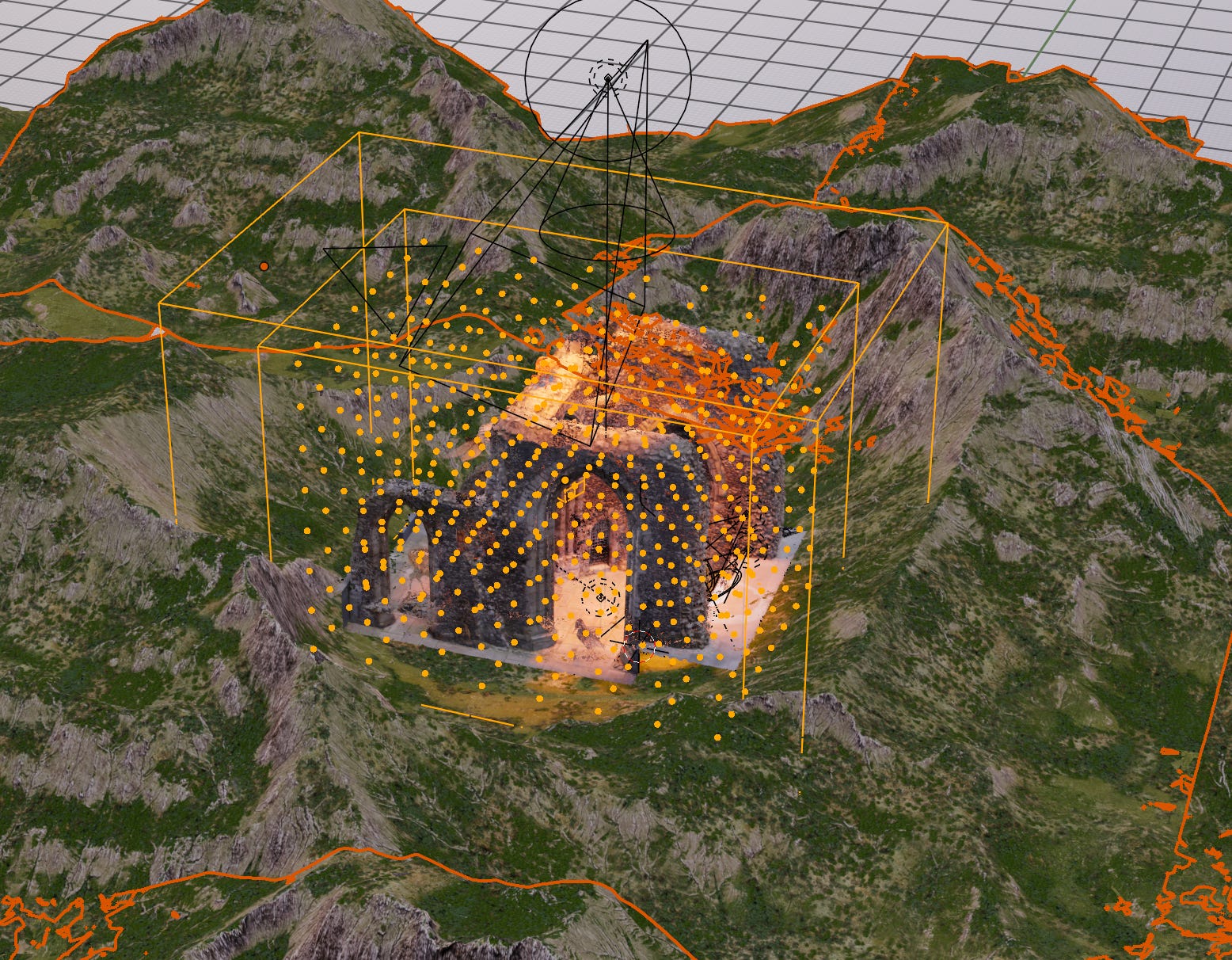
I’m floating in midair in a crisp sky. I think it's early morning. I can feel a thin blanket of dew settling across my cheeks. Below, there's a swathe of rocky green - in the middle, a ring of amber glow. I think I made this in a dream. It's the ruins of St Alphage Church - I thought they were meant to be in the middle of Moorgate, surrounded by high rises and overpriced cafes - it's like someone's plucked it from London and plonked it in this virtual field. I feel something scratching at the base of my neck, a niggling memory that it was me who plucked it from my browser and smacked it down as a .obj file. You wouldn't download the ruins of a 14th century church. Maybe I would. It seems I have. It's so strange that something built and rebuilt by monks 700 years ago, which lay dormant under the soil until the 1940s, when the Blitz uncovered it, is now a specter lurking in my downloads folder. I can't believe my GPU is big enough to hold a church.
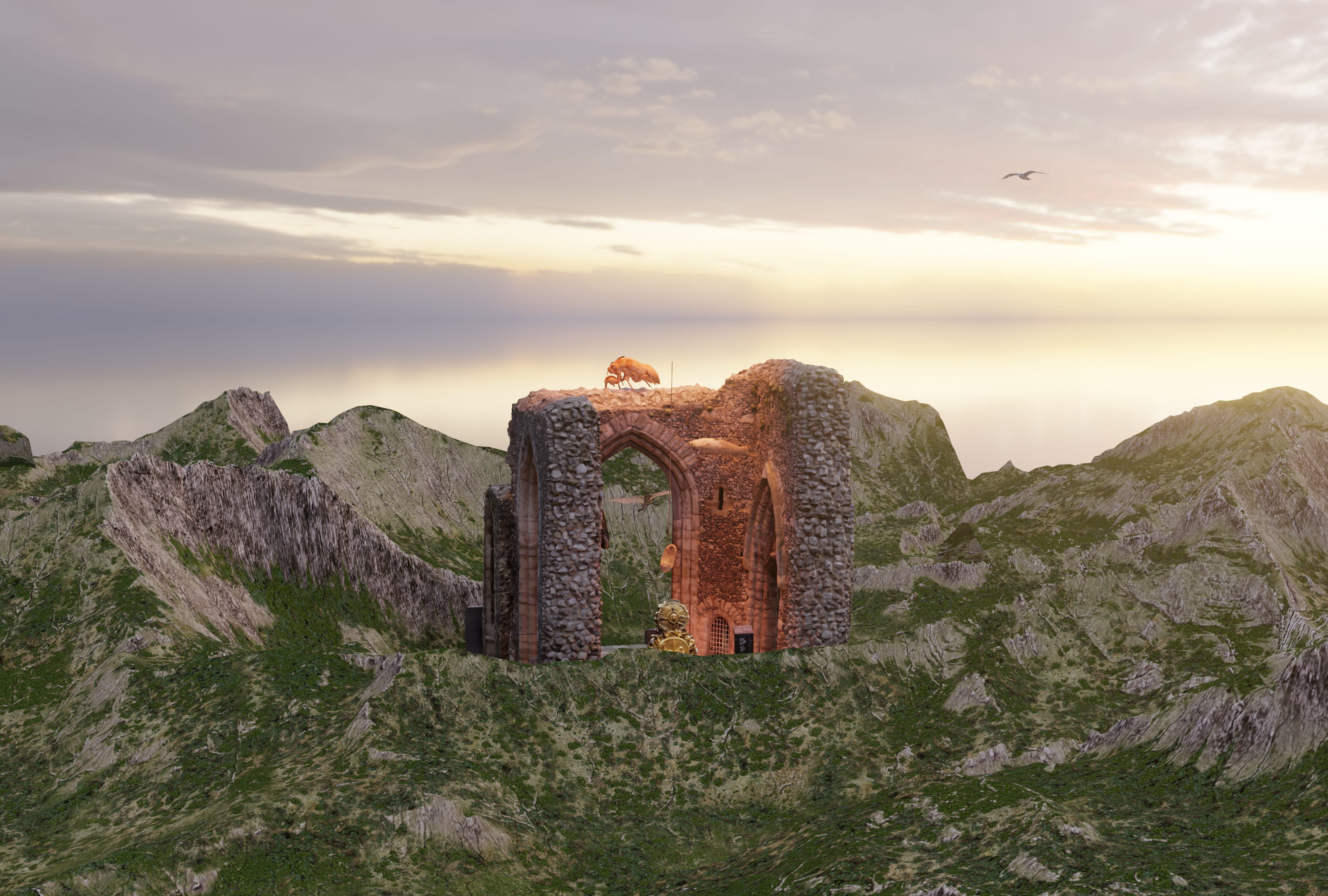
I got it off a website called Sketchfab, where institutions and individuals share their 3d models and scans. Most of them are of anime girls and radioactive waste for making post apocalyptic video games, but a small portion of them are elements of cultural heritage, converted into virtual meshes and re-named ‘'assets’. Maybe re-named isn't the right term, as they've always been cultural assets, belonging to museums and nations. Now they can be individual assets. I too, can be a collector of protected heritage items - priceless, in my case literally, as I can get them for free. The realisation that if I can download a church I can download a host of other things sends me into a bit of frenzy, and I begin to trawl through the 3d uploads of different museums across the world, hitting ‘'download for free’ on anything that catches my eye, regardless of what it is. I've got the storage, and if I decide I don’t fancy it I can always bin it with a satisfying computerised ‘whoosh’ as I press delete. Before I know it I've filled the abbey with a host of ghosts. I find myself standing face to face with a taxidermied deer from the National Museum of Nature and Science in Tokyo. It's been 3D scanned by a guy called Kent Mori. I've never been to Tokyo, let alone the museum this deer lives in, and the website is in Japanese, so I can’t find out much about it. I wonder when the deer was roaming the forest in Japan - he might have been alive 200 years ago, and now not only is his corpse behind glass in Tokyo, but he’s also made his way into my hard drive and I’ve put him in an English Abbey that’s meant to be in Moorgate. It’s a car crash of a scene, and to add salt to the flames I’ve also embedded a giant ball of prehistoric amber with a mosquito inside it onto his antlers.
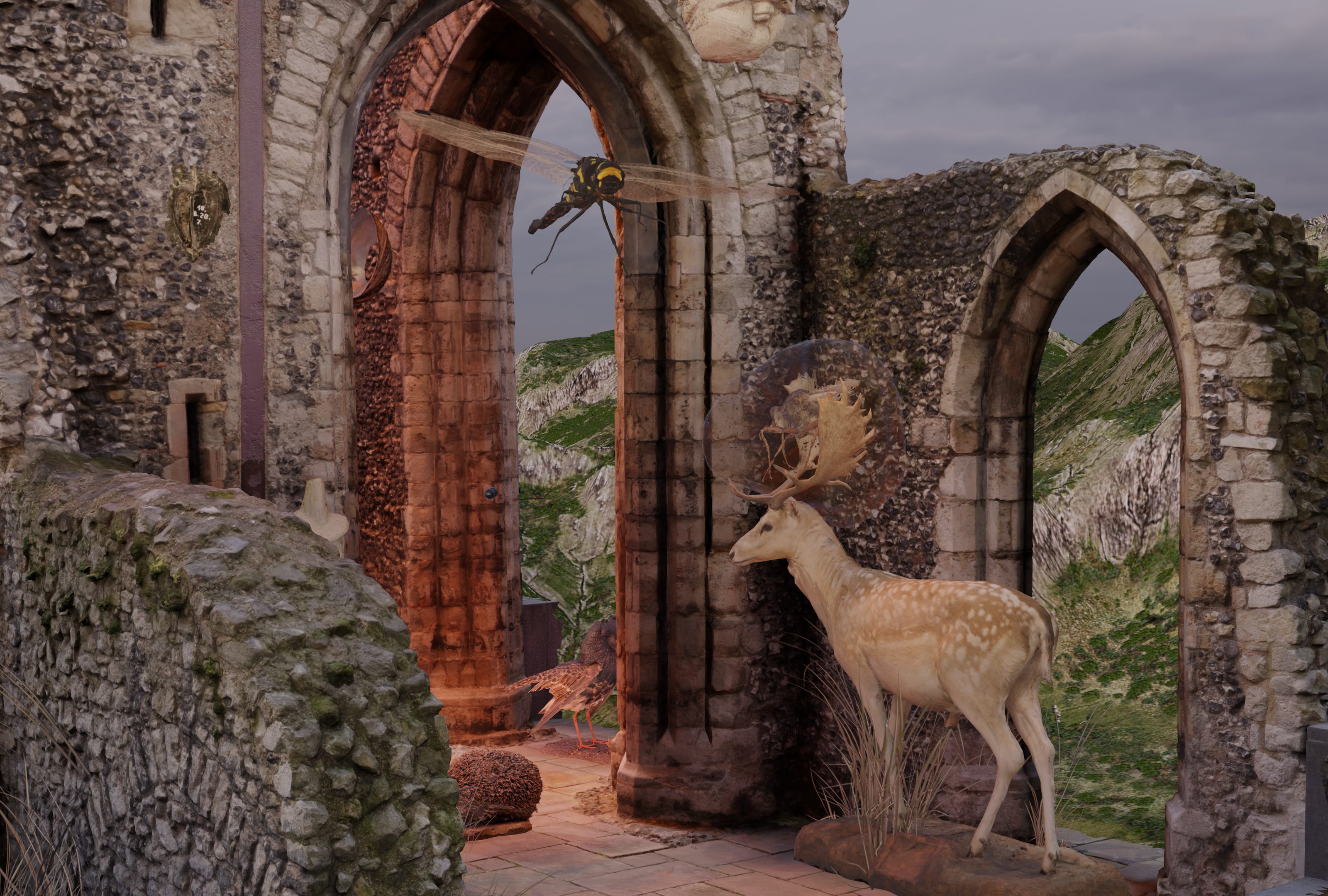
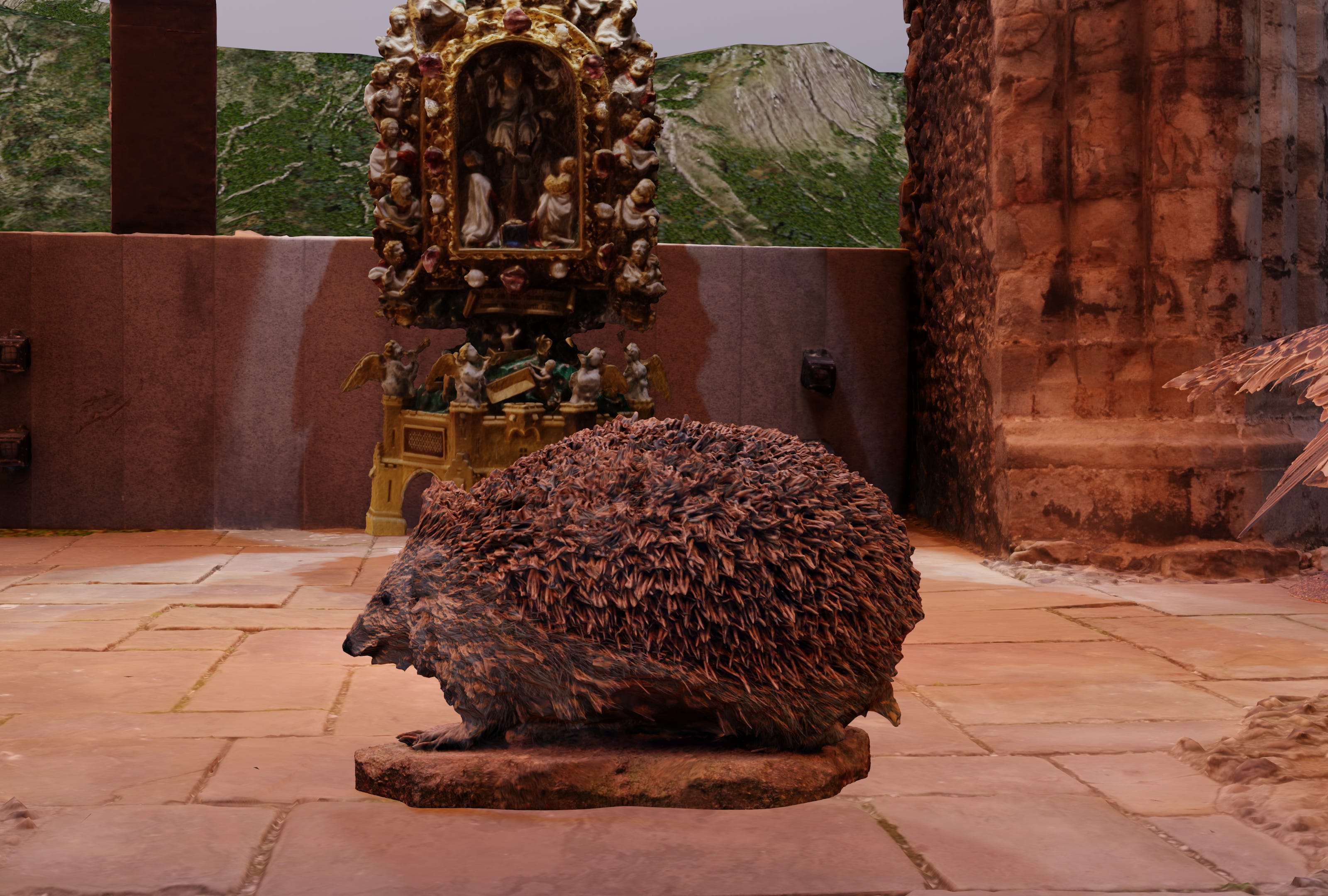
I feel something bristle across my ankle, and look down to see a stuffed hedgehog. His metadata tells me he’s from the Watt institution in Greenock, Scotland. I try to find out more about him on their online collections, but there's no trace of him. He only exists as a 3d file - placeless, timeless, floating in cyberspace. I reach my digital hand down to stroke his bristles. In a way I can't explain, he looks more alive in my computer screen than I think he would if I saw him stuffed behind a vitrine. As a non-thing, relieved of his physicality, the hedgehog has simultaneously more and less agency. Is the same for me as a viewer of this space? Relieved of my skin, am I freer? In Hito Steyerl's The Wretched of the Screen, she talks about the death of linear perspective due to the construction of ‘'imaginary vertical worlds’ (p.23) in 3D space. This vertical perspective is the drone’s-eye view — a post-human and technological gaze. To imagine reality in this new space - to imagine a Japanese deer in a medieval English church - to imagine it for real - requires the development of new hardware to make this vision possible. In Steyerl's book, she discusses how this ‘'hollogramatisation” of reality is imbued with a false sense of security. I feel freer in the 3D space because I am divested of responsibility - I think I am free because my “disembodied and remote-controlled gaze” (p.24) has doubly absolved me - I have not seen the hedgehog alive and in the wild, nor have seen him as a part-thing behind museum glass, I have seen a simulacrum of him. The reality of seeing this animal in the context I have crafted would require me transplanting the abbey brick by brick from London to a rocky field, getting the permission of the council to do so, getting transportation to help me do so, getting builders to help me rebuild it, convincing the Watt Institute to loan me the specimen and display it outside, and getting myself a jetpack to hover over the scene.
Is there any saving grace for this perverse creation? At the very back of the abbey there's a flash of gold, and I notice what looks like an ornate clump of jewels and metal. Of course, I know it's the Holy Thorn Reliquary, part of the Waddesdon Collection at the British Museum. I've downloaded a scan of it made by a user called artfletch who photographed it behind glass with a Sony a6000 in January of 2019, and processed it with a Software called Agisoft Photoscan. I wonder if Jean duc de Berry, who commissioned it to be made in the early 1400s, would think it was sacrilegious that I had digitised the content of the reliquary, which claims to be a thorn from the crown Jesus Christ wore before crucifixion. It's a bold claim. Let's take it at face value and trace the provenance of the thorn. According to the British Museum’s description, the thorn was part of a group of four which somehow wound up in the possession of the duc de Berry in the years leading up to the start of the15th century. He donated three of thorns to the church he built, the Bourges Sainte-Chapelle. This endowment of “well-authenticated” relics would increase the Church's status and attract pilgrims hoping for salvation and cures for their ailments. He kept the other thorn to make a personal reliquary for himself, and this is the one we are looking at now. As reliquaries were a highly sought after good, the market in the middle ages was saturated with fakes, and it was the institution of the church, by presenting them within a consecrated space, that bestowed them their ‘genuineness’. The personal reliquary of the duc de Berry was passed around and garnered a bit of a murky history until it arrived at the British museum in 1899, its true origin at this point uncertain, and thought to be late 16th century Spanish. As the years passed, it emerged there was a nearly identical reliquary in the Geistliche Schatzkammer of the Hofburg, in Vienna. It was believed to be the original because of where it lived, an old institution. It turned out to be a modern copy of the reliquary that was now in London. The ‘real’ London reliquary had previously been in the Schatzkammer’s inventory in 1677, and had somehow gotten swapped for a copy at some point in the 200 years that followed. Today, I could go and see the real and the fake, both behind glass, in London and Austria respectively. Presumably, neither would actually contain a thorn from Christ's crown. Am I sacrilegious for having downloaded the reliquary, or is the duc de Berry, for having cast 4 thorns of ‘Christ’ into the world which are still wreaking havoc 500 years later? Did either of us ever possess anything that amounted to authentic? Did any of the institutions that followed?
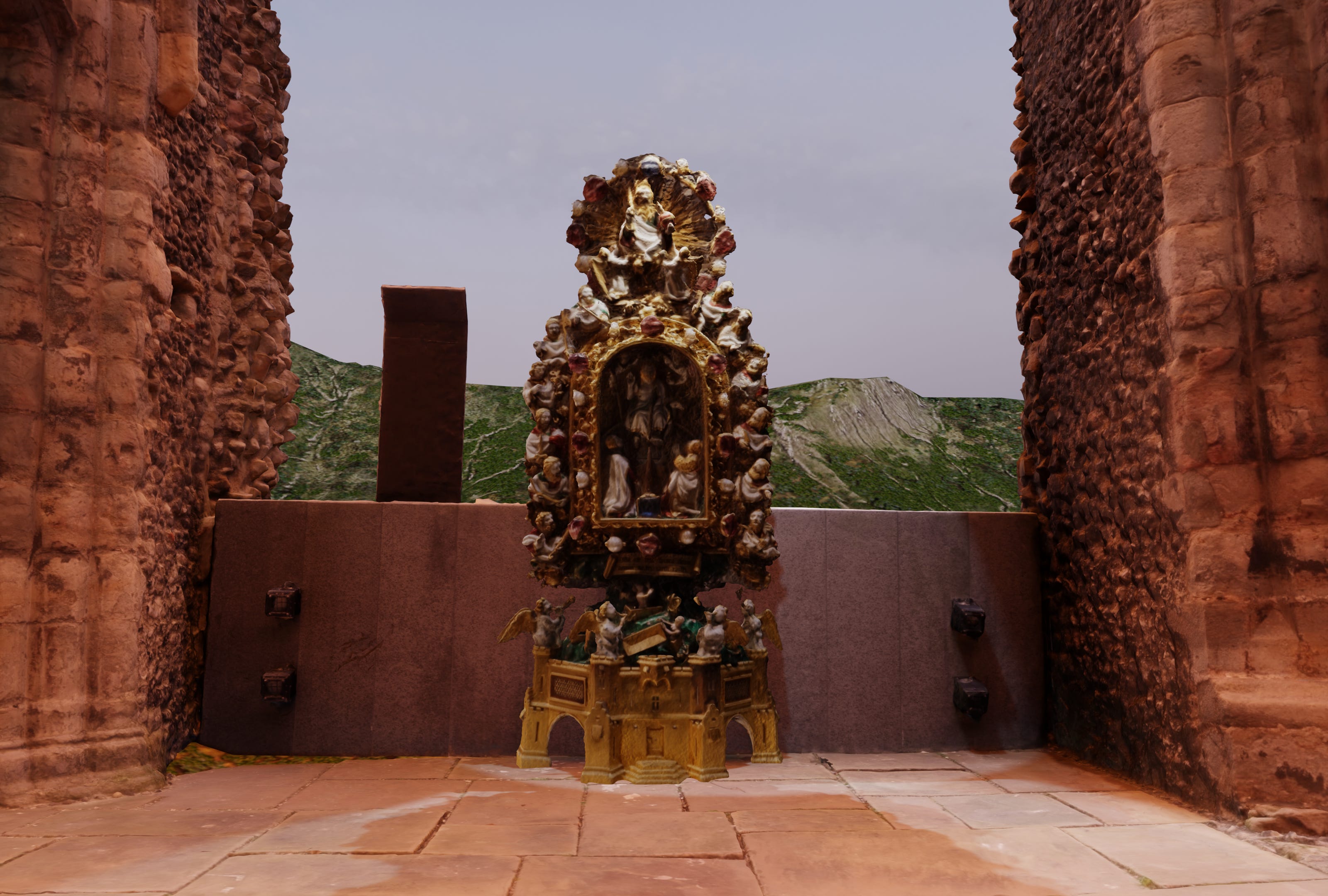
In this example, what counts as real has been fragmented into myriad layers, and it becomes difficult to say with any certainty where the line is to be drawn between reality and artificialia. What makes the 3D file on my laptop less real than the copy in Austria? What makes it less real than the one in London? The fact that I can't touch it? I can't touch either of the ‘'real’ ones either - they're behind glass. But Maria, one could touch them, if they asked very nicely for permission and wore special gloves. But would they really be touching them if they wore gloves? Does that matter to me as a viewer, who will likely never touch it? Does knowing that change my viewing experience? Yes and no. I've written previously about the importance of sensuous engagement when it comes to interacting with artefacts of cultural heritage, and of course our senses are flattened, muted, and warped in the digital sphere, but that doesn't mean that they don't exist, they’re just different. I can do lots of things to the reliquary in virtual space that I can’t do in a museum. I can change the lighting, I can float above it, I can see what it might look like underwater. What's to say my sensory experience in a museum isn't also flattened and warped? Museums have never been known for their authenticity - neither of experience nor of artefact - although they will fight tooth and nail to make you think otherwise, and for the most part, it's a battle they win. Is that just because there aren't many alternatives that satisfy the breadth and verisimilitude of the museum experience?
The difference between a private and public experience must also be taken into account here. If I went into the public space of an institution, who I regard as an arbiter of culture, and they presented me with a 3D scan of an object, but maybe had the real one in the basement, like a ghost of Schrodinger’s reliquary, I'd be pretty disappointed. However, in the private space of my living room, within the virtual nest of my laptop, at 9pm on a Monday, a 3D scan of the reliquary hits different because in a weird way it feels like it's mine.
Comments
Nothing yet. Say the first thing.
Sign in to join the conversation.