


Welcome to this special crossover issue of Data for Climate Progress with our friends at the UAW Center for Manufacturing a Green Economy!

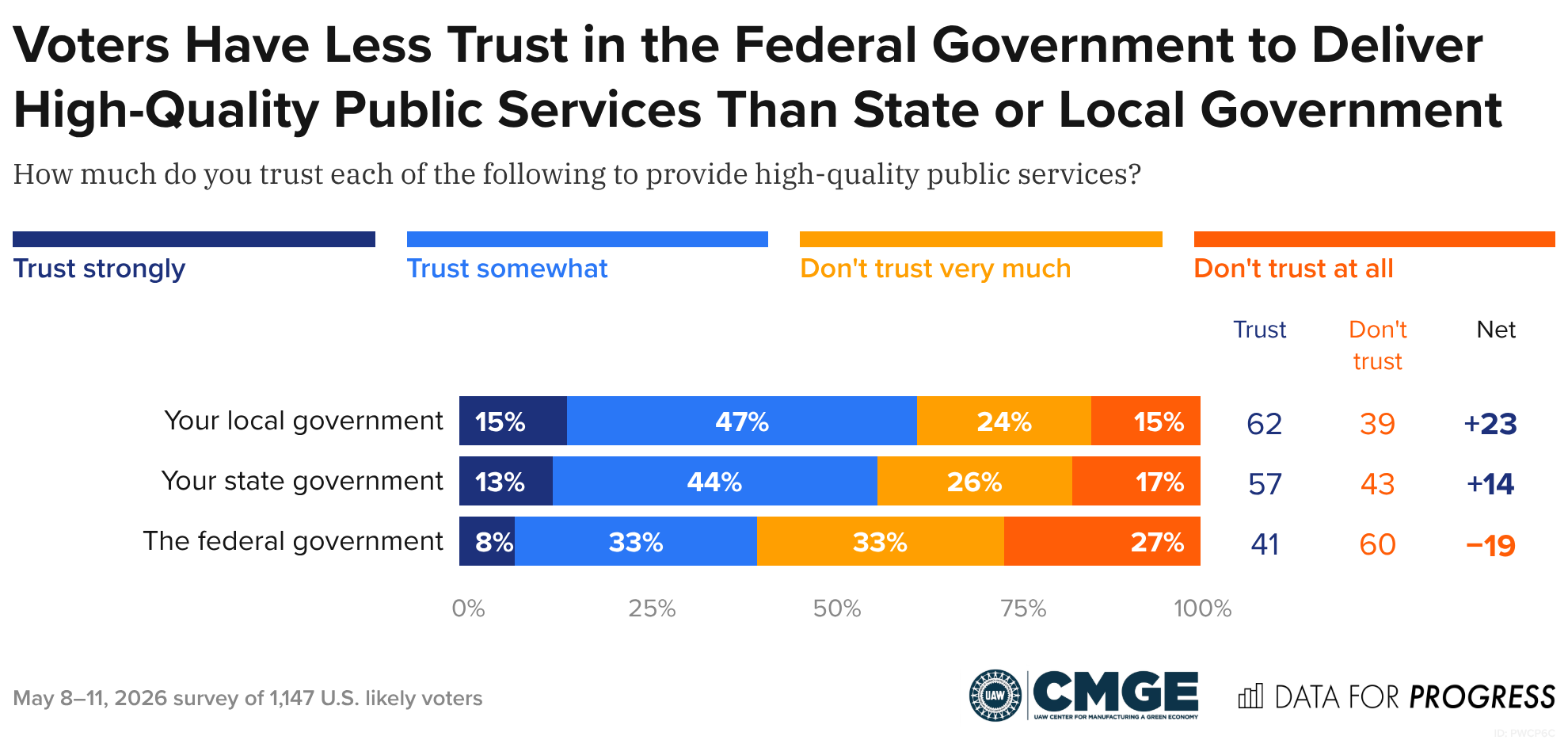
There is a growing “trust gap” in American governance, with new polling from Data for Progress and UAW-CMGE showing that voters are significantly more likely to trust local (62%) or state (57%) officials to deliver high-quality public services over the federal government (41%). Even as President Donald Trump and elected officials in Washington appear indifferent to the financial struggles of everyday Americans, state and local governments are finding ways to maintain trust and deliver for their constituents despite tight budgets. On the same day that Trump admitted he doesn’t “think about Americans’ financial situation,” New York City Mayor Zohran Mamdani announced that his administration will protect public services while filling the city’s $12 billion budget deficit with a combination of Albany’s support, a streamlined budget, and new pied-à-terre revenue raisers. New York — and other states and municipalities — are demonstrating that you can balance budgets while still putting people first.
Even where the federal government has achieved landmark policy victories, the benefits often remain unclear to Americans. On the issue of climate action, there’s little doubt that the 2022 Inflation Reduction Act (IRA) constituted this country’s strongest attempt at green industrial policy. But because the IRA failed to clearly link its investment in clean energy deployment and manufacturing to immediate and widespread economic prosperity, it was overshadowed by the real affordability concerns that drove choices at the ballot box.
In fact, climate change was ranked as the second-to-last issue that Americans considered in the 2024 election. And, where the benefits of the IRA were recognized, credit was often attributed to governors rather than the Biden administration, because governors made efforts to address affordability concerns alongside these climate investments. Policy is iterative, so the government must learn from past successes and missteps. A nearly 40-year effort to dilute the bureaucracy and throttle public investment meant that when push came to shove, the federal government’s attempt to build a new climate economy went unrecognized. Building the coalition to drive climate policies requires a politics of public trust, and to do that, the government must show it’s uniquely capable of an affordability agenda that crosses renewable deployment, industrial manufacturing, public services, infrastructure investment, and housing.
Americans perceive the government as being slow to deliver public services, unresponsive to the needs of the people, and lacking in transparency around how taxpayer money is spent. Many of those issues stem from the recent history of privatization of public services.
Since the 1970s and particularly after the election of President Ronald Reagan, privatization of public services has accelerated, with politicians ushering in austerity under the guise of “fiscal responsibility,” “efficiency,” or “attracting private investment.” These cuts have led to declines in the quality and speed — or the elimination altogether — of government services and infrastructure. Integrating a profit incentive and a commitment to shareholders above users can make private services a costly alternative to their public counterparts, with the private market often failing to deliver upon promised efficiency gains. Across sectors from public health to education, third-party middlemen and public-private partnerships that take over these services are often subject to less direct oversight and accountability than the public agencies formerly responsible, ceding space for underperformance and corruption to take root.
Our society is littered with the fallout: Energy rates spike higher in regions with investor-owned utilities, toll roads get pricier but no smoother while enriching successive private lessees, and passengers trying to shorten their time in airport security lines must shell out a fee to private pre-screening services. When finding out that New York City was paying $4 million to contract McKinsey to tell them trash may just be better off in trash bins, one starts to imagine where else that $12 billion deficit originated.
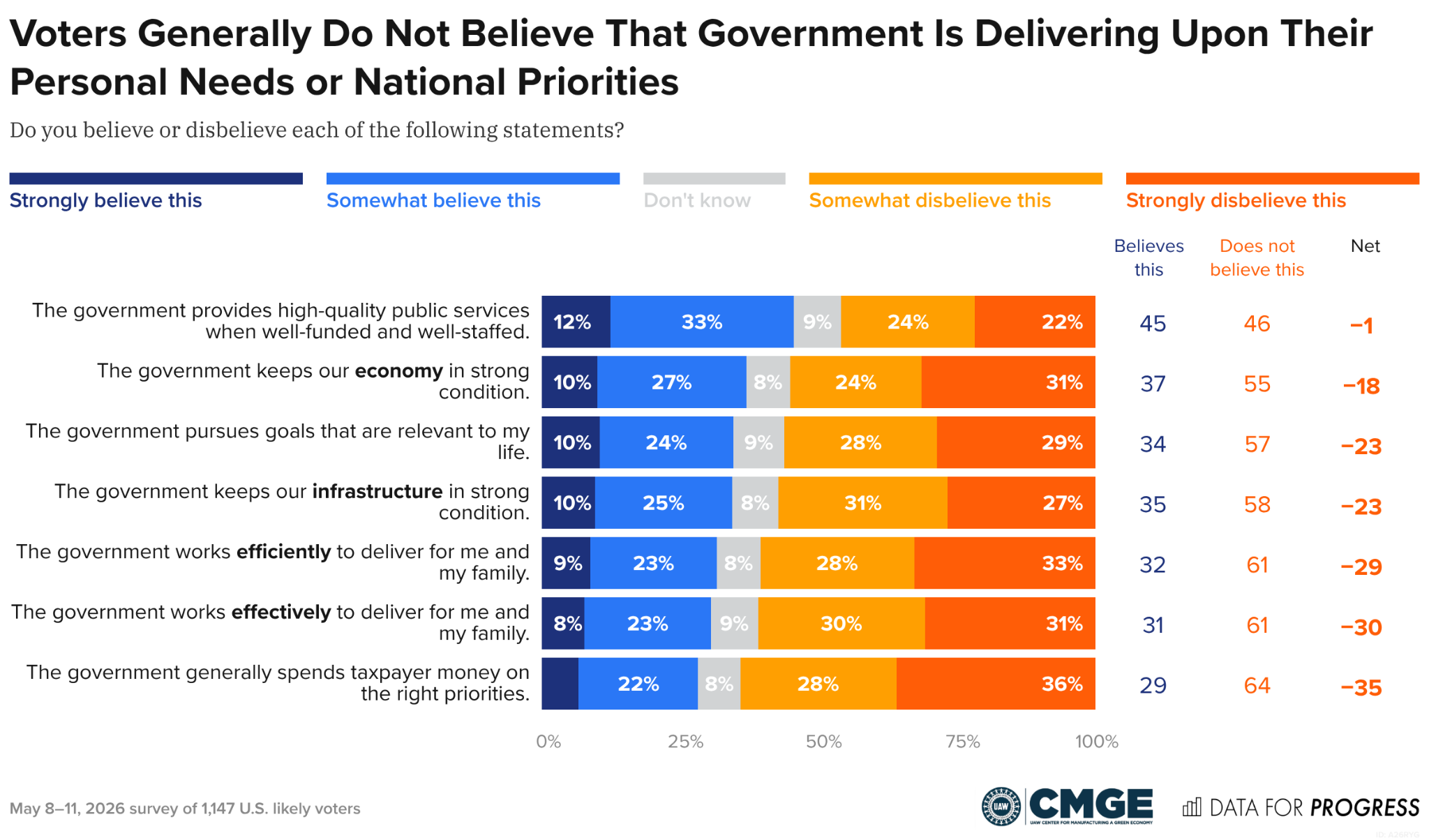
Symptomatic of these shifts, less than a third of voters say that they believe the government delivers efficiently or effectively for their household. Furthermore, only 29% of voters believe that the government expends taxpayer dollars on the right priorities. And, deficit concerns aside, voters are torn about whether they believe the government can provide high-quality public services even when well-funded and well-staffed (45% believe, 46% don’t believe).
Americans are facing unprecedented delays in mail delivery, enduring understaffed agencies handling tax returns and Social Security claims, and navigating chaotic, multihour airport security lines — all as their frustration with federal performance grows. These failings of the public sector fuel further austerity measures and budget cuts, creating a death spiral where tax dollars are repeatedly siphoned away from public entities to private contractors that monetize access to the same — though often inferior — services.
As a result, for many Americans, things just don’t seem to work like they used to.
All the while, Americans’ basic needs are increasingly going unmet. But despite its current shortcomings, the federal government has the ability to provide critical public resources, with features like universal service provision, that the private sector cannot or will not provide. Such public programs will be best positioned to address the economic, political, and social pressures wrought by climate change. And — critically — survey data from Data for Progress and the Climate and Community Institute finds that voters want to strengthen the public sector, with more than 4 in 5 saying it’s important that elected officials take action to do so.
If people don’t believe the federal government can deliver a mail-in vote or the newspaper, then they won’t believe it can deliver a multitrillion-dollar energy transition, or build the economy it takes to get there. Put another way, a government that asks its citizens to make the switch from gas-burning cars to EVs can develop much more credibility to do so if it first fills in the potholes on the roads they travel and provides quality public infrastructure to support the transition. Investing in high-quality, highly visible public services and infrastructure that address everyday needs is a necessary precondition to build political will for an economy-wide energy transition. In short, making the delivery of public goods a core priority of climate action can better facilitate the energy transition and ensure its benefits are evenly felt. Strengthening government capacity and putting the public sector in the driver’s seat will be necessary to deliver a transition that works in the public interest.
Fortunately, there are excellent examples of municipal and state leaders building the blueprint for this brand of governance. These elected officials offer hope that, by delivering on seemingly small, tangible, and visible priorities, government at all levels can build the trust necessary to tackle the bigger, more intractable challenges posed by issues like climate change.
In its first 100 days, Mamdani’s administration filled 100,000 potholes and shared nearly as many flashy promotional videos of NYC Department of Transit crews in the street doing this oft-undercelebrated work. Mamdani’s brand of pothole politics embraces the “sewer socialism” championed by elected officials in the 20th century, like Milwaukee Mayor Daniel Webster Hoan, and mirrors more recent efforts, like Virginia State Senator Danica Roem’s Fix Route 28 Now! platform and Michigan Governor Gretchen Whitmer’s commitment to “fix the damn roads.”
Mamdani brought a renewed spotlight to these approaches in his 100-day address. In describing the early achievements of his administration, he defined a philosophy of pothole politics as the common thread, “where government is not too busy, not too self-important, not too mired in paperwork to fix the problems of this city, no matter their size.”
Mamdani is not the only municipal leader taking this approach. On the West Coast, Seattle Mayor Katie Wilson had success centering her campaign around the city’s housing crisis, a top issue for Seattle voters. Before becoming mayor, Wilson coordinated the Stay Housed Stay Healthy coalition and helped pass a ballot measure to launch the publicly owned Seattle Social Housing Developer (SSHD). Since taking office, she has built on these efforts, working with the Seattle City Council to provide $115 million in funding to SSHD, which will expedite the timeline for the initial delivery of affordable housing units by developers, with Seattleites now able to expect them this year.
Beyond housing, Wilson campaigned on a promise to “unstick the ‘Late 8’ bus,” a notoriously unreliable — but crucial — high-ridership public transit route. Wilson prioritized its overhaul, promising to pave 13 more blocks of dedicated bus lanes to speed up and tangibly improve the route she and many other Seattleites rely on. This is the exact kind of initiative that can build goodwill with voters and a social license for future policy.
Pothole politics can pave the way for climate ambition. But pothole-level policies can also be climate policy. In Seattle, the SSHD is building energy-efficient housing and lowering utility bills. Wilson’s Late 8 overhaul and Mamdani’s fast and free bus pledge are making affordable, low-carbon transit more accessible, proving that the government can be trusted to deliver tangible, near-term improvements for taxpayers while also advancing longer-term climate action.
From New York to Seattle, Americans have been disenchanted by their government — losing hope and direct evidence that government can actually deliver for working people. The challenges posed by climate change and the urgent need to decarbonize are immense and complex, and to solve them, we need a trusted public sector guiding the way for the common good. But a successful, well-resourced public sector needs an electorate that believes in it.
Government can and must take lessons from pothole politics: Focusing on basic quality-of-life issues and services that deliver broad public benefits can enable the political will to make the big investments required to ensure a prosperous energy transition.

No posts
Comments
Nothing yet. Say the first thing.
Sign in to join the conversation.