

Welcome back to Data for Climate Progress — your one-stop shop for all things climate at Data for Progress. Catch us here every month for our latest climate polling, juicy insights, and can’t-miss reading lists.
As always, we’d love to hear from you — drop us (Grace Adcox and Catherine Fraser) a line at gracea@dataforprogress.org and catherine@dataforprogress.org. Forwarded this email? You can subscribe below.
Love this newsletter? Want to support our work? Donate here:

Senior Polling Analyst: We’re hiring a senior polling analyst to help expand our mission to empower movements using data. As a senior analyst, you’ll spend your days writing survey questions, analyzing data, and crafting polling memos. You’ll work closely with our polling team to run tests and prepare data products for the progressive movement. Apply here.

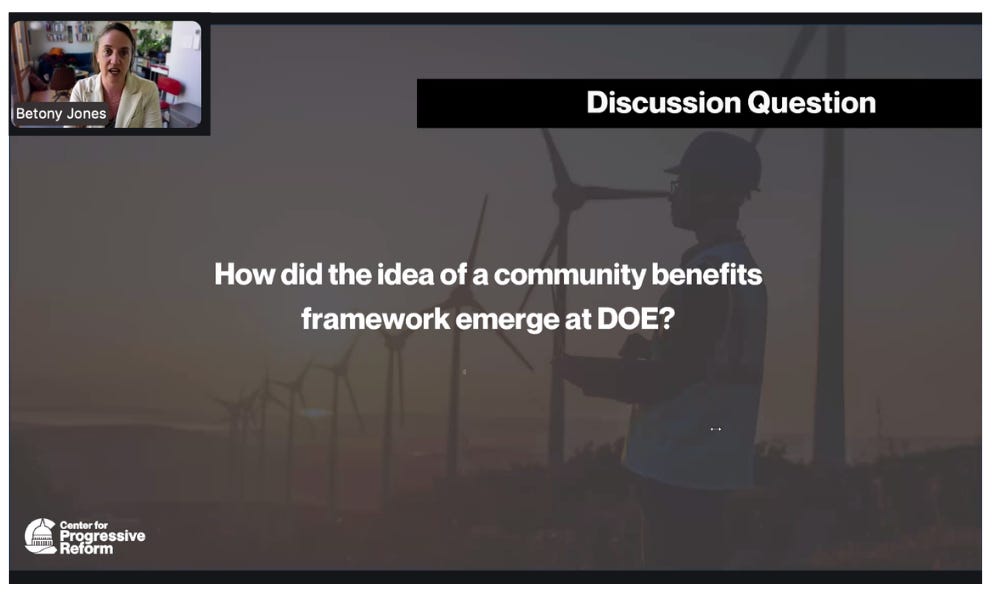
Data for Progress’ senior resident fellow for climate, labor, and economic policy, Betony Jones, spoke on a recent Center for Progressive Reform webinar, “Exploring Community Benefits Alongside Former DOE Officials: Achievements, Challenges, and What Lies Ahead.” Betony discussed her time as the director of the Office of Energy Jobs and senior advisor for labor to the secretary at the U.S. Department of Energy during the Biden administration, and particularly her role in developing the administration’s Community Benefits Plan (CBP) framework to tie together the administration’s climate, energy, labor, and DEIJ goals. You can find a recording of the webinar here.
This month, Betony also joined Volts’ David Roberts to discuss her fantastic new paper with Joe Peck for the Roosevelt Institute, “The Receipts: The Untold and Underappreciated Outcomes of Biden’s Clean Energy Strategy.“ The Volts episode is one you can’t miss. Check out Roberts’ description of their conversation and listen to the episode here:
Conventional punditry loves the narrative that woolly-headed progressive standards over-burdened federal climate spending and slowed everything to a crawl. In this episode, I talk with Betony Jones about her time designing labor policies at the DOE and what she learned from interviewing dozens of companies that received federal funding. We explore the difference between bad rules and weak administrative capacity, how the DOE successfully streamlined century-old Davis-Bacon compliance, and why creating high-quality jobs is essential for global competitiveness.

As any D.C. local knows, Rock Creek is awash with bacteria — the destination of stormwater and sewage alike when it rains. Yet that hasn’t stopped noted local germ theory-denier and Health and Human Services Secretary Robert F. Kennedy Jr. from ignoring the U.S. National Park Service’s ban on swimming and wading in Rock Creek. RFK fully submerged in the creek with his grandkids last year. Is it any surprise, then, that voters don’t trust the guy to handle a public health crisis? Amid hantavirus and ebola outbreaks, we find that a majority of voters (51%) — including 58% of Independents — say they don’t trust Kennedy to handle a public health crisis. Us too. Full polling brief here.
As some predict catastrophic job loss as AI replaces human workers, and others raise concerns about companies using AI to closely monitor workers’ activities, we find that a plurality of voters (27%) — including a plurality of Independents (36%) — trust labor unions most to protect workers from AI, followed by Democrats (23%), Republicans (19%), and employers (12%). In a split test, voters were asked whether they agree or disagree that employers using AI to monitor workers in all aspects of their jobs is a violation of “their privacy” (Split A) or “their freedom” (Split B). Voters agree that this is a violation of both — +55 and +45, respectively. Good news for union lovers? When voters are asked about their general levels of trust for five different groups, the only tested group that a majority of respondents trust is labor unions (59%). In comparison, less than half of voters trust Democrats (48%), Republicans (45%), corporations (36%), and politicians (27%). Full polling brief here.
New polling from Data for Progress and Greater Greater Washington finds that Democratic primary voters in Prince George’s County, Maryland, see room for improvement when it comes to the County Council’s handling of housing costs, age and quality of housing, and road safety, but few voters contact their members about issues in the county, especially when it comes to housing or zoning. Nearly all voters would like the Council and executives to redesign streets to improve road safety for all users, even if it slows drivers down, and 3 in 4 say the age and quality of housing is an issue. Democratic primary voters have clear priorities when it comes to lowering housing costs: Most respondents (57%) say it is more important to lower housing costs than to preserve neighborhood character. Younger voters (73%) and renters (64%) are even more likely to prioritize lower housing costs, and a majority of homeowners (52%) say the same. Full polling brief here.
In a new survey question fielded with the Center for Climate Integrity, we find robust bipartisan opposition to shielding oil and gas companies from climate accountability. Majorities of voters across party lines, including 71% of Independents and 53% of Republicans, are not interested in seeing federal policies that would give immunity to oil and gas companies from laws or lawsuits that would hold them accountable for climate damages. Read CCI’s press release on the survey here, and stay tuned for updates on the full survey soon.

At the beginning of 2026, Data for Progress’ polling revealed that voters have remained pessimistic about the economy since Donald Trump took office, despite his campaign promise to “make America affordable again.” Since then, Trump has launched an incredibly unpopular war, causing gas prices to surge across the country, all while continuing to defend his illegal and expensive tariff policy.
In longitudinal survey research from the last 16 months weighted to a likely 2026 midterm electorate, Data for Progress finds that voters report worsening conditions across most aspects of the economy in recent months, as well as sharp increases in spending on gas.
When asked whether they’ve paid more, about the same, or less for various goods over the past year, an overwhelming majority of voters have consistently reported paying more for groceries and food. However, recent jumps in gas prices have brought the two roughly even.

Notably, utility costs continue to be a pressing issue for voters, weighing even more heavily than household goods, healthcare, or housing costs.
To examine where rising costs are actually changing behavior, the survey asked voters which goods they are paying more for, and which goods they’ve cut back on or switched to a cheaper alternative.
The results demonstrate that some goods, like utilities, housing, and healthcare, are inelastic, in that voters report paying more but show little flexibility in buying less or opting for cheaper versions.
However, voters do report cutting back their spending in other categories, including household goods and groceries. Additionally, voters report surprising flexibility in terms of gas usage, replicating findings from other pollsters that demonstrate a significant percentage of Americans are cutting back on driving or travel.
 and share buying less, switching to cheaper substitutes, or stopped buying entirely (gray) — from a May 8–11, 2026 survey of 1,147 U.S. likely voters. Groceries and food: 79% paying more, 41% cutting back. Gas: 79% paying more, 29% cutting back. Utility bills: 66% paying more, 18% cutting back. Household goods: 53% paying more, 38% cutting back. Healthcare: 50% paying more, 18% cutting back. Housing costs: 48% paying more, 15% cutting back. Cars or car payments: 30% paying more, 18% cutting back.")
This survey reveals that voters remain pessimistic about the economy, with majorities across the board reporting that most aspects of the economy are getting worse for people like themselves. Voters also report paying more for most goods, especially gas and groceries, leading many to cut back their spending in these areas. Growing economic pessimism only further underscores the importance of advancing economic policy that delivers greater affordability for working people.
Read the full polling brief here.

‼️NEW from former DFP fellow Saul Levin ‼️The Hum: A podcast on the people fighting AI data center projects. Listen and subscribe here.
“Here’s How Democrats Should Talk About Climate Change,” by Kate Aronoff (The New Republic)
”The Places Where Americans Are Deciding Between AC and Food,” by Jeva Lange (Heatmap)


No posts
Comments
Nothing yet. Say the first thing.
Sign in to join the conversation.