
Continuing from my last blog, "The jacket that knew before I did"
After leaving Solana Beach that evening, I slid into my car expecting my usual ritual of chaotic joy, music blasting, and singing my favorite songs out loud. My twenty minutes of driving therapy.
But that night was different. I turned the key and sat in silence.
Not outside silence. Inside silence.
My mind wasn't racing with beats but with questions. Deep, uncomfortable questions that had been waiting for space to surface.
Questions about myself, my choices, my patterns.
Why had I become a quantity-over-quality person?
Why was my closet bursting while I still felt I had nothing to wear?
And why wasn't this just my struggle, but something I witnessed among so many of my friends?
I thought about our pre-vacation rituals — not packing what we had but frantically ordering midnight Shein deliveries and last-minute Amazon orders. The way we equate newness with worthiness. The subtle belief that the "one more thing" would finally make us feel like ourselves again.
And somewhere in that spiral, we'd lost the essence of why fashion mattered at all.
For me, fashion wasn't always consumption and trends.
Growing up in a middle-class family in a small town in India during the 90s, upcycling wasn't a trendy sustainability practice, it was simply life. Mom’s Old sarees transformed into dresses. My father's shirts became my shirts. A torn hem was just an opportunity to add decorative lace.
My relationship with clothing carried additional complexity.
Being born a fourteen-pound baby in an era before inclusive sizing meant off-the-rack simply wasn't made for bodies like mine. There were no XLs, no celebration of different shapes. My mother faced limited options: custom outfits from the local tailor or reimagining existing garments.
By necessity, not choice, I wore stories stitched from past fabrics. Not because it was fashionable, but because it was the only thing that fit. As a kid, I always wanted more of those ready-to-wear and never appreciated the compliments I got on my outfits.
Years later, with my first salary came modest clothing purchases. But student loans and responsibilities created natural boundaries. There was always a limit, a consideration, a pause before buying.
Then I moved to America, and everything shifted.
My first American shopping experience was Black Friday. And we all know what happens then…
Endless racks of clothing. Towers of shoes. Five-dollar price tags and buy-one-get-three deals promising abundance I'd never known. It felt like discovering a new world, one where I could finally buy without mental calculation, without guilt, without limitation. And for the first time, these clothes came in sizes that fit my body.
That single Black Friday changed everything.
What began with one pair of boots and a perfectly fitting coat expanded into a pattern. Soon, I was there for every sale, Christmas, Labor Day, Memorial Day, and Presidents' Day (why does every American holiday come with discounts?).
With a better salary and newfound access, I could finally purchase branded pieces that had once seemed out of reach. I didn't notice when it stopped being joy and became a habit, a pattern tied not just to consumption but to something deeper.
My changing body complicated everything. Some years, I lost weight; others, I gained it back. Each fluctuation demanded a new wardrobe.
And because I fundamentally despised waste, food waste, financial waste, clothing waste, I never discarded anything.
I kept it all for "someday."
The smaller jeans for when I'd lose weight again. The looser blouses for when I might gain. My closet expanded from guilt, from trying to hold space for all the versions of myself I might become.
That night, after my silent drive home, I did something unusual.
I stood before my overflowing closet to truly see what I had accumulated.
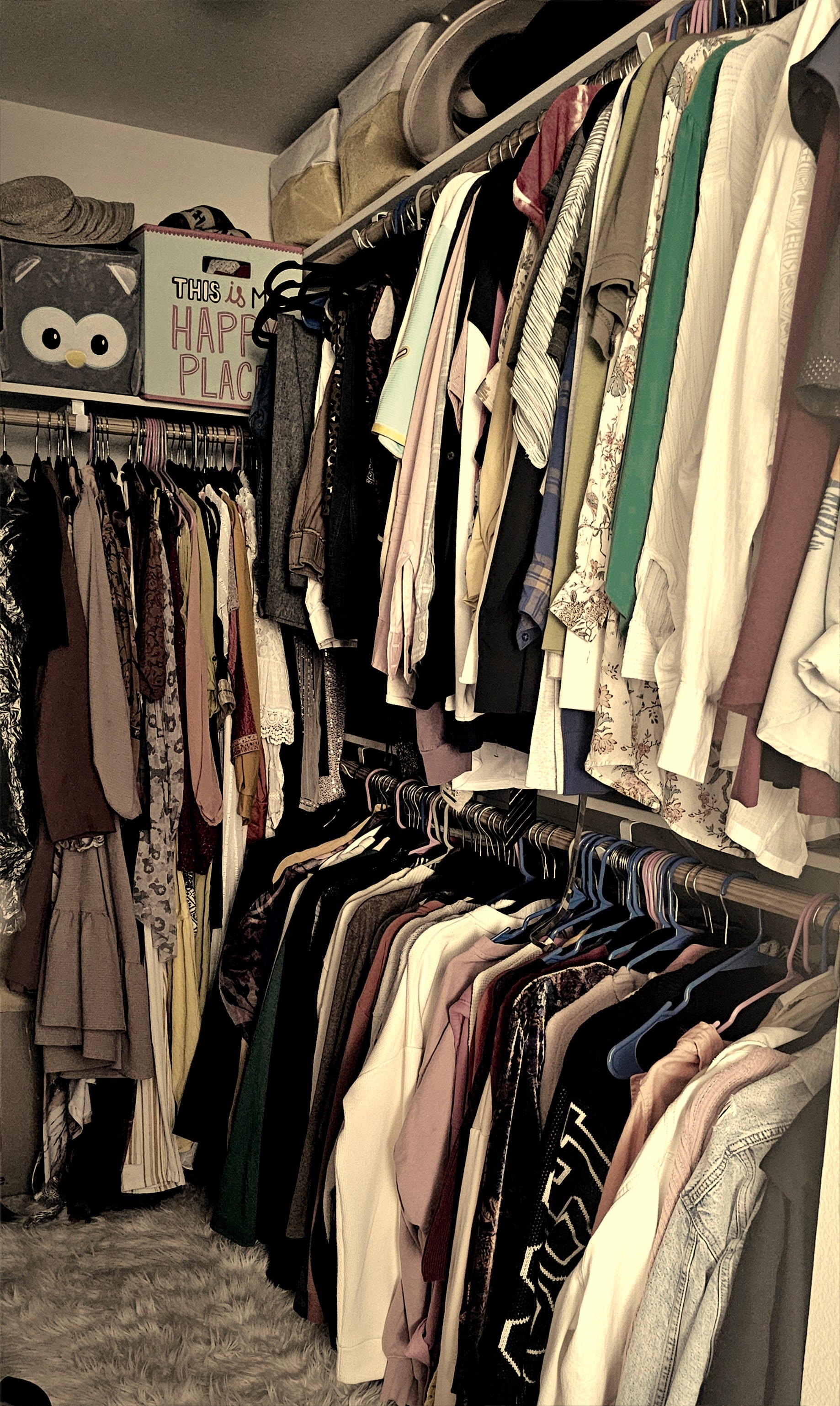
I asked myself: If I had to evacuate this house right now, which ten pieces would I take with me?
The answer revealed everything.
It wasn't the expensive items. It wasn't the trendiest or the newest. It was the authentic pieces, the ones that felt unmistakably like me.
Some were made by tailors who knew my name. Some were gifts carrying stories. Some had been crafted from old sarees; others had traveled with me across countries. But all of them, every single one, were one-of-a-kind and the most comfortable one, in which I can be myself.
None came from mass-market retailers. None were purchased simply because they were trendy. And that's when recognition dawned: out of hundreds of garments, only ten truly mattered.
Was this disconnect between what we accumulate and what we value unique to me?
Or was there something larger happening?
That question launched me into perplexity research. I abandoned sleep for the rabbit hole of consumer psychology and fashion waste.
What I uncovered would change everything…
Next Story in Thread: The Unwearable Truth
Subscribe to follow the entire Darzy journal, a story-led archive of reinvention, fashion, identity, and memory. We are not just building tech. We are stitching dignity into every design.
Comments
Nothing yet. Say the first thing.
Sign in to join the conversation.