
While the rest of the advanced world’s traffic deaths declined last decade, America’s death rate is stubbornly high. Dying in a car or being hit by one is as quintessentially American as burgers, guns and war. The perceived freedom of movement sold to Americans by oil companies and car manufactures beckons back to the cowboys on horseback from the old American frontier. Like the sheriffs chasing outlaws in Western lore, American police speed around in their own vehicles with guns on their hips chasing suspects.
Americans primarily engage with police through traffic stops, where police traditionally spot vehicles suspected in criminal activity by randomly driving around. The Flock corporation proposes giving a major advantage to American police by monitoring the location of vehicles across jurisdictions—all of them. Knowing that American drivers are uniquely deadly, urbanists have been conflicted in debate about whether they’re good or bad.
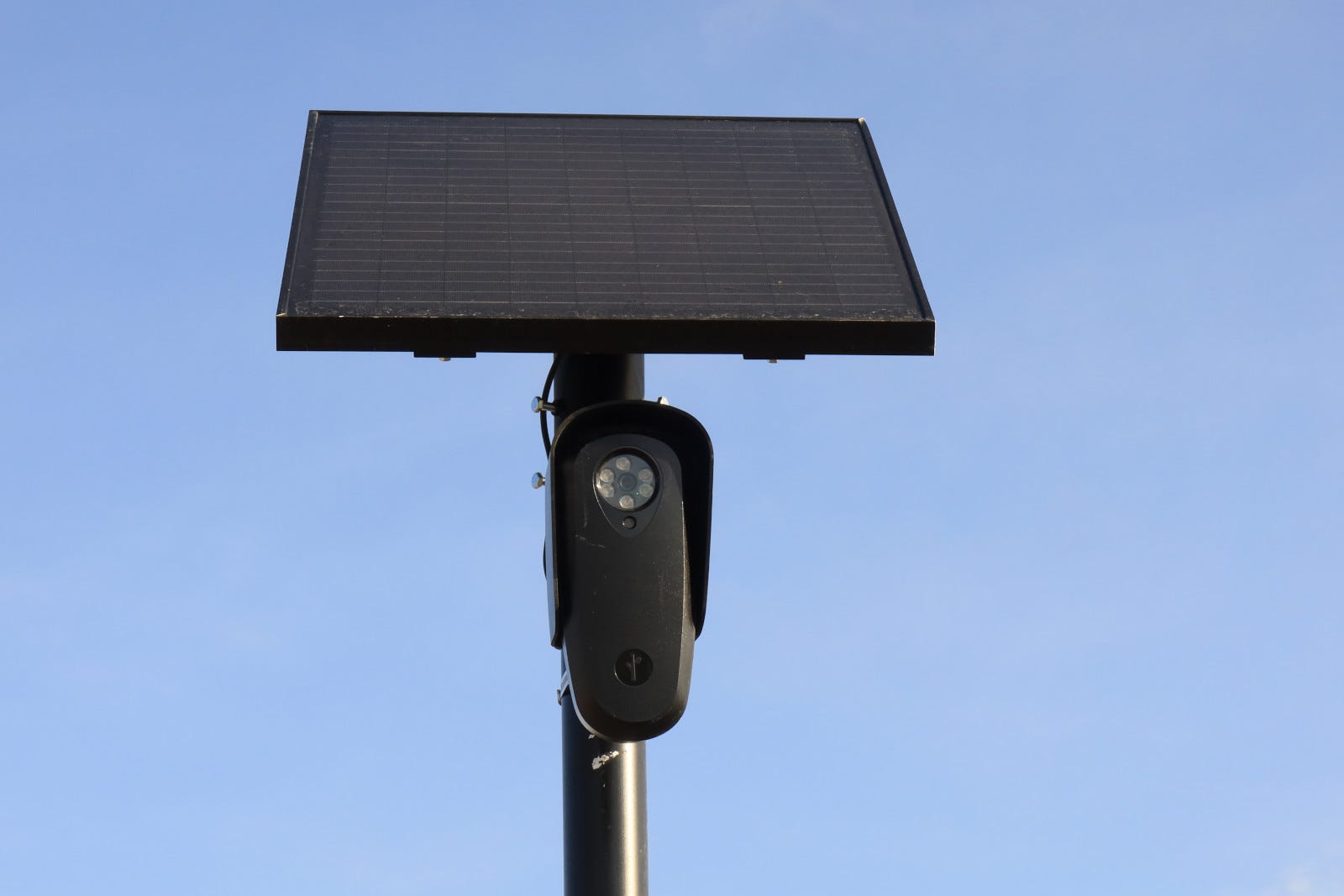
While traditional municipal plate readers that log vehicle travel have existed for some time in limited deployment with data stored locally, Flock differs by storing location data on a cloud database and scattering stationary cameras throughout cities. The Flock corporation specializes in surveillance technology and is aiming to become the nation’s largest supplier with an array of camera, drone and data tracking equipment for American police and private security.
With Flock cameras, vehicle locations are no longer just accessible to a local department operating the plate cameras but to any police, private and government entities nationwide that Flock customers have a contractual data sharing agreement with. Flock’s biggest selling-point is that the company offers easy cross-jurisdictional data sharing over other plate reader vendors. Now on paper, if a local police department’s contract stipulates their data can’t be shared with U.S. Border Patrol (USBP) for example, then USBP cannot access that local department’s data. However, issues have arisen regarding how this has actually plays out in practice.
Flock cameras are receiving public opposition because of concerns about privacy and surveillance. Some urbanists have been skeptical of anti-Flock uproar because some complaints about privacy sound similar to other American motorist complaints against red light, congestion or speed cameras—in which the motorist is really just mad about their poor driving being ticketed.
But there is a major difference between enforcement tech like speed cameras and red-light cameras versus automated license plate readers. Enforcement technology does not track vehicle whereabouts, it just notes the location of a traffic offense and issues a ticket. Records from automated enforcement technology typically remain under the control of a local transportation authority or police department—ideally the former.
Flock cameras are not instant ticketing devices but tracking devices of all plated vehicles—traffic offenders or not—into a database with the flexibility to be shared across jurisdictions, and through all levels of government. Flock cameras and their clients can decode where we’ve been, what cities, what states, what street corners, and what routes with our cars (and undoubtedly soon with other means of transport.) Flock cameras are so effective at identifying patterns of travel that recent news reports have identified police officers stalking their ex-partners with Flock cameras. Obviously, such technological architecture is a tremendous expansion in the surveillance of everyday people.
Some urbanists who are supportive or indifferent argue: well, that’s the social responsibility of driving. Motorists are not entitled to total privacy while doing deadly behavior.
Ideally, but not having to drive is oftentimes a privilege in this backwards country. At least 92% of American households own an automobile, and 76% of Americans commute to work primarily by car. To avoid having intricate detail of their driving activity in a database, the vast majority of Americans would have to surrender total mobility in places where alternatives do not exist. The urbanist project is oriented around making it so that Americans do not have to use deadly vehicles for daily activities, and it is not apparent that Flock helps achieve this goal.
Stationary plate readers are common in the high-income developed world. From the United Kingdom to Japan to South Korea to France, driving a car is less of a necessity compared to the U.S., thus it carries significant social responsibility alien to Americans that does not entitle a driver to total privacy. In the United States, the vast majority of Americans are deprived by federal and local government of public transit, cycling and walking infrastructure. Following that logic, we’re setting up a system where Americans are not entitled to any privacy expectations on the roadway.
Moreover, these countries have privacy regulations typically dictated by the central government. In France, the national government heavily regulates plate reader vendors, establishes rules of deployment and regulates data retention and access. Traffic cameras can still be controversial in France, but stronger accountability by the central government make deployment and privacy more assuring to public compared to the U.S.
In America, municipal governments negotiate with private corporations supplying our police departments with a largely absent (and currently antagonistic to cities) federal regulator on data privacy and camera deployment. Regardless of what local regulations are written and violations committed, local governments have weak enforcement power over the Flock corporation and violations of its contractual privacy rules.
On paper, localities have complete control over data sharing, not Flock. But in practice, the city of San Francisco argues that federal authorities accessed local Flock data in violation of their contract. Flock argues that the city hadn’t activated an anti-sharing feature, even though it was stipulated in their contract that San Francisco didn’t want these authorities to access their data. Realizing that data insecurity is not good for relations and cooperation with law enforcement, agencies like Los Angeles’s have canceled their 3-year contract over discomfort about Flock’s data sharing policies.
Even if Flock itself isn’t violating data sharing contracts, once the data is shared with another department, it’s out of the originator department’s hands irrespective of the contract. This has been the biggest complaint with Flock’s cloud network. Even if my local department handles our data responsibly, if the contract allows sharing with another department that mishandles it, abuses it or violates our contract by sharing with federal authorities, then the damage is done and the legal recourse is minimal and prolonged.
The benefit of being able to track suspect vehicles across jurisdictions does not outweigh the need of strong privacy regulations and enforcement, which must be done at the state and federal levels with a wide spanning database like Flock’s. Unfortunately, our federal government under Trump is extremely antagonistic to our many urban localities and has no respect for privacy or local needs except flooding them with federal law enforcement.
At least with non-Flock municipal plate readers the risk of privacy leaks are smaller and the enforcement mechanism by local voters much stronger because the databases are administered by local departments that aren’t intended to be quickly shared with others. Ideally, the best local plate reader databases are administered by civilian transportation departments for maximum privacy.
But are Flock cameras effective at reducing or combating crime? They get mentioned quite a bit in crime reporting by police, but there isn’t yet peer-reviewed research on Flock camera effectiveness that was not conducted by Flock researchers. The research is mixed and limited on automated plate readers in general as far as case closures and crime fighting go.
This summary of research indicates that plate readers are associated with finding stolen cars and more suspect arrests, but that there’s not a lot of clarity on cost effectiveness and there’s weak empirical evidence so far that it improves case clearance rates overall. Researchers are clear that so far there’s just not a lot of research on plate readers.
Merchant organizations remain the biggest non-police supporters for Flock camera expansion in local city politics to discourage robberies of their businesses by ensuring the tracking of fleeing suspect motorists. While plate readers could be strategically useful in certain locations like tolls and entryways to parking garages, the biggest issue for many businesses is street design, not technology.
Traffic calming and obstacles on commercial corridors creates congestion, and makes it significantly harder for suspects to drive away quickly enough. Los Angeles police in the 1990s significantly cut down violence and property crime just by making it harder to drive fast with the deployment of cul-de-sacs. In the Bay Area, property crime and auto-oriented robberies tend to be closer to neighborhoods by the freeways and highways because going deeper into cities with smaller streets and traffic congestion fumbles quick getaways.
Infrastructure through traffic calming and road diets always saves the most lives on the roadway. While speed cameras make sense on country roads where infrastructure can’t combat it, most speeding issues in city is a product of poor road design. Red-light cameras are typically the most justified at high injury intersections. Some technology is fine and unavoidable, but the best technology we have isn’t cameras, it’s traffic engineering.
But the biggest issue of all to grapple with is that surveillance technologies idolized in “high trust societies” work when there is broad, public consensus that the centralized government is trusted and accountable to the people. We don’t have that in this country and the Trump Administration’s deployment of troops for policing and abduction campaigns is deteriorating what little public trust Americans already had. Americans have good reason to be wary of expansion of tech surveillance cameras while their government is hostile to them.
New York’s congestion pricing cameras initially faced similar privacy concerns. Public opinion shifted as the program’s benefits quickly became apparent in improved traffic and crucially that the data remained under the control of a local entity accountable to local voters.
In a country where the federal government is hostile to localities, municipally controlled technologies with databases administered by civilian agencies is the safest bet if plate readers are used at all. The distinction is less about ownership of data or the technology itself, and more about institutional design of traffic technology. The Flock system is ultimately built to enable cross-jurisdictional sharing, while a municipal system can be built around a local transportation function under a locally accountable agency.
It is also true—as Flock supporters have noted frequently—that people flagrantly give their personal data and information to companies like Internet companies all the time, putting them at risk of exposure. But just because privacy has been dissolved in the age of the Internet doesn’t mean we shouldn’t work to restore and reverse that trend.
No posts
Comments
Nothing yet. Say the first thing.
Sign in to join the conversation.