
The UK may not call it fiscalization yet. But the direction is becoming clear, and retailers, POS software vendors, and compliance teams should start paying attention now.
Based on the open consultation and the questions already being raised, we can start to see how the government is thinking. We can also identify which countries seem to be used as reference models, and which type of compliance architecture could become realistic for the UK.
Combining this with typical UK tax policy processes and our experience from other countries, I also share my current estimate of a possible timeline. Not as a prediction, but as a practical planning scenario for companies that cannot wait until the final law is published.
That is the focus of the Dive in section of this issue.
But this newsletter is not only about the UK. I am also sharing what is currently on my desk: the next evolution of our Fiscal Portal and why I believe the future will move from fiscal knowledge to Compliance Intelligence.
In the In Action section, I look at three signals that are already relevant for retail technology teams: why e-invoicing should not simply be added to the POS or fiscalization layer, why quantum-ready security will eventually influence fiscal systems, and why the VAT reverse charge discussion matters for retail even when it first looks like a technical tax topic.
I also reveal two special highlights for our next Community Day in Belgrade. And at the end, in my Creativity Corner, I share something very personal: what I do when I need to be creative, but inspiration does not arrive on command.
Finally, I am very happy to invite you into another part of my life: one of my artworks is on its way to South Korea, where I have been selected to exhibit as part of IDENTITY PROJECT SEOUL 2026.
One topic currently on my desk is the next evolution of our Fiscal Portal.
For many years, the portal has helped international retailers, POS providers, and technology partners access fiscal knowledge across countries. It brings together documents, country information, regulatory updates, technical requirements, webinars, and expert interpretation in one place.
But retail compliance is changing. The challenge is no longer only to find the right document. Retailers need to understand which information is current, which source can be trusted, which country it applies to, which retail process is affected, and what a regulatory change means for real systems such as POS, e-commerce, self-checkout, receipts, reporting, middleware, and audit evidence.
This is why we are planning the next step: from fiscal knowledge to Compliance Intelligence.
Compliance Intelligence means transforming legal, fiscal, and regulatory knowledge into a trusted, source-grounded, and implementation-oriented knowledge layer. It is not about adding a generic AI chatbot to a document library. It is about building a smarter way to search, connect, explain, and use compliance knowledge in the daily reality of international retail.
The future Fiscal Portal should help users move from information access to better understanding. It should make knowledge easier to find, easier to trust, and easier to apply. Sources, dates, country context, expert validation, and implementation impact will become increasingly important.
For me, this is not only a product roadmap. It is also a research direction. The strongest compliance platforms of the future will not be defined by the size of their document archive. They will be defined by their ability to turn regulatory knowledge into trusted system knowledge.
Community question
What would make compliance knowledge truly useful for your team: better source transparency, better country comparisons, better implementation guidance, or direct connection to your systems?
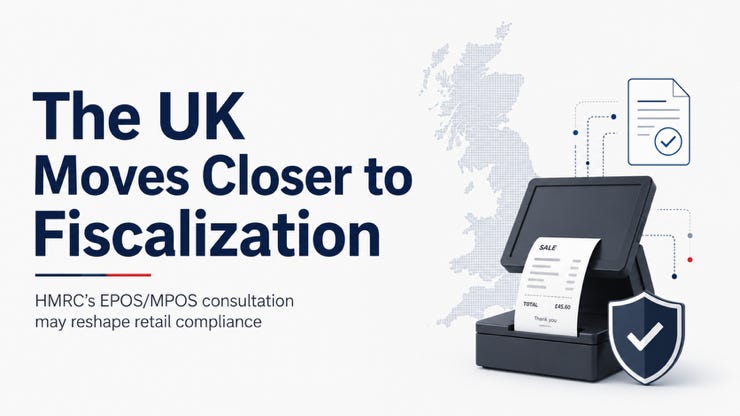
The UK has opened a consultation on Electronic Sales Suppression and the possible introduction of software standards for EPOS and MPOS systems. This could become one of the most important retail compliance developments in the country for years.
The consultation is not yet a law. But the questions HMRC is asking already show a clear direction. From my reading, the UK does not appear to be thinking primarily about a classic real-time fiscalization model as the first step. The direction looks closer to an audit-based, software-standard-driven model built around unalterable transaction logs, encrypted chaining, SAF-T data, certification or registration of systems, mandatory receipt or report data, and new compliance checks designed specifically for the retail sector.
In other words, this looks less like a Croatian-style real-time online model and more like a UK-specific combination of Germany, Austria, and Norway, adapted to the realities of a large, diverse, and commercially sensitive EPOS market.
The consultation also shows that HMRC is studying the international playbook carefully. The stakeholder list includes discussions with tax authorities in Austria, Germany, Greece, the Netherlands, New Zealand, Norway, and Australia. Austria is relevant for mandatory standards, receipt requirements, and cryptographic chaining. Germany is relevant for technical certification, digitally signed transactions, and supplier or manufacturer penalties. Norway is relevant for product declarations, SAF-T, registered systems, and digitally signed receipts. The Netherlands brings the example of a voluntary quality mark around reliable SAF-T-based record processing.
The UK’s likely path therefore seems to be a hybrid.
The most sensitive design decision will be timing. HMRC’s consultation closes in August 2026, and after that the process will normally move through the UK tax policy cycle, where policy design, draft legislation, and implementation are separate stages. My current estimate is that a first draft legislative proposal or technical draft could realistically appear during 2027, with adoption in 2027 or 2028 and phased implementation somewhere between 2028 and 2030.
For retailers, POS providers, and solution vendors, this is not a topic to watch only when the final law is published. The direction is already important. The UK may be moving toward fiscalization without calling it fiscalization.
What this means now
Retailers should start mapping UK EPOS/MPOS transaction flows, audit logs, receipt data, offline scenarios, returns, and reporting responsibilities. POS vendors should start thinking about tamper evidence, cryptographic design, export formats, and whether their architecture could support a future certification or registration model.
I wrote a full analysis of the consultation, the likely model, possible timelines, and what this could mean for retailers and POS providers.
Read the full article here: The UK Moves Closer to Fiscalization
E-invoicing and fiscalization are often discussed together because both are driven by tax authorities and both create technical compliance obligations.
But for retailers, they do not belong to the same architectural layer.
Fiscalization must stay close to the point of sale, where receipts, fiscal signatures, offline scenarios, returns, and immediate transaction evidence are created.
E-invoicing belongs much closer to ERP, accounting, and finance, because it is not only about sending an invoice. It is about the full invoice lifecycle: corrections, credit notes, debit notes, self-billing, rejections, statuses, archiving, and reconciliation.
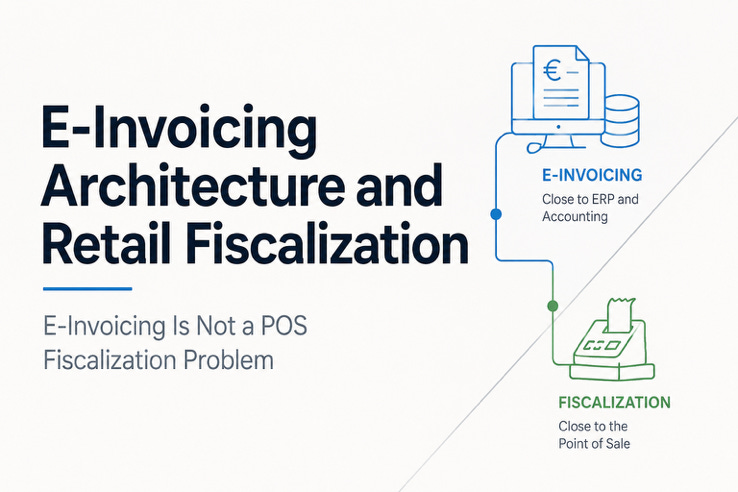
Mixing these two layers may look efficient at the beginning, but for international retailers it can quickly create duplicate ownership, more interfaces, more reconciliation, and higher compliance risk.
Practical point
Do not ask whether e-invoicing can technically be added to POS. Ask whether POS is the right ownership layer for invoice lifecycle, finance reconciliation, and cross-country e-invoicing architecture.
Read the detailed article here: E-invoicing is not a POS fiscalization problem
France may have sent an early signal that fiscalization will soon become part of a much bigger security discussion.
According to recent news, the French cybersecurity agency ANSSI plans to stop certifying security products that do not include quantum-resistant encryption from 2027. At first sight, this is not a POS topic and it is not a new French fiscal law. It does not mean that NF525 or other French POS certification requirements will immediately demand post-quantum cryptography.
But it would be a mistake to ignore the direction.
Fiscalization is built on trust. It depends on tamper evidence, signatures, certificates, secure archives, audit exports, and the long-term integrity of transaction data. In France, POS compliance already follows the principles of inalterability, security, conservation, and archiving. In Germany, Spain, Portugal, Italy, and many other countries, fiscal systems also rely on digital evidence that must remain trustworthy for years.
That is why quantum security matters. The real question is not whether tomorrow’s receipt can be attacked by a quantum computer. The real question is whether fiscal evidence created today will still be reliable in the future, when cryptographic standards and certification expectations may change.
For POS vendors and retailers, this is not a reason to panic. But it is a reason to start thinking about crypto-agility, certificate management, secure archives, and fiscal architectures that can adapt when regulators raise the security baseline.
I call this direction quantum-ready fiscal middleware®. It means designing fiscal architecture in a way that can move toward post-quantum requirements when certification bodies, tax authorities, or enterprise security policies start demanding it.
Read the full article here: Quantum Security Is Coming for Fiscalization
The European Parliament has published a detailed study on the VAT Reverse Charge Mechanism and the Quick Reaction Mechanism in the EU. At first glance, this may look like a technical tax topic. But the findings are highly relevant for retailers, POS providers, e-commerce platforms, and fiscalization systems.
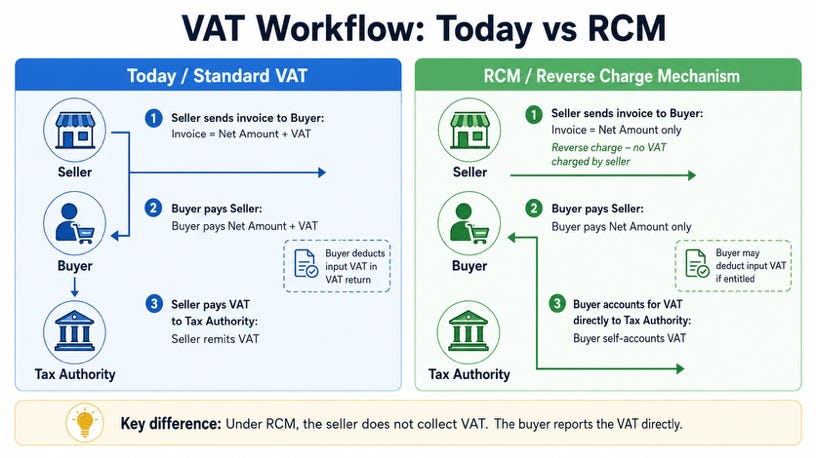
The study shows something important: when VAT fraud is blocked in one part of the transaction chain, the risk does not simply disappear. It can move toward the retail edge — especially final sales, online channels, refund claims, and transaction-level reporting.
For me, this is one of the big reasons why retail compliance cannot be treated as a back-office topic only. The store, the online checkout, the return process, the marketplace order, and the fiscal reporting layer all become part of the evidence chain.
Signal to watch
VAT control is becoming more transaction-based, more data-driven, and closer to the point where retail actually happens.
Read the full analysis here: The VAT fraud shift retail cannot ignore
On 15 October 2026, our community will meet in Belgrade, Serbia for something very special: Community Day 2026.
For us, this is not just another retail technology event. It is a focused, invitation-only gathering for people who work deeply with fiscalization, retail compliance, and POS implementation across countries.
There will be no sales pitches, no paid presentations, and no exhibition booths. The idea is simple: bring the right people into one room and talk openly about compliance, implementation challenges, regulatory change, and the future of fiscalization.
Today, I can already reveal two highlights.
First, we will welcome Avalara, who will join us to talk about e-invoicing — one of the most important topics shaping the next phase of tax technology and retail compliance.
Second, colleagues from METRO Cash & Carry will join our panel discussion on the internationalization of POS with focus on compliance. For international retailers and POS solution providers, this is one of the most relevant topics: how to build, roll out, and maintain POS solutions across different legal, fiscal, and operational environments.
I am sure these two sessions will be among the highlights of the day, alongside other discussions we are currently preparing. The detailed agenda will follow soon.
Please remember that Community Day is a private, invitation-only event for our community. We are intentionally limiting participation to around 80-100 people to keep the quality of discussions high and to make sure every participant can be part of a meaningful exchange.
To receive your invitation, please register here:
I am looking forward to seeing many of you in Belgrade.
In one of our recent marketing meetings, we discussed something that probably every creative person knows very well: how difficult it can be to be creative on command.
When your job requires creativity, you do not always have the luxury of waiting for inspiration. Sometimes there is a deadline, a campaign to create, a problem to solve, a post to write, a concept to develop, or a presentation to improve. And the more pressure there is to be creative immediately, the harder creativity becomes.
I think there is a way to make this easier.
Creativity does not appear from nowhere. It happens in the brain, and like many mental processes, it can be influenced by habits, environments, and repeated signals. A smell can bring back a memory. A song can put you into a certain emotional state. A place can immediately change how you feel.
That same principle can also be used for creativity: create a personal creativity trigger.
It can be a specific playlist, a certain type of coffee, a candle, an incense stick, a notebook, a special pen, a walk before writing, or even a specific piece of clothing you only wear when you create. The important thing is consistency. Use the same trigger again and again when you work on creative tasks.
Over time, your brain may begin to connect that signal with the state of creating. The music, the smell, the object, or the ritual becomes a doorway into the creative mode.
Creativity is not only inspiration. Sometimes it is also training, ritual, and repetition.
Question for you
Do you have your own creativity trigger? A song, a place, a smell, a ritual, a walk, or a strange little habit that helps you think differently?
Two days ago, one of my artworks left Hamburg.
First it travels to Italy. From there, it will continue to South Korea, where I have been selected to exhibit as part of IDENTITY PROJECT SEOUL 2026, taking place from September 2-6, 2026.

The theme of identity feels very close to the artistic direction I am currently exploring. In my work, identity is not something fixed or clean. It is fragile, emotional, distorted, sometimes disappearing, sometimes returning in another form.
It is a strange feeling to send an artwork away. Physically, it is just a package. But emotionally, it carries a part of the person who created it.
A small package. A long journey. A very personal moment.
I will share more about this project as the exhibition approaches.
Thank you for spending your time with this newsletter.
I know your inbox is full, your days are busy, and attention has become one of the most valuable things we can give to each other. That is why I never take it for granted when you read, comment, reply, or share one of my thoughts with someone else.
This newsletter is becoming more than a place where I publish updates. For me, it is becoming a space where technology, compliance, retail, creativity, and personal curiosity meet.
And I would love to build this space together with you.
So please tell me what you think. Which topic should I go deeper into next: UK fiscalization, Compliance Intelligence, e-invoicing architecture, quantum-ready fiscal middleware, or VAT fraud moving closer to retail?
Comment, challenge me, add your own perspective, or share this issue with someone who should be part of the conversation.

Comments
Nothing yet. Say the first thing.
Sign in to join the conversation.