
‘Here’s a mystery: some penguins travel inland and die. Do they intend to die? Do they simply explore too far? We don’t know.’ This essay by writer Stephanie Krzywonos, first appeared in Dark Mountain’s ‘requiem issue’ in 2021 and has since become a full-length memoir of life in Antarctica. The Blue Hours is her examination of hidden histories beneath the ice, of pushing beyond the boundaries of the known world and testing the limits of survival. Here, she follows the track of a solitary bird into the interior of this ‘graveyard full of bones’, into her own landscape of loss and grief, and then the world’s.
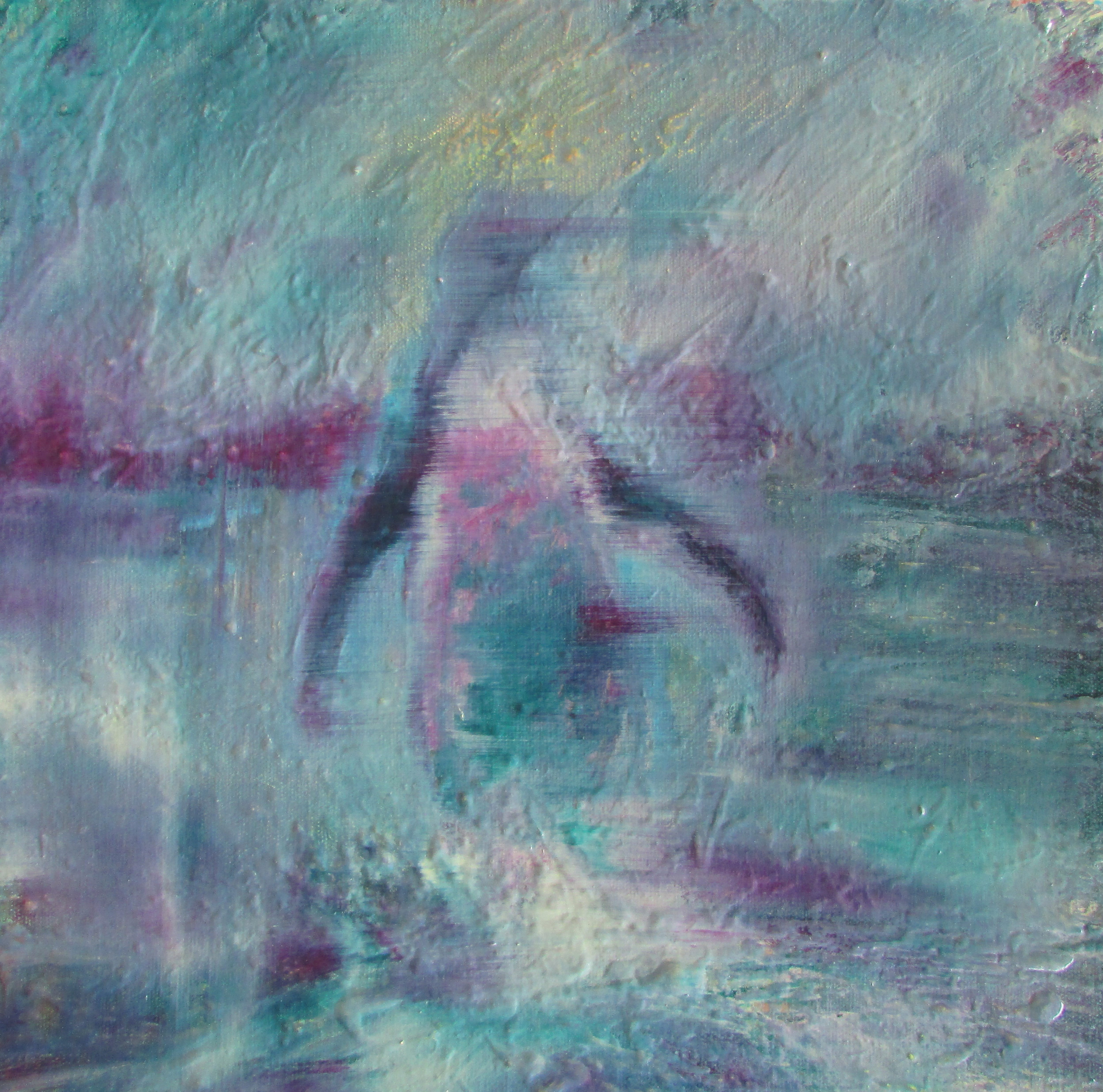
I FIRST MET A PENGUIN ON A BRIGHT SUNDAY while standing on the frozen sea. My silent human companion pointed towards a figure emerging from the white desert like a prophet.
By then, I’d lived in Antarctica for two calendar months and the sun coiled above the horizon for six ‘weeks’; I existed in one very long day. Antarctica’s nourishment seeped through my body, into my bones. Her glacial water fattened my cells. Her persistent wind fed my lungs and my blood. Her dryness altered my flesh for survival, morphing my skin into leather and my hair into a fossil record.
On that Sunday, I realised that if I walked too far in any direction I would die. In the green world, one could meander for days or even months across whole continents and find enough food, shelter, water and warmth to thrive. In this frozen world, life for humans is dire. I might only strive an hour in one direction, maybe ten minutes in another before surrendering to the snow.
The penguin, a small Adélie, hastened towards us before we saw her. She orbited us, alternating between sliding on her belly and waddling, curious and unafraid, playing, tottering, tender, childlike. She squatted on webbed three-toed feet, the colour of fallen leaves, next to the clunky blue moon boots entombing my numb feet. (How did her feet not freeze?. How was her existence, or any of this, even possible?) Behind us, a volcano, Mount Erebus – namesake of the Greek god of darkness and shadows, and son of Chaos – exhaled smoke into the sky and basked in the clean light.
As the little prophet gazed at me, she spoke, squawking and flapping her in a language I didn’t understand, and I – unaware of how braced and vigilant I’d become – softened. She turned her stark black back towards me and departed for the volcano. Earlier, I’d struggled to see her emerge directly in front of me. I realised why: she is camouflaged.
We live in intersecting worlds, whose centres are nowhere and circumferences everywhere, but I cannot go where she can go. I live only on the surface. She descends into profound waters, her darkness obscuring her in the shadows from predators above, her iridescent lightness blending and absorbing her into the ice, the sky and the light to predators below.
Comments
Nothing yet. Say the first thing.
Sign in to join the conversation.