
For our final story in this month’s series about the polar lands and perception we travel to Greenland – but not via ship or plane. Writer Ersun Augustinus Kayra explores the traditional life and culture of the Greenlandic people via his imagination, and how their deep interrelationship with place is shaped by language. ‘Geography, in this way of seeing, is not a stock of features to be inventoried but a web of relations to be lived inside. Where the Western map asks what is here?, this other naming asks, who is here, and with whom?’
With photographs by Nancy Campbell (from Issue 10: Uncivilised Poetics).
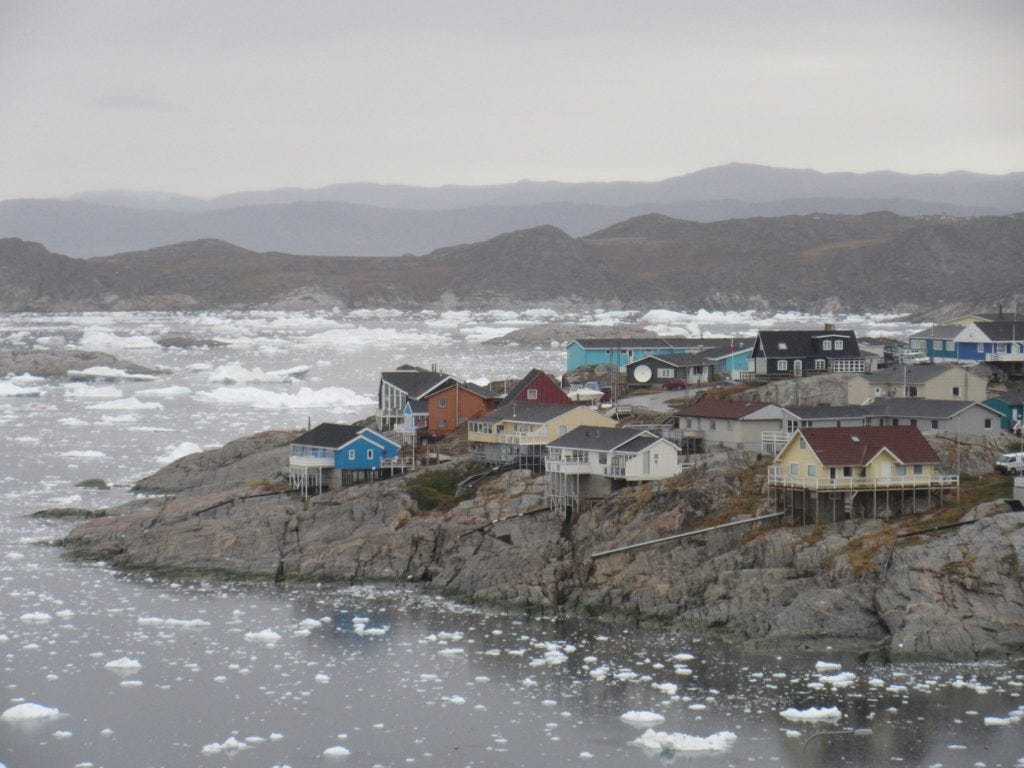
WE CALL IT GREENLAND: the green land. The name sits in the mouth like a misunderstanding left behind by the first stranger who saw it – someone who spun an entire island out of a few months of coastal grass and chose, deliberately or otherwise, to look past the ice that is the actual body of the place. It is a coloniser’s name in the oldest sense: a claim disguised as a description. It can sound, in retrospect, almost like an early advertisement in the North Atlantic: a word chosen to make a hard coast sound like pasture, to pull settlers across cold water on the strength of a syllable. And it tells you nearly everything about the mind that made it. The West has long named land by what the eye seizes first from the deck of a ship – a headland, a colour, a promise. Cape of Good Hope. Terra Nova. The green land. These are not descriptions; they are intentions. To name a country for its greenness is to name it for what it might yield, to file it under use before a single boot has touched the shore. The name arrives before the understanding, and then, having arrived, prevents it.
Those who live there call their home something else. Kalaallit Nunaat: the land of the Kalaallit, the land of the people. Not the land of ice, not the land of seals, not the land of some exploitable green. Sit with the difference long enough and it stops being a matter of translation and becomes a matter of ontology. One name points at a surface and calls it whole; the other points at the humans who walk the surface and lets the ice go unremarked – because the ice does not need naming, any more than breath needs naming. It is the given, the medium, the condition of everything. Geography, in this way of seeing, is not a stock of features to be inventoried but a web of relations to be lived inside. Where the Western map asks what is here?, this other naming asks who is here, and with whom? The entire distance between the outsider and the insider lives in the gap between those two questions. This essay is written from inside that gap – from the far side of the glass, by someone who has never smelled the cold and accepts, from the first sentence, that to look through a window is never to enter the room.
Begin, then, where a life there begins each morning: with a door.
In Greenland the door tends to be open. A birthday, a christening, an exam passed, the plain arrival of a Saturday – all of them dissolve into the same event, the kaffemik. The door is left wide, coffee and cake are set out, and whoever comes simply sits. No card in the post, no hour printed on an invitation, because there is no invitation. People arrive, settle, drink, rise, and are replaced by others – a slow tide moving through a warm room across a whole afternoon. I have come to believe a society confesses itself most honestly in customs like this, the small unpretentious ones it never thinks to defend.
Consider what the kaffemik quietly refuses. It refuses the appointment, that little contract by which we ration our presence to one another. It refuses the guest list, which is only a border drawn in ink. It refuses, above all, the founding myth of the bourgeois interior – an Englishman’s home is his castle – with its moat of privacy and its drawbridge of the scheduled visit, its self imagined as a keep that hospitality might breach. In the castle model, the home is where the world stops. In the kaffemik, the home is where the world is received. The self, accordingly, is not a fortress with a perimeter to patrol; it is something more like a harbour, defined not by its walls but by what it shelters, its boundary drawn and redrawn each afternoon by wherever the last guest happens to end.
The same openness runs through the food, though here it cuts deeper than manners. Here it becomes a geography of debt.
For most of the human history of this coast, survival hung on the hunt: seal, whale, narwhal, the fish beneath the ice. But the hunt was never the lonely heroism we picture from a warm distance – the man against the white, the spear, the hunger. By tradition the catch is not the hunter’s to keep. It is divided: carried to the elders, to the widow, to the household that could not go out that day. What looks, from outside, like generosity is closer to arithmetic – the plain mathematics of a place that learned, early and on the ice, that the only way to stand alone is to make certain no one ever does. Every shared portion is a thread, and the threads accumulate into a net, and the net is what holds when the weather turns. Debt, in this economy, is not a burden to be discharged as quickly as possible; it is the very fabric of belonging. To owe is to be woven in.
Every shared portion is a thread, and the threads accumulate into a net, and the net is what holds when the weather turns.
A European stomach may turn at seal, or at mattak (the skin and blubber of a whale) but the stomach is beside the point. The point is that a person here has always known exactly where a meal came from, whose hands carried it, whose absence it fills, to whom it leaves them indebted. Set against that, our own arrangement reveals itself as the stranger one. The grocery bag remembers nothing. The meat arrives severed twice over – from the animal, and from every hand it passed through – shrink-wrapped, weightless with forgetting. We are perhaps the first people in the history of eating who consume in perfect ignorance of our benefactors, and we have given this ignorance the gentle name of convenience. It might more honestly be called an ontological amnesia: a daily, deliberate unknowing of the web that keeps us alive. The Greenlandic table and the supermarket aisle are not two points on a scale of development. They are two answers to the question of whether a debt is a shame or a bond.
Then there is the language, and the language changes the shape of the sky.
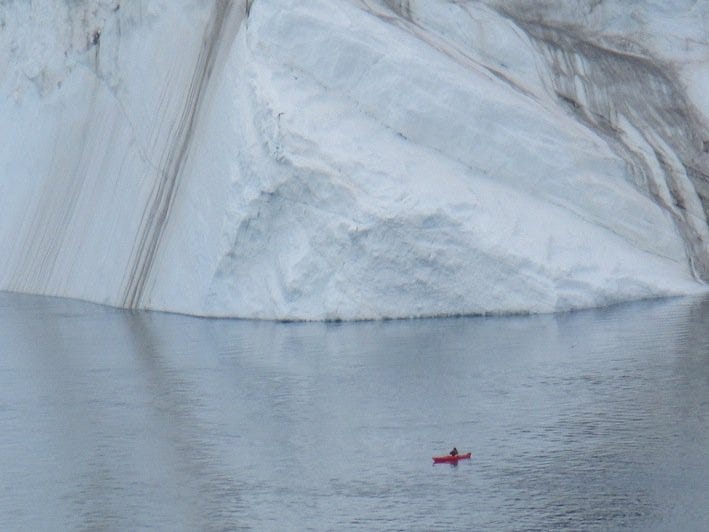
Listen to Kalaallisut spoken and you cannot find the seams. A single word carries what English would spend a whole sentence to say – suffix settling onto suffix onto root, the meaning thickening as it travels, like a walker gathering snow on the long way home. Linguists call this polysynthesis, but the dry term misses the philosophy smuggled inside the grammar. English often seems to proceed by dismemberment: it cuts the world into small hard pieces – nouns, verbs, subjects, objects – and then reassembles them, sentence by sentence, like a machine bolting parts. A polysynthetic word does not assemble; it grows. It holds actor and action and place and weather in one unbroken breath, the way the landscape itself holds them. To speak this way, day after day, generation after generation, is to rehearse a metaphysics: that the world is not a warehouse of separate objects but a single continuous event, and that language’s task is not to divide it but to carry it whole.
And near the centre of that language sits a word that ought to stop any Cartesian cold. Sila. Reach for it in English and you come back with weather – but that is only the nearest and shabbiest of its meanings. Sila is also the air, the outside, the encompassing world; and it is intelligence, reason, consciousness, the mind itself; and it is something like the breath that moves through the cosmos and through the person at once. One sound, holding what Descartes spent a lifetime splitting. The famous cut – mind on one side, mere extended matter on the other; the human subject in here, the mute wild out there – simply cannot be performed inside this word, because the word has no seam to cut along. A child raised inside sila does not first learn that she has a mind and then learn that there is a world; she learns one thing with two faces. When the wind rises, something of thought rises. When a person loses their reason, the elders might say their sila has left them – as though sanity were a kind of weather that can withdraw. Now set beside that child the rest of us, tilting our faces down at a glowing rectangle to check the weather – weather as data, as a percentage chance of rain, as something that happens to other objects. The two of them may lift their eyes to the identical sky. One sees information. The other sees the very substance she is made of. It is not that one is right and one is wrong; it is that one word keeps a wound closed which our whole civilisation was built by opening.
Light does the rest of the work. It bends time.
For weeks in winter the sun does not clear the horizon; through the summer it refuses to set. Duration answers to the sky rather than the clock, and the borders of sleeping and working and gathering go soft, expanding and contracting with the year like a lung. It is easy, from here, to read the dark months as deprivation – a void to be endured, a long absence of day. But absence is the outsider’s word. For the people of that coast the polar night is not empty; it is a season with its own interior, the time the household turns inward – toward the lamp, the conversation, the story told again and told differently. Perhaps that is why narrative stays so alive here, why meaning is still carved patiently into small figures of bone and passed from hand to hand and mouth to mouth: the long dark is the workshop of culture, the season in which a people weaves itself back together. Against that seasonal breathing, our own arrangement looks thin and slightly mad: the mechanical clock, that flat indifferent wheel, dragging every hour to the same grey length, forcing midwinter and midsummer into identical boxes, demanding that the body keep office hours the sun itself declines to keep. We flooded darkness with electricity and called it progress; perhaps we also abolished one of the last seasons in which people had nothing better to do than sit close and speak.
For the people of that coast the polar night is not empty; it is a season with its own interior, the time the household turns inward – toward the lamp, the conversation, the story told again and told differently.
Now for the trap – the one every outsider springs, and the one this essay has been circling all along.
It is the tense. It is speaking of all this in the past, as though Kalaallit Nunaat were a diorama behind museum glass, lit softly, labelled, safely over. It is not. The hunter with the harpoon has a smartphone in his pocket and a child studying on another continent. The kaffemik table argues about football. Teenagers post from the backs of snowmobiles, and a young woman takes a seal in the old way and comes home to Netflix, and there is nothing whatever strange in it – the strangeness is ours, manufactured at a distance by our appetite for the authentic, that quiet cruelty which grants Indigenous people a culture only on condition that it never change. We demand they hold still so that our photographs of them will stay true. But no living culture is a vitrine. It is a negotiation, permanent, unfinished and full of contradiction, and to demand otherwise is not reverence but a kind of taxidermy – the preservation of the skin at the cost of the animal.
And there is a harder edge to the present tense now, one that outsiders like me had a hand in sharpening: the ice under that hunter is thinner than the ice under his grandfather. The sea routes of memory no longer match the sea. A culture that read frozen water the way we read print is watching its library soften year by year, warmed by industries and appetites headquartered thousands of miles to the south. The people who never split mind from weather are being made to live inside the consequences of a civilisation that did. If the word sila holds world and mind together, then what is happening to the ice is not only an environmental event. It is something happening to thought itself.
Which returns me, at the end, to the glass, and to what little an honest stranger can say through it.
I have never smelled that ice. I have never endured the long night, never sat at a kaffemik table with the door swinging open behind me and the coffee going cold in a stranger’s cup. Every paragraph above is a translation of a translation, listening at a distance, and I will not pretend otherwise – the pretence would be one more act of naming from the ship’s deck. The only true thing I can offer is what is visible from this side of the window: that a world which treats sharing not as a virtue to be praised but as the plain arithmetic of survival; which names its country for its people and not its surface; which folds the mind and the weather into one small unbreakable word – such a world has something to say to us even across this distance, perhaps especially across it. It speaks of patience. Of debt as belonging. Of the neighbour’s open door and the long dark as a gathering place. It reminds us that the blank white space we so casually call Greenland is, and was always, the land of people.
Perhaps that is the most respectful thing a stranger can manage. To know that they do not know – and, knowing it, to keep the window clean, and to keep listening anyway.
Ersun Augustinus Kayra is an Istanbul-based essayist and public ethicist. His writing explores religion, moral life, ecology, and the tensions between place, memory, and modernity. His work has appeared in Commonweal, Touchstone, The Living Church, and other international publications.
Nancy Campbell is a writer whose decade-long creative response to the landscape and culture of the polar regions across poetry and non-fiction was awarded the RGS Ness Medal in 2020. Her publications include The Library of Ice: Readings from a Cold Climate, How to Say “I Love You” in Greenlandic: An Arctic Alphabet and the poetry collection Disko Bay.
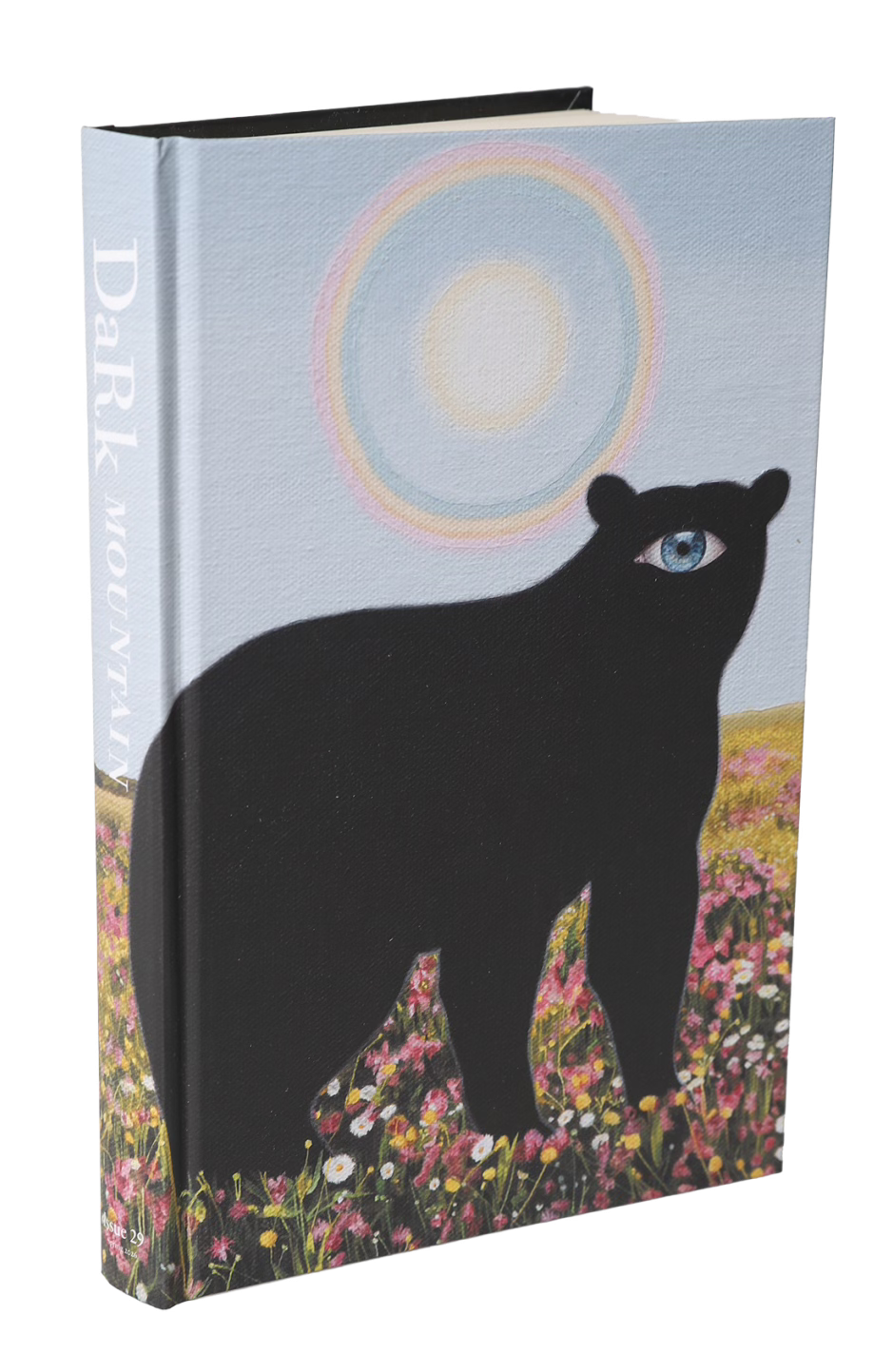
Dark Mountain: Issue 29 (£19.99)
Our Spring 2026 anthology is a hardback collection that steps outside the human bubble and puts animals at its heart. Order from our website or take out a subscription to future issues of Dark Mountain and get Issue 29 for only £14.99.
Subscribe to Dark Mountain's Books
The Dark Mountain Project is an entirely reader-funded organisation. If you enjoy these newsletters or posts, please consider supporting our work by visiting our shop or becoming a subscriber to our books and/or our online weekly edition on Substack. All back issues in the archive are available both in print (Issues 21, 22, 25-28) and PDFs (from £5). Many thanks!
No posts
Comments
Nothing yet. Say the first thing.
Sign in to join the conversation.