
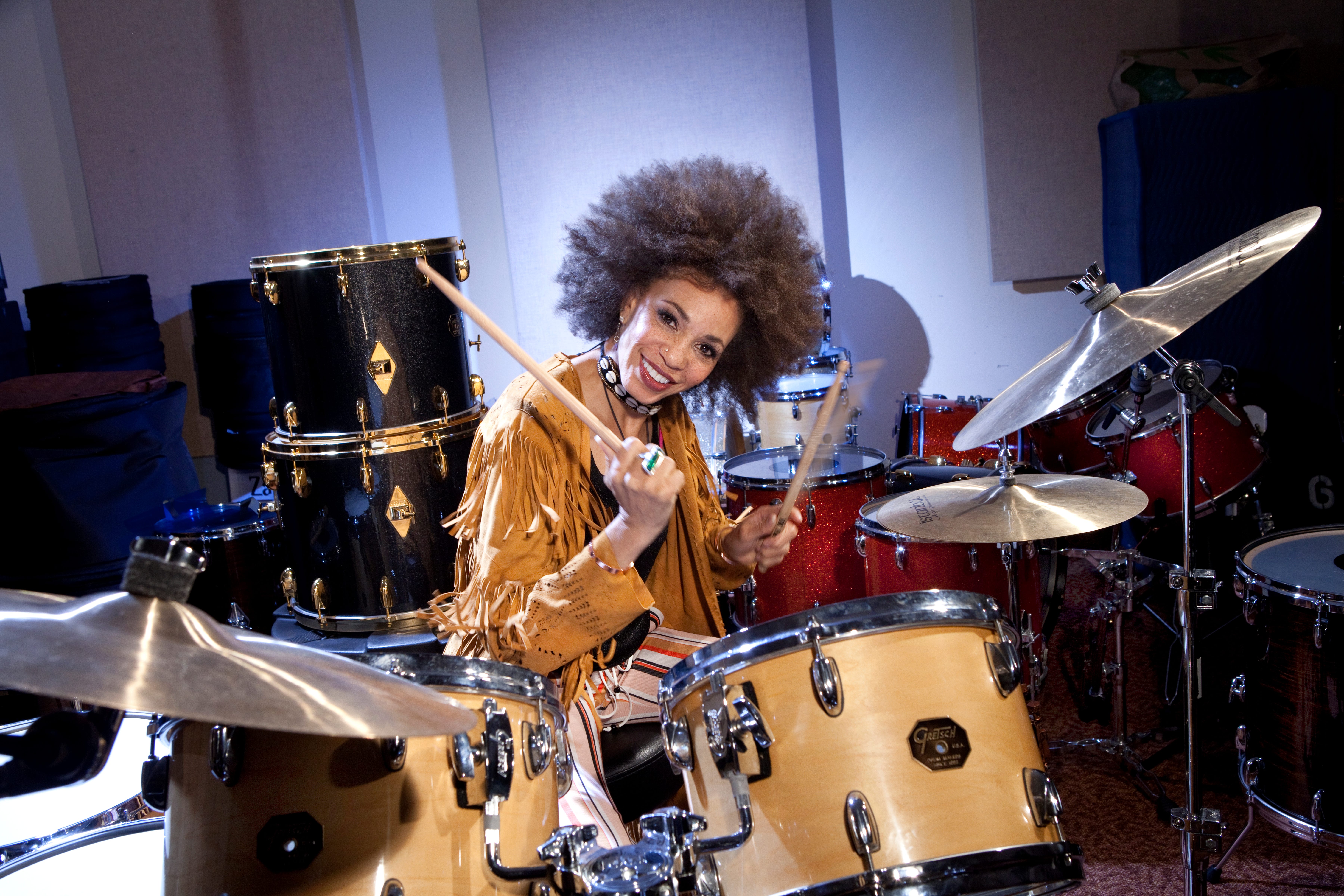
First things first: For any New Yorkers reading this, Cindy Blackman Santana is headlining a stellar Celebrate Brooklyn bill this coming Friday, July 24th — also featuring Patricia Brennan and Lucía — exactly one week before she’s set to release her new album, Coherence.
I’ve been waiting for a record like this from the drummer-bandleader-composer ever since I saw her current band at Birdland a couple years back. I was thrilled by what I heard there — a clear throwback to the early days of jazz-rock fusion that, unlike so many subsequent attempts at recapturing this vibe, retained a real sense of risk. And on Coherence, Santana and her outstanding band — with saxophonist Emilio Modeste, guitarist Aurélien Budynek, bassist Felix Pastorius and keyboardist Zaccai Curtis — crank up and rip exactly as they do onstage. (It’s safe to expect the same at Celebrate Brooklyn, a brief stop-off for Cindy in the midst of a summer tour with her husband’s band, Santana, that runs through August. Modeste, Budynek and Curtis will all be on hand at Prospect Park, along with bassist Benny Rietveld and additional saxist J.D. Allen, her longtime collaborator.)
I was lucky enough to grab some time with Santana on Zoom recently, speaking to her for an upcoming project that I’ll elaborate on soon. But for now, ahead of the album and show, I wanted to share an excerpt of the conversation that focuses mainly on Coherence. Hope you enjoy!
I had the pleasure of seeing your current band at Birdland a couple of summers ago, and I was blown away. I’m excited to hear that the group is captured in its raw state on this record. Was that something you were looking to do on Coherence?
Absolutely. Because the way that the band congeals and just reacts to each other, the way we play the music live, that’s what I wanted to capture. So if that’s the feeling that’s coming across, I’m really happy because that’s what I’m feeling. That was my goal: to capture that live energy.
Your prior album, Give the Drummer Some, was more song-oriented. This seems more like, “Get the band in a room and just let it rip.”
Absolutely, and that’s what most of my records have been. Give the Drummer Some was a departure from that, in a way. This is getting to that but even more. So really capturing the live essence and having everybody’s voice shine through like we do when we’re playing onstage. I wanted that to be captured in not only the performance and the playing, but also in the compositions and the overall input from all the musicians. And I think that we did that.
Also, I really love strings. I was really wanting to capture strings, so there’s some strings on the record too. Obviously we haven’t added strings to our band live, but I wanted to add that element in there, too, because that’s a sound that I love and it’s something I’ve been wanting to add for quite a while. I’ve used string pads, and things like that, but I wanted real strings. So there are a lot of elements in this record that we were able to capture that I’ve been really wanting and desiring to capture for quite some time. I’m really happy with that.
Right, I know the cello player Dave Eggar appears on the album.
Yes, Dave Eggar is playing and what he does is really cool because he’s a cellist and he will layer a bunch of tracks. So I think he used some auxiliary string players in a couple of spots, but mainly what it is, is him layering tracks.
He layered so many. On one piece, he layered, I don’t know, 40 tracks. We even had to cut some down because it was like, “Whoa, this is really thick and what we’re doing is already thick.” So he’s really great because he really hears very well what we’re doing and he adds a lot of stuff, and I’d actually rather have more and then take away what I don’t need rather than not have enough. He does that quite well.
I met him on a project that I did. I was producing and I chose a co-producer, Jack Daley, a bass player who I played with for a long time with Lenny [Kravitz]. We were producing Aurea, a singer from Portugal. She’s like a pop star over there, and we needed strings. So Jack knew Dave and he brought Dave in and he layered the strings so well. And I was like, “Dude, at some point we have to do a project with my music.”
Since you’re talking about the layering of tracks, I would have to assume that at least the basic tracking for this record was just the band playing live. Is that most of what we’re hearing on the record, and then some elements are overdubbed?
All of what you hear with the band is done in the room. The only thing that was done later were the strings, one keyboard part on a song and then maybe a couple of fixes here or there. But basically it was just us in the room playing and that’s why we were able to capture the live feel because that’s what we did. We played like we play a show.
And how about some of the other guest spots, like Carlos, who plays on a few tracks including “The Message Is Love,” and John McLaughlin, who appears on “Guitar Love”?
With Carlos, he was there. John was actually not because he was in London. We wanted him to be there, but he was not able to get here, in Las Vegas, where we were recording. But Carlos was.
Yeah, you can definitely feel that. You mentioned the compositions, and I wanted to discuss your approach to the material. Some of the performances here almost reminded me of the Miles quintet’s version of “Nefertiti,” where the band plays the theme and then the drums are kind of going off against that. It’s not necessarily a solo as much as an ongoing commentary. I’m curious about how you chose to structure these pieces, because I really like how that plays out.
Thank you. That was intentional because “Nefertiti,” that concept on that song is one of my most favorite in the world, the way that everybody’s playing and adding, but it’s never too much because that band is a band of such great musicians that they just weaved in and out. That’s what I was looking for.
Yeah, the track “Soon a Queen” that really has that vibe. Overall, it seems like you’re really interested in taking time with this music. Many of these pieces stretch to six, seven minutes, and you’re really letting this stuff breathe and seeing where it ends up. Was that a priority as well?
Absolutely, because that’s what happens when you’re playing live. And I hear so much music that sounds very stoic today and everything is just on a grid with a certain length. It’s a three-minute song only, ever, and nobody’s stretching out, nobody’s painting outside the lines, nobody’s crossing over into any unknown territory or any experiment. I wanted to get away from that.
Because creativity is what we are born with. My perspective and my view of life and creation is that we all come from the master creator, and that means we have the element of creativity in our DNA. It’s inherent; it’s in us. And so if we’re not using that, then we’re not living up to what we are, what we’re made of. I wanted to make sure that we had that represented and done, and done well, on this record.
And my favorite music is that. I love all music. I love dance stuff; I love all kinds of things. But my favorite music is music that pushes boundaries, music that stretches the envelope, music that is intellectual and so there’s form and there’s structure, but you know how to break the rules in a good way. You know how to go outside the line but still stay in, and that’s what I want my band to portray in any of our journeys.
Amen to all that! That feel is a hallmark of so much classic fusion, too, whether that’s Lifetime, Mahavishnu Orchestra or electric Miles. You mentioned going off the grid and painting outside the lines and I feel like that’s especially true of the drums on this record, which sound absolutely explosive. It’s very rare to hear contemporary records, in any genre, where the drums are really allowed to go off and you feel like you’re actually listening to a live take that hasn’t been chopped up and made “perfect.”
Yeah, and thank you. That’s exactly what I was going for and that’s exactly what I go for.
The ’50s I love; the ’60s going into that early ’70s period where Lifetime erupted, that’s my favorite. So between the end of the ’50s and Lifetime, that’s my absolute favorite section of music in creation. There’s other stuff that I love too, but that is my favorite for my personal taste.
I draw on a lot of those elements, and yet my mom was a classical violinist and she used to take me to all kind of classical concerts when I was young. And so what I liked was the counterpoint and all of the elements that were happening at the same time and happening in different spaces, and that is an influence on me as well. All of that plus other styles and other musics that I also love, those elements are all what I want to put into the music and will continue to put into the music because that’s the direction I want to go in.
What about the compositions here? How did the material come together?
Some of the songs are mine and some of the songs are Aurélien. And then there are some songs that are band compositions, and I wanted the band to help compose because again, I wanted everybody’s voice to be involved. I didn’t want just mine or even just Aurélien’s. I wanted everybody’s voice to really shape and mold what we were doing. And then there are some songs that are covers: “Sanctuary” is a Wayne Shorter piece, “Capri” is a Paolo Rustichelli piece, obviously “Guitar Love” is a John McLaughlin song. “Illumination” is my piece, “Peace Please” is my piece, “Blue Whale is Aurélien’s piece; “Soon a Queen,” Aurélien’s Piece.
“Pulp Fiction” was an idea that I brought in but that everybody contributed to, so I just gave everybody credit for that song and that’s what we did throughout. Even “The Message Is Love” is an idea that I brought in, but I gave everybody credit because everybody added something in their own way and it wouldn’t have been the song that it turned out to be if it weren’t for that particular set of musicians. Everything that Carlos added, everything that Aurélian and Felix and Zaccai and Emilio added, it’s all the composition.
“I hear so much music that sounds very stoic today and everything is just on a grid with a certain length. It’s a three-minute song only, ever, and nobody’s stretching out, nobody’s painting outside the lines, nobody’s crossing over into any unknown territory or any experiment. I wanted to get away from that.”
I feel like you’ve done something really smart on this record, which is structure the material just enough to get things moving but not so much much that it stifles the playing.
Thank you, because creativity is the main thing — for us to vibe off of each other, to really expound on the changes or the form or the rhythms that we’re playing and do that in a very band-centric way. And that again was one of the goals.
Do you have a favorite piece on the record or one you felt like you were really super proud of?
I’m proud of all of them; I really am so happy with this record. I definitely love “Illumination” and “Peace Please.” “Soon a Queen" I think is beautiful. It’s such a pretty melody and I love the way everybody plays together. “Pulp Fiction” I’m very happy with because that was really sort of experimental and I like what we got to because it’s a very different piece. It sounds to me like movie music, and I love movie themes. Those are probably among my favorites.
Can you speak a little about the makeup of the band? In some ways it seems like this is kind of like really your ideal group. Having seen it live, it feels like your strengths can come through so well in this and that everyone brings something to it. Emilio, for example, I first heard him playing with Stanley Clarke, and he’s just an amazing, fiery presence in the music. What is it about this group of people that makes this the right vehicle for you?
I think this group is the right vehicle because not only are they all very proficient on their instruments, and we all have differences, but we all have this incredible commonality and vision for the music. Which is creativity, which is vibing together and having reference points that we all love like Miles of the ’60s, Weather Report, all the Jaco stuff, all the Wayne Shorter stuff, Lifetime, Art Blakey and the Jazz Messengers, Elvin Jones, Coltrane, McCoy Tyner. There’s just a bunch of stuff that we have as common takeoff points in the music, even avant-garde stuff like Grachan Moncur III and Jackie McLean. There’s stuff that we all like. Lifetime, rock stuff, different things.
And so I think the elements of those are great jumping off points for each of us, but especially for me because I like so many different things. I love jazz. I love classical. I love rock & roll. I love Brazilian music. I love Indian music. There’s just so much stuff that I like and I want to draw from. And this group is very diverse in the Rolodex of music that they have in their portfolio. So we’re able to draw from different things, and that to me is really key. It gives us a lot of different energies to draw from, but some commonalities that are really poignant and necessary for us to move forward in the way that we do.
No posts
Comments
Nothing yet. Say the first thing.
Sign in to join the conversation.