
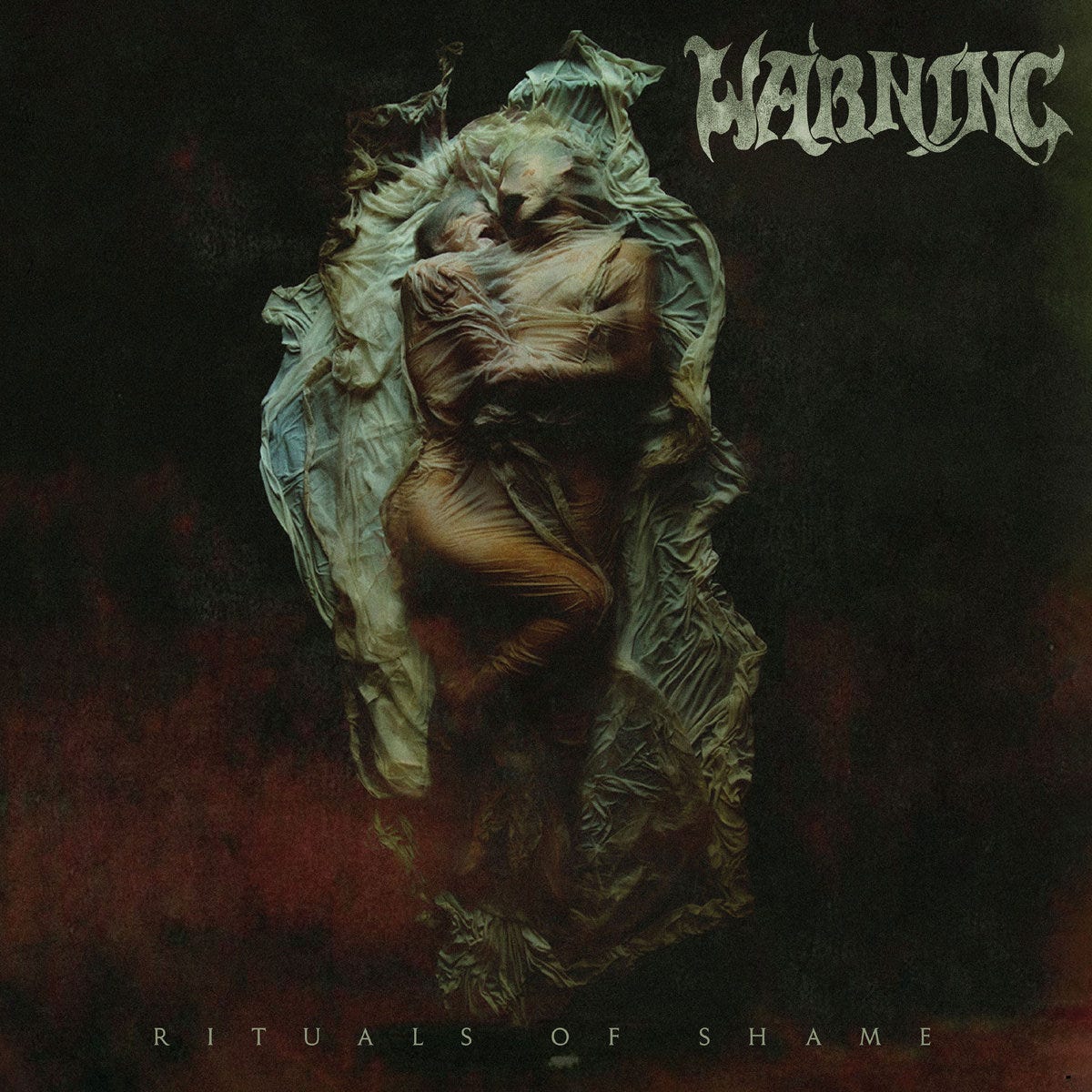
It’s a familiar lament these days: There’s nowhere to cover Record X. I won’t rehash the collapse — or, if you will, the morphing-beyond-recognition — of the culture-journalism ecosystem, which you have surely read about in a dozen different places. It’s real, of course, and clearly demonstrable. But on the other hand, if I, as someone who writes about music both as a profession and a calling, let this stop me from answering that call, then that’s purely on me.
I did make some effort to pitch a story on Rituals of Shame, the first album in 20 years by Warning, the British doom-metal band led by singer-songwriter Patrick Walker, which is out today on the venerable Relapse label. My pitch went unanswered. Hey, it happens — it’s part of the gig.
In some ways, I’m relieved that no one bit, because in pitching the album, I found myself straining to manufacture a sense of “relevancy” around it. As a music lover, relevancy, the sense that a given artist or release matters to the culture at large, is generally irrelevant to me; as a professional writer trying to land pieces in outlets in exchange for money, though, it’s simply a necessity.
Let me dispense with the notion that the new Warning album matters in any broader sense and say simply that it matters to me, that I believe its arrival ought to be celebrated, and that I think if any of what I have to say about it (in the limited time in which I have to put down these words) resonates, then you should spend some time with it.
A quick primer: Before Rituals of Shame, there were two prior Warning albums, but the second of these, Watching From a Distance, released just shy of 20 years ago, in December 2006, is a special case. Albums become cult classics for all sorts of reasons. Watching From a Distance has attained this status for the best reason, which is that it is an extraordinary work of art. Genres are all good and well, but in the end, I’m always looking for the artist or album so potent that they transcend the ultimately petty matter or whether or not a given listener happens to have an investment in Scene X. Like, say, Demilich’s Nespithe or Abdul Wadud’s By Myself, two of my other all-time-favorite cult classics, Watching From a Distance is one of these.
In pitching it around this spring, I described it as the saddest record I’d ever heard. Is that true? There are probably some other viable candidates (honestly, Ween’s Quebec comes to mind, and before you scoff, sit with tracks like “I Don’t Want It” and “If You Could Save Yourself (You’d Save Us All)”), but yes, I’m sticking by it. No album I know embodies pure despondency more fully than this one. You could describe it as a sort of endless keen, a wallowing that never relents, but as weighty as it is, its expression is far from monochromatic. I love Watching because it transmutes misery into something that feels almost holy. Listening to the tectonically heaving riffs, to Walker’s dolorous, and anguished wail, which captures some kind of timeless existential howl, you trudge through the gloom, but you’re always aware of the beauty buried beneath the pain.
I have no idea what actually inspired this record, but everything you need to know is in the music. Beholding a track like “Footprints” — and especially the glorious denouement of its final two minutes, where Walker’s delivery morphs into something ragged and desperate, his expression of presumably romantic grief taking on the dimension of an epic poem — no further explanation is needed.
Here I am wide open, I leave behind me the ruins
Surrendering to your side
I have laid down my armor,
I have no sword at my side
Of the fortress I swore to defend
I leave behind me foundations,
I'll leave you a man I'll need you to mend
In the immortal words of David Letterman, I’ll take all of that you got.
How does one go about following that up? Well, for 15 years or so, Walker hasn’t even tried. Instead, he started a new band, 40 Watt Sun, that has made four of the best albums of the 21st century, in any genre. As much as I urge you to acquaint yourself with Warning, these — 2011’s The Inside Room; 2016’s Wider Than the Sky, maybe my favorite of the bunch, though it’s a very close call; 2022’s Perfect Light; and 2024’s Little Weight — get my highest possible recommendation. As I put it in a brief 2021 Rolling Stone write-up on Perfect Light:
Since 2009, across two excellent albums by his current band 40 Watt Sun — named for a lyric by his favorite band, neo-prog heroes Marillion — [Walker has] experimented with just how many of the superficial trappings of [doom metal] he can shed while retaining the same emotional gravity. Now, with “The Spaces in Between” (the lead single from the band’s upcoming fourth album, Perfect Light, due in January) we have a definitive answer: pretty much all of them.
I could go on and on about 40 Watt Sun (and I have in the past, as have other writers I admire, including Ron Ben-Tovim, who ran a rare, in-depth interview with Walker back in 2019 on his essential Machine Music site), but for now, just go to the source, and see the band, or its current solo-acoustic incarnation (which has brought me to tears during two separate live encounters in Brooklyn within the past year), anytime you get the chance.
So yes, now, after around a decade of sporadic live appearances focused on the old material, we have a new Warning album. To cut to the chase, this is not the same Patrick Walker of 2006 — crazed with grief, pushing his voice and emotions to feral extremes. As I hear it, this is a less desperate, more assured Walker, infusing Warning with all the wisdom and patient craftsmanship of 40 Watt Sun, and arriving at some new peace within the upheaval.
He’s still concerned with charting the contours of grief and longing (the track below, “Stations,” makes reference to a “vast and aching hunger”), but he seems less racked by it here, more able to sort of stand apart and observe it, appreciating its beauty, its peaks-and-valleys progression, while weathering its harshness. (“Whatever you leave me, you leave me alive,” he wails at the end of “Stations,” with more than a hint of triumph.) His songwriting has grown more sophisticated, so that he can now express in the contours of the riffs, and their lovely and unhurried build, what he formerly had to wrench into being with the raw expulsions of his voice.
I’m still getting to know Rituals of Shame and don’t pretend to have my head or my heart all the way around it yet. I’ve been living with Watching From a Distance for a decade or more (I think I discovered it around the time I first heard 40 Watt), and it’s taken that long for it to really sink in.
But here’s the thing: Patrick Walker is a master songwriter, one of the greatest alive, in my estimation. He doesn’t phone anything in. Each new release tells us something new. There’s nothing on Watching From a Distance that sounds anything like much of what we hear on Rituals of Shame — nor does the new album feel quite like a continuation of 40 Watt. Take a track like “Night Comes Down,” for example, which contains some of Walker’s most otherworldly riffing to date; or “Landing Light,” with its heart-wrenching melodic resolutions at the end of each verse.
What is familiar is the sting of the music, the way Walker’s verses bend almost magnetically toward some axis of hurt, either a throb of melancholy or a twinge of agony (he lets that old Warning snarl loose in select moments on the title track), and the way the songs build methodically toward torrential payoffs in their home stretches, a hallmark of all of Walker’s work.
Overall, though, this is a new chapter, something special and distinct. And like all of Patrick Walker’s records, it’s something to be lived with. These songs are patiently hewn, lovingly brought forth, justifying the 20-year wait. You don’t drink down a record like Rituals of Shame all at once; you let it seep in. In a time when we’re all drenched in absurdity, in danger of going completely numb, it’s a patient infusion, another work to live with and treasure. Take it for the gift and salve that it is.
No posts
Comments
Nothing yet. Say the first thing.
Sign in to join the conversation.