
Hey! It’s me, Darcy! Welcome to the fifth issue of The Vanishing Word where I chat with newsletter editor, Tania Reitsma, about my process of making comics while keeping you up to date on anything new and exciting.
In this issue:
What’s New? – Rain City Comicon & Comic Salon Erlangen 2026 in Germany
How I Make Comics Q&A #4 (of 12) – First Draft, Part 1
Comic Shop Spotlight – Variant Edition Graphic Novels + Comics
Mailbag – Ask Me Anything!
The Cutting Garden - Preorders!
Just a quick thank you to everyone who suffered through my endless badgering to pre-order our upcoming graphic novel, The Cutting Garden, coming out in September from Image Comics. Self-promotion is easily the second hardest part of this job but apparently it works! Because you all showed up and we are so thrilled at the numbers we got on pre-order.
More on this book as we get closer to launch. For now, just a big ole THANK YOU!
Highlights from Rain City Comicon
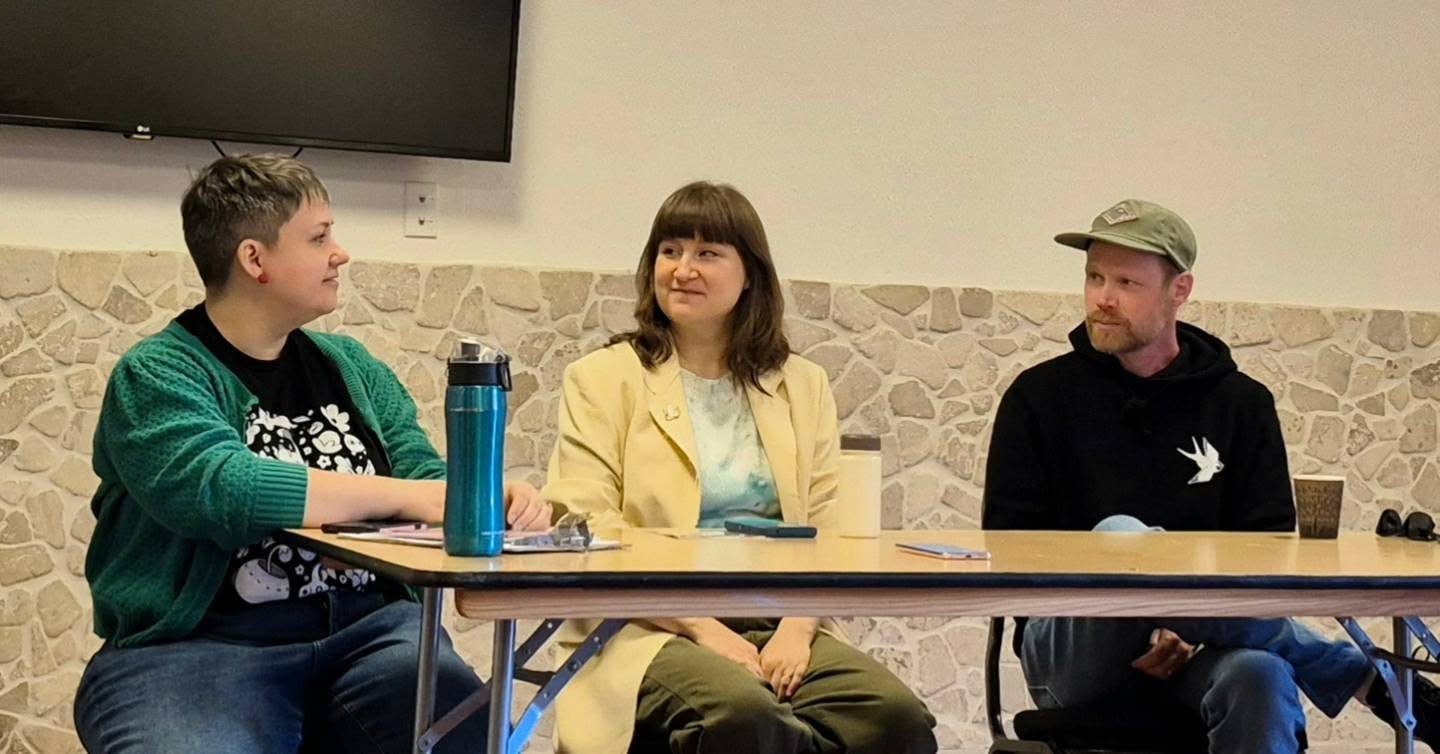
I had a great time at the local Vancouver con, Rain City Comicon where I hawked my wares, met with readers, and did a panel on the topic entitled, Making a Living with Comics. Fellow comic creator and all-around good fella, James Loyd, snapped this pic of the panel alongside the illustrious Faith Erin Hicks and Lisa LaRose. It was a great turn out with lots of great questions, and I tried not to open my trap too much because these two creators next to me brought the knowledge!
Comic Salon Erlangen 2026 in Germany
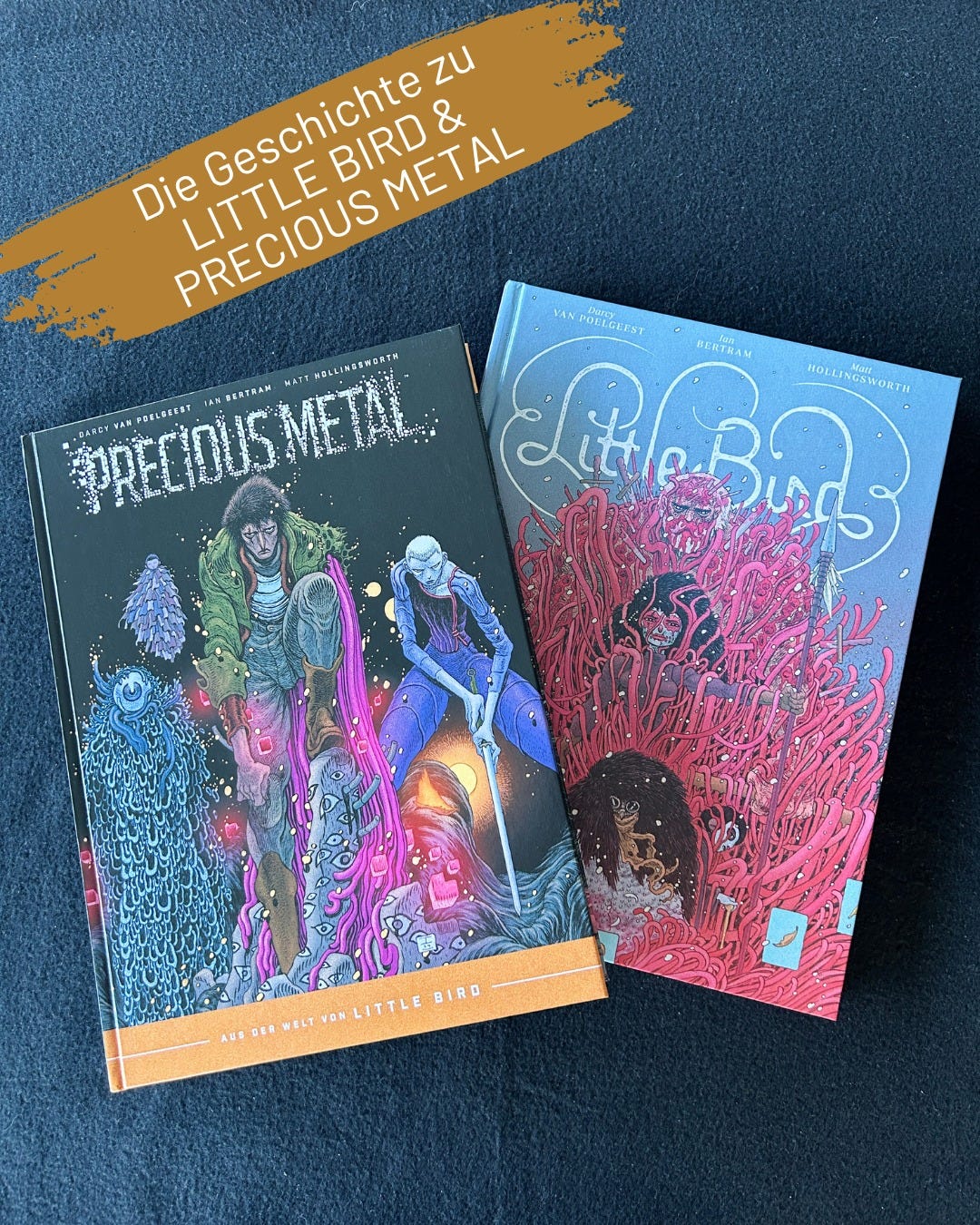
I’m big in Germany! At least that’s what I keep telling people and now I’ve got some hard evidence. I’m very excited to be headed to Germany next month as a special guest at the Comic Salon Erlangen 2026 in Germany from June 4th-7th. All of this has been arranged by my incredible publisher Cross Cult who continues to do the most beautiful German translations of my work.
Look for my signing and panel schedule at the festival in our June 1st newsletter—just in case you happen to be in the neighbourhood!
In this ongoing series called How I Make Comics, I reflect on my process and experience of making comic books in conversation with The Vanishing Word newsletter editor, Tania Reitsma. We invite you to subscribe, and share this with anyone who’s interested in following along!
In our previous Q&A, we talked about outlining—what my typical outline looks like, why I appreciate outlines, and my definition of the “perfect outline”. If you’d like to revisit that, here’s the link: Q&A #3.
This time, our topic is scripting a first draft. To give you a more complete picture, we’re breaking this down into two parts. Today we cover Part 1, the functional stuff which sets the scene for an even deeper dive into this topic next month.
In Part 1 we discuss:
The building blocks of the first draft
How the outline begins to vanish
My mindset during this stage in the comic-creation process
Let’s begin!
The Building Blocks
TR: What’s your approach to starting the first draft? How does your outline help you as you get into this stage?
DVP: Fortunately, I’m not staring into blank pages right off the bat. Quite often the scene summaries from the outline are simply copied and pasted into the actual script document exactly as they are.
So to illustrate this, let’s just quickly back it up to outlining again. Here’s what I wrote in the outline for Chapter 1, Scene 1 of Lotus Land.

From there, I start to build out the script by expanding on each of those scenes. Translating a few simple sentences from the outline into a living and breathing scene in a script is primarily done by expanding it through the language of a script, comprised of two key elements: action and dialogue. Action being the description of what we’re seeing, and dialogue being what the characters are saying and/or thinking.
My starting point is nearly always the action. I want to know how a page or scene is working visually, or how it’s paced in order to capture the mood I’m after, before committing dialogue or narration. Sometimes when a piece of dialogue or a caption is critical to a scene, I’ll add it very quickly. But most of the time I’m finding the action and the pacing of a scene before anything else.
Here are scene pages 1, 2 and 3 built out of Scene 1 of the outline you saw above.
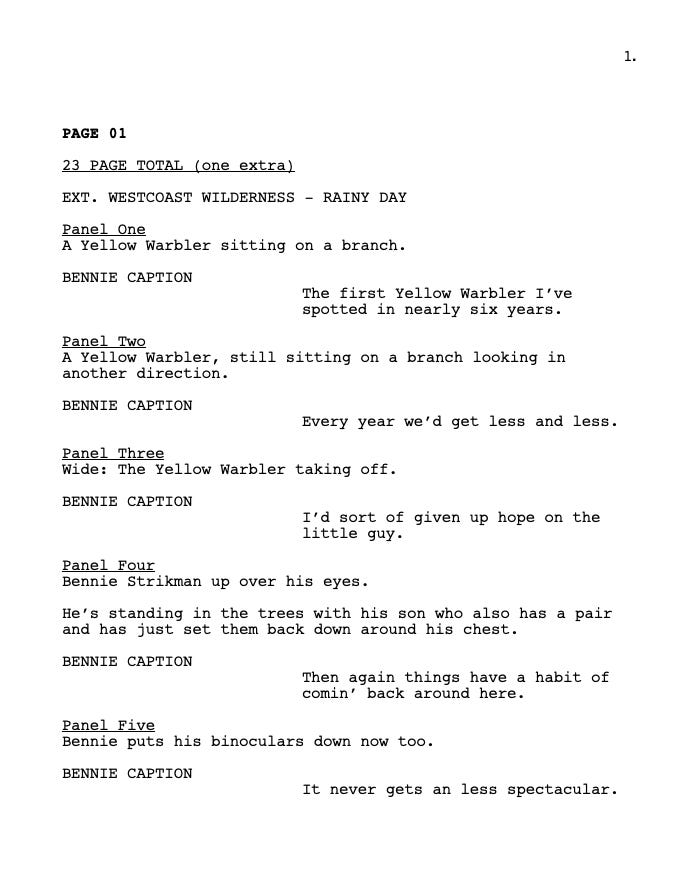
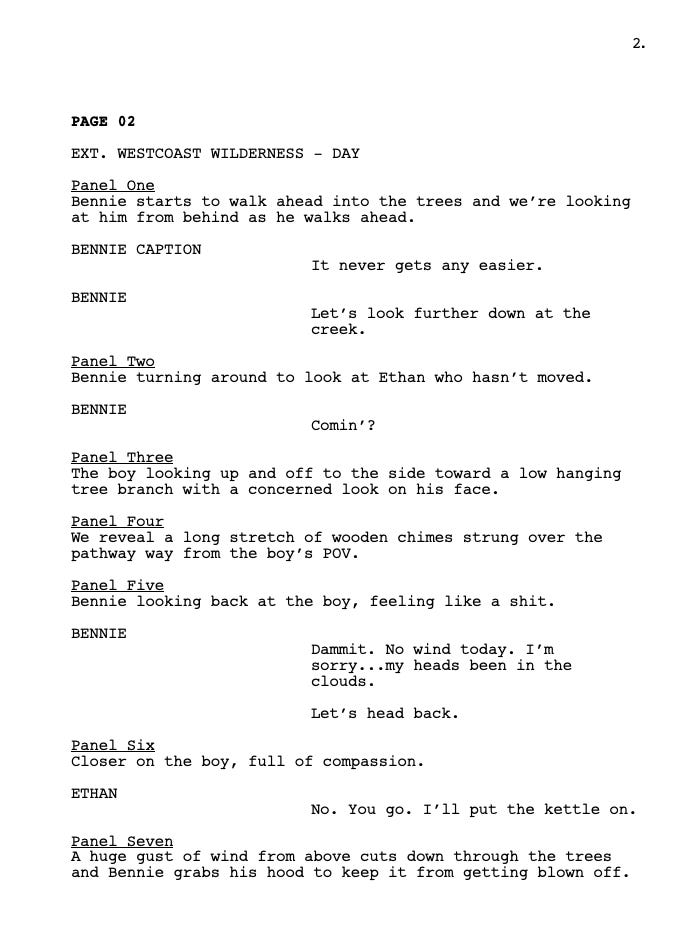
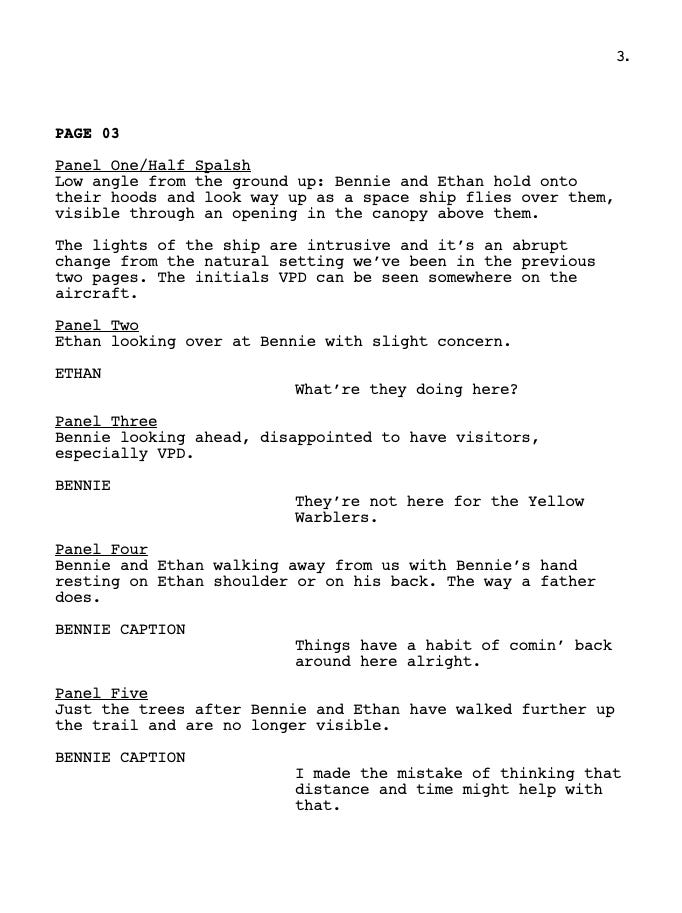
TR: I love a good set of screenshots! Super helpful, thanks! Now do you already have some of those details worked out in your head or written down in a notebook somewhere?
DVP: I fill notebooks with all kinds of random things including bits of dialogue, sketches of layouts, and of course just a whole lot of often contradictory ideas. I continue to do that through the entire process of outlining and scripting. My notebook is my safe place for anything that doesn’t immediately have a home. This is critical for me—to have a place where I can put down any random thoughts without judgment or scrutiny.
The Vanishing Outline
TR: In the beginning of this stage, the information in your outline seems to serve as the initial building blocks or the skeleton of your first draft. As you get deeper into scripting the first draft, and more details of the story get created, do you rely less on your outline?
DVP: What inevitably happens throughout the writing of a first draft, and is one indication of progress, is those page or scene summaries I copied over from the outline begin to…vanish. Over time, they become irrelevant and are deleted.
The more I flesh out a scene, the more the characters take control of the script away from me. The plot lines from the outline that once represented my story fade into the work. Some of the scenes that replace them are almost exactly the same and some of them are not recognizable in any way, shape or form.
It’s different every time. But either way, the outline itself becomes dead material as the script comes to life. This passing-on of the outline is another key indication that I’m close to the end of a first draft. So now I have a draft. It’s living and breathing but I’ve not yet reached that stage of being ready to send it off for someone else to read. I’ve got a body (the draft up to this point) that gets up and walks around and moans, occasionally bumping into walls. But I want it to sing and I want it to dance.
Stick around for Part 2 of first drafts to find out what the hell I’m talking about!
The Unease
TR: Wait…can you at least share one more thing? I know we told readers that today is about the functional stuff, but can you share a bit of how you feel up to this point before we sign off on Part 1?
DVP: Oh, this is very much the “I’ve screwed this up” phase of the writing process. I’m responding to these questions with the experience of being through it enough times to know that I’m never as doomed as I feel. Every time though, at this halfway point on a first draft—when it’s all there on paper but as this clunky zombie as described above—I’m convinced that what I set out to do won’t work.
There’s nothing logical about it but the fear and dread is pretty overwhelming at times. And the only way out is to just scroll back to the top of the script and just write my way through it. A ship in the fog, desperately searching for a shoreline.
TR: Thanks, Darcy! It truly would not be a proper DVP Q&A without hearing about your angst and self-inflicted pain in the creative journey. And I’m glad that you know you’re not doomed.
To our readers—Darcy and I will be back to discuss more on this topic, so please join us next time for Part 2. If you have any questions or comments to share about our conversations so far, go ahead and leave a comment or send an email.
TR: Okay…to pull us out of Darcy’s first draft dread, let’s change things up now with a look into our favourite comic shops.
In this month’s Comic Shop Spotlight, we’re visiting Variant Edition Graphic Novels + Comics in Edmonton, Alberta. Here’s a message from Co-owner, Brandon Schatz!
Brandon: Variant Edition is a graphic novel store whose goal is to help people find their new favourite stories. Through curating a diverse line of remarkable works, we aim to connect as many new people as possible to the comics medium. We provide a relaxed, introvert-friendly environment, where we foster an inclusive community that’s also family-friendly. We might not be the biggest, but we are the absolute best.
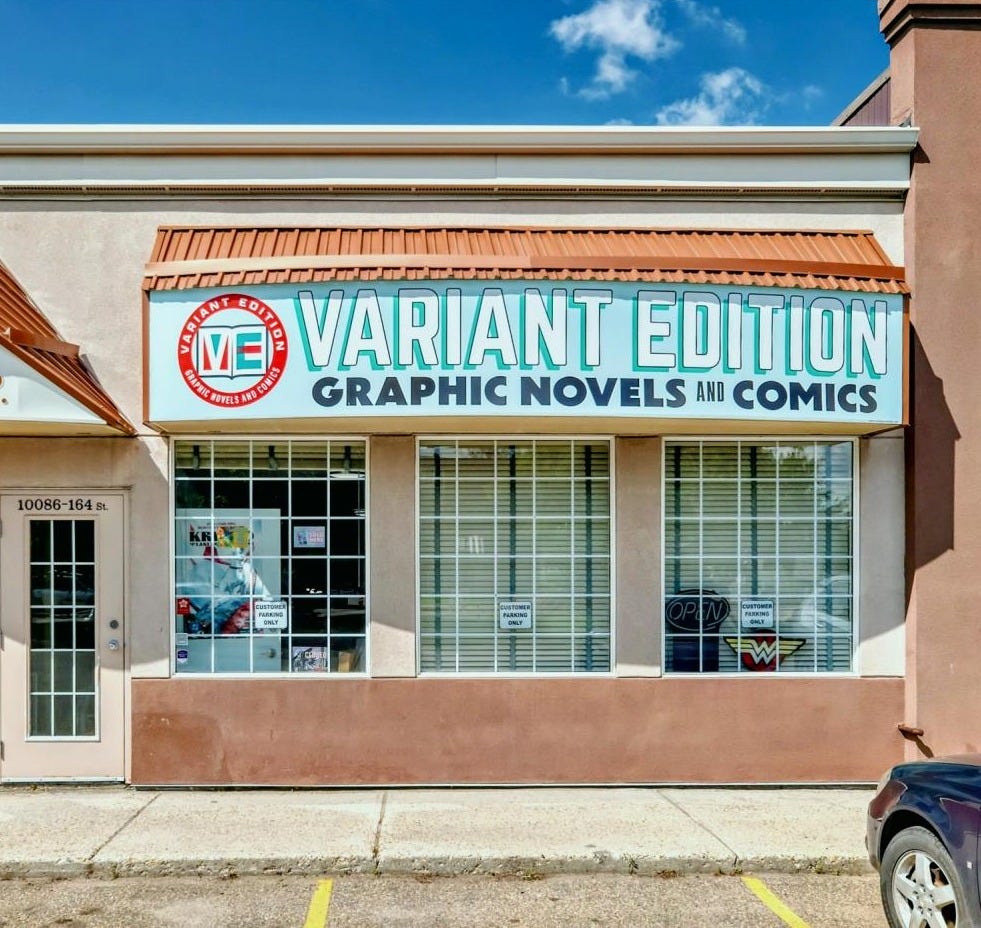
DVP: As the saying goes, comics are for everyone, and Variant Edition is living up to that promise. Variant Edition is one of those rare shops that feels like it’s doing more than selling comics—it’s on a mission to sell some really great ones. It’s not just a matter of getting cool comics in their customers’ hands (although they absolutely do that), but to expand people’s ideas around the medium as a whole—help readers look beyond superhero books and discover something new.
This is yet another retailer that helped support me with my first book and continues to get behind local Canadian talent. So, if you happen to be in the Edmonton area and you’ve never visited Variant Edition—please go! Look around at all the beautiful things and ask them for a recommendation. You won’t regret it!
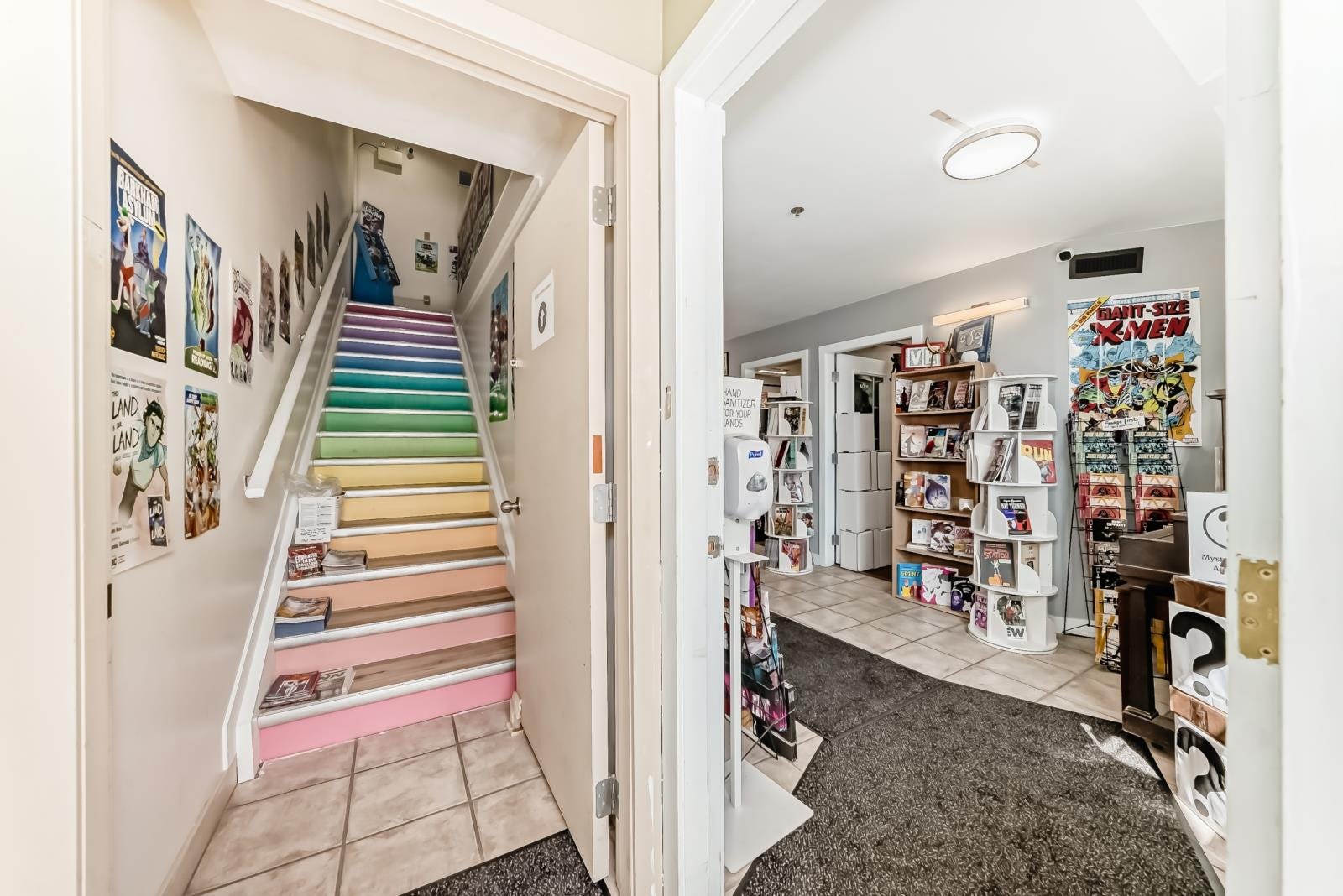
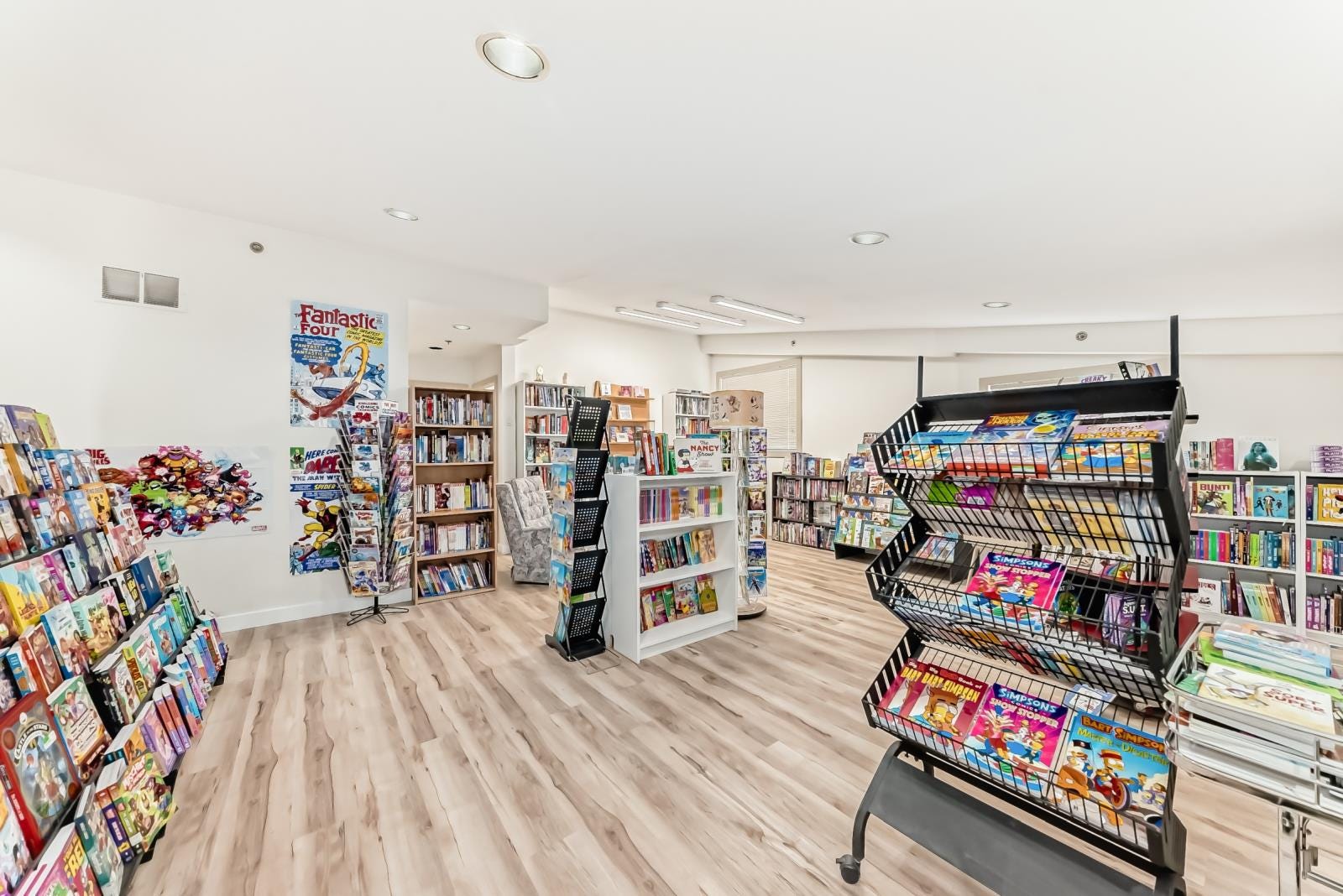
Remember to support your local comic shop whenever possible as they remain the lifeblood of this whole industry.
You can shop and learn more about Variant Edition Graphic Novels + Comics here!
Got a question or a thought to share about our discussions on The Vanishing Word? Send a reply! From time to time, we’ll share a message and answer it here!
We’ll be back next month to pick up where we left off, diving deeper into our Q&A on the making of a first draft. I hope you’ll join us!
Thank you for reading! Be kind to yourself – DVP
No posts
Comments
Nothing yet. Say the first thing.
Sign in to join the conversation.