
For more of Dante King’s writing, courses, and educational work, visit www.danteking.com. You can also follow Dante on Instagram @dantedkingofficial and TikTok @dantekingauthorofficial. Consider becoming a paid subscriber to support this work.
Paid subscribers make it possible to continue producing in-depth analysis, public scholarship, and educational content that challenges dominant narratives and advances a deeper understanding of our collective history.
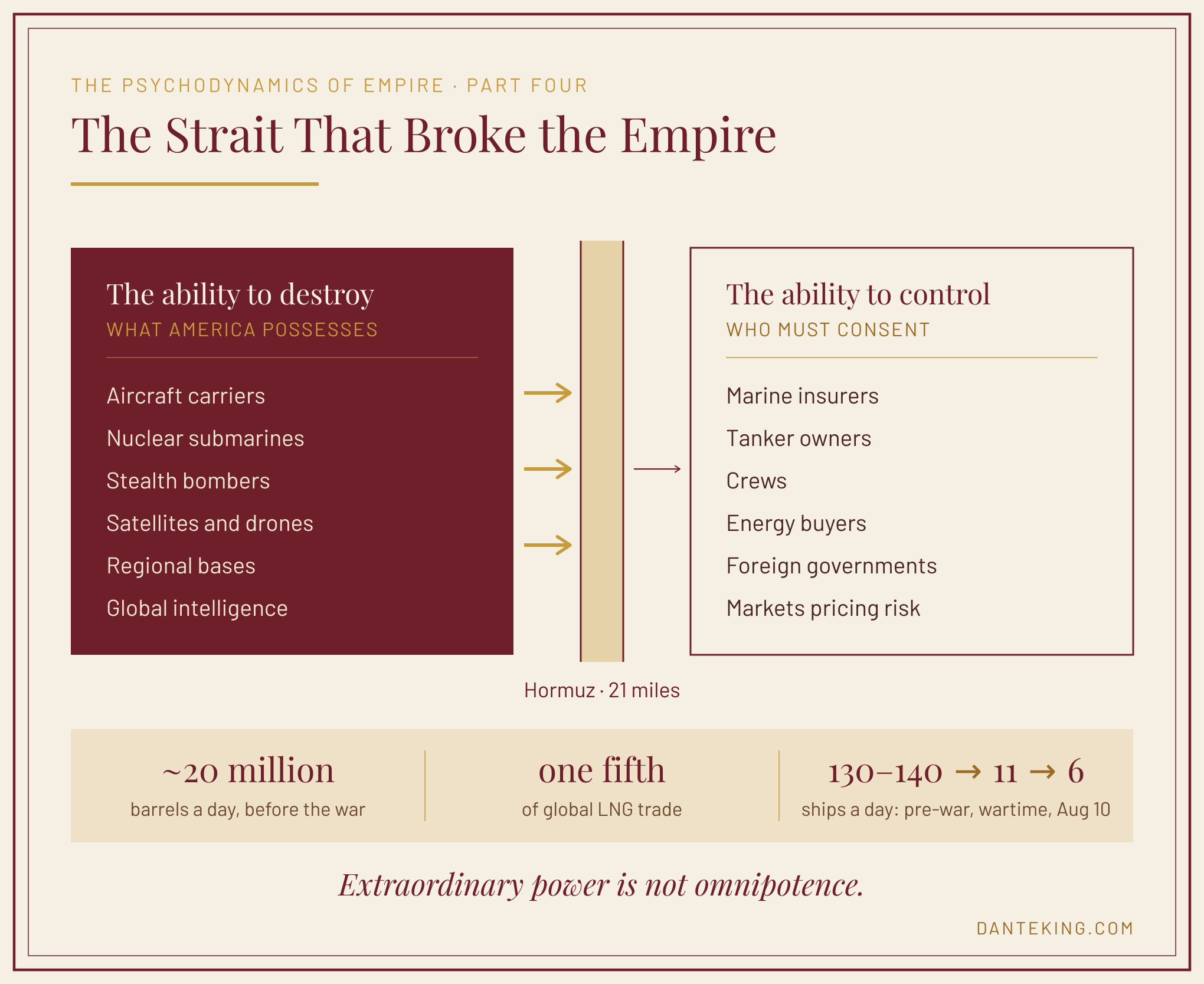
There is something profoundly revealing happening in the Strait of Hormuz.
The United States possesses the most expensive military apparatus humanity has ever constructed.
Aircraft carriers.
Nuclear submarines.
Stealth bombers.
Satellites.
Drones.
Missiles capable of striking targets thousands of miles away.
An intelligence apparatus spanning the globe.
Military installations throughout the Middle East.
And yet one narrow body of water—approximately twenty-one miles wide at its narrowest point—has exposed an uncomfortable truth:
The ability to destroy is not the same thing as the ability to control.
That distinction matters.
Because Donald Trump has built much of his political identity around the mythology of domination.
He promised strength.
He promised winning.
He promised that America’s enemies would fear us.
He repeatedly suggested that overwhelming military force could compel adversaries to submit.
Iran has now confronted that mythology with geography.
And geography does not care about political branding.
Before the current war, roughly twenty million barrels per day of crude oil and petroleum products routinely moved through the Strait of Hormuz. About one-fifth of global liquefied natural gas trade also passed through it.
The U.S. Energy Information Administration has called Hormuz the world’s most important oil transit chokepoint.
There is a reason.
Saudi Arabia.
The United Arab Emirates.
Kuwait.
Iraq.
Qatar.
Iran.
Much of the energy exported from the Persian Gulf must pass through this tiny maritime corridor before reaching the rest of the world.
There are pipelines capable of bypassing some of it.
But there is no easy substitute for Hormuz.
That makes the strait more than geography.
It is leverage.
And leverage is power.
This is where the psychology becomes fascinating.
American political culture has been trained to understand power primarily through domination.
Who has the largest military?
Who possesses the most weapons?
Who can destroy the most targets?
Who can project force the farthest?
By those measures, the United States remains extraordinarily powerful.
But power has never been one-dimensional.
A farmer controls food.
A worker controls labor.
A debtor may possess leverage over a creditor who cannot afford the debtor’s collapse.
A geographically positioned nation may control access to something vastly more valuable than its military budget would suggest.
And a relatively narrow waterway can constrain a superpower.
This is precisely what Hormuz has demonstrated.
Before the war, approximately 130 to 140 ships reportedly passed through the strait each day. Earlier this month, Reuters reported traffic falling on one day to six vessels.
Six.
The United States has not lost its aircraft carriers.
It has not lost its missiles.
It has not lost its military bases.
It has encountered something more psychologically destabilizing:
the limits of what those things can accomplish.
America can bomb Iran.
It cannot bomb away the Strait of Hormuz.
It can destroy military installations.
It cannot redesign the Persian Gulf.
It can threaten ships.
It cannot manufacture an alternative maritime geography.
It can destroy bridges.
It cannot force commercial insurers to decide that shipping through a war zone is safe.
It can escort tankers.
It cannot guarantee that every tanker owner, energy company, crew, insurer, and government will accept the risk.
That distinction is enormous.
And it helps explain why Trump’s rhetoric has become increasingly grandiose as the strategic problem has become increasingly difficult.
When material control diminishes, rhetorical control intensifies.
That is not unusual.
It is psychologically predictable.
Dr. Frances Cress Welsing described white supremacy as a compensatory behavioral system operating through economics, education, entertainment, labor, law, politics, religion, sex, and war.
The key word is compensatory.
When actual control becomes uncertain, the performance of control becomes more important.
When dominance is challenged, dominance must be demonstrated.
When superiority becomes questionable, superiority must be announced more loudly.
This is why I believe Hormuz must be analyzed psychologically as well as geopolitically.
The United States is confronting something its imperial identity has historically struggled to tolerate:
a limit.
And limits are psychologically intolerable to systems organized around omnipotence.
Trump’s rhetoric has recently gone even further.
He has publicly suggested that after defeating Iran, the United States could declare the Strait of Hormuz American territory.
Think about the psychology embedded in that proposition.
A strategic waterway thousands of miles from the continental United States becomes difficult for America to control.
The response?
Perhaps America should own it.
That is not merely geopolitical bravado.
That is colonial imagination.
When another people’s geography frustrates imperial objectives, the imperial mind imagines possession as the solution.
The proposition belongs to an ancient tradition:
If the land contains something we require, our need becomes a justification for authority over it.
Europe used this logic across Africa.
Across Asia.
Across the Americas.
Across the Caribbean.
Indigenous land became European land.
African labor became European property.
Natural resources became imperial commodities.
Trade routes became imperial possessions.
Trump’s fantasy regarding Hormuz therefore does not emerge from nowhere.
It emerges from a political imagination centuries in development.
Dr. Amos Wilson’s analysis of power is especially useful here.
Power is not merely possession.
It is the capacity to produce outcomes.
You may possess extraordinary resources and still fail to produce the outcome you desire.
That is the distinction America repeatedly avoids.
The United States possessed overwhelming military superiority in Vietnam.
It left Vietnam.
The United States possessed overwhelming military superiority in Afghanistan.
Twenty years later, the Taliban returned to power.
Military superiority and political control are not synonyms.
Iran does not need a military larger than America’s.
It does not need more aircraft carriers.
It does not need a larger defense budget.
It merely needs enough capability to make the cost of American objectives unacceptable.
That is asymmetrical power.
And empires routinely underestimate it because imperial psychology encourages them to measure opponents using their own definitions of strength.
Frantz Fanon understood that colonial systems construct themselves around an illusion of permanence.
The colonizer appears omnipotent because the institutional order has been constructed to make domination appear natural.
But the illusion lasts only while the colonized accept the terms upon which power is measured.
Once resistance begins, something psychologically devastating occurs.
The colonizer discovers that authority and obedience are not the same thing.
You can possess authority and still encounter refusal.
You can possess weapons and still encounter resistance.
You can possess wealth and still encounter leverage.
You can possess military superiority and still fail to control outcomes.
This is the humiliation at the center of the colonial encounter.
The supposedly omnipotent discovers dependency.
There is another irony here.
For generations, the United States helped construct a global economic system built around interconnected markets.
Oil.
Shipping.
Banking.
Insurance.
Trade.
Supply chains.
International finance.
That system helped produce extraordinary American wealth.
But interdependence works both ways.
If approximately one-fifth of the world’s energy trade must navigate a geographically constrained region, disruption there does not remain there.
It moves.
Into gasoline prices.
Airline tickets.
Shipping costs.
Manufacturing.
Food prices.
Inflation.
Household budgets.
Political approval ratings.
In April, amid disruption through Hormuz, Brent crude briefly reached approximately $118 per barrel.
This is what empire often forgets:
The systems through which it exercises power also create dependencies.
Globalization did not eliminate geography.
It magnified it.
This is where Dr. Bobby Wright’s work becomes particularly important.
What happens when a system encounters evidence that its behavior is failing?
A psychologically healthy system reassesses.
What assumptions were wrong?
What strategy failed?
What information was ignored?
What needs to change?
A pathological system does something different.
It projects.
It blames.
It escalates.
It punishes.
It doubles down.
Instead of asking whether the strategy itself produced the crisis, it interprets resistance as evidence that greater force is required.
This is precisely the danger of malignant power.
Failure does not produce reflection.
Failure produces escalation.

This may be the most important point.
Iran does not have to defeat the United States militarily.
That framing itself reflects American assumptions.
Iran merely has to prevent America from achieving its objectives at an acceptable cost.
Those are entirely different propositions.
This is how asymmetric conflicts work.
A materially weaker power does not defeat an empire by becoming the empire.
It changes the price of domination.
That price may be measured in casualties.
Money.
Oil.
Inflation.
Political instability.
International legitimacy.
Military exhaustion.
Time.
Or uncertainty.
Empires possess enormous resources.
But they rarely possess unlimited patience.
Hormuz is therefore more than a battlefield.
It is a mirror.
America looks into it and sees something it does not want to see.
Dependency.
Limitation.
Vulnerability.
Interconnection.
The impossibility of controlling every outcome.
Those realities conflict with the mythology of American exceptionalism.
We are supposed to dominate.
We are supposed to dictate terms.
We are supposed to possess escalation dominance.
We are supposed to determine when wars begin and when they end.
But Iran has demonstrated that another nation can possess leverage capable of disrupting America’s preferred timeline.
That is precisely why this moment matters.
Donald Trump interprets almost every human interaction through dominance.
Someone wins.
Someone loses.
Someone submits.
Someone controls.
Someone is humiliated.
This worldview may occasionally produce leverage in transactional negotiations.
It is extraordinarily dangerous when governing international relations.
Nations have memory.
They have constituencies.
They have pride.
They have geography.
They have allies.
They have internal politics.
They have interests that cannot simply be bullied away.
Diplomacy exists precisely because sustainable international relationships cannot be constructed entirely through domination.
Yet Trump repeatedly treats diplomacy as though it were a real-estate negotiation in which one party must leave the room humiliated.
That may produce a headline.
It does not necessarily produce peace.
Perhaps this is the deeper pathology.
American empire has historically struggled with refusal.
Indigenous nations refused removal.
They were attacked.
Enslaved Africans refused enslavement.
They were terrorized.
Colonized populations refused American domination.
They were described as insurgents.
Countries reject American geopolitical demands.
They become threats.
The specific histories differ enormously, and they should not be collapsed into one another.
But the recurring psychological question deserves examination:
What happens when America is told no?
Too often, the answer has been:
Punishment.
Sanctions.
Isolation.
Destabilization.
Intervention.
War.
The assumption underneath each is remarkably similar.
America possesses the right to establish the terms.
Resistance becomes the offense.
Twenty-one miles of water have challenged the mythology of limitless American power.
Not because America suddenly became powerless.
It has not.
The United States remains extraordinarily powerful.
But extraordinary power is not omnipotence.
That distinction may be the most important lesson of this war.
America can destroy Iran.
Iran can impose extraordinary costs upon America and the global economy.
Both statements can simultaneously be true.
That is what mature leadership must understand.
The purpose of diplomacy is not surrender.
It is recognizing reality before reality imposes itself through catastrophe.
The Strait of Hormuz has not broken America.
It has broken an illusion.
The illusion that enough military power eliminates vulnerability.
The illusion that domination produces obedience.
The illusion that economic interdependence only benefits the empire.
The illusion that smaller nations possess no meaningful leverage against larger ones.
And perhaps most importantly:
The illusion that possessing the ability to destroy something means possessing the ability to control what happens afterward.
This is where the psychodynamics of empire become dangerous.
Because an empire confronted with its limits has two choices.
It can develop maturity.
Or it can escalate.
It can recognize interdependence.
Or it can seek greater domination.
It can negotiate.
Or it can destroy.
It can redefine strength as the capacity to achieve sustainable outcomes.
Or it can continue defining strength as the capacity to inflict pain.
Donald Trump appears committed to the latter.
And that is precisely why the Strait of Hormuz matters.
The Strait has exposed something that bombs cannot repair.
Something aircraft carriers cannot intimidate.
Something presidential declarations cannot erase.
America is powerful.
America is not omnipotent.
A psychologically healthy nation would understand the difference.
The question before us is whether this one can.
To learn more about Dante King’s books, educational resources, online video courses, and upcoming events, please visit:
www.danteking.com
You can also follow Dante’s work and commentary on social media:
Instagram: @dantedkingofficial
TikTok: @dantekingauthorofficial
If this article resonated with you, please consider becoming a paid subscriber. Your support helps sustain the research, writing, and educational work dedicated to examining the historical and psychological foundations of anti-Blackness, racism, and white supremacy in American culture and institutions.
Paid subscribers make it possible to continue producing in-depth analysis, public scholarship, and educational content that challenges dominant narratives and advances a deeper understanding of our collective history.
Thank you for reading, engaging, and supporting this work.
Thanks for reading! This post is public so feel free to share it.
No posts
Comments
Nothing yet. Say the first thing.
Sign in to join the conversation.