

I was 35 miles into a half-century ride last week when that inevitable numbing, nagging pain worked its way from the backside to the brain.
I hurt, just as I knew it would.
Loyal readers know I intend to ride the Seattle to Portland Bicycle Classic (STP) in mid-July, the 206-mile roll south across Washington State to the Columbia River. That’s two days of pedaling, something I have never attempted.
I had a plan to train my mind for the monotony and my behind for the many hours of pressure on my ischial tuberosities, the bones that absorb weight while perched atop the saddle. The sit bones.
Please share this article with your cycling friends.
Find more than 70 posts in the complete “Why We Ride” destination cycling guide here.
My training began in mid-April during a California cycling trip, but it came to an abrupt halt on April 18 when I broke my right hand in a freak bike accident. Surgery followed. With my doctor’s permission and an admonition — “just don’t fall” — I returned to the bike earlier this month. I tested the hand with a 30-mile spin outside Baker City, Oregon, and all was well.
I was optimistic two days later when I joined Bike Rides Northwest in Walla Walla, Wash., for the start of its five-day Bike Camp Walla Walla event. The hand survived unscathed but the sit bones sent a different message: Stop it. Stop it now!
I now have four weeks to prepare for long days on the saddle. I’m increasing my time on the bike, riding on back-to-back days, and using chamois cream to reduce friction. I’ve been wearing Castelli’s Cento bibs for two years and recently added a pair of Endurance 4 shorts for thicker padding.
The thicker the better, I thought. In fact, I want padding like the pros wear.
Curiosity taking hold, I wanted to understand the difference between my two pairs of shorts. I met with Steve Chapin, general manager for Castelli Cycling US, in his Portland office, and he distilled it all down for me with this revelation: Professional cyclists such as the Soudal Quick-Step World Tour team, wear the same padding I do.
“We have gender-specific pads, but we have 2 road pads and a tri pad (for triathletes),” Steve says. “The KISS pad and the Progetto X2 Air Seamless, which I describe as more plush with more padding. That being said, we don’t distinguish between better and worse.”
He points to the world tour team. “(The riders) are about 50/50 in terms of which pads they prefer,” he said. “Some like a thicker pad and some like a less-thick pad, so they’re both designed to perform and be extremely comfortable. It’s just a question of do you like a little bit more padding?”
The Right Fit
Let’s review the basic principles.
- Bib shorts, bike pants with suspender-like straps, can be evaluated in two parts. There are the Lycra or Spandex pants and the padding, or chamois, which is stitched inside. For this conversation, I am focusing on the chamois.
- Different chamois have different thicknesses, of course, but the basic concept is the same. The fabric closest to the skin is designed to wick moisture and feel soft against the body. The padding provides more cushion while sitting on the bike and, at the same time, reduces friction and chafing.
- Chamois designed for high-mileage rides may include gel or gel-foam inserts. Gel is thinner and denser than foam and therefore provides more support in less space.
- Fit is everything. If the shorts are too big, the chamois will move and chafe.
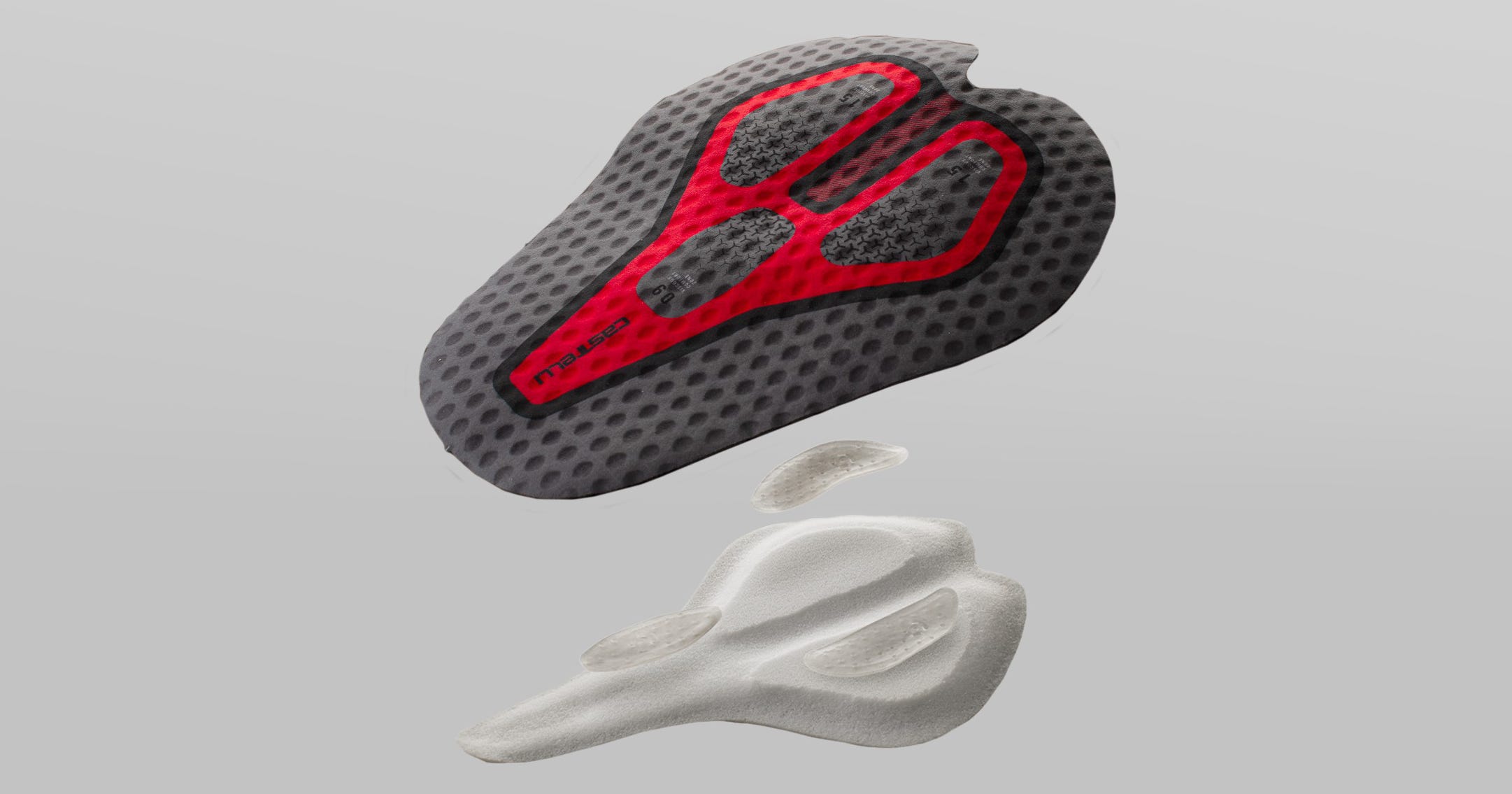
Looking at a diagram, Steve explained the Progetto X2 construction. “This is the skin layer,” he said, pointing to the black-and-red moisture wicking surface fabric. “The idea here is two-fold. It’s supposed to be as comfortable as possible in contact with the skin, and it also manages moisture. We want it to be breathable.”Gel inserts are placed within foam padding to provide added comfort whether “you’re going for 30-minute or a 30-hour bike ride,” he said. “Those gels go directly underneath your sit bones and then right in the perineum to give you a little bit more comfort where you need comfort. The idea is to not unnecessary overbuild the pad.”
Throughout his explanation, Steve talks about performance, but I remind him that I am not a pro cyclist. I’m not svelte. I’m not aero.
“No, absolutely, and that’s how you define performance,” he said. “A single discipline like aerodynamics is incredibly important for some folks and incredibly important for our racers and our teams, but you’re not as concerned with aerodynamics. There are still aspects of comfort in performance. How do we create a product that has the right amount of stretch that’s still fitting given a variety of body shapes and sizes? How do we create a product that has the best moisture management capability? So, whether you’re going 13 miles an hour or 26 miles an hour, it can still work for you.”
I like my Progetto X2 chamois. And as I add more and more miles, I feel the saddle pressure less and less. With STP less than a month away, I’m growing confident I’ll sit through 206 miles.

Dan Shryock is a travel writer and career journalist who focuses on cycle tourism. Based in Oregon, his work has appeared in magazines and websites in California and the Pacific Northwest. His book, “Cycling Across Oregon: Stories, Surprises & Revelations Along the State’s Scenic Bikeways” is available on Amazon.
Comments
Nothing yet. Say the first thing.
Sign in to join the conversation.