
Research update: The original Algevity® ingredient presentation listed its human clinical trial as submitted. That study has since been published in the journal Nutrients in July 2026.
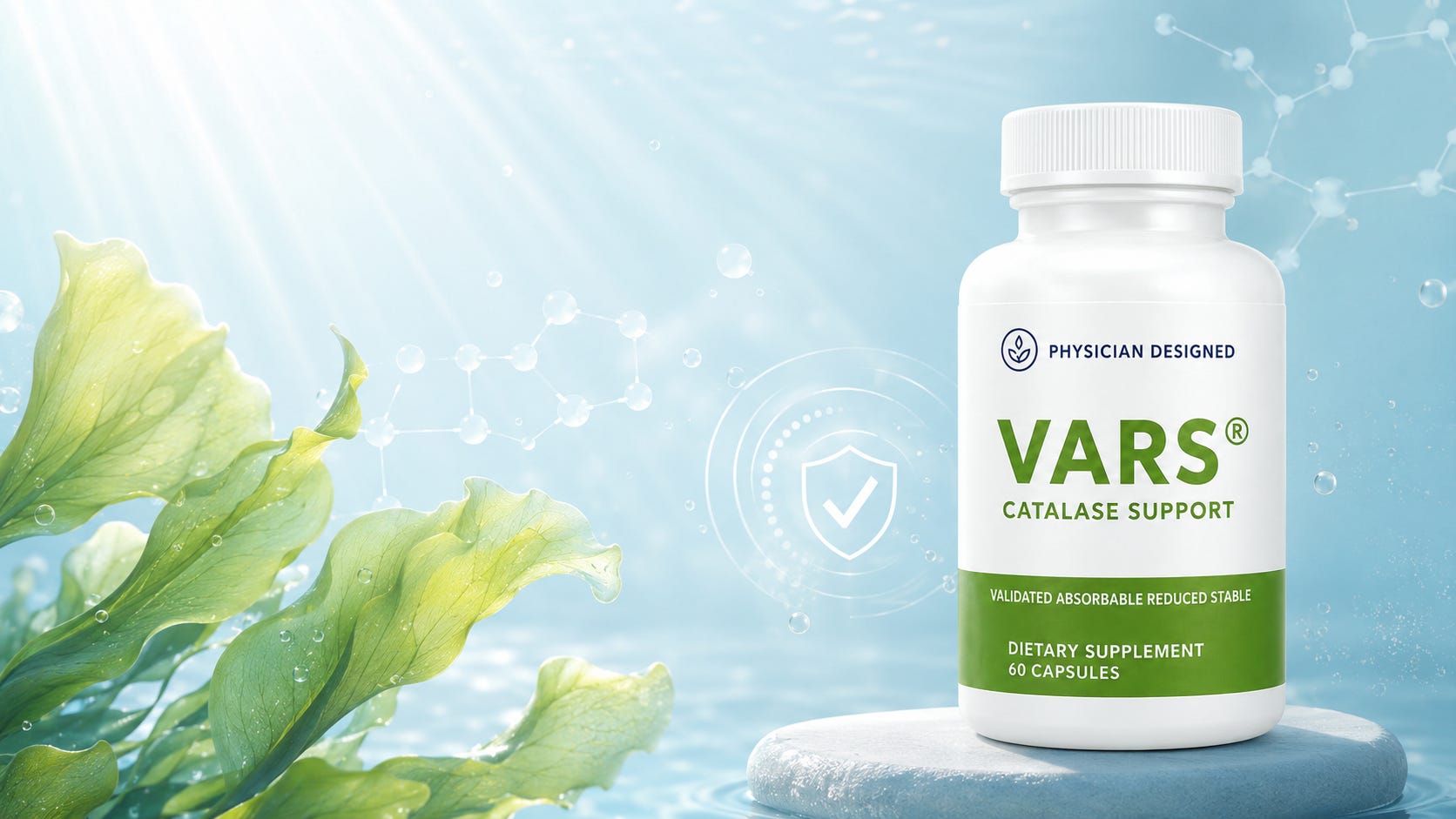
Most people have heard about glutathione. Far fewer have heard about catalase, even though catalase performs one of the most important cleanup jobs in the body’s antioxidant defense system.
Every day, our cells produce reactive oxygen species as a natural part of energy production, exercise, immune activity, and normal metabolism. Environmental exposures, illness, poor sleep, stress, and other challenges can add to this burden.
One of the reactive molecules the body must manage is hydrogen peroxide. In controlled amounts, hydrogen peroxide participates in normal cellular signaling. When it accumulates faster than the body can neutralize it, however, it can contribute to oxidative stress.
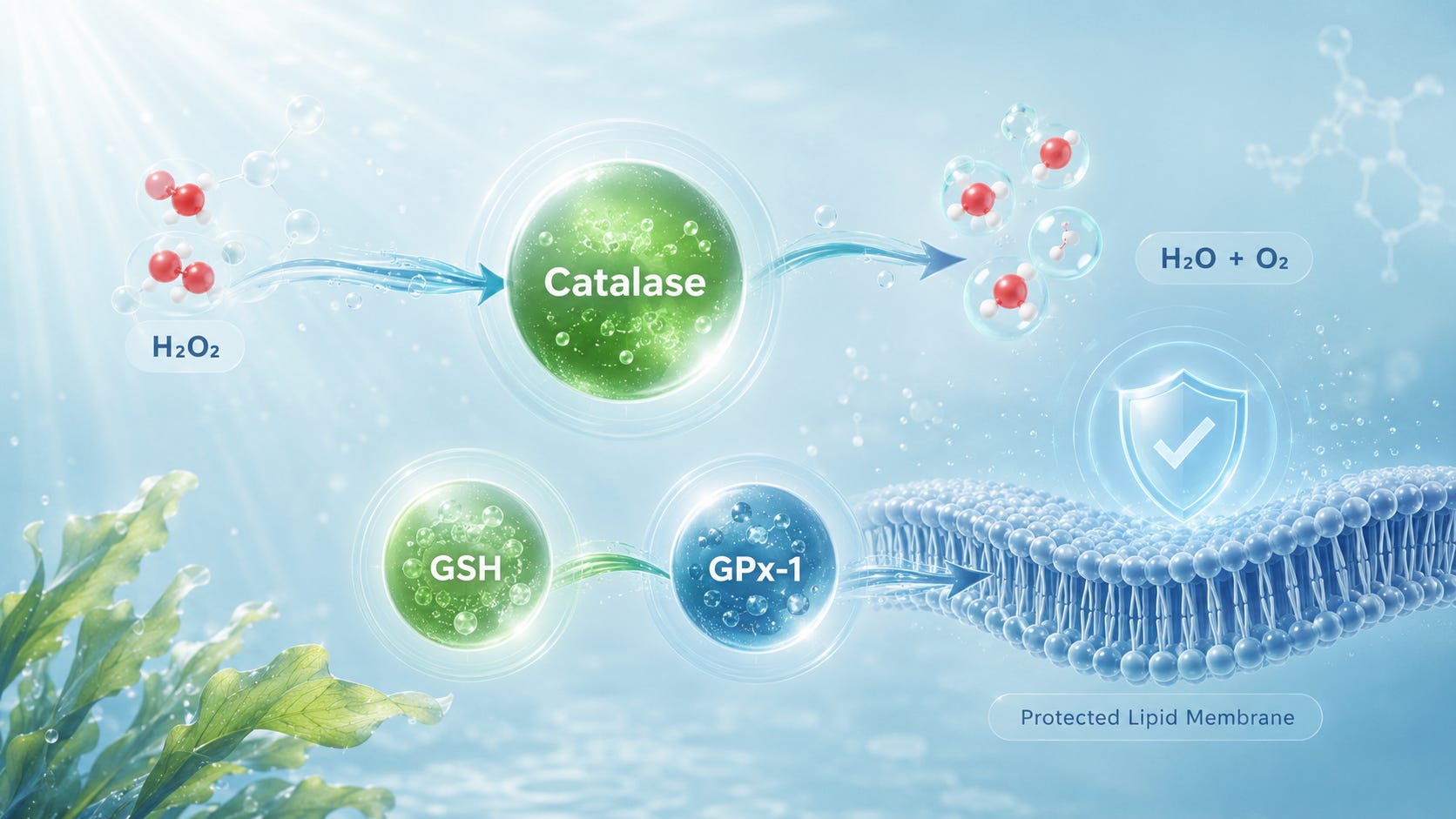
Catalase helps protect against that buildup by breaking hydrogen peroxide down into water and oxygen.
That is one reason we believe catalase deserves far more attention.
It is also why the main ingredient in VARS® Catalase is Algevity®, a clinically studied extract derived from Ulva lactuca, commonly known as sea lettuce.
Antioxidant protection is not the work of one vitamin, one nutrient, or one molecule.
It is a coordinated network.
Glutathione, glutathione peroxidase, catalase, superoxide dismutase, thioredoxin, and other protective systems work together to help cells manage oxidative stress. When one part of that network is under strain, the entire system may become less efficient.
For example, glutathione peroxidase-1, or GPx-1, uses glutathione as part of the process of reducing hydrogen peroxide and lipid peroxides. Catalase provides another route for breaking down hydrogen peroxide. Together, these systems help protect cell membranes, proteins, mitochondria, and other cellular structures from oxidative damage.
This is the philosophy behind the VARS® antioxidant family. Instead of treating antioxidant defense as a single pathway, we look at the larger network.
VARS® Glutathione supports glutathione status. VARS® SOD Booster supports another major antioxidant enzyme. VARS® Catalase was developed to help complete that cellular-defense conversation.
Algevity® begins with Ulva lactuca, a fast-growing green macroalga that has been consumed as a marine vegetable in coastal regions of Asia, Africa, and Europe.
Unlike plants grown in relatively stable terrestrial environments, Ulva lactuca must survive changing salinity, intense ultraviolet exposure, temperature shifts, and continuous oxidative pressure. To survive these conditions, it has evolved its own sophisticated protective chemistry.
The algae contains polyphenols, sulfated polysaccharides known as ulvans, minerals, antioxidant compounds, and unusual lipid-based signaling molecules. Its ingredient profile is distinct from that of more familiar brown and red seaweeds.
That natural resilience caught the attention of marine natural-product researchers.
A structured discovery program evaluated 30 marine algae species in cell-based assays to determine how effectively they activated Nrf2, one of the body’s central cellular-defense pathways. Candidates were ranked by the strength and reproducibility of that activation. According to the ingredient research dossier, Ulva lactuca stood out, and subsequent in vivo work demonstrated induction of Nqo1, a downstream marker of Nrf2 activity, across multiple tissues.
The foundational peer-reviewed research, published in Free Radical Biology and Medicine in 2013, identified extracts and unsaturated fatty acid constituents from Ulva lactuca as activators of the protective Nrf2-ARE pathway.
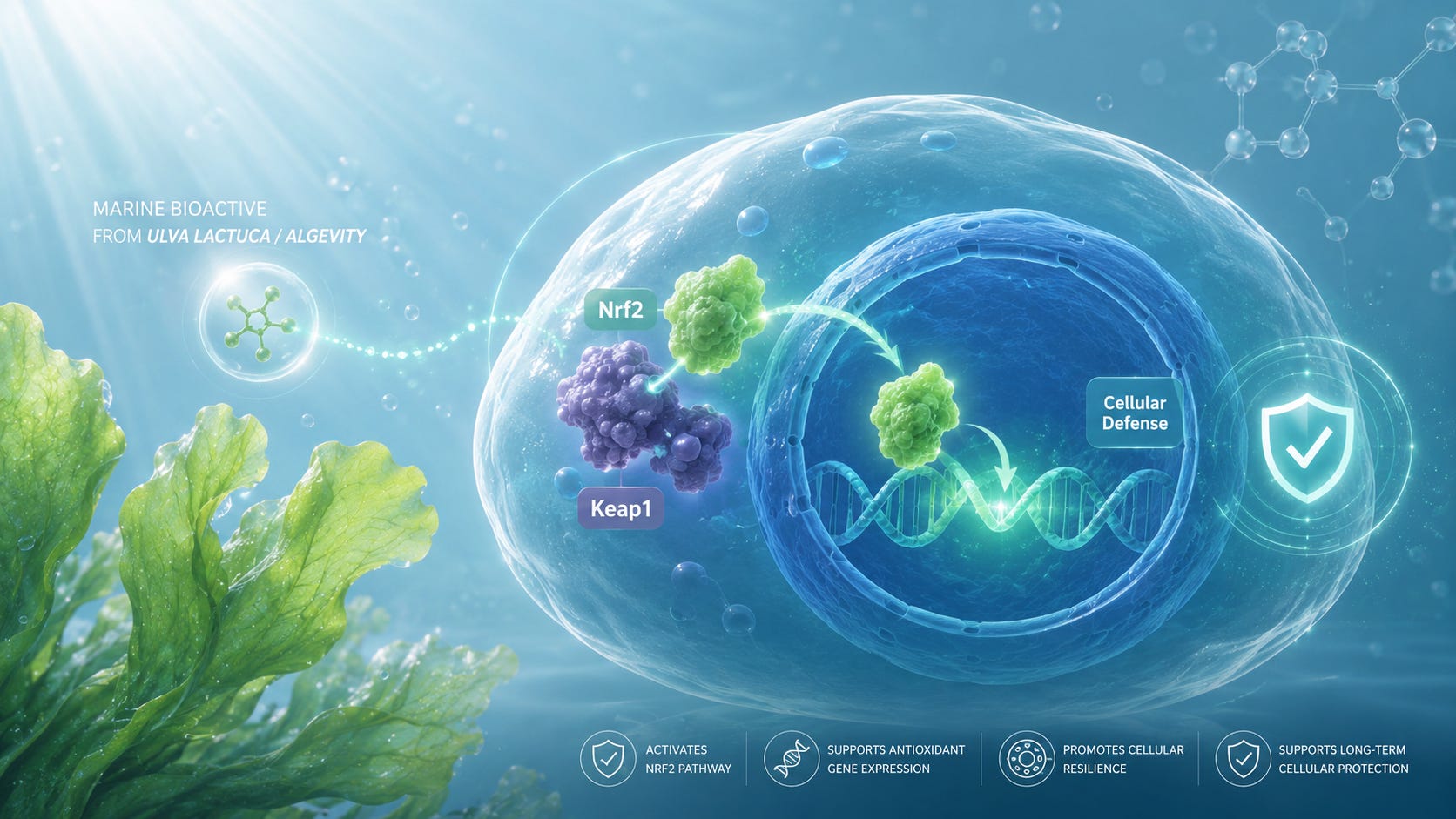
Nrf2 is sometimes described as a master regulator of the cellular stress response.
Under ordinary conditions, a protein called Keap1 helps keep Nrf2 under control. When cells encounter certain stress signals or protective electrophilic compounds, that relationship changes. Nrf2 can then become stabilized, move into the nucleus, and help activate genes involved in antioxidant protection, redox balance, and cellular defense.
The Ulva lactuca research identified specialized keto-unsaturated fatty acid derivatives associated with this signaling activity. The published Algevity® trial describes the extract as containing lipid constituents previously identified as Nrf2-ARE activators.
The ingredient dossier also describes Nrf2-associated activation of protective genes such as NQO1, HMOX1, GCLC, GCLM, and members of the glutathione S-transferase family. At the same time, transcriptomic research suggested an opposing effect on inflammatory signaling associated with NF-κB.
A later peer-reviewed marine fatty-acid study further demonstrated how a related marine keto-fatty acid could target the Keap1/Nrf2 pathway while influencing inflammatory activity. This later study was mechanistic research on a related marine compound, not a clinical study of the finished VARS® Catalase product.
In simple terms, Algevity® is not being studied merely as an antioxidant that neutralizes one free radical at a time. It is being investigated for its ability to signal the body’s own protective systems.
That is a very different approach.
Algevity® is a proprietary, standardized extract. It should not be confused with ordinary seaweed powder.
The ingredient is produced from wild-type Ulva lactuca using supercritical carbon dioxide extraction. The ingredient dossier describes a process that includes wild harvesting, natural drying, low-temperature extraction, traceable sourcing, controlled processing, and efforts to preserve the plant’s bioactive constituents.
The published clinical paper reports that the investigational Algevity® material was independently analyzed and contained polysaccharides, lipids, and specific keto-unsaturated fatty acid derivatives previously associated with Nrf2-ARE activation.
This standardization matters. A clinical study on a particular extract does not automatically validate every seaweed powder or every Ulva lactuca supplement.
The most exciting development is that Algevity® has now moved beyond laboratory and animal research into a controlled human trial.
The study was randomized, double-blind, and placebo-controlled. Twenty healthy adults were enrolled, with an average age of approximately 30 years. Participants received either:
300 milligrams of Algevity® once daily
or
a matched placebo once daily
The intervention lasted for 28 days.
Researchers measured blood biomarkers related to antioxidant defense and oxidative stress, including reduced glutathione, GPx-1, catalase, malondialdehyde, and thioredoxin. They also measured inflammatory and regulatory markers, including CRP, IL-6, IL-1β, IL-11, and PPAR-γ.
The published paper describes the trial as a short-duration pilot study and reports that the extract was well tolerated. The investigators also emphasized that larger and longer studies are still needed.
The ingredient research summary reports coordinated changes across both antioxidant and inflammatory biomarkers.
After 28 days, the Algevity® group showed the following changes from its starting measurements:
Reduced glutathione increased by 40%.
Glutathione peroxidase-1 increased by 15%.
Catalase activity increased by 13%.
Malondialdehyde decreased by 18%.
Circulating thioredoxin decreased by 13%.
Glutathione and GPx-1 work closely together in the body’s endogenous antioxidant system. Malondialdehyde, commonly abbreviated as MDA, is used as a marker of lipid peroxidation and oxidative damage. The investigators interpreted the lower circulating thioredoxin measurement as another indication of a reduced oxidative-stress burden.
The Algevity® group also demonstrated changes in several inflammatory and regulatory markers:
IL-6 decreased by 19%.
IL-1β decreased by 17%.
IL-11 decreased by 7%.
C-reactive protein decreased by 20%.
PPAR-γ increased by 15%.
IL-6 and IL-1β are important immune-signaling proteins that can rise during inflammatory activity. C-reactive protein is a broader marker of systemic inflammation. PPAR-γ participates in metabolic and inflammatory regulation.
The overall study summary presents these findings as coordinated modulation of oxidative stress and inflammatory balance.
The most compelling part of the research is not one isolated percentage.
It is the pattern.
The study did not report a change in only one antioxidant marker. It reported movement across glutathione, GPx-1, catalase, MDA, and thioredoxin.
It did not report movement in only one inflammatory marker. It reported changes across IL-6, IL-1β, IL-11, CRP, and PPAR-γ.
That coordinated direction is consistent with the idea that Algevity® may be influencing a broader cellular-defense network. It appears to be supporting the systems that help cells respond to oxidative and inflammatory pressure, rather than acting as a simple one-target antioxidant.
This is still an early interpretation, but it is an important one.
The body works through networks. The most valuable nutritional strategies may be the ones that respect those networks.
At Purser Wellness, we are interested in more than the amount of an ingredient printed on a label.
We want to understand what that ingredient does inside the body.
Does it support the body’s own enzymes?
Does it work through a meaningful cellular pathway?
Does it complement the other parts of the antioxidant-defense system?
Has it been studied in humans?
Algevity® stood out because its research connects marine bioactives, Nrf2 signaling, glutathione, GPx-1, catalase, oxidative-stress markers, and inflammatory balance.
That makes it a natural fit for VARS® Catalase and for our larger VARS® antioxidant philosophy.
VARS® Glutathione, VARS® SOD Booster, and VARS® Catalase are not intended to be three copies of the same antioxidant. Each is designed to support a different part of the body’s interconnected cellular-defense network.
The newly published Algevity® research strengthens the scientific rationale for that approach.
Algevity® represents a fascinating meeting point between marine biology and human cellular defense.
It began with the discovery that Ulva lactuca contains unusual natural compounds capable of activating the Nrf2-ARE pathway. It progressed through preclinical research demonstrating antioxidant and inflammatory signaling activity. It has now reached a randomized, double-blind, placebo-controlled human trial showing meaningful movement across multiple biomarkers.
The strongest findings included:
A 40% increase in reduced glutathione
An 18% reduction in MDA
A 13% reduction in circulating thioredoxin
A 19% reduction in IL-6
A 17% reduction in IL-1β
A 20% reduction in CRP
A 15% increase in PPAR-γ
The reported 13% increase in catalase and 15% increase in GPx-1 are also encouraging, although those particular between-group findings need confirmation in larger trials.
We are excited about Algevity® not because it is a miracle ingredient, but because it represents a more intelligent approach to antioxidant support.
It works with the body’s own cellular-defense pathways.
It supports an interconnected antioxidant network.
And it gives us a scientifically grounded reason to bring catalase into the larger conversation about glutathione, oxidative stress, inflammatory balance, and healthy cellular aging.
That is the science behind VARS® Catalase.
Wang R, Paul VJ, Luesch H. Seaweed extracts and unsaturated fatty acid constituents from the green alga Ulva lactuca as activators of the cytoprotective Nrf2-ARE pathway. Free Radical Biology and Medicine. 2013;57:141-153.
Al-Awadhi FG, Simon EF, Liu N, Ratnayake R, Paul VJ, Luesch H. Discovery and Anti-Inflammatory Activity of a Cyanobacterial Fatty Acid Targeting the Keap1/Nrf2 Pathway. Marine Drugs. 2023;21(11):553.
Jäger R, Luesch H, Purpura M, Godavarthi A, Balcombe ST, Vasenina E. Effect of an Ulva lactuca Extract on Systemic Antioxidant and Inflammatory Biomarkers in Healthy Adults: A Randomized, Double-Blind, Placebo-Controlled Trial. Nutrients. 2026;18(14):2244.
BluGen. Algevity® Introduction 2026, Version 3.
This article is for educational purposes and is not intended to diagnose, treat, cure, or prevent any disease. Dietary supplements should be used under the guidance of a qualified healthcare professional, particularly during pregnancy, nursing, treatment for a medical condition, or use of prescription medications.
No posts
Comments
Nothing yet. Say the first thing.
Sign in to join the conversation.