
Back in October I wrote about Cursor launching Composer 1, their first fully custom agent model. It was a massive step beyond their fine-tuned tab complete model.
My read at the time was that this signaled something bigger about where the application layer companies were heading, towards training their own models.
Now, early in 2026, that trend is intensifying with companies like Intercom (Fin), Cursor (again), Airbnb, Windsurf (Cognition), Instacart, Pinterest, all investing in custom, vertical, models.
Within the last few weeks Cursor and Intercom both shipped their own AI models that outperform frontier models on product-specific dimensions.
Thanks to the advancements in open-source models, this is becoming easier for companies that have the data to run intensive post-training. Are the frontier labs in trouble?
This post is sponsored by Modal. A lot of what I wrote about today, the post-training, the RL loops, the sandboxed agent environments, needs serious infrastructure underneath it. Modal is what companies like Decagon and Ramp actually use to build this stuff. Ramp's internal coding agent, which now writes over half their merged PRs, runs on Modal sandboxes. We use it for Converge too. Sign up free here.

On March 19th, Cursor shipped Composer 2. I’ve been using it for the past week or so, it’s solid but certainly not Sonnet/Opus/GPT-5.4 level. But it’s getting close.
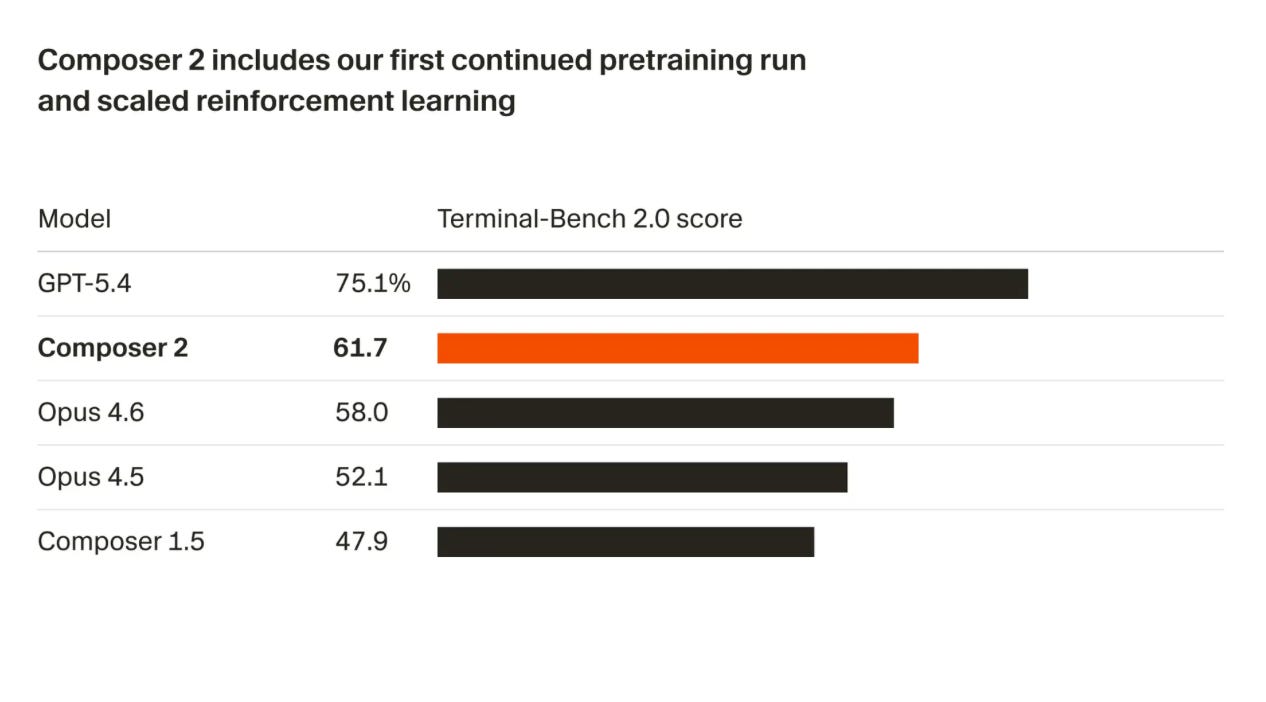
Composer 2 scores 61.7 on Terminal-Bench 2.0, beating both Opus 4.6 and Opus 4.5. The improvement came from their first continued pretraining run, giving the model a stronger coding foundation before scaling RL on top.
But the more interesting chart is performance vs. cost:
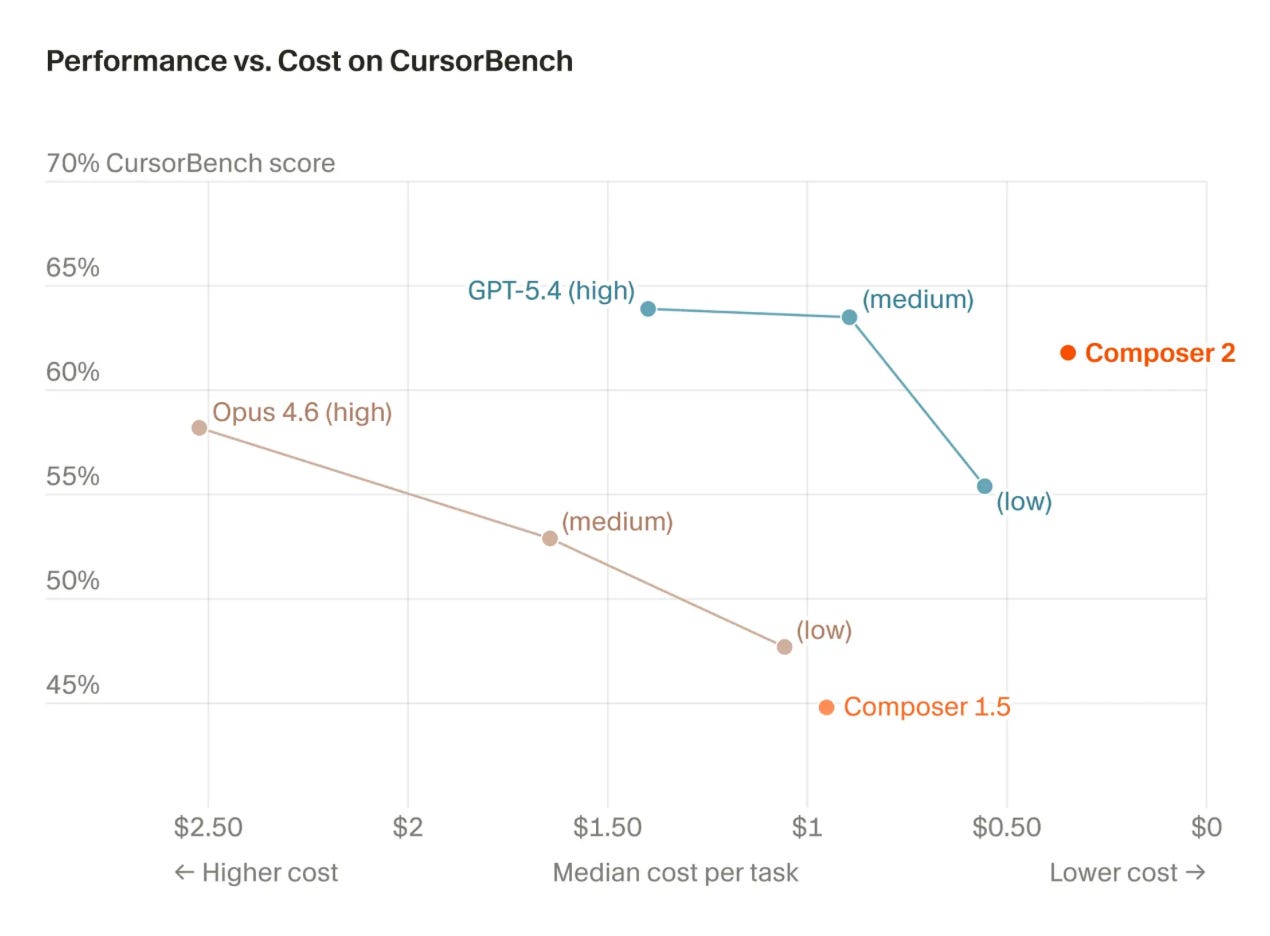
Composer 2 achieves near-GPT-5.4 performance at $0.50/M input tokens! That’s the vertical model value proposition in a single chart.
Then a week later, they published something that takes further advantage of all the data streaming in from Cursor IDE usage: Improving Composer through real-time RL
They’re using live production traffic as a training signal. Every user interaction, accepted edits, rejected ones, frustrated follow-up messages, feeds back into training (with protection against reward hacking).
New model checkpoints ship to production as often as every five hours. Admittedly, these probably aren’t huge updates, rather minor tweaks to the weights, but it’s still significant.
Of the improvements they measured: edits that stick in the codebase up 2.28%, dissatisfied follow-ups down 3.13%, latency down 10.3%.
Intercom is one of the most fascinating and heroic stories of a SaaS company turned AI company.
In current days where SaaS stocks are getting killed every week, Intercom keeps rising, thanks to going all in on AI early on, and for aligning a team of extremely talented folks around that message.
Their latest release is arguably their biggest release ever and in their words
We’ve just shipped the most significant new technology in the customer service agent category: Apex, a brand new model for Fin.
Firstly, love the name Apex.
Before Apex, the core answering model inside of Intercom’s customer service agent, Fin, was a frontier model from a top lab (probably a mix of at least OpenAI and Anthropic). They’ve now shifted all Fin interactions to their own model. Let that sink in.
The numbers are insane.
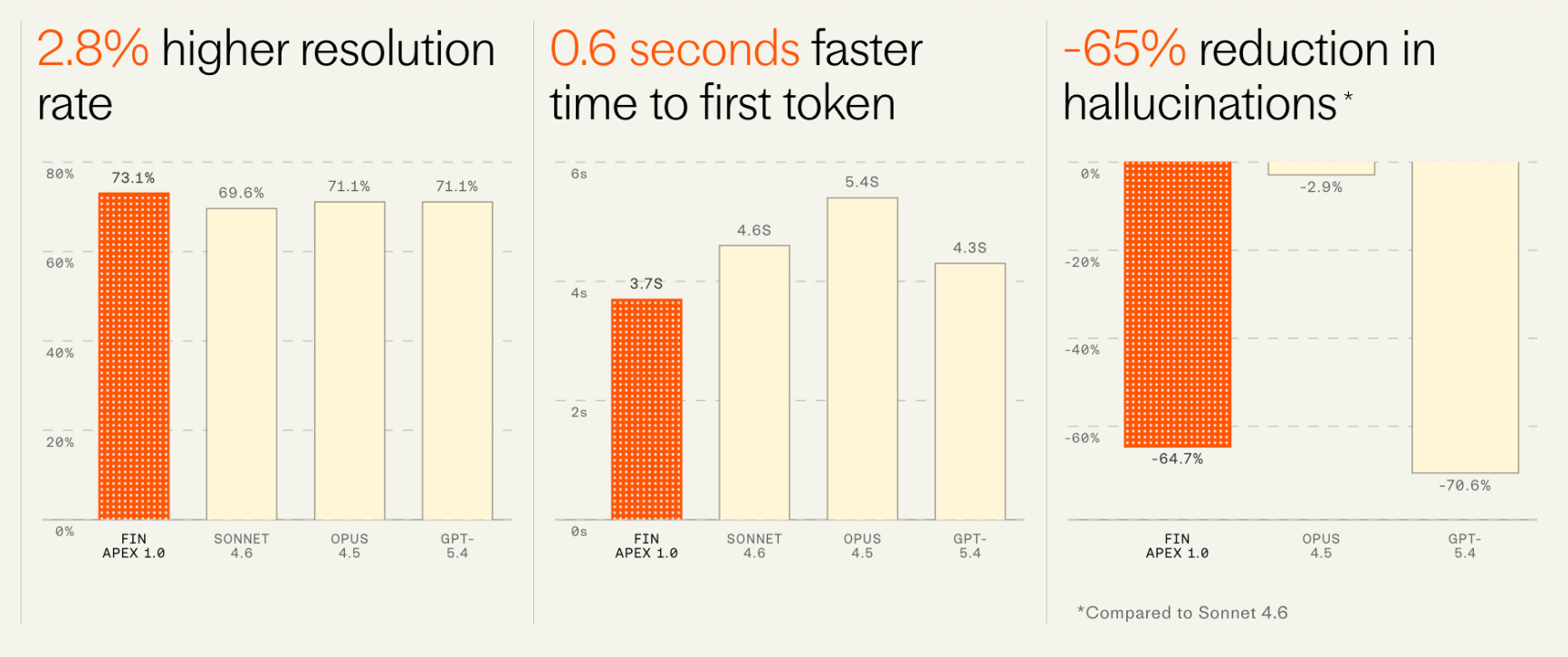
A 2.8 percentage point resolution rate improvement over the next best model might sound small, but to beat the smartest models from the best AI companies in the world is almost unheard of.
Additionally, at Fin’s scale, almost 2 million conversations per week, that gap represents hundreds of thousands of customers who get their issue resolved instead of escalated to a human.
One of our largest customers in the gaming space saw their resolution rate improve overnight from 68% to 75% (i.e. a reduction in unresolved conversations of 22%). We’ve never seen a jump this large from a single improvement since we started Fin.
Apex reduces hallucinations by 65% compared to Sonnet 4.6. This reduction shows how verticalization and reinforcement learning on specialized datasets can really improve UX. A general purpose model that’s brilliant at broad tasks can be mediocre, or actively bad, at specific ones.
Two days prior to Intercom’s launch of Apex, Decagon (a Modal customer) launched Decagon Labs, which is their internal research arm focused entirely on post-training. Their blog post announcing Decagon Labs doesn’t really cover any hard facts like Intercom’s post did, other than this:
Today, over 80% of all model traffic at Decagon runs on models we trained ourselves. They outperform the best foundation models on our real-world use cases.
Hopefully in the future third party benchmarks emerge so we can do an apples-to-apples comparison of how these specialized agents and harness compare against each other.
Cursor isn’t alone in the coding vertical, Windsurf also shipped their own model, SWE-1.5. No new models since late October.
Instacart rebuilt their entire query understanding system with LLMs
Pinterest fine-tuned open-source LLMs on their query/Pin relevance data to replace human annotation
Airbnb is post-training and tuning third-party models on their proprietary dataset of 500 million reviews and over a million support interactions. Their custom-built AI agent already handles a third of customer support issues in North America, and Brian Chesky has set a public goal of more than 30% of all tickets resolved by AI within a year, expanding from chat to voice.
The story is post-training and proprietary data.
Pre-training a model from scratch, i.e., creating a new model, is expensive, slow, and the domain of the well-capitalized frontier “labs” (Anthropic, OpenAI). That’s not changing.
But post-training is different. Post-training means taking an existing base model and fine-tuning it on your specific domain, with your specific reward signals.
This is where companies with high-quality proprietary data have a structural advantage the labs cannot replicate (for now?).
Intercom has billions of customer service interactions.
Cursor has trillions of tokens of real coding sessions.
Instacart has the purchase behavior behind millions of grocery searches.
Airbnb has years of reviews and support data in dozens of languages.
But the part that people don’t really want to talk about, and that Cursor only mentioned because someone dug and found it out, is that the base models enabling all of this are largely Chinese open-weights.
This matters because the economics of vertical AI only work if the foundation is cheap. As I wrote in December, Chinese open-weight models have closed the quality gap faster than anyone expected.
DeepSeek V3.2 scores a 66 on the Artificial Analysis Intelligence Index, beating Claude Sonnet 4.5, at $0.28 per million input tokens. Running inference on a fine-tuned open-weight model at scale is a fundamentally different cost structure than frontier API calls at the same volume.
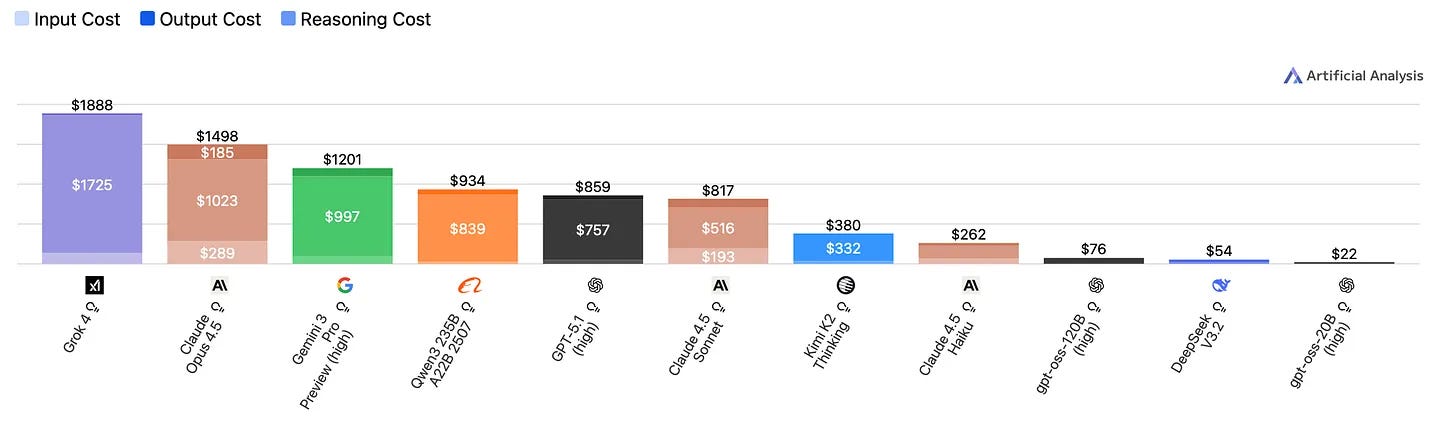
Running the full Artificial Analysis benchmark suite costs:
Grok 4: $1,888 (35x more expensive than DeepSeek)
Opus 4.5: $1,498 (28x)
Gemini 3 Pro Preview: $1,201 (22x)
GPT-5.1 (high): $859 (16×)
DeepSeek V3.2: $54
Three things have to be true for vertical AI to work:
A capable open-weight base model
Proprietary domain data
Post-training infrastructure (Hardware, software, people) to bring them together.
Nobody building vertical models is going to advertise which base model they fine-tuned, because the marketing story is about proprietary data and domain expertise. But the foundation enabling the economics is usually a model whose weights were released by a company in Hangzhou or Beijing.
All three pieces are now in place, which is why you're seeing this happen simultaneously across multiple industries in the same week.
Vertical AI may not be a code red for Anthropic and OpenAI, but the threat is real. If application companies can build vertical models that beat general models on specific tasks, and open-weight models keep improving, the general-purpose model starts to look like a commodity.
But the labs aren’t sitting still. We’ve already seen Anthropic launch Claude for financial services and Claude for healthcare. I would expect to see much more of this in the coming year(s). The labs are probably actively mapping knowledge work to RL environments, one job function at a time, spending billions on domain-specific training data in the process from providers like Mercor.
Customer service is an obvious target that I would expect to happen this year. If Anthropic trains a Claude variant specifically on customer service tasks at that scale, does it close the gap that Intercom and Decagon just opened?
Maybe. We’ll see just how powerful Intercom and Decagon’s billions of real conversations with real resolution outcomes actually is. A customer who got their issue resolved and never contacted support again is a cleaner signal than any human grader scoring a synthetic interaction. That’s hard to manufacture.
The race is on in both directions: vertical companies training up into the model layer, labs building down into applications. The next 12-18 months will tell us a lot about who has the stronger hand.
The GPT-wrapper is still alive and well, it’s what we’ve done with Converge. It’s how most AI features get built today and will keep working for a long time.
But the companies that define AI products over the next three to five years are doing three things that compound:
They’re treating their data as infrastructure: Collecting, structuring, labeling, and building pipelines that turn user behavior into clean training signal (Cursor’s real-time RL loop).
Emphasis on evals: The reason Apex beats GPT-5.4 at customer service is that they have domain-specific evals built from billions of real interactions. Without those evals you can’t measure improvement. Without measurement you can’t improve systematically. The eval is the moat as much as the model is.
They’re building out infrastructure and expertise: To fine-tune effectively you need the right people and the right infrastructure.
Who’s next to join the verticalized AI club? Replit/Lovable? Harvey/Legora?
No posts
Comments
Nothing yet. Say the first thing.
Sign in to join the conversation.