
“What’s your moat”
“How is this defensible”
“Can’t XYZ competitor do this tomorrow?”
These were the types of questions I got over and over again whenever raising venture capital. Tbh, getting these types of questions usually means the VC has no idea what your company does and just needs to ask something to fill the silence and feel like a good participant.
Anyways, as a result, I’ve been forced at times to think deeply about moats for a while. In general my view has been that moats don’t really exist and it all comes down execution, but does that change in the age of AI?
Let’s start with the most popular AI app, built by the most well funded private company of all time, ChatGPT. Does it have a moat?
A year ago, the common answer would’ve been yes, partially thanks to first mover advantage, but also because of memory. The longer you use ChatGPT, the more it knows about you, and the harder it is to leave.
Well, like most “moats”, it turned out to be pretty shallow.
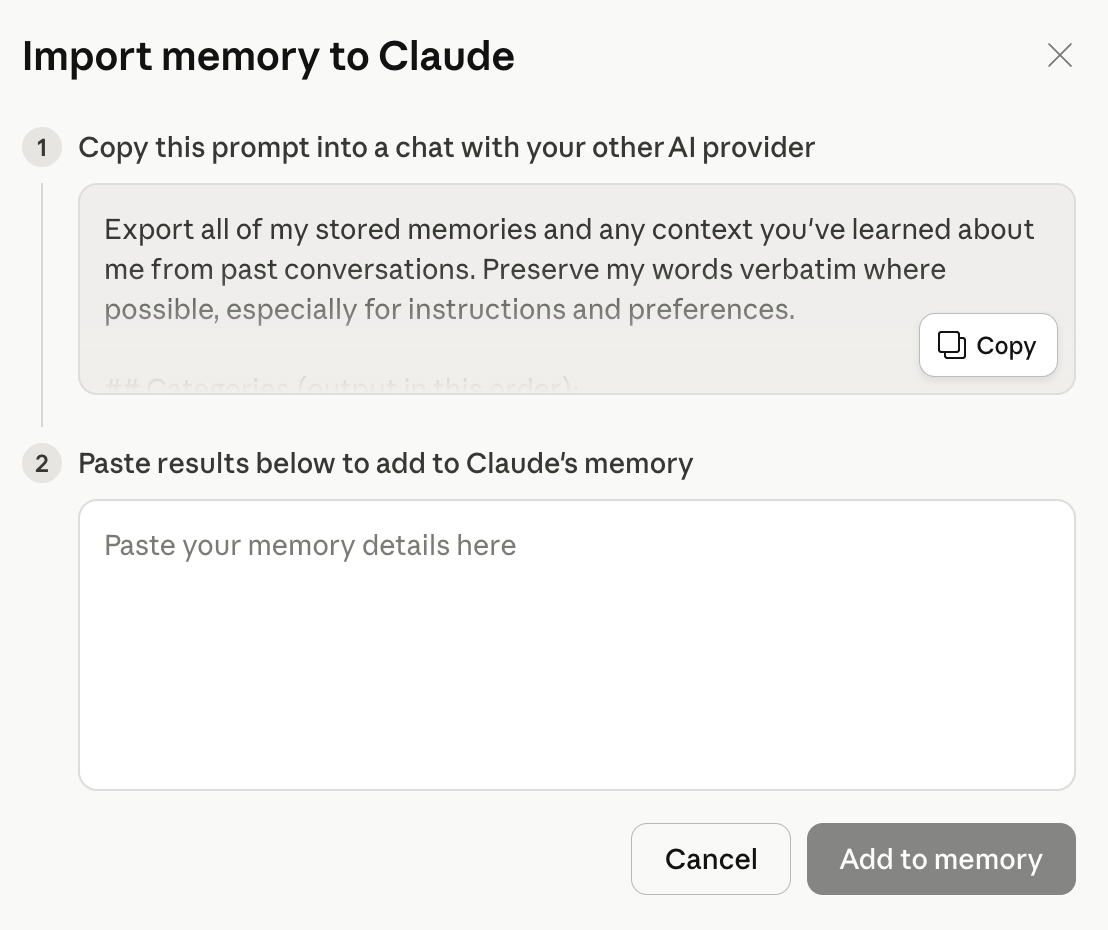
In March, Anthropic launched an import tool to switch over. The implementation is so simple it’s almost funny this hasn’t really been done before.
All you do is go into settings, click an import button which gives you a prompt that you paste into “a chat with your other AI provider” aka, ChatGPT, then paste the output back and add to memory.
Google followed three weeks later.
Gemini rolled out their own “switching tools” on March 26, which essentially was the same feature.
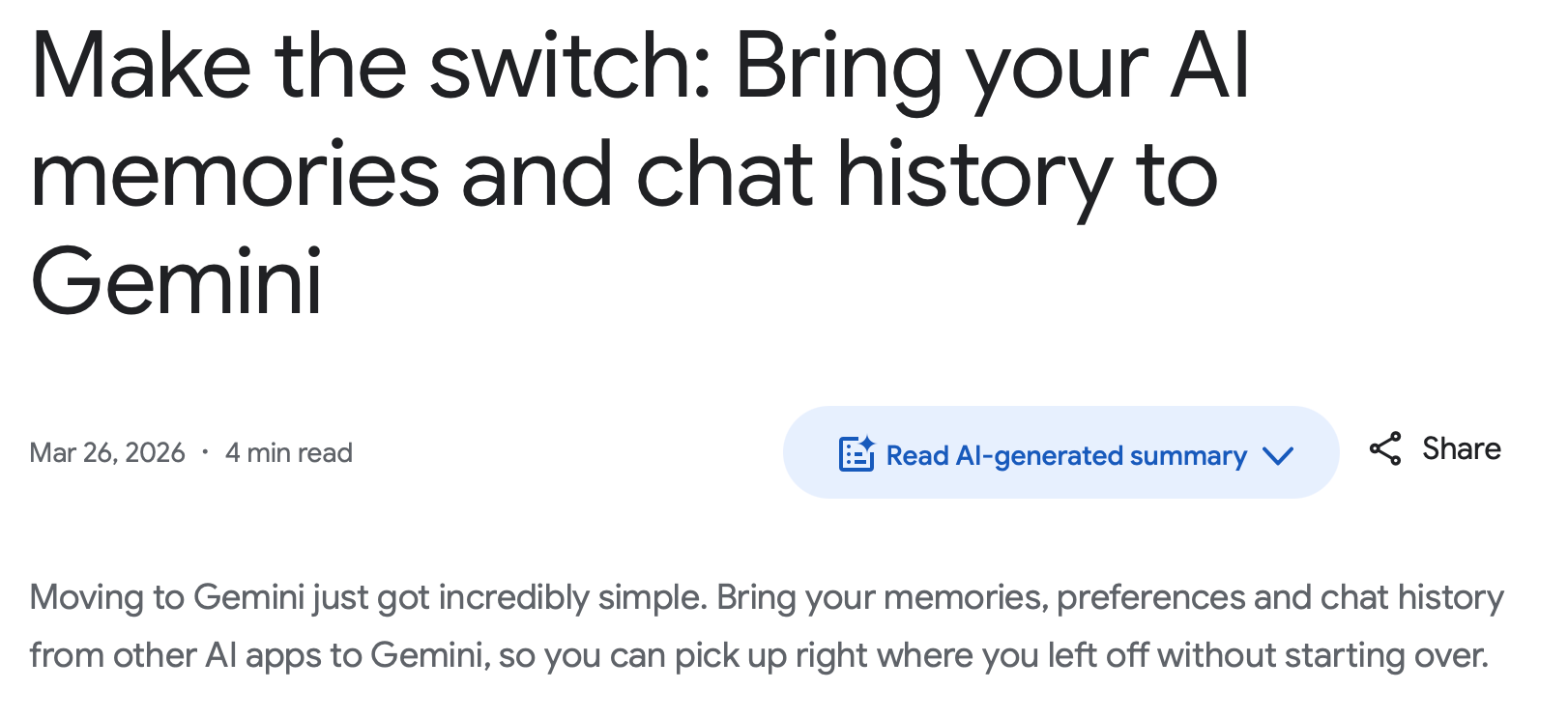
One of the most commonly cited AI product moats now has migration tools built against it by two different competitors within a month of each other.
I think we’ll see this pattern more often: taking context out of a tool via a prompt and bringing it elsewhere.
We just did something similar with Converge. If you’ve been building in Lovable, Replit, v0, or Bolt and hit a wall and want to move your project over, we give you a prompt to run in that environment.
It produces a handoff document with your data model, every page, your auth setup, third-party integrations, your visual and brand decisions etc. All wrapped in a single code block you paste into Converge. Under a minute to move an entire project.

The mechanics are identical to Claude’s memory import: a well-crafted prompt reads the context from one AI environment, extracts what matters, and hands it somewhere else.
No API partnership. No linking the GitHub repo and traversing it with an LLM to figure out the details of the project. No export button. Just a prompt.

The most interesting part is that this type of migration has been available to everyone for awhile. There wasn’t some new model drop that made this available, someone at Anthropic, presumably a human, just had a good idea.
Historically, the more integrations a team set up, the higher their retention. The deeper you’re wired in, the more painful it is to leave, every webhook, every API connection, another reason to stay.
That’s changing too.
Getting your Stripe payments, GitHub actions, and database connections wired up in a new tool used to take some effort. You didn’t want to do it again. When I set up Convalytics, I wired all of it, payments, email, DNS, from Claude Code in a few minutes.
As I wrote recently, Intercom shipped their own vertical model for customer support that outperformed top models from Anthropic and OpenAI.
All they had to do was post-train an open-source model: supervised fine-tuning on labeled examples, then reinforcement learning to align outputs with what good support looks like. Pennies compared to what pre-training costs.
The capital barrier that seemed to protect model quality as a moat doesn’t apply once you have a narrow task and a strong open-source model to start from.
So does Intercom’s custom model even need to keep pace with frontier labs? At some point it just needs to be good enough for the task at hand and once it clears that bar, it doesn’t matter what OpenAI/Anthropic ship.
In the pure vibe coding space, not terminals, IDEs etc, there are more-or-less three major players: Bolt, Lovable, and Replit.
Bolt popularized vibe coding as we know it, chat on left, web app on right. They were able to do so because they'd spent 7 years building web containers, which is a full dev environment in a web browser. Perfect for agents.
Replit has been building their own infrastructure stack for years: their own database, their own compute layer, their own auth, etc.
Then Lovable showed up, grabbed an Anthropic model, a sandboxing provider, a hosting partner, and became one of the category leaders.
All the infrastructure work Replit and Bolt had done for years turned out to matter less than expected. The model is the real magic, everything around it is important, but secondary and easier to swap.
Aside from the classics like Facebook’s network effects and Netflix’s scale, I’ve never really believed technology moats exist in B2B software. It all comes down to execution.
Slack, Zoom, Atlassian. None of them have an intellectually cute moat. They outsell their competition because they execute go-to-market better. That’s it. Most companies build operational moats, not technical ones. Whatever moats do emerge usually show up much later in the company’s life, not in the first act.
That’s been true in enterprise software for decades. It’s becoming true in AI faster than anyone expected.
No posts
Comments
Nothing yet. Say the first thing.
Sign in to join the conversation.