
Blending agile methods with AI in KM requires policy and practice shifts, alongside innovative technology adoption. Here are some practical good practices to guide your journey, informed by real-world successes:
Make Knowledge Everyone’s Job (Cross-Functional Teams): Don’t leave KM to a small, siloed team. Create a cross-functional knowledge structure or working group, or even better, communities of practice accountable for knowledge that embrace diverse disciplines, such as IT, support, operations, and HR, who generate or use critical knowledge. This mirrors the agile principle of cross-functional teams and ensures diverse input.
Only smaller organizations should consider a single knowledge management team. Larger firms need to consider knowledge management in terms of function and geography, allowing communities to form that support knowledge in a distributed manner, with like functions across geographies coordinating their efforts.
Treat Knowledge as a Product, with a Backlog and Sprints: Just as software teams maintain a backlog of features and fix bugs in iterations, maintain a knowledge backlog. Capture requests for new articles, needed updates, and ideas for improvements in a tool or spreadsheet that the team continually prioritizes and updates. Use short iterations (sprints) to tackle a set of these items, then release the updated knowledge (publish those articles, refresh that FAQ) immediately.
A backlog also helps manage the contribution of AI: for example, if the AI flags ten outdated documents, they can be added to the queue and allocated, a few at a time, during each sprint. A telecom company broke their policy manual overhaul into bi-weekly sprints, each cycle updating and releasing a handful of policies. Within a few months, their entire repository was refreshed without a massive project upfront, and it stays up-to-date through continuous small increments.
Leverage AI as Your Knowledge-Assistant: Incorporate AI tools to assist, not replace, your knowledge workers. For example, enable support agents or technical writers to use an internal generative AI assistant when creating or updating articles. This might be a bot integrated in the knowledge management system that can draft an article based on a support ticket or suggest relevant content to include. (See number 8 below for precautions and guidance.)
By doing this, organizations reduce the effort required for documentation and dramatically speed up content creation. However, always have the human expert review the AI’s suggestions; this not only ensures accuracy, but also turns the process into a learning opportunity (the human might catch errors and feed corrections back into the system, training it over time, and the person might see patterns across their reading that the AI misses, such as a need to restructure a problem solving approach that has become less effective over time).
Think of it like pair programming, but for documentation: the AI writes a first pass, the human refines and approves, and both learn.
Integrate Knowledge Capture into Workflows: Agile KM works best when creating or updating knowledge isn’t a separate, cumbersome task outside daily work. Follow the principle of capturing knowledge in the moment. That means that service desk software, project management tools, or collaboration platforms should make it easy to contribute to the knowledge base without disrupting the workflow.
For instance, if a consultant finds a new insight during a project, they should be able to jot it down in minutes, with a click, from whatever app they are using. Some teams implement lightweight forms or chatbots (“Did you just solve a problem? Briefly note the solution here…”) to prompt people to contribute on the fly.
Easy interface = more knowledge captured. Modern AI-enhanced systems even allow contributions via voice or chat – an engineer could tell a bot the solution they just found (or dictate it while driving), and let the AI transcribe and draft it into a shareable format. The key is removing friction from knowledge capture.
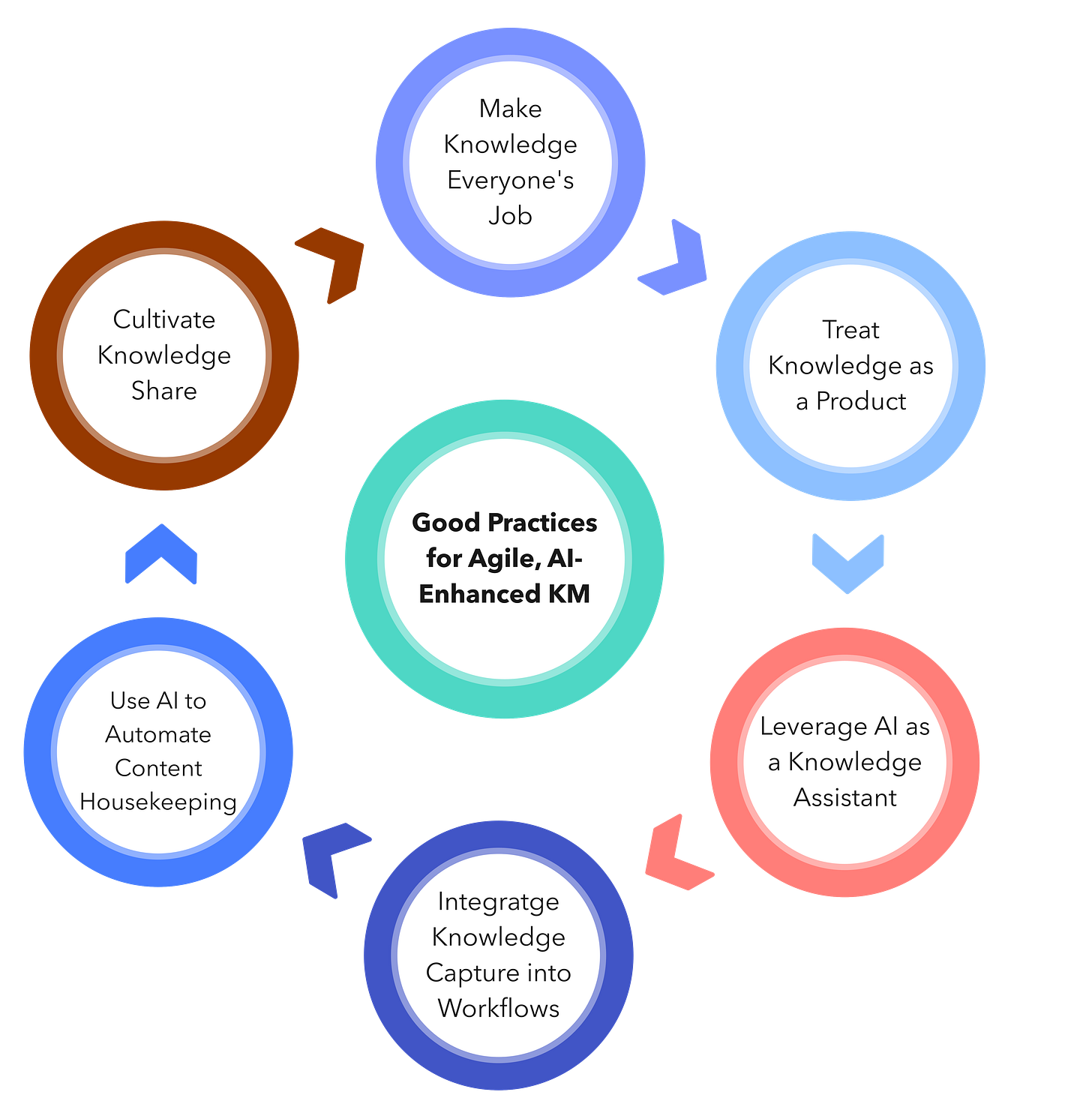
Use AI to Automate Housekeeping: Over time, knowledge bases can become cluttered with duplicate, irrelevant, or outdated entries (the dreaded knowledge ROT: redundant, obsolete, trivial content). AI can be the cleanup crew. Set up AI tools to periodically scan the repository for anomalies, such as multiple articles addressing the same question (suggesting they be merged, even how), content that hasn’t been viewed in over a specified period of time (which may imply it is obsolete), or inconsistent terminology that could confuse users.
Some organizations schedule a monthly “AI audit” report that flags potential issues identified by AI. The knowledge team or community reviews that content and decides what to do (keep, update, or delete). This ensures continuous quality without relying solely on someone remembering to review old pages. These AI-driven audits can save hundreds of hours by pinpointing which knowledge articles need attention.
Measure and Adapt: In agile, we inspect and adapt. Similarly, establish metrics for KM efforts and let the data guide improvements. Track usage stats: which articles are most viewed, which searches yield no results, and what questions are users asking the chatbot that it can’t answer. Also track outcome metrics, such as support case deflection rates, average time to find information, and employee onboarding time reduction, among others.
For example, after implementing agile KM practices plus an AI search assistant, a company might see that employees are finding information 40% faster (measured by time-to-answer in the service desk) or that new hires reach full productivity in 2 weeks instead of 4.
If a metric isn’t moving in the right direction, use agile problem-solving, do a root cause analysis, experiment with a change in the next sprint, and see if it improves.
Metrics not only record the value of KM (to secure continued funding and support), but they also highlight where the approach needs improvement. [Note: This aligns with my position that all “process” work is knowledge work. The process captures “process” knowledge. Therefore, iterating on a process is no different than iterating on content, save for the need for more robust change management practices.]
Cultivate Knowledge-Sharing (with Leadership Support): No method or tool will succeed if the organization doesn’t value knowledge. Leaders should encourage teams to dedicate time to documentation, celebrate those who contribute valuable insights, incorporate knowledge goals into performance reviews, and regularly share their knowledge and how they apply organizational knowledge. In my experience, organizations that excel at KM treat knowledge as core infrastructure, as important as their products and services. They move beyond the mindset of “knowledge is extra work” to “knowledge is part of everyone’s job.”
A practical tip: hold regular knowledge-sharing sessions (such as brown-bag sessions or “demo days” where teams showcase new knowledge they’ve captured or a cool use of the AI tool to solve a problem). This normalizes knowledge work and generates enthusiasm.
Also, ensure incentives are aligned – if support agents are only rewarded for closing tickets quickly, they won’t take the extra 5 minutes to document solutions. Adjust KPIs to reward knowledge contributions.
Governance and Guardrails for AI: Establish guidelines so AI remains a helpful partner, not a loose cannon, by setting up a review workflow for AI-generated content.
Maintain transparency about AI’s sources: if an AI-generated answer draws from a specific document or external site, have it cite that source so users can verify the information. Even better, have it provide the answer in context. This builds trust in the content. Be mindful of information security. Those who employ cloud AI services must ensure they’re not feeding sensitive data without proper encryption or agreements. And importantly, educate staff about AI, its capabilities and its limitations.
When everyone understands that the AI might occasionally err or “hallucinate,” they’ll be more vigilant, and the whole organization will use the tool more effectively. A balanced governance approach will enable organizations to harness AI’s speed safely, thereby maintaining the credibility of the knowledge base.
By following these practices, organizations can create a synergistic system: agile methods ensure continuous improvement and relevance, while AI tools provide scale, speed, and intelligence. Companies that get this right are effectively building a self-learning organization, one that quickly absorbs new information, disseminates it through intuitive AI-powered channels, and adapts its knowledge stores in response to real-world usage.
No posts
Comments
Nothing yet. Say the first thing.
Sign in to join the conversation.