
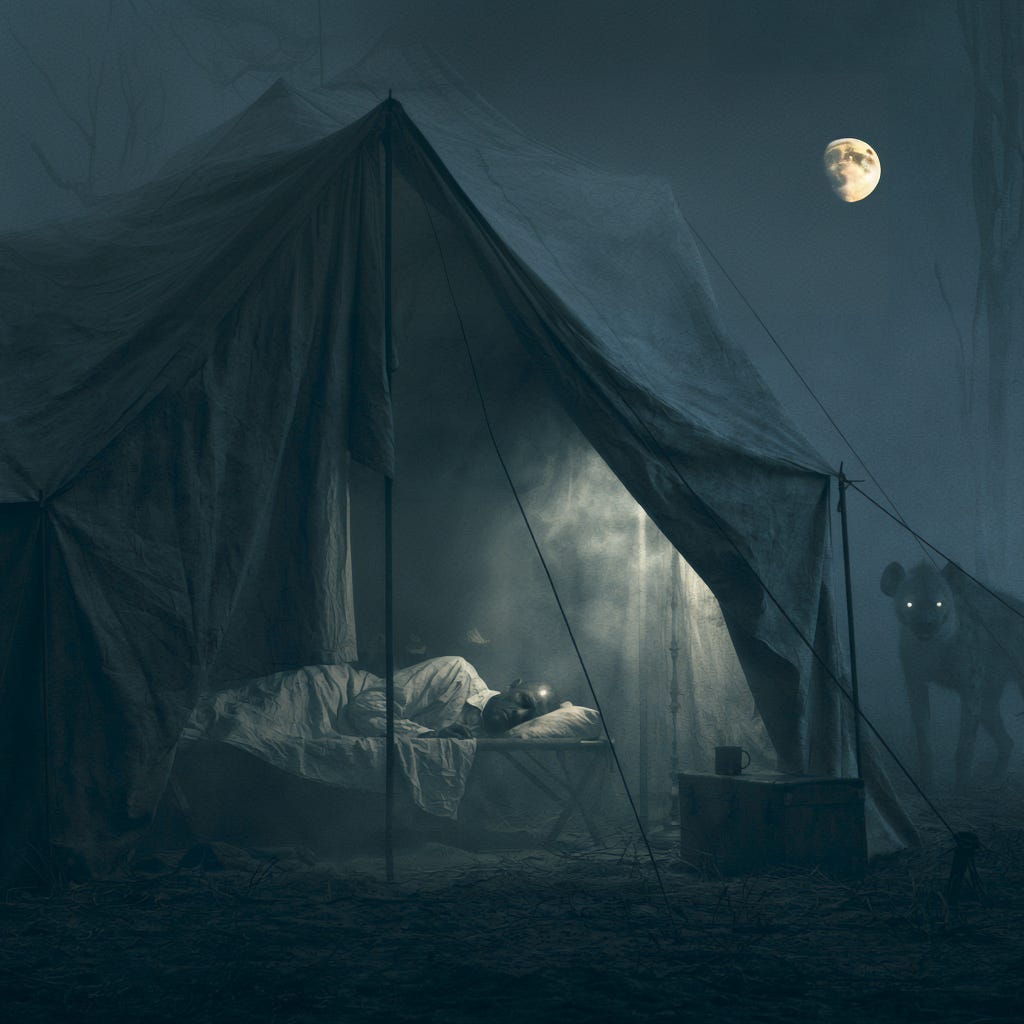
Toto’s 1982 hit “Africa” declares that Kilimanjaro “rises like Olympus above the Serengeti,” which is patently false. The Serengeti is more than 200 miles away from the eponymous mountain of Ernest Hemingway’s 1936 short story, “The Snows of Kilimanjaro.” And unlike Olympus, it is a free-standing mountain—the highest on the earth, rising over 19,000 feet above the savanna of what at the time of the story’s publication was the British-administered territory of Tanganyika, an area later to become the Republic of Tanzania following the mainland’s union with Zanzibar in 1968.
Death pervades Hemingway’s gothic tale, which opens with a description of a leopard’s carcass permanently frozen on the mountain’s western summit, a detail that will be alluded to (though not explicitly mentioned) one more time near the story’s conclusion. No one knows how the leopard reached an altitude so far from its natural habitat. But the very real phenomenon, first recorded by the English mountaineer Donald Latham in 1926, adds to the macabre atmosphere of what is arguably the most borderline paranormal tale Hemingway ever wrote.
To praise Hemingway’s economy of expression in “The Snows of Kilimanjaro” is not to imply the story is flawless. For example, the author claims the Maasai call the mountain’s summit Ngaje Ngai (“The House of God”), an extraordinary assertion considering no such phrase exists in the Maa language, nor have the Maasai ever been associated with a mountain the indigenous WaChagga regard as their ancestral home. And in a particularly annoying episode the protagonist recalls “a hot Armenian slut” he seduced in 1920s Istanbul, which alone is tasteless, but hardly distracts from the willfully butchered Turkish place names, such as Taksim Square (rendered “Taxim”), or the Ottoman fort on the European side of the Bosporus called Rumeli Hisarı (which he spells “Rimmily Hissa”).
Throughout the ’70s and ’80s, it was not uncommon for Midwestern scoutmasters, school teachers, and youth ministers to encourage boys to read Hemingway’s first anthology, In Our Time, which (to their mind) evoked the pleasures of hunting, camping, and fishing, while enforcing Roman morals, like courage and fortitude in the face of adversity: Forsan et haec olim meminisse iuvabit. (“Perhaps one day we’ll laugh when recalling this pickle we’re in.”) But these same educators and role models drew a veil over Hemingway’s personal life and made no mention of his death by suicide. It was only in 1987 while standing in an aisle of B. Dalton Bookseller in the Greenwood Mall that I discovered Hemingway’s 1,400-word short story “Hills Like White Elephants,” about a man trying to persuade a woman to have an abortion.
By the time I was at university, Hemingway’s popularity was on the wane. His notorious depictions of women and nonwhite characters in his fiction made him a bête noire among students and professors on campus. And in some academic circles, admitting that you enjoyed Hemingway was tantamount to calling Leni Riefenstahl’s Triumph of the Will a heartwarming documentary of hope born out of hardship. Even the “Hemingway style” of storytelling, a way of writing he had perfected while working as a stringer for The Toronto Star and later as a correspondent in Europe, was poo-pooed as simplistic, unexceptional, vulgar, repetitive, and easy to parody—charges often leveled against his work by critics whose own prose would not have suffered from a little more clarity and precision.
Like Rudyard Kipling and H. Rider Haggard, Hemingway was skewered as a colonialist and imperialist. He was excoriated for perpetuating the myth of “The Great White Hunter”—a four-letter phrase some believed he invented despite his never using it in his writing. He called some characters “white hunters”; and the 1947 film version of his tale, “The Short Happy Life of Francis Macomber,” was released as The Great White Hunter, though whether Hemingway had any say in the matter is uncertain. But what is important for this essay is that the embarrassing phrase did make its way into the script of 20th Century-Fox’s 1952 blockbuster, The Snows of Kilimanjaro, starring Gregory Peck, Susan Hayward, and Ava Gardner.
Unlike Hemingway’s story, which is set in the turbulent 1930s under the looming threat of war, the film relishes in the newfound prosperity that emerged out of the rubble of the most destructive conflict in human history. The Snows of Kilimanjaro is a Technicolored fever dream of highball-swilling jet-setters, a vamp who wears lipstick and eyeshadow behind the mosquito netting of her pith helmet, a brooding writer and veteran of the Spanish Civil War, and an otiose Scandinavian countess in bat-wing sunglasses. The movie ends happily ever after and bears as much of a relation to the original as a box of Mogen David to a bottle of Bordeaux.
But the film score, composed by Bernard Herrmann (of Psycho and Vertigo fame), is predictably magnificent and enhances the matte-painted panoramic shots of the wild African landscape with its acacia and baobab trees. But even Herrmann’s inspiration seems to fail him when called upon to enliven scenes in which the blasé and inherently uninteresting characters pleasure-boat in mahogany runabouts on the Riviera, sip champagne during Flamenco performances in Madrid, or flirt with each other in the half-light of a baby-blue jazz club near the Café Emile on the Left Bank of Paris.
[Continue to Part 2]
This track from Bernard Herrmann’s soundtrack of The Snows of Kilimanjaro is called “The Witch-Doctor” (a character, incidentally, that does not appear in the original story). But fans of John Williams may hear echoes of Raiders of the Lost Ark in the low horns and trilling strings.
No posts
Comments
Nothing yet. Say the first thing.
Sign in to join the conversation.