
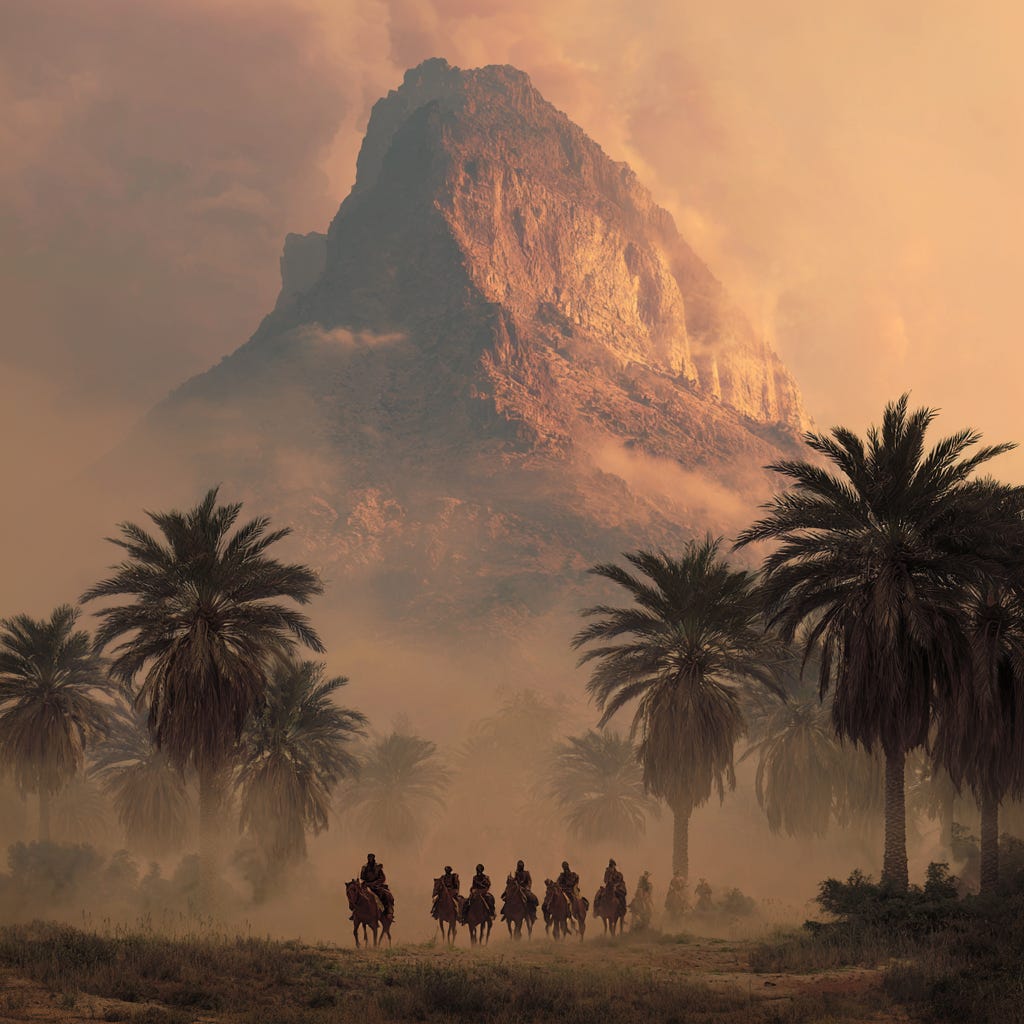
“Simeliberg” (Simeli Mountain) was tale 56 in the 1812 edition of Kinder- und Hausmärchen (“Children’s and Household Tales”) of the Brothers Grimm. It is essentially a condensation of “Ali Baba and the Forty Thieves” from the eighteenth century edition of Les Mille et Une Nuits (One Thousand and One Nights) by Antoine Galland. There is no Arabic version of this alleged Arabian folktale predating its appearance in Galland’s work. Like “Aladdin and His Marvelous Lamp,” Galland’s source was the Syrian Maronite storyteller Hanna Diab.
In the Grimms’ version, “simeli” is a nonce word the wicked brother recites when he forgets that “sesame” is the key that opens the mountain. The word “sesame” in English comes from the Akkadian šamaššamu and is related to the Egyptian, smsmt, which may itself stem from Akkadian. The Grimms’ version of the tale sets it in a vaguely European realm. I have elected for a compromise between their version and Galland’s by placing the action in Bronze Age Mesopotamia.
Long ago between the Tigris and Euphrates, there lived two brothers, one very rich and the other very poor. The rich man was stingy and unrighteous. He refused to help his destitute sibling, who made a living stripping fibers from palm trees to weave into baskets. The palm-fiber merchant made very little money from his trade; and there were many nights when he, his wife and two daughters went to bed hungry.
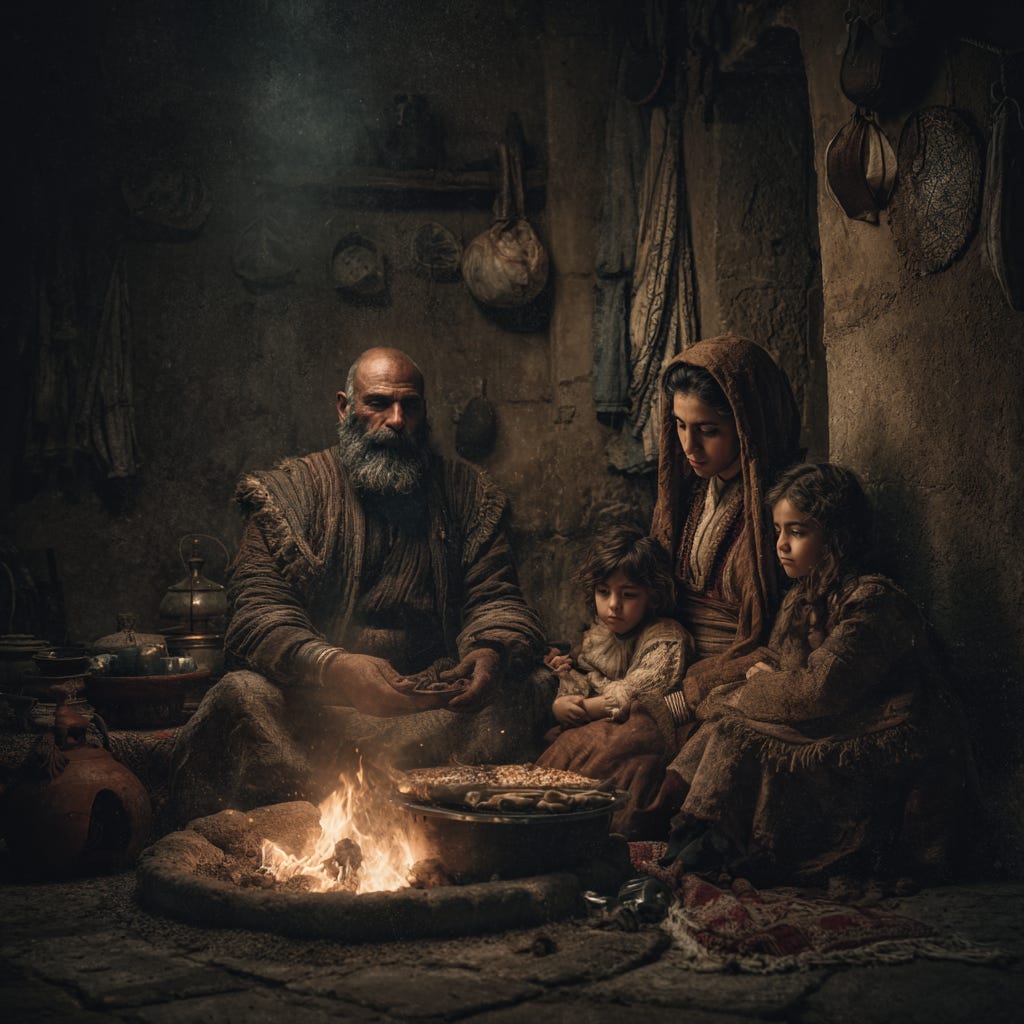
Late on a humid afternoon, the humble man trekked into an unfrequented palm grove near a bald mountain so unremarkable that no one in the village spoke of it. The man paused in his labors when he saw dust rising in the distance, far off in the direction where the sun begins its daily descent. Soon he heard the hoofs of many horses beating on the desert floor.
Fearing for his life, the man shinnied up a tree and hid amid broad fronds, which clacked together due to the commotion created by his ascent. Beneath him passed twelve riders shrouded in black. They appeared to be malefactors of some sort. Each one had two bags bursting with gold hanging on either side of his mount.
On the mountain’s west flank, the leader halted his horse. He raised both arms to the sky and cried out, “Open, oh Shamash-Shamu Mountain! Open, oh Shamash-Shamu Mountain!” He continued to repeat the phrase, which seemed peculiar. For the word “shamash-shamu” meant sesame. This meant the man was calling the rock “Sesame Mountain.”
The poor man could not fathom what was transpiring beneath him or why the man continued to repeat the phrase. But to his astonishment, the invocation was met by a loud rumble and a sound like a peel of thunder. A vertical cleft appeared on the western face and dilated until it formed a portal into the living rock. The twelve horsemen entered and the mountain closed behind him.
Perplexed but curious, the man waited until sun set and the moon began to rise. Again, the mountain opened. And again, the twelve horsemen exited. And in the glimpses of the moon the man saw that the bags strapped to their saddles were gone. When the dust settled and the desert floor was still, the man climbed down from his hiding place and went to where the leader had brought his horse to a stop.
He repeated the words he had overheard the leader of the twelve riders say: “Open, oh Shamash-Shamu Mountain! Open, oh Shamash-Shamu Mountain!” It did not take long until the same thing happened. The mountain opened, and the poor man stepped inside.
The antechamber was dark, but he saw the wavering light of cressets down a corridor. He followed to a vast chamber that was full of gold. There were ancient sphinxes and coffers dripping with jewels. Heaped in a pile were the twenty-four bags of gold that the twelve riders, whom he now realized were thieves.
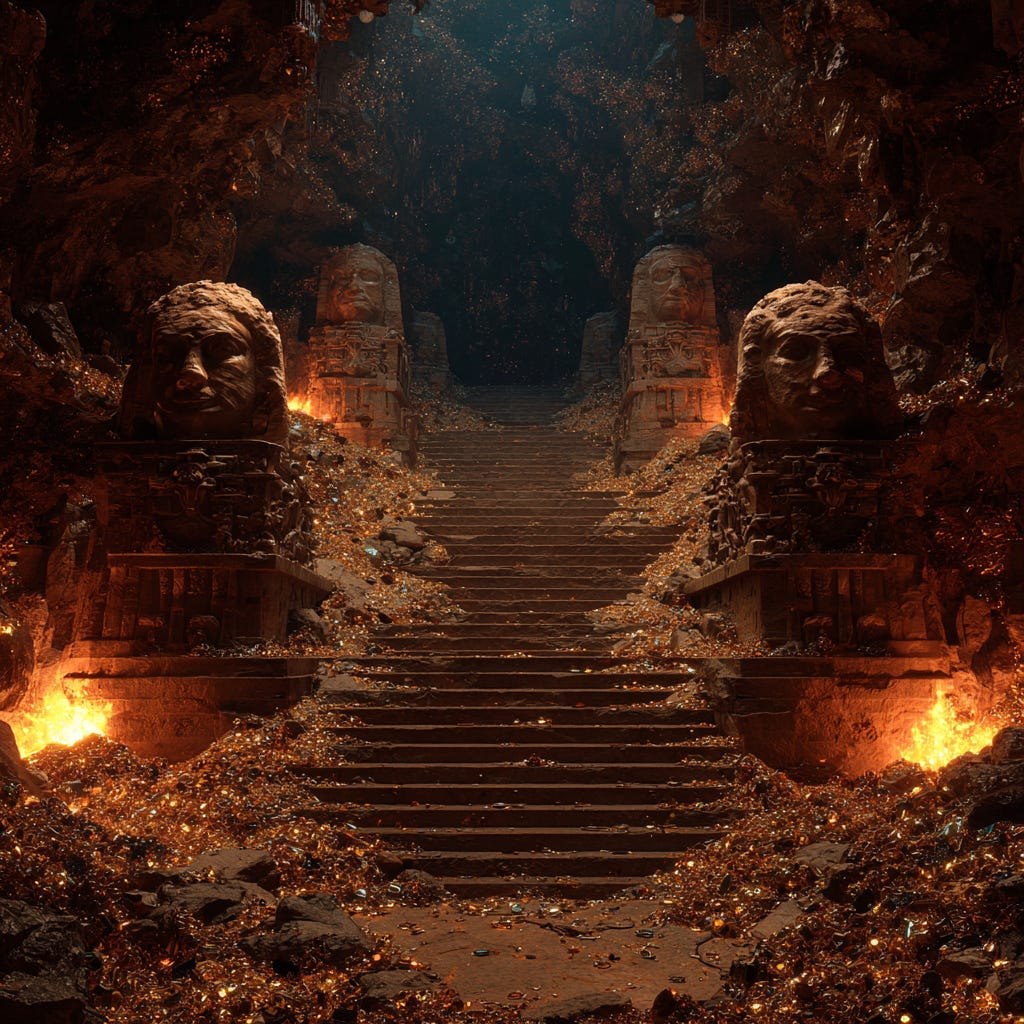
He was afraid that the twelve men, whom he was now certain were thieves, might return at any moment and kill him. He could locate no other way out of the mountain. So he said, “Open, oh Shamash-Shamu Mountain!” And repeated this until the mountain opened again. And then he ran as fast as his legs would carry him back to his home.
He cursed himself for not bringing some of the wealth he had found with him. So he devised a plan. He would need a receptacle to carry the treasure out. It was a melancholy fact that, even though the man made a living gathering palm fibers to weave baskets, he possessed now a single basket of his own. So he went to his wealthy brother; and asked to borrow one for the day.
The wicked brother relished the prospect of gratifying his man’s request, because it emphasized the contrast between their respective estates.
But in the days following the request, the poor man seemed to have mysteriously acquired a fortune. With this he bought his family a large mansion. And now they had plenty to eat, and they never went to bed hungry.
The problem with the palm-fiber merchant was that he was an overly kind and generous man. And he soon gave away all of his riches until he was poor again. So he asked to borrow his brother’s basket a second time, and was again seen to be unaccountably wealthy. But he was poor again within a few months.
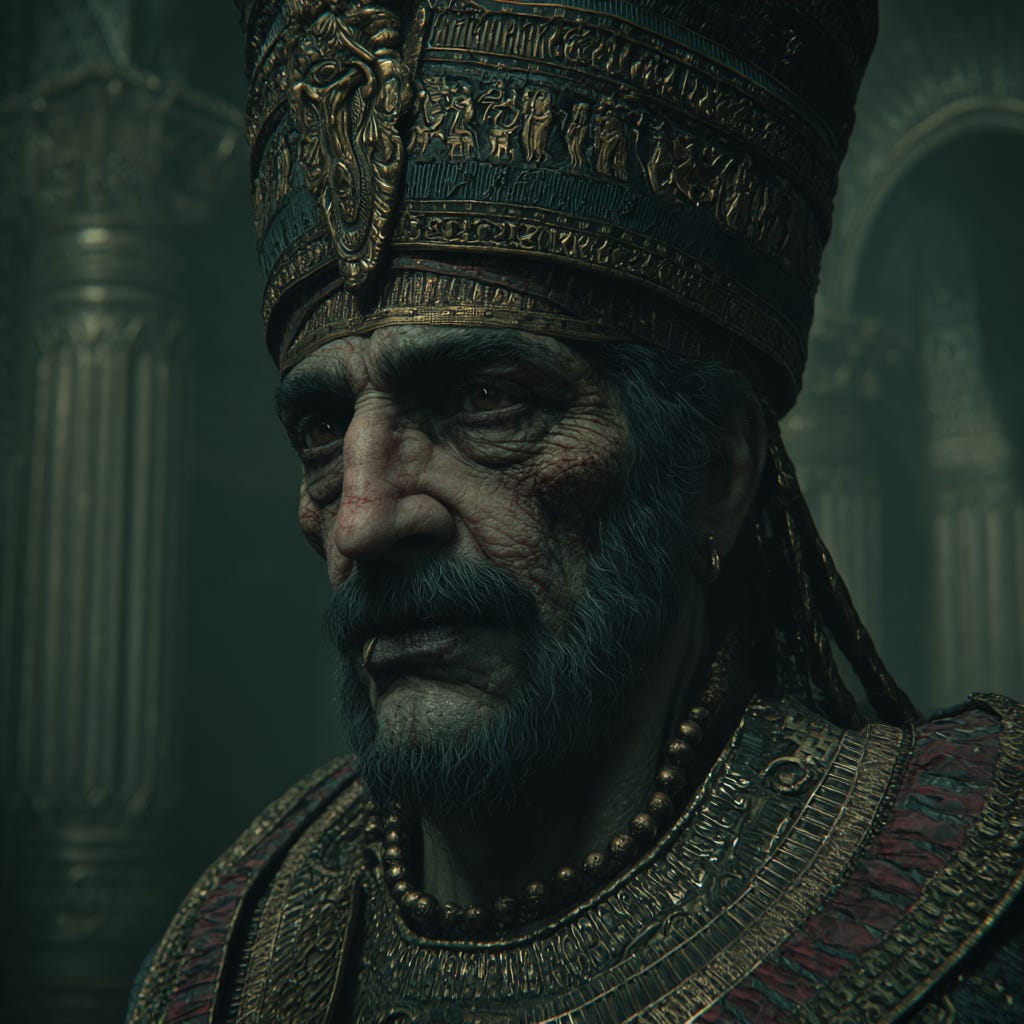
This time when he went to his brother to ask for a basket, the miser devised a plan of his own. He smeared naphtha to the bottom of the basket; and when it was retuned to him, the wicked brother found a stray gold coin stuck to the bottom, which he showed to his brother. “Now I’ve caught you. Tell me where you are getting this treasure or I will kill you.”
In an access of despair, the wretched man confessed. He told him the secret of Shamash-Shamu Mountain, and revealed to him the password to access the thieves’ treasure.
Alone, the wicked brother went to the mountain, carrying one of his baskets to take as much of the treasure as he could carry. “Open, oh Shamash-Shamu Mountain!” he repeated over and over again, until a rift formed in the smooth face of the rock and was wide enough for him to enter. He stepped inside as the walls closed behind him.
He was so overwhelmed by how much treasure there was that after he had filled the basket and returned to the dark antechamber, he had forgotten the phrase to open the mountain. He seemed to recall that the password involved some mention of the sun. And so he said, “Open, oh Shamash Mountain!” But nothing happened. “Open, oh Shamash Mountain!” he said again.
For a long while he waited in the dark until, to his relief, the walls parted. When the man saw the sinking sun on the western horizon, he was gratified. But at once the lurid red disc was obscured by the flapping of black robes and what he thought was a mirage of twelve horsemen approaching.
They entered the mountain, and circled the wicked brother in the vast antechamber. They seemed amused; and as their horses’ hoofs echoed on in the darkened chamber, their leader spoke. “Did you think we would not notice that a pest has been nibbling away at our goods?”
“There’s been a mistake,” the miser said. “It’s my brother who has been stealing from you!”
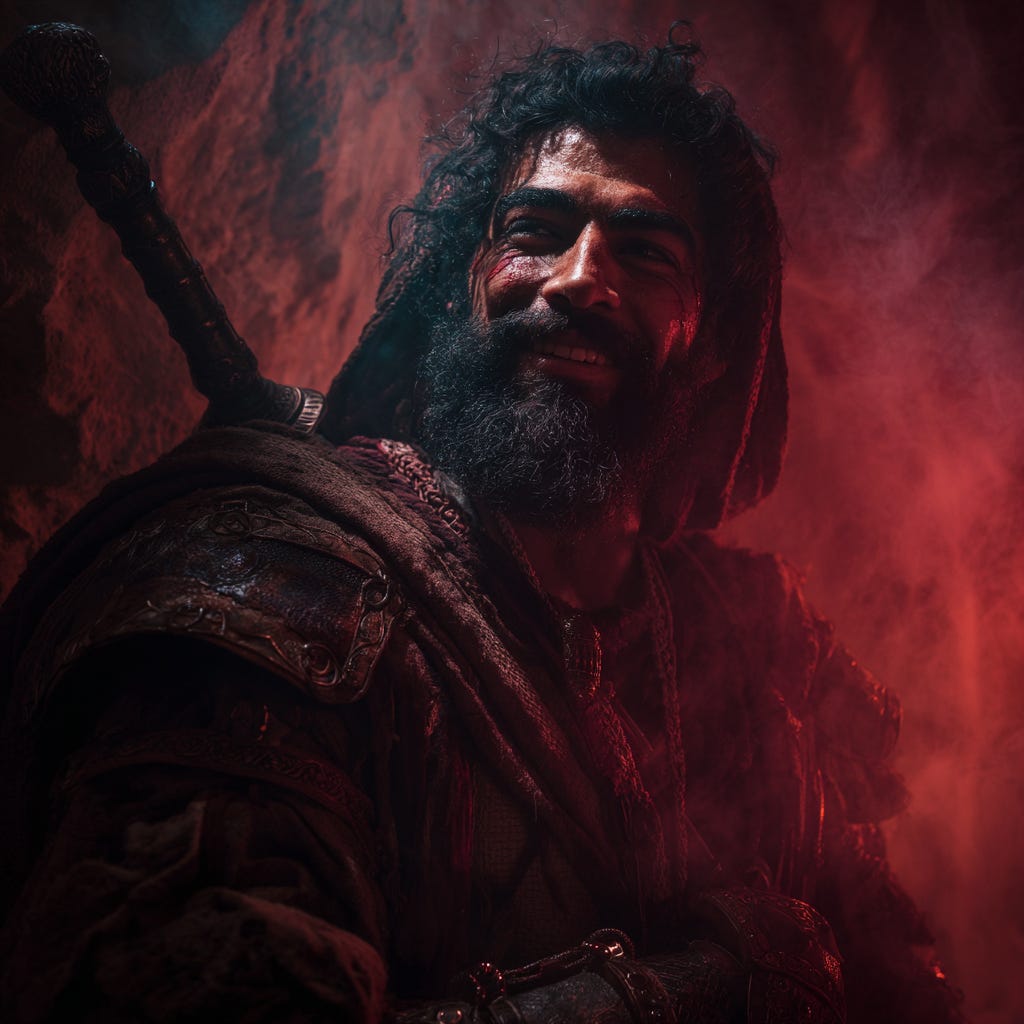
The next day the good brother was summoned to the marketplace.
“What is the meaning of this?” he asked his friends. The crowd stepped away to reveal a boy in a loincloth holding a large basket with both hands. The boy set it down, opened it, reached inside, and pulled out something shaggy and matted with gore. The spectators gasped. It was the fly-covered head of the poor man’s brother.
“I found this basket in a palm grove where I play,” the boy said. “Near a nondescript mountain.”
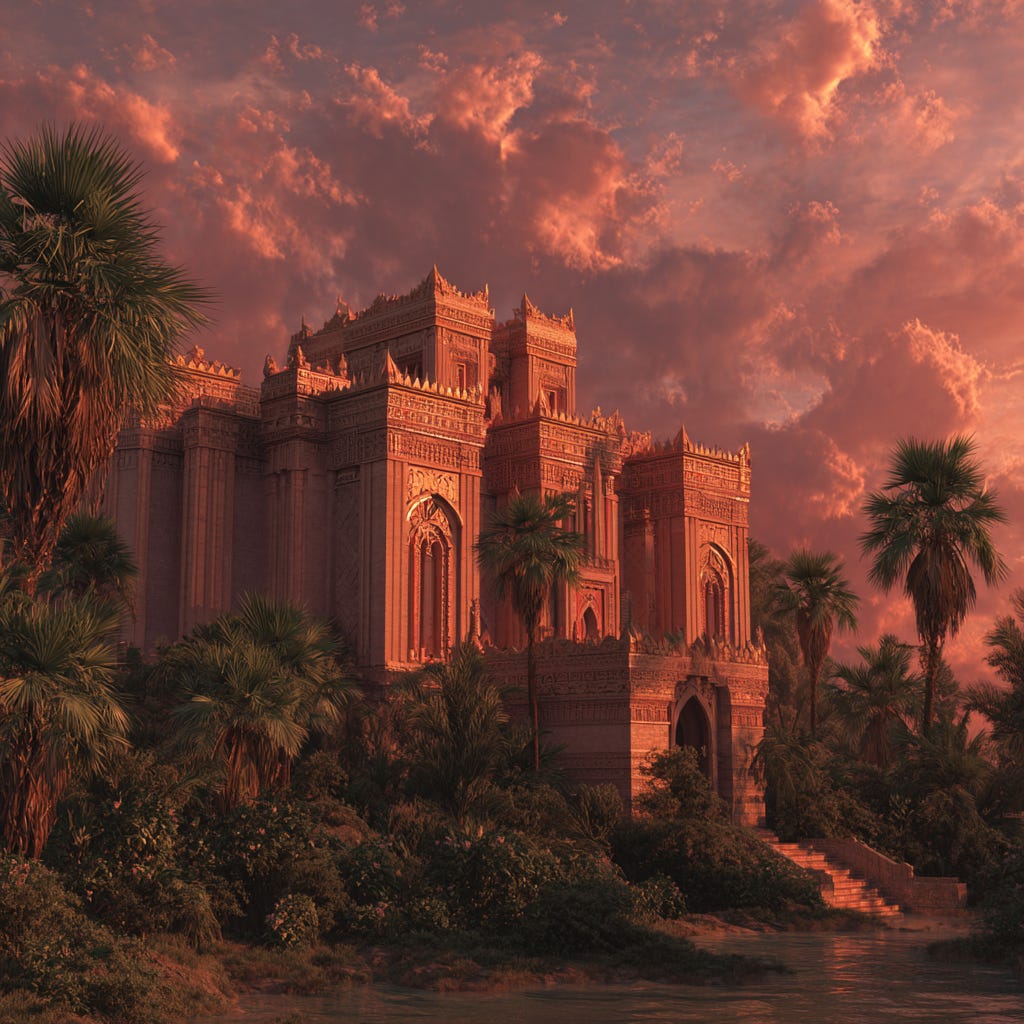
The palm-fiber merchant inherited his brother’s great palace. But when he and his family took charge of it, it was almost entirely empty. Thieves had stolen everything that could be carried away, except for a few baskets in a storage room. The righteous brother counted his blessings and took this as a warning. He vowed never again to visit Shamash-Shamu Mountain.
No posts
Comments
Nothing yet. Say the first thing.
Sign in to join the conversation.