
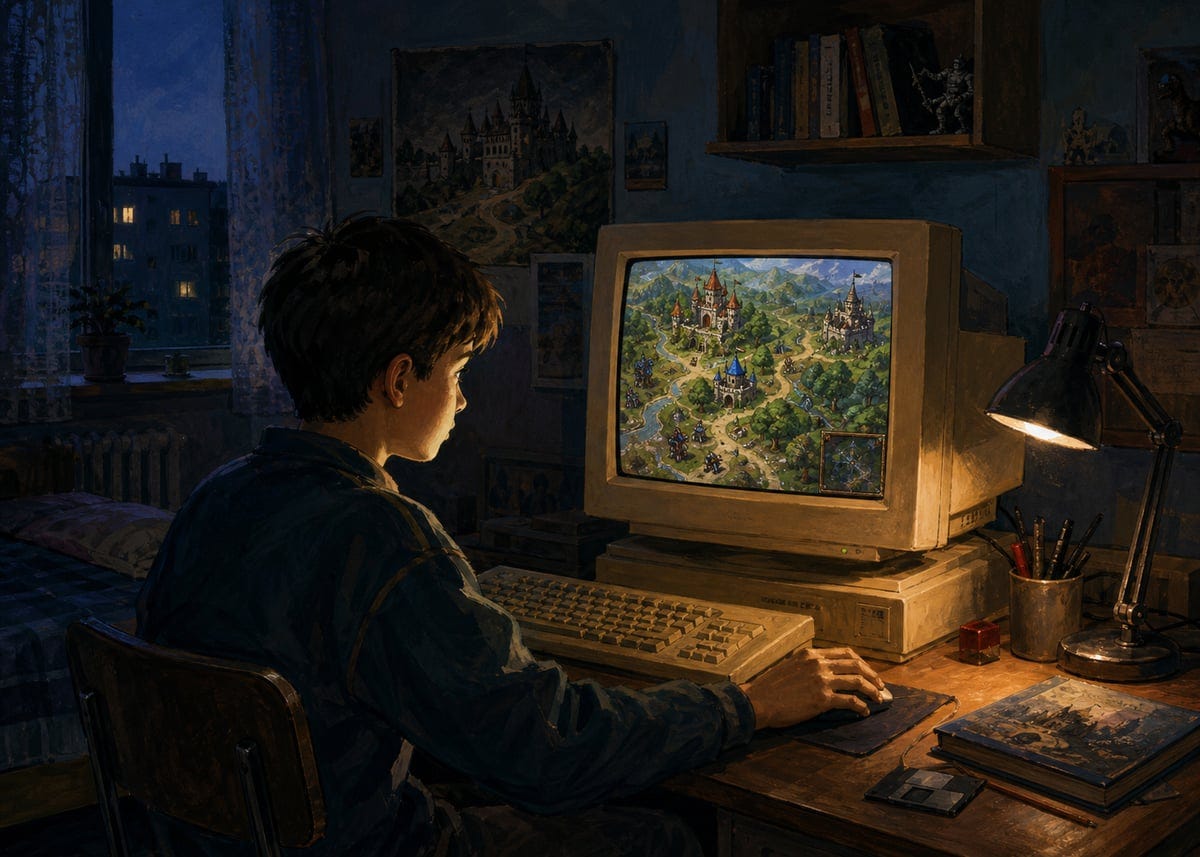
There is a button in Heroes of Might and Magic III called End Turn. Nothing in the game moves until you press it.
You can hang over a decision for five seconds or an hour. Armies stand still. The whole map holds its breath until you say otherwise.
Heroes III is the game I have loved the longest. We had Heroes II as well, and later the fourth one, but the third is the one that stayed. Ask anyone who grew up in Czechia in that era; it has a cult here that never really ended.
Here's what surprises me when I look back. I can't name a single map anymore. I couldn't tell you one campaign or one battle.
What I remember is the feeling of that button.
When you're a kid, almost nothing happens on your schedule. School starts when it starts, dinner is when it is. Decisions arrive from above, already made, and your job is to live inside them.
A turn-based game is the exact opposite of that. Where the hero goes, what the city builds, whether to fight or wait. Nothing proceeds without you.
I didn't play Heroes III to win. I played it to be consulted.
If your kid gravitates to slow strategy games, look past the dragons. It may be the only place in their day where nothing moves until they decide.
That need is real, and the game is meeting it. A question worth asking your kid: "where else in your life do you get to decide anything?"
I still think about that button when I build things now. Software, games, whatever it is: let the person sitting there decide when the world moves.
If you know someone who spent half their childhood pressing End Turn, restack this for them. They'll know exactly which button I mean.
P.S. This is part two of Games That Shaped Me — a series about why kids run to game worlds, written for the adults who watch them do it. Part one was about the red CD and my mom's high scores. Which game asked for your opinion when nobody else did? Reply or comment; I read everything.
Hi, I’m Daniel — a software engineer, solo builder, and the person behind Digital Craft Workshop.
I’ve spent ten years writing TypeScript, .NET, and React for a living. The last few of them I’ve been building on the side of the day job: AI video tools like the Reel Pipeline Kit on Gumroad, Reads in Motion — reels made from other writers’ Substack posts — and a history reel channel that publishes without me touching it. Some shipped. Some I killed. Both are useful.
The long game: small digital properties — tools, content, products that earn on their own — until they can fund what I’ve wanted since I was a kid with a borrowed GameBoy: building my own game worlds.
Digital Craft Workshop is for developers, AI builders, and indie founders who’d rather understand the craft than ride the hype. The kind of reader who distrusts gurus and wants AI that’s cheap, practical, and accountable to one engineer in a workshop.
Each essay is something you can read in one sitting and use the same week: an architecture pattern, an AI workflow a single developer can actually run, a build log, or a postmortem on a project that didn’t make it.
Everything here, I actually ran — including the parts that broke.
No posts
Comments
Nothing yet. Say the first thing.
Sign in to join the conversation.