

TL;DR
A cold DM offered me a roadmap for $199 — or a done-for-you service for $799. Mid-conversation, a $350 tier appeared between them.
I read their whole public archive instead of buying — 23 posts, roughly 22,000 words — and the posts contradicted the pitch.
About 30% of that archive was worth having, and all of it was already free. I built my own 90-day plan out of it.
A cold DM landed in my Substack inbox, offering me a roadmap for $199 — or, for $799, someone to run the whole account for me. Halfway through the conversation, a third price appeared between the two.
The DM had opened with a compliment on my "workshop" branding. That worked on me. I do like my workshop branding.
The compliment is the part that made everything after it land. They had read the publication long enough to name the thing I care most about. That buys goodwill, and goodwill is what a pitch runs on.
The rest did what pitches do. Six Substack bestsellers is a credential, and $15K to $96K is a range wide enough that any number inside it counts as a hit.
Ten million downloads came with no denominator — downloads of what, spread across how many years, nobody said. Then the closer: exactly one spot open.
The offer itself was a strategic-advising roadmap. Two prices arrived first — $199 for the plan, $799 for full account handling. Then a $350 "high tier" materialized between them, mid-chat, unprompted. I read a ladder that grows new rungs while you're talking as a probe for what I'll pay.
The same chat told me there are no guaranteed numbers or timelines. One minute later it gave me a 45-day timeline to $7K a month.
The textbook answer here is to archive the DM and get on with my evening. I didn't, for two reasons.
The claims were specific enough to be checkable, which is unusual. And checking them has become cheap in a way it wasn't two years ago.
Substack archives are public. That's most of the trick.
I pulled theirs and handed the pile to an AI with one question. Does the archive agree with the pitch?
The posts kept contradicting each other.
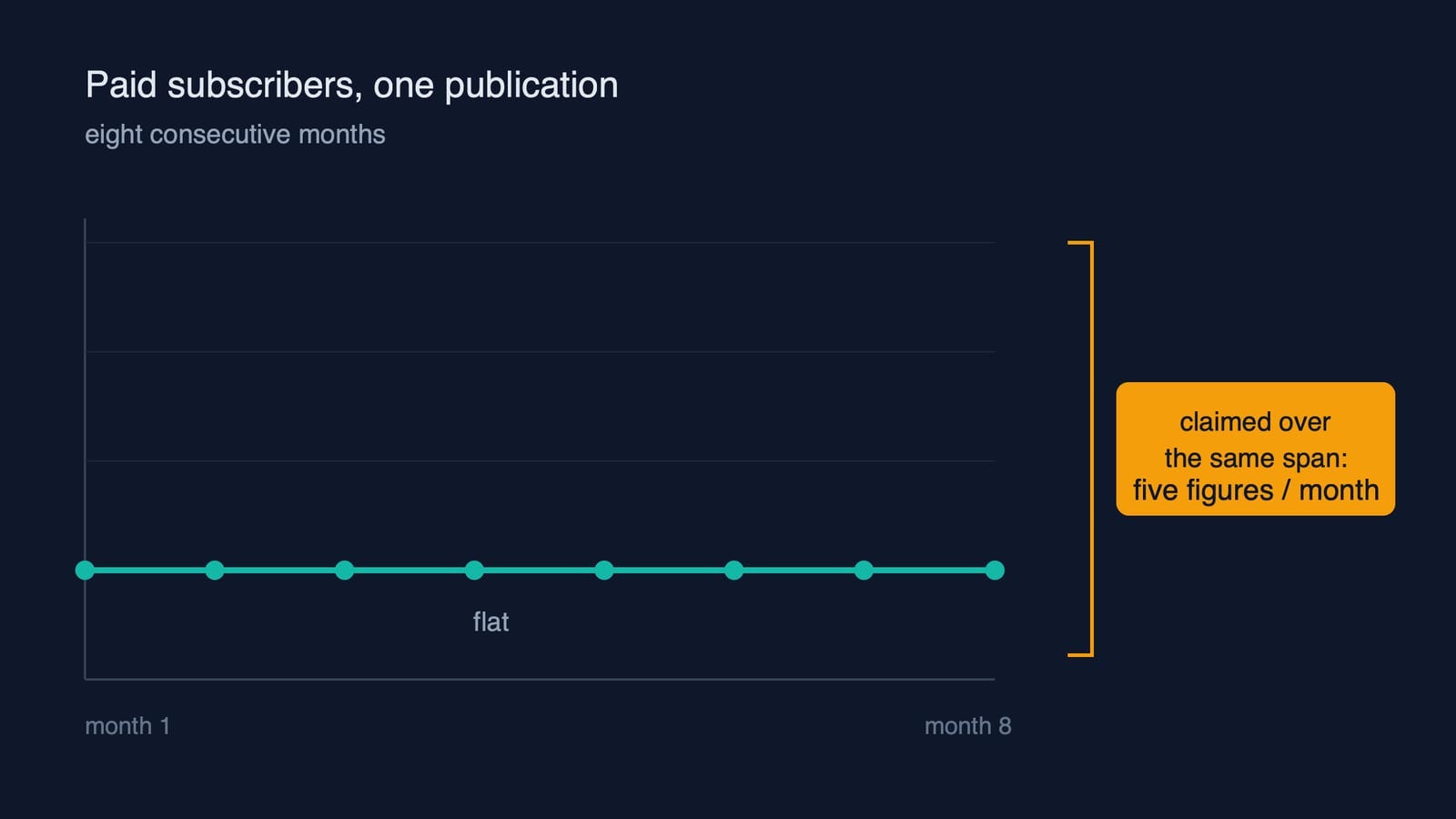
Their paid subscriber count hadn't moved in eight months.
One post claimed five figures a month. Another disclosed lifetime product sales that didn't add up to one of those months.
The bestseller-client count doubled between two posts five days apart.
The one-spot-left line appeared in every post that month.
Their own publication grows about a subscriber a day. The system on sale promises more than 30x inside a year.
No nameable client anywhere in the archive. Every case study under NDA.
The chat had its own version of this. Clients earning more than $50K a month lived three messages away from the actual disclosure: two founders paying $1,200 a month.
They have also published their own account of how a cold DM turns into a paid call.
So the cold DM is the business, written up by the person running it. I found that oddly reassuring. It was all there in public, filed somewhere nobody reads.
When I declined, they offered a 100% refund guarantee. That's the takeaway close. They stopped selling and made it free to say yes.
By that point I was taking notes.
Roughly 70% is the same handful of frameworks restated across posts, which is what weekly publishing does to anyone. The other 30% is real methodology, mechanical enough that I could implement it without asking anyone.
The profile page is a funnel. The bio line, the pinned note, the description, and whatever order a stranger happens to meet them in are all doing the same job. All of it does sales work whether or not I wrote it to.
I filled mine in on day one and never looked at it again.
The offer ladder. Free, then cheap, then the expensive one, with something in between. People climb it a rung at a time, and nobody makes the jump from zero to $199 on the strength of a direct message.
My own ladder has a large hole in the middle. I could only see it once I had a shape to compare it against.
The anchor essay. One substantial piece a week, and everything else that week points back at it. Notes, comments, the chat thread — all of it.
I had been running notes and essays as two separate streams. Fixing that changed more than anything else on the list.
A discovery mechanism for products after launch. Launch day gave me one spike, then nothing. The weeks after needed a standing route in — a nav tab, and cross-links from every essay that touches the same subject.
All four came out of posts they gave away. What $199 buys on top of that is sequencing, and someone telling me which piece to do first.
So I built the roadmap myself. Ninety days, mapped against my actual numbers. It took one sitting.
It cost nothing. I understand every line, because I wrote every line.
The result is unglamorous. Most of it is repair work on things I have already published.
The profile, the nav, the welcome email. Internal links between essays that should have been linked from the start.
After that, one anchor essay a week with everything else pointed at it. Then the missing rung on the ladder, somewhere between free and my paid product.
That rung is the one thing on the list I'm building rather than repairing: Reel Pipeline Studio, the tool behind my faceless history channel, aimed at October. The waitlist is open if you want to watch that bet play out in public.
None of it is a secret.
Here are mine, because transparency is the only thing I have that the pitch didn't. Month five. 257 subscribers, 16 sales, and $265 on Gumroad since May.
Three months ago that same list read 74 subscribers and one paying reader.
16 sales is a number I can list from memory. I know roughly when each one arrived and which post it followed. At this size I don't need a dashboard to tell me that.
Which post came first tells me more than the total does. A sale I can trace back to a specific essay tells me to write more of that essay.
The 74 is the line I look at most. Three months of work sits between those two rows. Every post from those months is still in my own archive, in the open, the same way theirs was.
The pitch's headline case study was 33x subscriber growth in eleven months. I can't picture tens of thousands of anything, let alone check it.
The goal I'm working toward is an honest $500 a month by November. I can name where every dollar of the $265 came from. That's why $500 is a target I can plan against.
When one of these numbers moves I notice, and I usually know why.
I have no way to check a $96K launch figure in someone else's DM, or to tell whether it ever moved.
Their disclosed lifetime sales are well ahead of mine. They built something that turns cold DMs into paid conversations. Then they published the method themselves.
It worked well enough to reach someone who wasn't looking for it. That's a real skill, and I don't have it yet.
I happened to have a tool that reads 22,000 words while I make tea. That was my edge, and it isn't much of one.
What I got from the consultant was a working demonstration of the funnel. The compliment opened it. Then the numbers, then the scarcity line, then the rung that grew in the middle of the ladder.
The refund guarantee caught me on the way out.
That was worth more to me than the roadmap it was carrying.
Restack this with a line from a pitch you still remember — the compliment that was a little too specific, or the number with nothing behind it. I want to see which lines are still doing the work.
Hi, I’m Daniel — a software engineer and solo builder behind Digital Craft Workshop.
Ten years of TypeScript, .NET, and React for a living. In the evenings I build small digital properties: AI video tools like the Reel Pipeline Kit, and a history reel channel that publishes without me touching it. Some shipped, some I killed, and I write about both.
The long game is funding what I’ve wanted since I was a kid with a borrowed GameBoy: my own game worlds.
Each essay is something you can read in one sitting and use the same week. Everything here I actually ran, including the parts that broke.
No posts
Comments
Nothing yet. Say the first thing.
Sign in to join the conversation.