
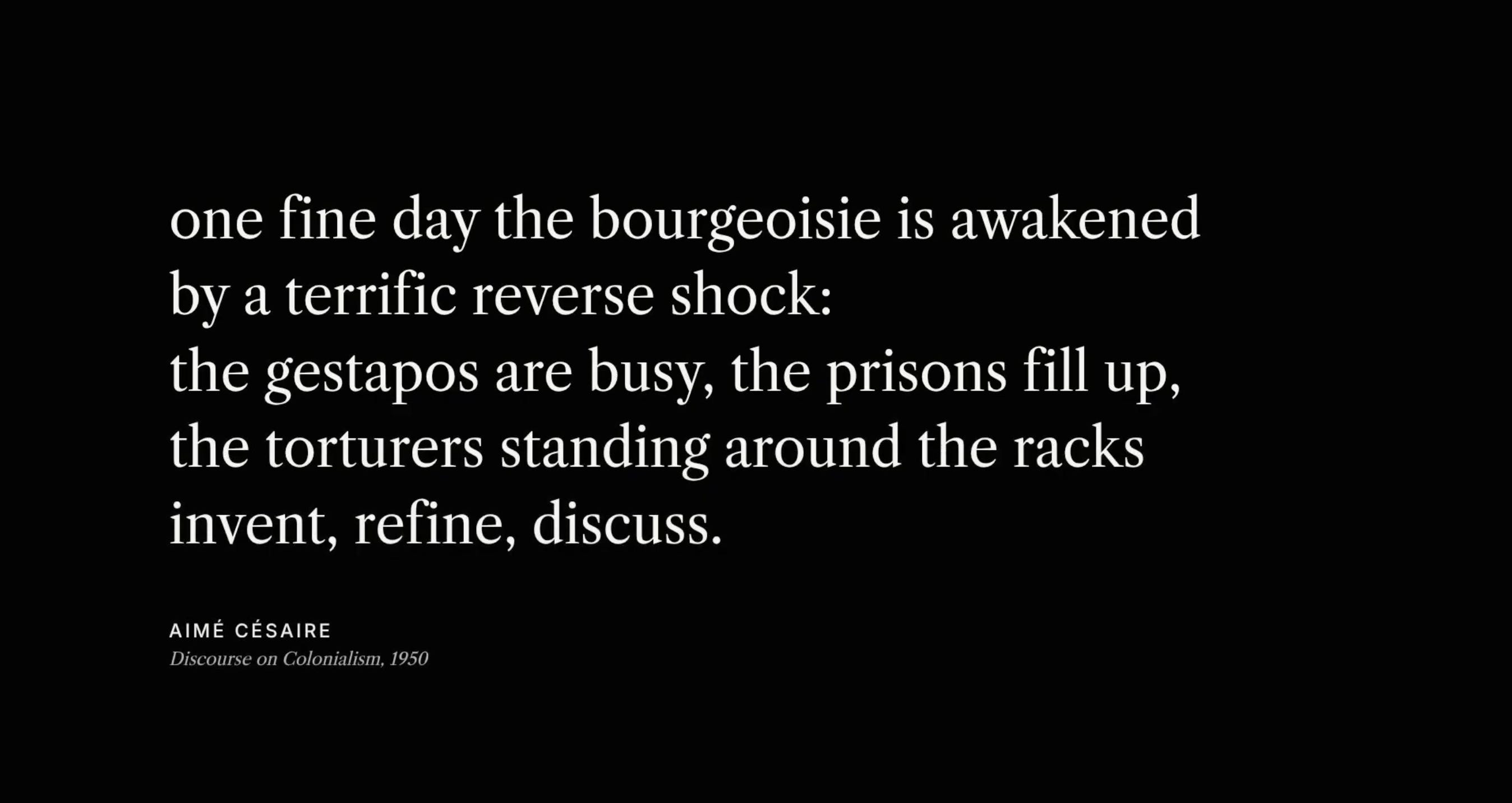
What we’re experiencing now in the U.S. is what the poet Aime Cesaire called “the imperialist boomerang,” when the drastic techniques of torture, mass incarceration, suppression of dissent, and so on, previously used against foreign populations across the developing world get applied domestically. You could also call it an internal colonization. These techniques, unfortunately, are being turbo-charged through Artificial Intelligence and advanced surveillance tools. While many more people in the U.S. are against what’s happening than support it, we suffer from a massive coordination failure due to the dismantling of our civil society infrastructure over the last 150 years. In other words, the situation is becoming increasingly critical and existential while our capacity for collective response remains limited and dysfunctional.
To speak bluntly, I would say that one of the main reasons the Iranian regime has been able to thwart the U.S. war effort is because of their religious faith. Their leaders are much less afraid of death than secular progressives in the U.S. They equate death in war with holy martyrdom. The U.S. and Israeli leadership assumed that their capacity for targeted assassination would compell the Iranians to capitulate. Instead, we just strengthened their resolve.
Political philosopher Giorgio Agamben coined the term “bare life” (nuda vita) for the specific condition that emerges when a sovereign power or totalitarian State strips a human being of all legal rights and political protections, reducing existence to a purely biological fact that can be terminated by the State at any time. The Trump regime is telegraphing this power in a variety of ways — whether through the killing of American citizens in Minneapolis, the blowing up of fishing boats off the coast of Venezuela, or the brutal, inhumane treatment of immigrants, including many who have followed our rules seeking legal status here. The integration of the U.S. and Israeli military is another indication that the U.S. plans further repression of its domestic population here, particularly as Trump’s economic policies combined with AI will further decimate the middle and working class, leading to a society split between plutocrats and precariat.
Sadly, if we are ever going to see a sufficient counterforce in the U.S. coming together to push back against Fascist consolidation, it will probably require a significant subset of the population willing to accept the possibility of death, torture, or long-term incarceration. This is partly why I think it so essential that we interrogate the flawed ontological and metaphysical limits of the materialist worldview. At the moment, most progressives and Leftists assume there is nothing beyond this life, which makes them choose conciliation or capitulation over conflict.
I am serializing a book, Why We Need an Esoteric Left, in this newsletter. In the first chapters, we looked at how populist Right Wing and reactionary movements have embraced transcendence as well as the psychic, supernatural, and so on. We looked at Christian nationalism and “dispensationalism”, the messianic vision behind Israeli politics, the Silicon Valley drive toward a transhumanist Singularity, and the bitter subcultures of the manosphere.
While the Right offers mythic narratives of cosmic war and salvation, the Left counters with tepid policy papers, legal briefs, and structural critique. The Left is still wedded to reductive materialism, which is an obsolete paradigm: Recent discoveries in physics prove an intrinsic relationship between consciousness and physical reality. For the last centuries, progressives and Leftists saw themselves as brave realists because they did not attempt to escape or deny the scientific demystification of the universe. Now that worldview is out of date. But the entrenched discourse on the Left struggles to evolve out of it.
In the last section, I looked at Jürgen Habermas, a German political philosopher. He spent fifty years building the most rigorous secular defense of democracy, only to realize that it couldn’t sustain itself without a religious basis. Habermas called this the “motivational deficit,” and it forced him to reconsider religion late in life to supply the ethical will that cannot be generated by reason alone. He realized our modern focus on human rights and our secular faith in social justice were a direct result of our Judeo-Christian heritage, not some purely logical deduction.
Today, I want to look at two thinkers who highlight the necessity of a transcendence-based politics from different starting points. On the Conservative side, Patrick Deneen argues that liberalism failed because it achieved its aims, leaving an atomized public that now requires a conservative elite to restore order by force, backed by traditional religious faith. The Mexican political analyst Macario Schettino argues that our shared cultural fictions have shattered. He optimistically or naively believes that AI will be used by the younger generation to rebuild Democratic coherence. I don’t entirely agree with either view, but seek to explore a range of perspectives.
As I noted last time, a wide range of critics and thinkers now see the need for a resacralization of politics — that civilization requires some form of transcendence as the basis for social cohesion. A well-known conservative critic, Patrick Deneen is a Professor of Political Science at the University of Notre Dame, author of Why Liberalism Failed and Regime Change. Deneen believes that liberalism has failed — not because it fell short of its ideals, but because it succeeded in realizing them too well. Liberalism redefined “freedom” as the liberation of the individual from natural limits, local communities, and inherited traditions. This created the conditions for liberalism’s inevitable collapse. The final result of liberalism is atomization that leaves isolated individuals entirely dependent on a massive, centralized state to manage their lives, mediating their market participation and social interactions.
Ultimately, Deneen argues, the liberal ideology hollowed out civic life, degraded the environment through unbridled consumerism, and generated widespread alienation, proving itself fundamentally unsustainable by dismantling the cultural foundations required to sustain human community. There is a reasonable basis to some of his criticism, but Deneen’s 2023 follow-up veered further into reactionary populism.
Why Liberalism Failed was primarily a localist, defensive critique (shades of Wendell Berry) urging the creation of small, intentional communities to weather the collapse of the liberal order, Regime Change goes full Trumpian, advocating for what Deneen calls “aristopopulism:” the top-down replacement of the current progressive, meritocratic elite with a new elite of reactionary rulers ((people like him), in other words) who will enforce a fundamentalist idea of the “common good” through the raw assertion of state power. Regime Change aligns Deneen with the Heritage Foundation, who built the plan for using the government to reshape not just the political economy but what Habermas called the lifeworld. Deneen supports Trump as a “brusque” means to this end, a necessary evil. He anticipates a successor — someone like JD Vance — who will consolidate the gains without the corruption and chaos.
As with other conservative ideologues, Deneen sees traditional religion not as a private lifestyle choice, but as the indispensable basis for cultivating the virtues of self-governance and moral restraint. He redefines liberty, rejecting the modern view of freedom as the absence of external constraints, returning instead to what he understands as the classical and Christian understanding of libertas. For Deneen, true liberty is not the right to do whatever we want, whenever we want; it is the hard-won capacity for self-governance, achieved by mastering our base desires, appetites, and impulses.
Comments
Nothing yet. Say the first thing.
Sign in to join the conversation.