
Last week, I posted about NUMINA, my first entry into the FutureX Prize competition (submissions due today). After tracking dozens of submissions and weighing the early reactions, I decided to take another shot. This time, I approached the project the way I would approach a mainstream magazine assignment: work within the parameters, gauge what the judges want, and execute. I asked myself what narrative and scientific concept would stand the strongest chance in a contest with a $2.5 million top prize and ten $100,000 finalist spots.
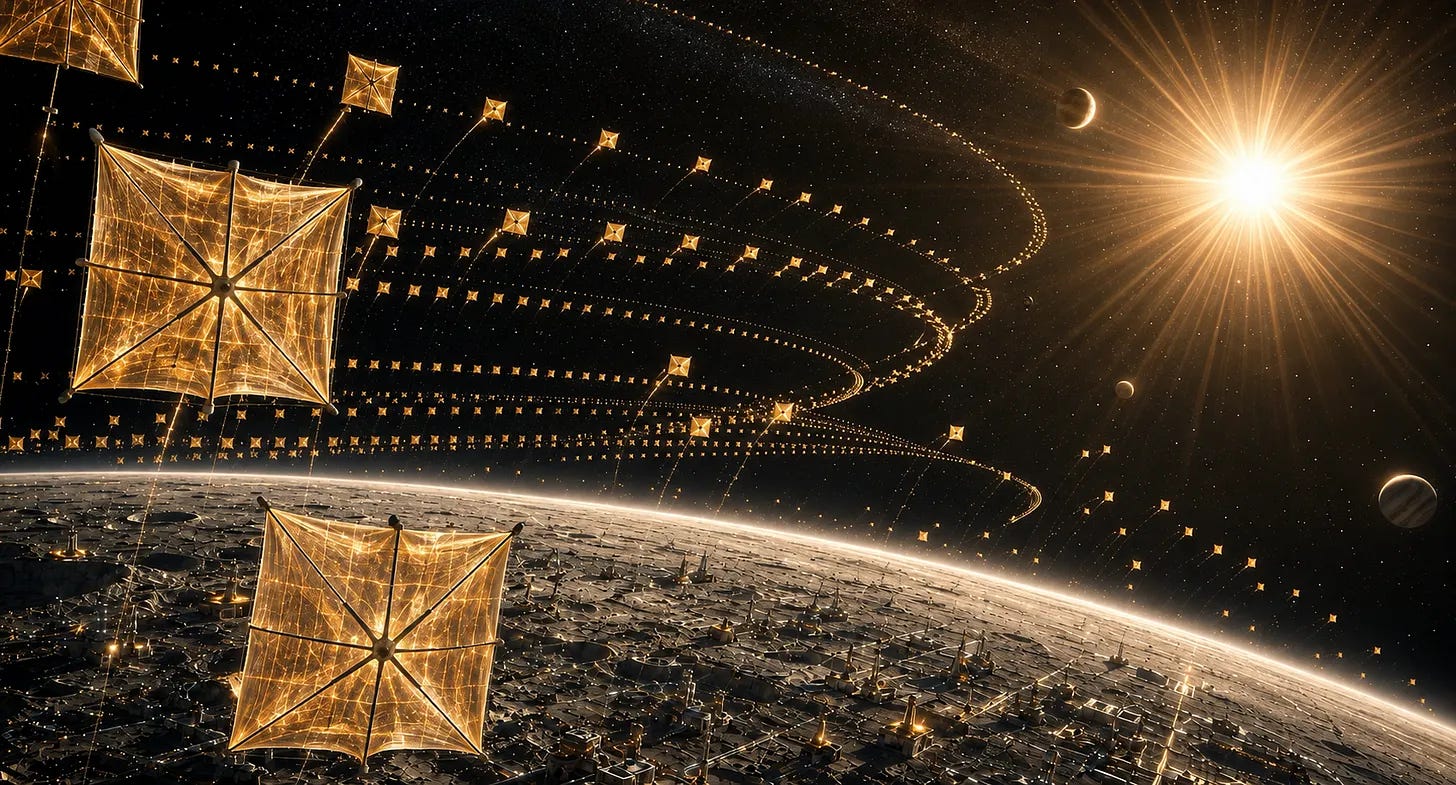
The result is ILLUMINA, which explores the realistic engineering pathway to constructing a Dyson swarm—the practical, megastructure variant of a Dyson sphere—in the near future. Please watch, like (if you do like), share, and comment.
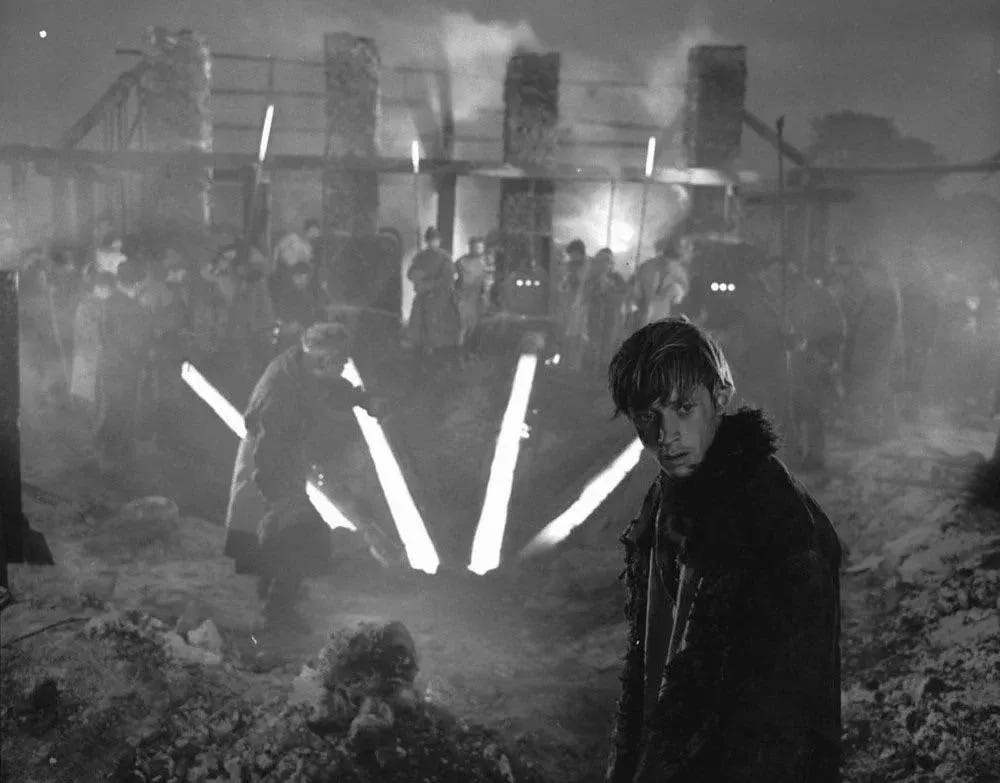
Cinema often works best when it tracks the grueling, magnificent construction of an impossible object (what Jacques Lacan called the petit objet a). You see this in the assembly of the bomb in Oppenheimer, the mobilization of an insurgency in The Battle of Algiers, or the casting of the church bell in Andrei Tarkovsky’s Andrei Rublev, where the community-wide effort led by a single inspired genius becomes an emblem of artistic creation. As J. Hoberman observed of Tarkovsky’s film, “No movie has ever attached greater significance to the artist’s role.” In ILLUMINA, there is no conventional villain. The Sun serves as both adversary and source, while the immense pressure of finishing a multi-decade project across twenty-five years drives the human drama.
I entered this contest twice because I think we have arrived at an authentic watershed moment. Production tools, creative workflows, and generative models are colliding rapidly, carving out open territory for independent creators who work outside legacy systems. Because mainstream film and television institutions still resist or reject generative tools—constrained by legal inertia and legacy IP frameworks—the field remains open to newcomers.
Physicists and futurists have long noted that building a Dyson swarm would be accomplished by extracting minerals from Mercury for raw materials. A fleet of self-replicating automated factories would mine the planet, then build the factories to fabricate an expanding armada of ultra-thin solar collectors to encircle the Sun and beam massive energy arrays back to Earth. The laws of physics permit it; the challenge is sheer logistical scale and generational time. ILLUMINA links this impulse back to the Pyramids—another monument raised by a Sun-obsessed civilization—and traces the technical arc to its conclusion.
Watching the submissions stream into the private Slack channel, I noticed how rapidly generative video converges on shared tropes, drifting toward the plastic sheen of video game aesthetics. The uncanny valley remains stubbornly difficult to escape — we are so attuned, as humans, to micro-effects of voice or gesture. While generative tools can render almost any concept on command, keeping the visuals consistently on point requires immense effort; without constant friction and precise attention, the models pull everything back toward a generic (awful) median. I am not satisfied with every frame of the trailers, due to time and money constraints. But the technical and editorial lessons were invaluable.
Below is the trailer for NUMINA, my initial entry exploring time and consciousness, which took a somewhat more philosophical angle than the judges may want.
If you have a moment, please give both trailers a watch, leave a like, and share your thoughts in the comments. Following the parameters, these are quite mainstream. In future projects, including the upcoming Breaking Open the Head adaptation, I intend to lean much further into avant-garde experiments. I hope you will follow me there, as well.
Comments
Nothing yet. Say the first thing.
Sign in to join the conversation.