
Here’s a lesson I’ve learnt from coaching and being coached: the first answer to what matters most to you? is almost always the one you’ve been rehearsing. It comes out a bit too smooth: family, health, meaningful work... It sounds true while you’re saying it, but the trouble starts a few hours later, when your week begins again and the answer turns out to predict little about what you actually do with your time.
The usual diagnosis is that you lack discipline, or values clarity, or commitment. I think the more honest diagnosis is harder.
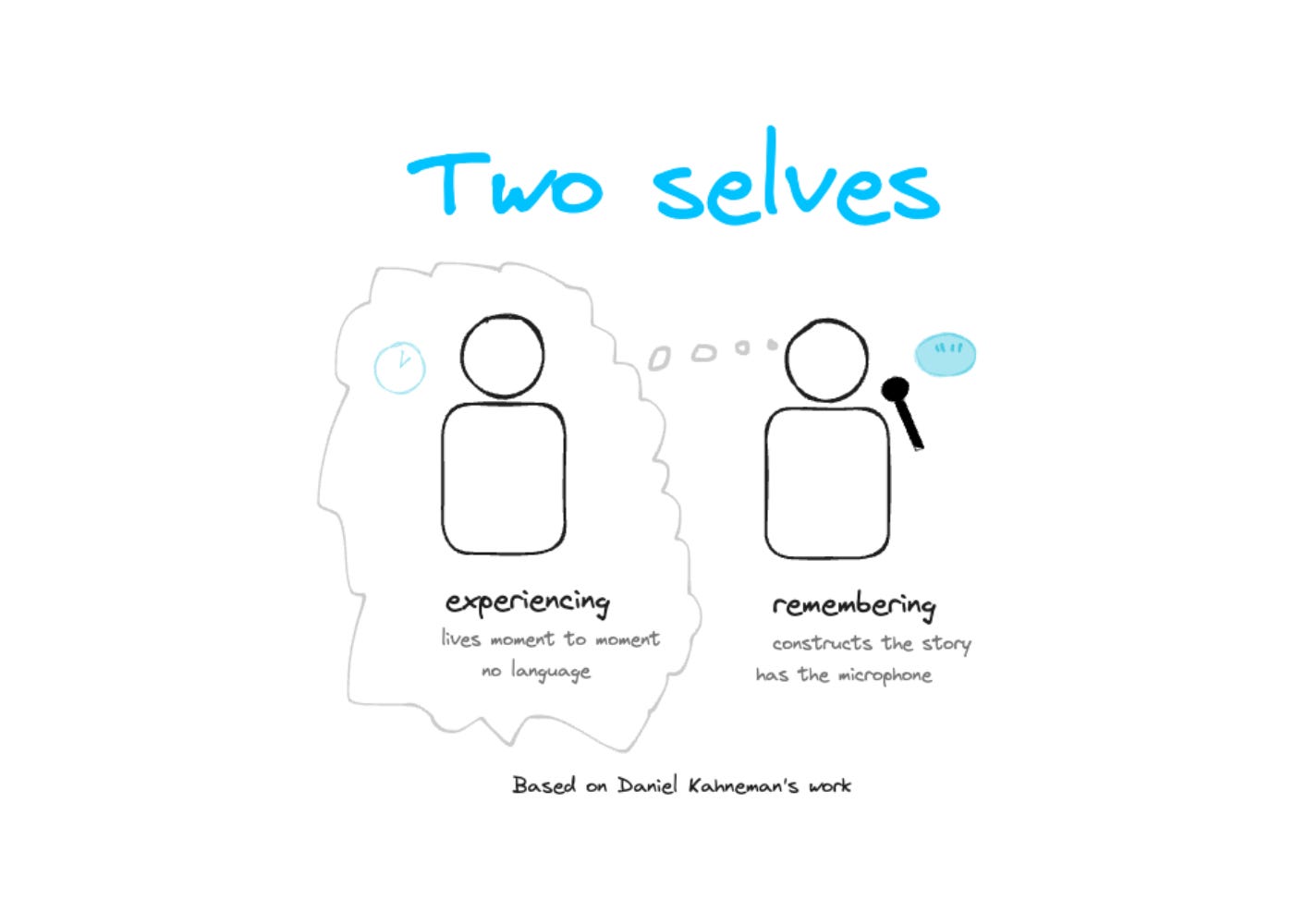
The self that answered the question was not the self that lives your week. They’re produced by different cognitive systems. They disagree about what matters. The one with language is the one you’ve been listening to.
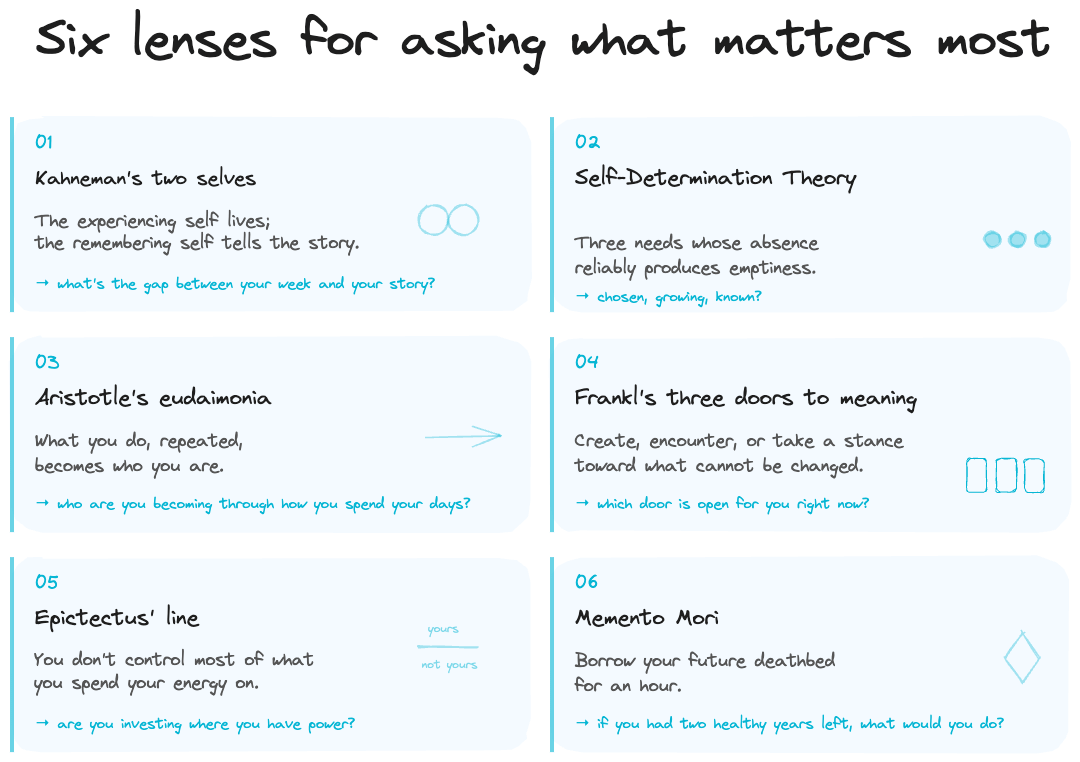
If a single answer can’t be trusted, then no single question can be trusted either. What follows is six lenses serious thinkers have built for the different aspects of the broad what matters most question. Each one cuts at a different angle. Together they triangulate, and - taken together - you arrive at a more complete, a more honest, answer to the question.
Daniel Kahneman spent his last decade on a finding he treated as more important than most of what made him famous. There are two of you, he argued. One lives the moments. The other tells the story afterward. The second one is the one with language.
The remembering self uses the most intense moment plus the final moment as its summary, and ignores most of what happened in between. The experiencing self has no voice. By the time you’ve formed any sentence about what you care about, the remembering self is the one talking. The experiencing self has already moved on.
Odd as it may seem, I am my remembering self, and the experiencing self, who does my living, is like a stranger to me. - Daniel Kahneman
This is the meta-finding behind everything that follows. Each of the next five frameworks asks a question. The remembering self answers all of them. The experiencing self never gets a turn. That doesn’t make the questions useless. But it does mean you should treat the answers as evidence provided by one witness - your remember self - rather than as verdicts. But what we can do, is cross-examine the witness: ask it multiple questions from different angles.
Three questions from the first lens:
What did you actually do with your last week?
What story do you tell about it?
Where do the two diverge?
The divergence is the data.
Edward Deci and Richard Ryan spent forty years building one of the most replicated frameworks in psychology. Their argument, simplified: there are three psychological needs whose absence reliably produces a feeling of emptiness regardless of how successful the rest of your life looks:
Autonomy
Relatedness
Competence
Autonomy is whether the values you act from are ones you chose, or ones you absorbed from a milieu you never quite stepped out of. Relatedness is whether you matter to specific people, and they to you, in ways that aren’t performative. Competence is whether you’re building real capability.
All three matter. A life that satisfies any two but not the third tends to feel hollow in a way the person can rarely name. The ambitious founder with autonomy and competence but no relatedness. The thriving parent with relatedness and autonomy but no growing capability. The accomplished professional with competence and relatedness but no genuine ownership of the goals they’re chasing.
Three questions:
What in your life is genuinely yours?
What are you actually getting better at?
Who makes you feel known?
Aristotle drew a distinction most modern readers find inconvenient. The pleasant life and the well-lived life, he argued, are not the same thing. Sometimes they are opposites.
His word was eudaimonia. It is usually translated as “flourishing,” which sounds soft. The closer translation is something like “the well-conducted life”, a life whose shape, looked at as a whole, you would endorse. Aristotle’s claim was that this kind of life is not produced by accumulating pleasant moments. It is produced by the cultivation of conduct over time. What you do, repeatedly, becomes who you are.
The inconvenience is that this works whether you intend it to or not. There is no neutral hour. The evening you spent half-attending to your phone, or the years you spent saying yes to projects you knew weren’t yours: none of it sat outside the formation, all of it was the formation, of who you are becoming.
Two questions:
Who are you becoming through how you spend your days?
Is that who you want to become?
Viktor Frankl was a young Viennese psychiatrist in the 1930s when he developed the framework he is now best known for. He had a draft manuscript with him when he was deported to the concentration camp Theresienstadt in 1942, and lost it. He survived the camps, reconstructed the manuscript afterward, and published it as The Doctor and the Soul.
Frankl argued that meaning enters life through three doors.
The first is what you create: work, contribution, anything made. The second is what you experience, with attention: beauty, truth, particular people, the specific texture of being alive in a particular place. The third is the attitude you take toward what you cannot change.
The doors are not equal. The first two depend on conditions Frankl knew you don’t always control. You cannot always make. You cannot always encounter. A long illness can close both doors. So can grief, or a regime, or simply the late stage of a life. Frankl’s claim - and he lived it - was that even when the first two doors are shut, meaning remains available through the stance you take toward what you cannot change. It’s the door that doesn’t close.
Three questions:
What are you creating that, if you stopped, would feel like a real loss - to you, to someone else, to the world?
Who and what are you encountering with full attention - and where are you going through the motions without actually being there?
What unavoidable difficulty in your life are you treating as an obstacle, when it might be the thing your life is currently asking of you?
Two thousand years ago, a former slave named Epictetus drew a line that takes about a minute to understand and a lifetime to actually live by. Some things, he said, are up to you. Most aren’t. The line sounds simple. The trouble is when most of what you pay attention to in life sits on the wrong side of it.
What’s yours: your effort, your conduct, your judgments, your character. What isn’t: outcomes, recognition, what other people do, how the work lands, whether the right people notice. The Stoic claim is that what matters most has to be drawn from the first list, because investing in the second is investing in what you don’t control. Most people invest mostly in the second.
This is sharper than it first appears. It means that any commitment whose worth depends on whether you succeed, or on whether the right audience exists, is conditional in a way you may not have admitted. It means that the shape of your character - how you show up, how you decide, what you reject - is the only ground you can build on without being at the mercy of the world. The harder version of the claim is that the moment you understand this, you stop being able to use external outcomes as your reason for acting. You have to find a different reason.
Three questions:
What part of your current frustration depends on something you control?
What part depends on something you don’t?
And how much of your week is spent trying to control the second?
Stoics called it praemeditatio. Christians called it ars moriendi. Tibetan monks built lifelong practices on it. The instruction is the same: borrow your future deathbed for an hour, and use it as the vantage point from which to find meaning today.
The reason this works is not morbidity. It’s that present commitments are notoriously hard to evaluate from inside the present. The week that feels urgent now will not feel urgent at the end. The audience whose approval seems to matter now will not be in the room. The fights that are consuming you will, mostly, have ended without being decided. The view from the end strips away the focusing illusion of the present moment and lets you see what survives the stripping.
Most readers have done some version of this exercise. The version that I find most helpful: not “imagine your funeral” but “imagine you have two healthy years left.” Two years is long enough to do something. It is not long enough to defer anything.
Three questions:
If you had two healthy years left, what would you stop?
What would you start?
What would you keep exactly as it is?
Sixteen questions across six lenses. The questions don’t converge on a single answer, and they’re not supposed to. The Stoic question and the Aristotelian question will pull in different directions. Frankl’s third door and Kahneman’s experiencing self will produce contradictions. The work the answers do is in the friction, not the harmony. Where two lenses disagree, both are pointing at something true. The discipline is to stay with the disagreement rather than tidy it.
What this isn’t is an instrument that delivers the answer in an afternoon. The questions are most useful sat with over weeks, in unhurried conditions, ideally with a notebook rather than a screen. Some will be answered immediately. Some will refuse to be answered, which is itself insightful. And the ones you answer too quickly are the ones to come back to.
But remember Kahneman’s research: even with sixteen questions, from six lenses, there’s only one cognitive system answering them all: your remembering self.
Kahneman’s diagnosis was that this system is, at best, half the picture. The other half - the part of you that actually lives the moments your remembering self later edits - isn’t fully reachable through reflection. It’s reachable, if at all, through a different instrument. That’s probably the next post for me to write.
For now:
Ask the sixteen questions.
Stay with the contradictions.
Notice which answer arrived too quickly to be trusted.
Let me know what comes up.
Comments
Nothing yet. Say the first thing.
Sign in to join the conversation.