
Here’s what I keep seeing with even the most accomplished of clients. They sit down in the morning with a clear plan, often to reserve some time working on the thing that matters most. But by 11am, they’ve taken a call they didn’t need, answered email that could have waited, and reorganized a dashboard that was doing fine. The plan was overruled by a version of themselves that showed up mid-morning with different priorities.
I’ve been thinking about why this happens. And the best explanation I’ve found comes from an unexpected place: constitutional theory.
Behavioural scientists have measured the gap between what people plan to do and what they actually do. The best-measured version comes from physical activity research. Feil and colleagues, aggregating 25 studies with nearly 30,000 participants, found that 47% of people who intend to exercise don’t follow through. The gap in professional work is harder to measure, but anyone who has watched a Monday plan dissolve by the afternoon knows the pattern.
I see this with almost every leader I work with. They know what matters. They can name their top priority without hesitating. But weeks can pass with negligible progress on it, because the day fills up with things that feel urgent and aren’t.
These are not people who struggle to perform. Often, they’re successful because they’re responsive: fast on email, reliable in meetings, always available when something needs attention. Many organizations - in sectors as diverse as professional services, politics, NGOs - reward that. Responsiveness keeps you employed, promoted, trusted. The problem surfaces when you want something more than responsiveness can deliver: the new product, the book, the strategic initiative, the thing that won’t happen through reacting faster. That work requires sustained, protected attention. And sustained, protected attention is exactly what a reactive operating mode cannibalizes first.
The standard diagnosis for this: you lack discipline, you need more willpower, better motivation. The standard diagnosis is wrong.
Countries have been writing constitutions for nearly 2,400 years - ever since Aristotle catalogued 158 of them - and they’re all trying to solve a version of the same problem. The people who govern tomorrow might not honour what was decided today
The people who govern tomorrow might not honour what was decided today. A new administration comes in, priorities shift, previous commitments get dropped. The political theorist Jon Elster compared constitutions to Odysseus tying himself to the mast before sailing past the Sirens. You constrain yourself now because you know what the pressure will do to you later.
But Elster later revised his own argument. He pointed out that constitutional framers aren’t usually binding themselves. They’re binding others: future governments, opposition, successors they don’t trust. The act of writing a constitution is closer to negotiation between competing interests than to a single will exercising noble self-restraint.
That revision is the part that struck me. Because it maps onto my own experience and that of many of my client with uncomfortable precision. The version of you that makes the morning plan is a different cognitive actor than the version that abandons it at 11am. They have different priorities, different tolerance for discomfort, different time horizons. Research on present bias and time-inconsistent preferences confirms this: your preferences at one point in time genuinely conflict with your preferences at another. The 9am planner and the 2pm reactor are, in a meaningful sense, different parties to a negotiation.
Willpower frames this as a fight you should win through character. Constitutional design frames it as a problem you solve through structure. The second framing is more useful, and it leads somewhere practical.
The political scientist Giovanni Sartori studied constitutions that look real but hardly constrain. Some are nominal: reflecting how power is organized but not really shaping constraining it. Others are decorative: impressive on paper, but performative and functionally hollow. A real constitution actually binds the government and limits arbitrary power.
Most personal productivity systems fall into the first two categories. Think of the time blockers that get ignored, the priority list that follows to-dos (not vice versa), the elaborate Notion dashboard that hasn’t been opened in two weeks. These systems formalize what should happen without constraining what does.
So the useful question becomes: what would make a system actually binding?
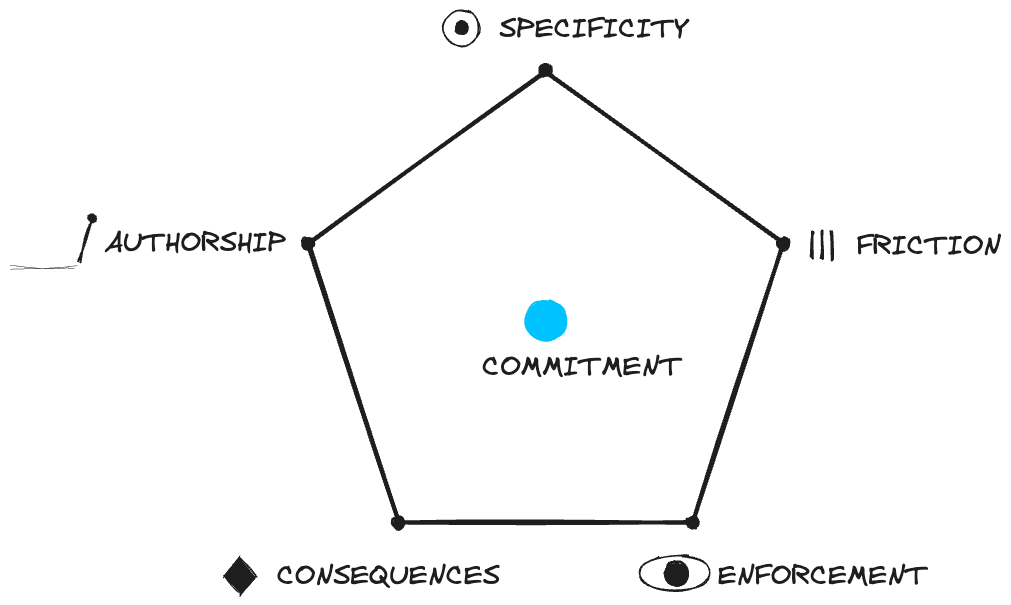
Constitutional theory and behavioral science converge on what separates a binding commitment from a nominal one. I count five conditions. Each one has a version for countries and a version for your Tuesday morning.
Specificity. A constitution that says “we value freedom” constrains nothing. One that says “Parliament shall make no law abridging the freedom of speech” constrains something. Paschal Sheeran’s review of 642 independent tests of implementation intentions found the same pattern at the individual level: vague goals (”I’ll exercise more”) barely move the needle. Specific if-then plans (”If it’s 7am on a weekday, I will run stretch for 10 minutes before preparing breakfast”) produce consistent, measurable effects. The vaguer your commitment, the more nominal it is.
Friction against override. Constitutional amendments require supermajorities or referenda. Ordinary legislation passes with a simple majority. The design ensures that undoing a foundational commitment is structurally harder than keeping it. Thomas Webb and Paschal Sheeran’s research on how if-then plans work found something striking: specific plans work because they make the planned action cognitively accessible before deliberation kicks in. The pre-commitment fires automatically. Your personal version of it: defaults that require active effort to break. The regular check-in with an accountability partner or the website blocker that makes distraction take thirty seconds of friction instead of zero.
Enforcement. Constitutional courts exist because self-enforcement isn’t reliable. Someone external checks whether the rules are being followed. In personal terms: a coach, a peer, an accountability partner, a weekly check-in where you actually review the data. It’s you telling someone what you plan to do and they ask you about it next week. Without enforcement, a commitment is a wish.
Consequences. If a government passes an unconstitutional law and nothing happens, the constitution is nominal. If a court strikes it down, it’s binding. Personal equivalent: if breaking your pre-commitment costs nothing - no social stake, no visible record, no money lost - you will break it whenever the pressure rises. The behavioral economics literature on commitment devices confirms this: people who put money on the line (even small amounts) follow through at significantly higher rates than those who simply state intentions.
Authorship. This is the condition most people skip. Constitutions imposed by an outside power tend to fail; they lack legitimacy because the people they govern didn’t write them. Richard Koestner’s research found the same pattern with individual goals: implementation intentions only work when the underlying goal is self-concordant, i.e. when it reflects your actual values rather than an externally imposed expectation. Productivity systems copies straight from a book or a course share the same structural problem. They’re someone else’s constitution. They carry no legitimacy with the self that has to live under them.
The system that binds you has to be yours. It has to be built from your values, designed around your strengths and blindspots, and reflecting the life you’re trying to lead. Imported frameworks are starting points, but they’re not self-authored constitutions.
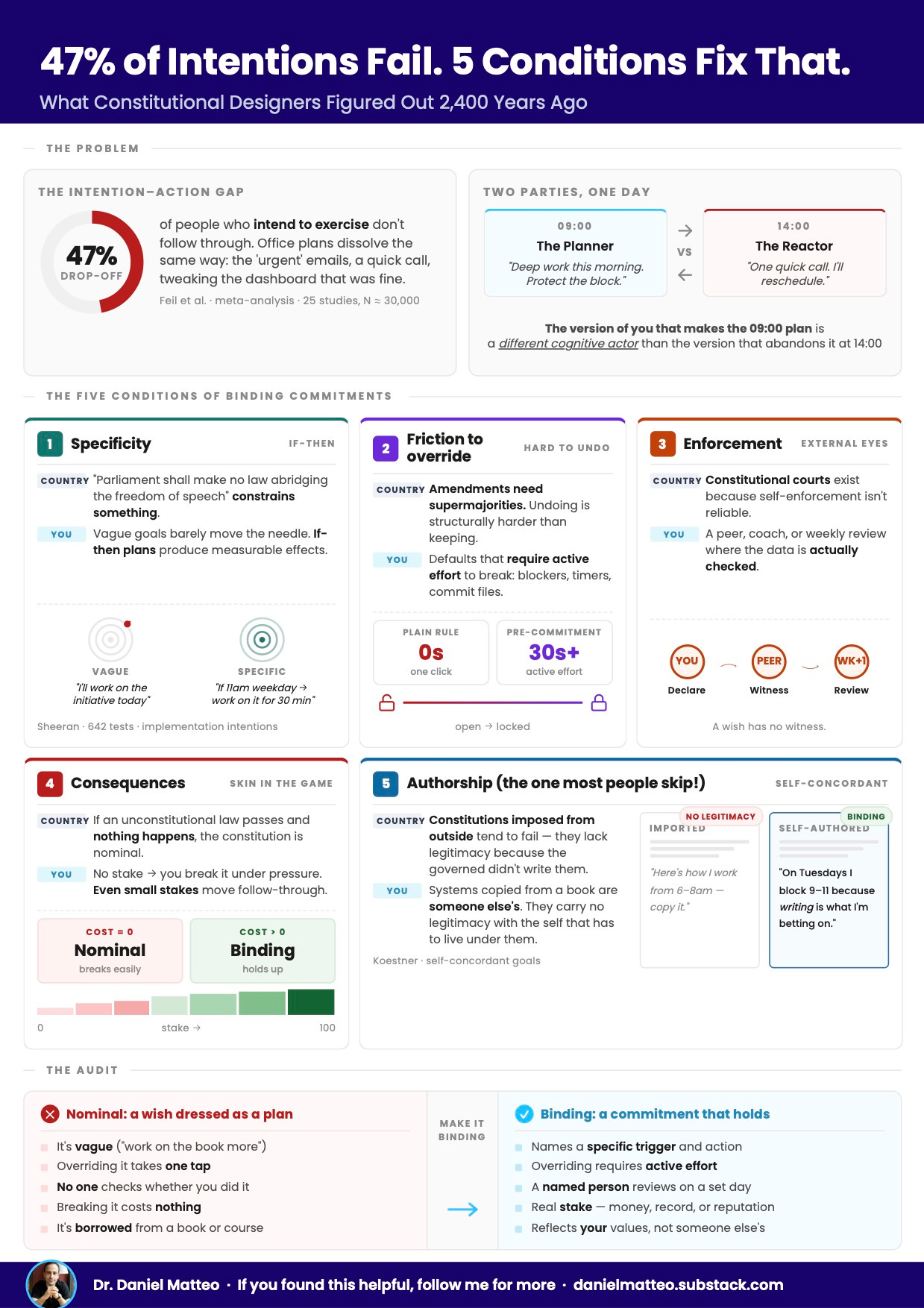
You have a plan every morning. Most ambitious people do. But if it’s vague, easy to override, unenforced, free to break, and borrowed from someone else, you’re betting on a coin flip.
That’s worth fixing. It’s a design problem, which means it’s solvable.
For subscribers only: Click the button below to get a prompt to apply this - it uses what your LLM already knows about you to turn the five conditions into three or four binding pre-commitments specific to you that, if they held, would make a real difference in your life.
Comments
Nothing yet. Say the first thing.
Sign in to join the conversation.